
By maxaeo.ai | Published 2026-09-25 | Updated 2026-09-25
When buyers ask ChatGPT, Perplexity, Gemini, or another AI search engine for product recommendations, competitors may appear because of sources you have never analyzed. To reverse engineer competitor citations in LLMs, you need to examine more than brand mentions. The useful question is: which prompts trigger the competitor, which pages are cited, and what evidence does the answer absorb?
This guide presents a repeatable framework for turning competitor AI visibility into a prioritized content and distribution plan.

What does it mean to reverse engineer competitor citations in LLMs?
To reverse engineer competitor citations in LLMs means tracing a competitor’s appearance in AI-generated answers back to the prompts, source pages, domains, and content characteristics associated with that appearance.
The process has four layers:
- Prompt layer: Which buyer questions cause the competitor to appear?
- Answer layer: Is the competitor merely mentioned, recommended, compared, or ranked?
- Citation layer: Which domains, articles, reviews, documentation pages, or discussions are cited?
- Absorption layer: Which facts, claims, comparisons, or phrases from those sources influence the final answer?
This distinction matters because a cited page is not always a decisive page. Recent GEO research separates citation selection from citation absorption: an engine may retrieve many sources, but only a smaller set meaningfully contributes evidence or wording to the answer. (arxiv.org)
Why competitor citation analysis is different from SEO competitor research
Traditional SEO analysis usually starts with rankings, backlinks, and keyword gaps. LLM competitor analysis starts with answers and evidence paths.
A competitor may be cited even when its page is not the highest-ranking traditional search result. In a controlled 2026 study covering 252,000 trials across six LLMs, topical relevance and list position were major citation factors, while explicit pricing, recent timestamps, completeness, and trust cues also influenced citation selection. (arxiv.org)
| SEO competitor analysis | LLM competitor citation analysis |
|---|---|
| Tracks rankings and backlinks | Tracks mentions, recommendations, and citations |
| Focuses on one result page | Examines multi-source generated answers |
| Measures position and clicks | Measures citation share, position, sentiment, and source influence |
| Audits your competitors’ pages | Audits the entire citation supply chain |
| Often uses monthly snapshots | Benefits from daily or repeated monitoring |
The practical implication is simple: do not copy only the competitor’s landing page. Identify the wider network of sources that makes the competitor easy for an AI engine to describe and recommend.
How to reverse engineer competitor citations step by step
1. Build a buyer-prompt sample
Start with questions that reflect commercial intent rather than generic brand searches. For a SaaS company, useful prompt groups include:
- “What are the best tools for [category]?”
- “[Competitor] alternatives for [use case]”
- “Compare [Competitor A] and [Competitor B]”
- “Which platform is best for a [specific company size]?”
- “What should I look for when buying [category] software?”
Use 10–20 prompts for an initial audit, divided across discovery, comparison, evaluation, and category-defense intent. Keep the wording stable so changes in visibility are easier to interpret.
A strong prompt set should include the language buyers actually use. Existing SEO keywords can be converted into AI monitoring prompts, but add natural-language questions, constraints, and comparison requests that traditional keyword tools often miss.
2. Record the complete AI answer
Do not record only whether a competitor appears. Capture:
- Brand mention
- Recommendation or ranking position
- Sentiment and positioning
- Cited domains
- Exact cited URLs
- Claims made about the competitor
- Whether the competitor is presented as a category leader, specialist, budget option, or alternative
This creates a baseline for separating visibility from meaning. A competitor that appears frequently but is described as expensive, limited, or unsuitable may have high mention visibility but weak recommendation value.
MaxAEO’s AI search visibility gap analysis framework uses this type of prompt-level comparison to identify where competitors appear and where a brand is absent.
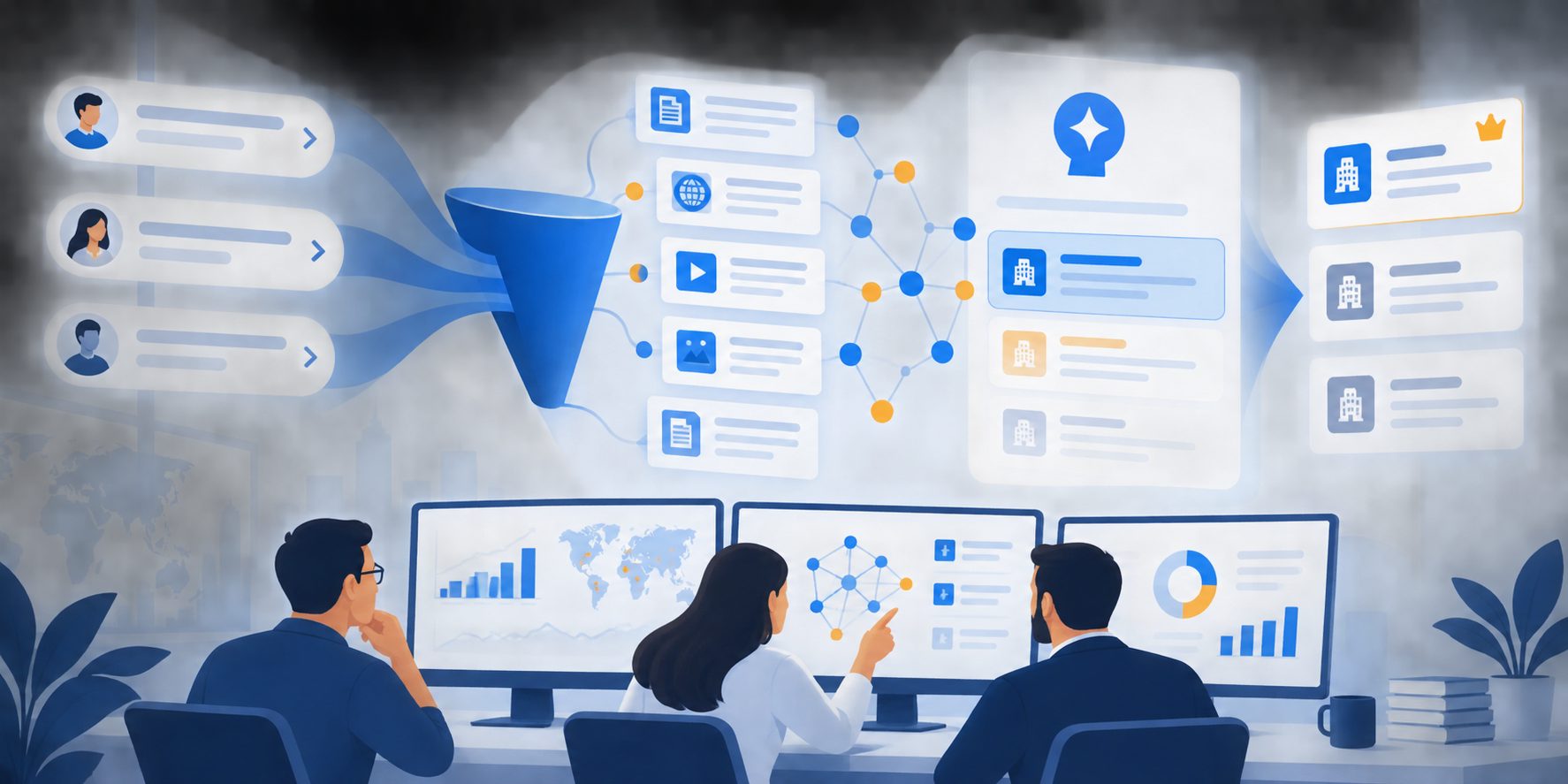
3. Map the competitor’s citation funnel
Group cited sources into source types instead of treating every URL as an isolated event.
| Source type | What to inspect | Typical strategic response |
|---|---|---|
| Review sites | Category descriptions, ratings, pros and cons | Improve factual consistency and third-party presence |
| Comparison pages | Feature tables, alternatives, use-case language | Publish balanced, evidence-backed comparison content |
| Documentation | Definitions, integrations, technical proof | Make product facts easier to extract |
| Reddit and communities | Repeated user language and objections | Address real buyer questions transparently |
| Industry blogs | Expert framing and category authority | Contribute original research or expert commentary |
| Competitor-owned pages | Positioning, terminology, proof points | Identify claims your own site does not clarify |
A useful original concept is the citation funnel concentration score:
CFC = citations from the top five recurring domains ÷ total competitor citations
This is not a universal industry benchmark. It is a prioritization metric. A high score suggests that a small set of trusted domains supplies much of the competitor’s visibility. A low score suggests a more fragmented authority pattern requiring broader distribution.
MaxAEO’s citation tracing can show the specific domains, articles, and platforms cited across monitored answers, helping teams identify whether a rival’s visibility depends on reviews, comparison pages, documentation, Reddit, blogs, or a combination of sources.
4. Compare source quality, not just source quantity
For every frequently cited competitor source, score five dimensions from 0 to 2:
- Topical match: Does the page directly answer the buyer’s question?
- Entity clarity: Is the brand, product, category, and audience clearly defined?
- Evidence density: Does the page contain facts, benchmarks, examples, or comparisons?
- Extractability: Can an engine easily isolate concise definitions and claims?
- Freshness: Are dates, product details, and market context current?
The maximum score is 10. This creates a practical teardown model:
- 8–10: High-priority citation asset; study its structure and distribution.
- 5–7: Useful source with identifiable weaknesses.
- 0–4: Likely incidental or low-influence citation.
This scoring method adds an important safeguard: it prevents teams from assuming that the most frequently cited page is automatically the best page. Some pages are cited because they are relevant to a narrow prompt, not because they establish broad authority.
5. Separate the competitor gap into three fixes
Every citation gap should be classified as one of three types:
- Content gap: Your website lacks a direct answer, comparison, definition, or proof point.
- Authority gap: You have similar content, but the sources AI engines trust do not mention you.
- Extraction gap: Your content contains the information, but it is difficult to parse or quote.
Each gap requires a different response. A content gap may need a new comparison page. An authority gap may require third-party coverage or a review-site presence. An extraction gap may be solved by clearer headings, concise factual statements, tables, documentation, or structured internal linking.
This is more efficient than publishing another general blog post and hoping the model notices it.
How to turn citation findings into a GEO action plan
Prioritize opportunities using this simple formula:
Priority score = commercial value × citation frequency × fix feasibility
For example, a comparison prompt that drives qualified pipeline and repeatedly cites two review sites should outrank a low-intent informational prompt cited only once.
A practical 30-day sequence looks like this:
- Week 1: Lock buyer prompts and establish competitor baselines.
- Week 2: Identify recurring citation domains and classify source gaps.
- Week 3: Update or create the highest-value answer assets.
- Week 4: Address third-party authority gaps and rerun the same prompts.
Track mention rate, recommendation position, sentiment, citation sources, and the percentage of answers where the competitor appears without you. Do not evaluate progress from one answer. AI outputs vary by engine and prompt wording, so repeated monitoring is more informative than a single manual search.
MaxAEO monitors brand visibility across eight AI engines, including ChatGPT, Gemini, Perplexity, Claude, Copilot, Grok, Google AI Mode, and Google AI Overviews. Its daily monitoring includes competitor comparisons, citation-source tracking, sentiment analysis, recommendation position, and trend reporting. A free AI visibility diagnostic can provide an initial baseline using your brand, website, and competitors.
For a broader measurement model, see how to calculate share of voice in LLM responses.
Common questions about competitor LLM citations
Can competitor citation analysis replace SEO?
No. It complements SEO. Search visibility still supports discovery, authority, and traffic, while LLM citation analysis reveals how brands are represented inside generated answers.
Should every cited competitor source be copied?
No. Copying structure or wording can create weak content and legal or editorial risks. Extract the underlying information need, then produce a more accurate, useful, and independently supported answer.
How many AI engines should a SaaS brand monitor?
A cross-engine view is preferable because citation patterns differ between platforms. Monitoring several major engines helps distinguish a durable visibility pattern from a model-specific result.
Is a brand mention the same as a recommendation?
No. A mention may be neutral or negative. Recommendation position, sentiment, context, and cited evidence provide a more useful view of commercial visibility.
How often should the analysis be repeated?
For active GEO programs, daily monitoring provides the clearest trend line. A manual monthly review can support strategic planning, but it may miss short-term changes in prompts, sources, or recommendation order.
Final takeaway
The goal is not to imitate a competitor’s content library. The goal is to understand the evidence system behind its AI visibility: the questions it wins, the sources that support it, the facts engines absorb, and the gaps your brand can address.
When you reverse engineer competitor citations in LLMs systematically, GEO becomes a measurable research and execution process rather than a collection of speculative content tactics.