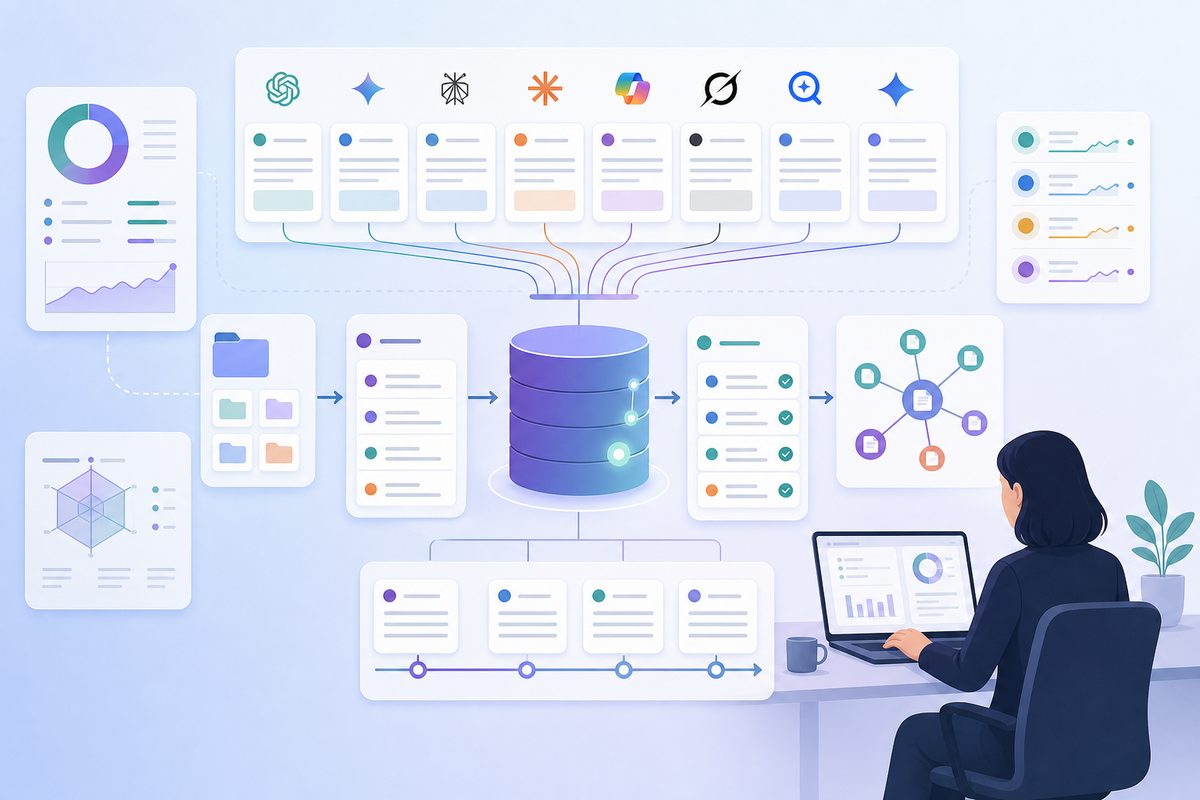
Your CEO asks ChatGPT for the best tools in your category. Three competitors appear. Your company does not.
The screenshot lands in Slack, and the team immediately starts proposing fixes: rewrite the homepage, publish ten articles, add schema, launch a PR campaign.
Stop. One answer is a signal, not a benchmark. Before you decide what to fix, you need to know whether the gap repeats across prompts, AI engines, and time.
That matters because the answer itself is increasingly the destination. In a Pew Research Center study of Google searches, users clicked a traditional result in 8% of visits with an AI summary, versus 15% without one, and clicked a cited source in only 1%. The study covers Google rather than every AI assistant, but it shows why answer-level visibility deserves measurement.
TL;DR
- Run the same four prompt families across the AI surfaces your buyers use before changing your content.
- Track answer presence, recommendation position, framing, citations, and consistency as separate metrics.
- Use the Authority Stack below as a diagnostic model, not as a secret ranking formula disclosed by an AI platform.
- Fix the weakest measured layer, then rerun the same prompt panel. Do not replace the benchmark after the work begins.
Run these four prompts before changing anything
Start with four prompt families that represent different points in a buying decision. Replace the brackets, keep the wording stable, and use a clean conversation for each run.
| Test | Prompt template | What to record |
|---|---|---|
| Category shortlist | What are the best [category] tools for [ICP or use case]? | Brands mentioned, order, stated strengths, cited sources |
| Alternatives | What are the best alternatives to [competitor] for [constraint]? | Whether you appear, which competitor owns the alternative slot, why |
| Head-to-head | Compare [your company] vs [competitor] for [specific use case]. | Winner by use case, missing facts, negative or outdated claims |
| Trust and sentiment | Is [your company] reliable for [use case]? What do customers say? | Sentiment, proof cited, objections, misinformation |
Use the systems that influence your market. A practical manual set is ChatGPT, Gemini, Perplexity, Copilot, and Google AI Mode; add Claude, Grok, or Google AI Overviews where relevant. Repeat each test three times in the same window, keeping location, language, and account state as consistent as possible.
Do not assume Google’s two AI surfaces will agree with each other. Google says AI Mode and AI Overviews may use different models and techniques, and both may use query fan-out to search related subtopics and sources. Different answers and links are expected. That is a reason to preserve engine-level results, not average them into one vague score.
A screenshot is not a benchmark
“AI share of voice” is useful only when the denominator is clear. Teams often mix several metrics into one number.
Use at least these five:
Answer presence rate = responses that mention your brand / valid responses tested. How often are we in the conversation?
Share of mentions = your brand mentions / all tracked brand mentions in the same response set. How much of the competitive conversation do we own?
Recommendation position and framing = where you appear and what job the AI assigns you. “Best for small teams” is different from an unqualified first-place recommendation.
Citation source share = which domains support the answer: owned pages, review sites, editorial lists, communities, or analyst sources.
Consistency = whether the result survives repeated runs, engines, and weeks.
A recent MaxAEO monitored slice shows why the distinctions matter. For one competitor-benchmarking prompt, the dataset contained 54 answers across eight AI surfaces. Profound appeared in 23 answers (42.6%), OtterlyAI in 22 (40.7%), and Peec AI in 17 (31.5%). The monitored client brand appeared in none.
The percentages do not add to 100% because brands can co-occur. They are presence rates for one prompt and run, not universal market share, but they quantify a gap that one screenshot cannot.
| Benchmark dimension | Baseline question | Repair signal |
|---|---|---|
| Presence | Are we named at all? | Missing across most engines or prompts |
| Position | Where and for which use case? | Mentioned only as a niche or weak alternative |
| Framing | What does AI say about us? | Outdated, vague, negative, or inconsistent description |
| Citations | Which sources support competitors? | Repeated competitor sources where your brand is absent |
| Persistence | Does the pattern repeat? | Results disappear by engine, phrasing, or week |
Diagnose the gap with a five-layer Authority Stack
No major AI platform publishes a complete brand-recommendation formula. The Authority Stack is a diagnostic model, not an official OpenAI, Google, Microsoft, or Anthropic ranking system. It connects a visible benchmark symptom to the next investigation.
1. Entity clarity
Symptom: AI describes your company differently across engines, confuses your category, or repeats old positioning.
Test: Compare your homepage, About page, LinkedIn, review profiles, directories, and press coverage for conflicting names, categories, audiences, pricing, or claims.
Repair: Publish one clear category definition and consistent core facts. Fix contradictions before adding content.
2. Third-party consensus
Symptom: Competitors appear with strong proof while your own website is the only source that describes your strengths.
Test: Map competitor citations by review platform, editorial list, community, customer story, analyst source, and partner page.
Repair: Earn accurate inclusion where the benchmark shows a gap. Another owned blog post does not replace independent validation.
3. Query-to-use-case fit
Symptom: You appear for broad category prompts but disappear when the buyer adds an industry, company size, budget, integration, or workflow constraint.
Test: Compare the four prompt families and note the modifier that removes you from the answer.
Repair: Create decision evidence: use-case pages, honest comparisons, implementation details, pricing, integrations, or case studies.
4. Extractable evidence
Symptom: AI finds your page but cites a competitor that states the answer more clearly.
Test: Look for direct definitions, best-fit statements, comparison facts, limitations, dates, and sourceable proof in text.
Repair: Put the answer before the marketing language. Use concise claims, descriptive headings, useful tables, and buyer-language FAQs. As Growtika notes in its guide to being crawled but not cited, access and citation are different stages.
5. Technical access and freshness
Symptom: Important information is blocked, rendered only after heavy client-side JavaScript, missing from indexed pages, or contradicted by stale pages.
Test: Check crawl access, indexability, canonicals, visible text, update dates, and stale discoverable pages.
Repair: Keep important facts current and crawlable. Google says no special AI schema is required for AI Mode or AI Overviews; normal search eligibility remains the foundation.
Fix the weakest layer in the right order
Use this order unless your evidence points elsewhere.
First, freeze the measurement panel. Keep prompts, engines, and metrics stable so weekly changes remain comparable.
Second, fix entity contradictions. Correct names, categories, audiences, and product facts across owned and authoritative third-party profiles.
Third, close the source gap. Investigate why recurring competitor sources omit or misrepresent your brand.
Fourth, publish missing decision evidence. Build the use-case, comparison, objection, integration, or proof page exposed by the panel. Do not publish ten generic posts when one definitive comparison is missing.
Fifth, improve extraction and access. Make claims specific, current, visible, and supportable. Technical work does not create third-party consensus.
Rerun weekly and track whether gains spread across engines, prompts, and time. The loop is measure -> diagnose -> repair -> retest, not “publish more and hope.”
Where MaxAEO fits, and where it does not
You can run this in a spreadsheet, but prompts multiplied by engines, competitors, and weekly repetitions quickly become hundreds of observations.
MaxAEO automates that layer across eight major AI surfaces, combining competitor benchmarking, prompt-level mentions, sentiment, citation tracing, prompt research, daily monitoring, and optimization recommendations. Coverage and limits vary by plan.
It cannot manufacture authority or guarantee a recommendation. Its role is to preserve the panel, show where competitors win, identify sources and framing, generate actions, and verify whether change lasts.
In other words: use the tool to replace manual repetition, not strategic judgment.
The bottom line
Your competitor appearing in ChatGPT is not proof of a permanent ranking. It is evidence that deserves a proper benchmark.
Run the four prompts. Preserve engine-level results. Separate presence from share of mentions. Diagnose the weakest Authority Stack layer. Fix that layer, then rerun the same panel.
You can start with a spreadsheet today. If the panel becomes too large to maintain, use a platform such as MaxAEO to automate the monitoring and get a free AI visibility report.
Frequently asked questions
Why does ChatGPT recommend my competitor instead of us?
The competitor may have stronger third-party consensus, clearer use-case evidence, more extractable comparisons, fresher information, or better prompt fit. Test several prompt families before choosing the cause.
How do I measure AI share of voice against competitors?
Track presence, share of mentions, position, framing, citations, and consistency across fixed prompts and engines. Do not call one screenshot “share of voice,” and remember that presence rates can overlap when brands co-occur.
Is publishing more content enough to change AI recommendations?
Not when the gap is inconsistent entity information, missing third-party validation, poor use-case fit, or blocked pages. Publish after the benchmark identifies the missing evidence.
How many prompts and AI engines should we track?
Start with these four families and the surfaces buyers use. Add meaningful audience, industry, budget, and workflow variants. A small stable panel beats a large list that changes weekly.
How long does it take for AI recommendation visibility to change?
There is no universal timeline. Search-grounded surfaces may reflect new evidence sooner than other systems. Measure weekly, judge persistence over multiple runs, and avoid deadlines the platforms do not guarantee.
About the contributor
The MaxAEO Research Team studies how brands are mentioned, positioned, and sourced across major AI search and answer surfaces. This article uses a prompt-specific monitored benchmark and public platform documentation; it does not claim access to any AI provider’s private ranking formula.