An AI visibility holdout test is a controlled experiment that shows whether a content, PR, schema, or entity-cleanup change caused more AI citations, brand mentions, or recommendations. It compares an optimized treatment set against a similar untouched control set, then reports the net lift after normal AI answer volatility is removed.
That distinction matters because AI search is not a stable ranking table. ChatGPT, Gemini, Perplexity, Claude, Copilot, Grok, Google AI Mode, and AI Overviews can change cited sources across runs, prompts, locations, and model updates. A before-and-after screenshot proves that an answer changed. It does not prove that your work caused the change.
This guide gives marketing, SEO, PR, and analytics teams a field-ready method: how to choose experimental units, match controls, set baselines, handle crawl lag, calculate net lift, apply a volatility threshold, and report results without overclaiming.
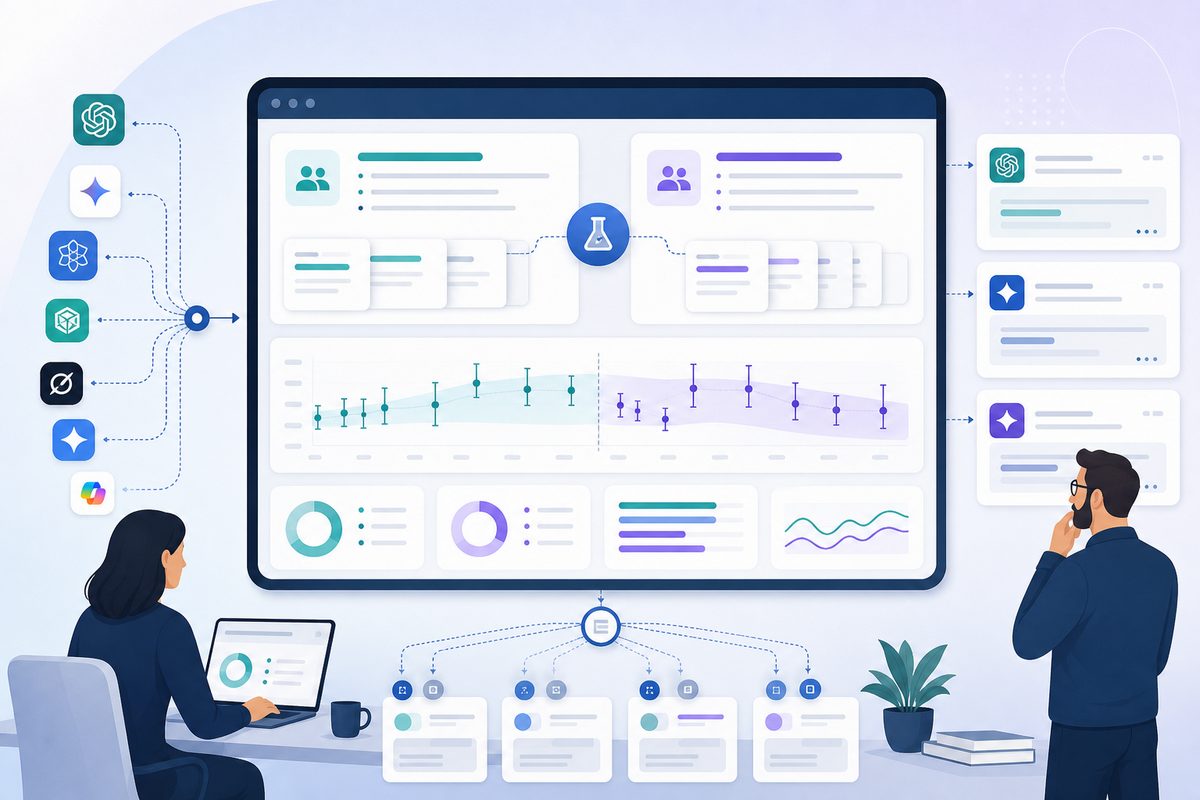
What Is an AI Visibility Holdout Test?
An AI visibility holdout test is an experiment where one matched set of prompts, pages, entities, or topics receives an optimization while a similar set is deliberately left unchanged. Success is judged by the difference between treatment movement and control movement, not by treatment movement alone.
The core calculation is:
Net lift = treatment change – control change
If treatment citation rate rises from 18% to 30%, the raw lift is 12 percentage points. If the control group rises from 17% to 24% in the same period, the net lift is only 5 percentage points. That 5-point difference is the result you can reasonably attribute to the intervention, assuming the groups were well matched and no major spillover occurred.
A holdout test answers a different question from ordinary AI search monitoring:
| Method | Question it answers | Weakness |
|---|---|---|
| Before-and-after check | Did our visibility change? | Confuses your work with model noise, recrawling, competitor changes, and category-wide movement. |
| AI search monitoring | Which prompts, engines, brands, and URLs moved? | Useful for detection, but not enough for causality. |
| AI visibility holdout test | Did our intervention outperform a similar untouched group? | Requires planning, frozen prompts, and a control group. |
Use a holdout when the decision has budget attached: rewriting a content cluster, funding analyst relations, scaling a schema rollout, or proving that a generative engine optimization program created measurable lift.
Why AI Visibility Needs Controls
AI visibility measurement has two hard problems: stochastic answers and uncertain source selection. The same prompt can produce different answers, citations, and shortlist orders across repeated runs. AI engines may also retrieve different sources as indexes refresh or query expansion changes.
Recent research supports this caution. The 2023 GEO paper introduced generative engine optimization and reported that tactics such as adding citations, statistics, and authoritative language could improve visibility in generative responses. Later work, including Don't Measure Once, argues that AI visibility should be measured as a distribution rather than a one-time snapshot. Quantifying Uncertainty in AI Visibility shows why single-run citation share can look precise while still sitting inside the noise floor.
Google's own documentation also makes simple attribution risky. Its AI features documentation says AI Overviews and AI Mode may use query fan-out, may show different links, and require ordinary Search eligibility rather than a special AI-only optimization path. Google also notes that recrawling after preview-control changes can take from several days to several months, depending on the page.
The practical implication: do not claim causality from a single chart going up. Claim causality only when the treated group beats a matched control group after enough time has passed for crawling, retrieval, and answer variation to show up.
The Volatility-Adjusted Holdout Design
The useful version of an AI visibility holdout test is a volatility-adjusted difference-in-differences design. It has five parts:
- Matched prompt-topic clusters so treatment and control start from similar conditions.
- A frozen test plan so metrics, prompts, engines, and time windows are not changed after results appear.
- A lag buffer so new or changed pages have time to be crawled, indexed, retrieved, and cited.
- Net lift calculation so category-wide movement is removed.
- A noise-floor rule so small differences are not reported as wins.
The simplified formula is:
Net citation lift =
(treatment post citation rate - treatment baseline citation rate)
-
(control post citation rate - control baseline citation rate)
The decision rule should be set before launch:
Call the test directionally positive only if:
1. net lift is greater than 0,
2. net lift exceeds the pre-set noise floor,
3. the lift is not driven by one prompt, one day, or one engine,
4. no major spillover contaminated the control group.
This is the main information gain for teams doing AEO or GEO in production. The goal is not to create a perfect lab experiment. The goal is to stop mistaking ordinary AI answer churn for successful optimization.
When Should You Run an AI Visibility Holdout Test?
Run an AI visibility holdout test when the action is expensive, repeatable, or politically important. Use a simpler before-and-after check only for debugging.
Good use cases include:
- Rewriting "best X tools" and competitor comparison pages.
- Publishing original research or benchmark data to earn citations.
- Cleaning up entity descriptions across owned pages, profiles, directories, and third-party sources.
- Adding or correcting structured data that matches visible page content.
- Updating partner, analyst, review, or marketplace pages.
- Testing whether a new definition, methodology, or comparison table gets absorbed into AI answers.
- Measuring whether a PR push changes shortlist inclusion or brand mention rate.
A holdout is less useful when the change affects the whole site or brand at once. A rebrand, acquisition, domain migration, large navigation change, global schema rollout, or category-wide PR event may leave no clean control group. In those cases, use interrupted time-series analysis, competitor benchmarks, and prompt-level diagnostics instead.
If your team is still building the basic visibility workflow, start with the broader guide to getting discovered in AI search before running causal tests.
What Should Be the Experimental Unit?
The best experimental unit is usually a prompt-topic-engine pair, not a single keyword. Buyers ask AI systems for recommendations, comparisons, definitions, implementation steps, and alternatives. Your unit should reflect that behavior.
A complete unit includes:
| Unit element | Example | Why it matters |
|---|---|---|
| Prompt | "Best SOC 2 automation tools for startups" | Captures the buyer's actual information need. |
| Topic cluster | Compliance automation shortlist prompts | Groups semantically similar prompts that may cite the same sources. |
| Engine | ChatGPT, Perplexity, Gemini, Claude, Copilot, Grok, Google AI Mode | Each engine has different retrieval and citation behavior. |
| Locale | US English | Reduces geography and language drift. |
| Target outcome | Brand mention, cited URL, citation position, recommendation presence | Prevents cherry-picking after the test. |
A page-level holdout can work when one page maps cleanly to one prompt cluster. For example, a "best compliance automation software" page may support shortlist prompts, while a schema guide may support implementation prompts. But many AI citations come from third-party pages, so prompt-topic clusters usually give a cleaner view of market visibility.
If you do not yet have a buyer-led prompt universe, build one first. The process in prompt research for AEO is a better starting point than guessing from traditional keyword lists.
How to Build a Matched Control Group
A control group should behave like the treatment group before the intervention. It does not need perfect similarity. It does need enough similarity that, without your change, both groups would likely move in the same direction.
Build the control group in seven steps:
- Create a candidate prompt pool. Include recommendation, comparison, alternative, integration, problem-aware, category-definition, and vendor-evaluation prompts.
- Exclude contaminated prompts. Remove prompts where treatment and control would rely on the same page, press mention, or directory listing.
- Record a baseline. Track each prompt-engine pair daily for at least 14 days. Use 21 to 28 days for volatile categories.
- Stratify by intent and engine. Compare recommendation prompts with recommendation prompts, and Perplexity prompts with Perplexity prompts.
- Match on baseline metrics. Pair units with similar citation rate, brand mention rate, competitor density, answer length, and source diversity.
- Randomly assign within matched blocks. Randomization prevents the team from putting easier prompts into treatment.
- Freeze the control. Do not rewrite pages, add schema, brief PR, change third-party profiles, or add internal links tied to control prompts during the test.
A practical matching table:
| Matching variable | Good match | Bad match |
|---|---|---|
| Baseline citation rate | 18% treatment vs 17% control | 18% treatment vs 2% control |
| Intent | "best tools" vs "top platforms" | "best tools" vs "what is SOC 2" |
| Engine mix | Same engines in both groups | Treatment mostly Perplexity, control mostly Gemini |
| Competitor density | 4-6 recurring competitors in both groups | Treatment has 2 competitors, control has 12 |
| Source type | Review sites and owned pages in both groups | Treatment cites review sites, control cites docs only |
| Brand maturity | Both topics have weak existing brand visibility | Treatment already dominates, control is absent |
The most useful maxaeo rule of thumb: match on the pre-test answer pattern, not just the prompt wording. Two prompts may look similar but behave differently if one cites analyst pages and the other cites documentation, forums, or listicles.
What Metrics Should Be Locked Before the Test?
Lock one primary metric before the test starts. Secondary metrics are allowed, but they should explain the result rather than replace the result after the fact.
For most teams, choose one of these primary metrics:
| Metric | Definition | Best use |
|---|---|---|
| Citation rate | Percentage of answers that cite your domain or target URL | Owned content and technical eligibility tests |
| Brand mention rate | Percentage of answers that mention your brand | Entity cleanup and awareness tests |
| Recommendation presence | Percentage of shortlist answers where your brand appears | Demand capture and category leadership |
| AI share of voice | Your mentions or citations divided by tracked competitor mentions or citations | Competitive reporting |
| Description accuracy | Percentage of answers that describe your product, category, pricing, or audience correctly | Reputation and entity accuracy work |
| Citation absorption | Percentage of answers where the final text appears to use your page's facts, framing, or evidence | Evidence and methodology upgrades |
Citation count alone is not enough. The 2026 paper From Citation Selection to Citation Absorption separates whether a source was selected from whether it actually influenced the generated answer. That distinction matters because an answer can cite a URL without using the page's key claims.
Secondary diagnostics should include:
- Cited URL and cited domain.
- Citation position or order.
- Brand mention position in the answer.
- Competitor mentions and shortlist order.
- Answer sentiment or recommendation language.
- Source type: owned page, review site, analyst page, documentation, forum, news, directory.
- Evidence reuse: whether the answer reflects your definitions, data, steps, or comparison table.
For stakeholder reporting, avoid vague claims such as "AI ranking improved." Use measurable phrasing: "Citation rate increased by 7.6 percentage points versus matched controls after the 21-day post-change window."
How Long Should the Test Run?
A useful default is 14 days of baseline, 7 days of lag buffer, and 14 to 21 days of post-window measurement. Use longer windows when the intervention depends on slow-moving third-party pages, PR, review sites, or analyst coverage.
A practical 35-day schedule:
| Period | Days | What happens |
|---|---|---|
| Baseline | 1-14 | Track treatment and control without changes. |
| Launch | 15 | Publish or deploy the treatment intervention. |
| Lag buffer | 16-22 | Keep tracking, but do not judge the result yet. |
| Post window | 23-35 | Measure the result window. |
| Analysis | 36 | Compare treatment change against control change. |
The lag buffer matters. Google's AI features documentation says pages must be indexed and eligible for a Search snippet to appear as supporting links in AI Overviews or AI Mode, and Google notes that recrawling can take from several days to several months depending on the page. Other AI systems have their own retrieval and refresh behavior, so a 48-hour check is usually too short for attribution.
What Intervention Should the Treatment Group Receive?
A clean holdout changes one coherent signal bundle. If you change content, schema, PR, internal links, and third-party profiles at the same time, the test may show lift but it will not tell you which lever worked.
Common treatment bundles:
| Intervention | What changes | What it tests |
|---|---|---|
| Evidence upgrade | Add original data, methodology, screenshots, named sources, definitions, and dated examples | Whether stronger extractable evidence earns citations or answer absorption |
| Citation-readiness rewrite | Add answer-first sections, tables, steps, summaries, and source-backed claims | Whether the page becomes easier for answer engines to cite |
| Entity cleanup | Align brand name, category, descriptors, executives, pricing language, integrations, and use cases | Whether clearer entity signals improve brand mentions and descriptions |
| Structured data cleanup | Ensure Article, Organization, Product, FAQ, or HowTo markup matches visible page text where appropriate | Whether parsable structure supports retrieval and interpretation |
| Third-party source push | Update review profiles, analyst pages, partner directories, marketplace pages, and media mentions | Whether off-site authority changes recommendations |
| Technical eligibility fix | Improve indexability, internal links, rendered text, canonicalization, and crawl access | Whether retrieval access was the blocker |
For schema-specific work, use structured data as a clarity layer, not as hidden content. Google states that structured data should match visible page content, and the same principle applies to AI visibility work. See schema for AI search for a deeper implementation workflow.
Do not cloak test pages or serve one version to crawlers and another to users. Google's A/B testing guidance warns against cloaking, recommends canonical links for alternate URLs, and recommends temporary redirects for temporary variants.
Worked Example: A 35-Day Holdout for Citation Lift
This example uses a synthetic planning dataset. It shows the math and reporting structure, not a universal benchmark.
A B2B SaaS team wants more AI citations for "best compliance automation tools" prompts. It tracks 80 prompt-engine pairs across ChatGPT, Perplexity, Gemini, and Google AI Mode. Forty are assigned to treatment and 40 to control after matching by intent, baseline citation rate, source type, and competitor density.
The treatment bundle is an evidence upgrade to one comparison page:
- A dated methodology section.
- A product-fit table by company size.
- Screenshots of workflow steps.
- Clear definitions for compliance automation, audit readiness, and evidence collection.
- Integration language aligned with the product documentation.
- Source-backed claims with no inflated superlatives.
The control cluster is left unchanged.
| Group | Baseline citation rate | Post citation rate | Raw change |
|---|---|---|---|
| Treatment | 18.4% | 31.2% | +12.8 pp |
| Control | 17.9% | 23.1% | +5.2 pp |
| Net lift | +7.6 pp |
The treatment improved, but the control improved too. That means part of the raw lift probably came from model refreshes, category-wide source churn, competitor movement, or broader market interest. The defensible number is the net lift: +7.6 percentage points.
Now add a volatility check. Suppose the control group's daily change during the baseline had a standard deviation of 2.1 percentage points. A practical noise floor is 2x that standard deviation, or 4.2 points. The 7.6-point net lift clears the rule.
A plain reporting sentence would be:
After a 14-day baseline, 7-day lag buffer, and 14-day post window, treated prompt-engine pairs gained 7.6 percentage points more citation rate than matched controls. The lift exceeded the pre-set 4.2-point volatility threshold and appeared in 3 of 4 tracked engines.
That is stronger than saying: "Our AI visibility went up 12.8 points."
How to Decide Whether the Result Is Real
A credible result clears five checks: direction, magnitude, distribution, timing, and contamination.
| Check | Pass condition | Fail signal |
|---|---|---|
| Direction | Treatment change is greater than control change | Both groups moved equally |
| Magnitude | Net lift exceeds the pre-set noise floor | Net lift sits inside normal volatility |
| Distribution | Lift appears across multiple prompts, days, or engines | One prompt, one day, or one engine explains the result |
| Timing | Post window begins after the lag buffer | Result is judged immediately after publishing |
| Contamination | Control group remains untouched | Sitewide, PR, schema, or internal-link changes affect both groups |
For higher-stakes tests, add bootstrap confidence intervals around treatment change, control change, and net lift. If the lower bound of net lift stays above zero, the result is stronger. If the interval crosses zero, report the result as inconclusive even if the point estimate looks positive.
A practical decision table:
| Outcome | What it means | Decision |
|---|---|---|
| Positive and stable | Treatment beat control, cleared noise floor, and spread across prompts | Roll out to similar pages with a fresh holdout |
| Positive but narrow | Lift came mostly from one engine or prompt type | Scale only to that segment and retest |
| Positive but contaminated | Lift occurred, but control was touched or category changed sharply | Treat as directional, not causal |
| Flat | Treatment and control moved similarly | Do not scale yet; diagnose source eligibility and answer absorption |
| Negative | Treatment underperformed control | Revert or revise the intervention before broader rollout |
What Can Break an AI Visibility Holdout Test?
Most weak holdouts fail before analysis. The problem is usually contamination, not math.
| Failure mode | What happens | Fix |
|---|---|---|
| Prompt contamination | Treatment and control prompts cite the same page or third-party source | Re-cluster prompts by cited-source overlap before assignment |
| Sitewide spillover | Navigation, schema, templates, or internal links affect both groups | Document the event and downgrade the test to directional |
| Competitor shock | A competitor launches PR, research, or review campaigns mid-test | Track competitor share of voice and extend the window |
| Model or retrieval update | Citations reshuffle across many prompts at once | Compare against controls and segment by engine |
| Manual prompt drift | The team changes prompt wording, locale, or engine settings | Freeze prompt text and run configuration before launch |
| Sample peeking | Stakeholders call the test early when a chart looks good | Set the analysis date before the intervention |
| Control neglect | Nobody tracks whether the control was accidentally changed | Keep a treatment-control change log |
| Single-run reporting | One screenshot is treated as proof | Use repeated sampling and uncertainty reporting |
The subtle failure is category-wide uplift. If every brand in the category gets cited more often, your treatment chart will look good while your competitive position may stay flat. That is why AI share of voice belongs next to citation rate in every report.
If your diagnostics show competitors replacing your URLs, investigate the source-selection problem separately. The guide to why AI search engines cite competitor pages instead of yours covers that workflow.
What Data Should You Store?
A holdout needs raw evidence, not just a dashboard score. Another analyst should be able to reproduce the conclusion from your stored data.
Store at minimum:
- Prompt text, engine, model or product surface, locale, timestamp, and run ID.
- Full answer text.
- Cited URLs, cited domains, and citation positions.
- Brand mentions, competitor mentions, and shortlist order.
- Extracted answer spans used for sentiment, description accuracy, or evidence absorption.
- Treatment-control assignment.
- Frozen test plan and metric definitions.
- Page-change timestamps, publish dates, crawl evidence, and indexability checks.
- Third-party change log for PR, review sites, directories, analyst pages, and partner pages.
- Known market events, competitor launches, or major engine updates during the test.
This is the difference between basic AI search monitoring and experiment-grade LLM brand tracking. Monitoring says what moved. A holdout explains whether the movement should influence budget, roadmap, or client strategy.
For repeatable tracking, define the prompt universe before the test. The guide to creating a prompt set for AI brand monitoring covers prompt grouping, engine coverage, and monitoring cadence.
How to Report the Result to Stakeholders
Report the result as a causal estimate with limits. Stakeholders need the decision, the evidence, and the caveats.
Use this format:
| Report field | Example |
|---|---|
| Test question | Did the evidence upgrade increase citations for compliance automation shortlist prompts? |
| Primary metric | Citation rate across matched prompt-engine pairs |
| Design | 40 treatment and 40 control prompt-engine pairs; 14-day baseline; 7-day lag buffer; 14-day post window |
| Intervention | Evidence upgrade to one comparison page |
| Result | +7.6 pp net citation lift versus control |
| Confidence | Lift exceeded the 4.2 pp volatility threshold and appeared in 3 of 4 engines |
| Limit | Google AI Mode moved less than ChatGPT and Perplexity |
| Decision | Roll the evidence upgrade into 12 related pages, then rerun with a fresh holdout |
Avoid these claims:
- "We proved ChatGPT will recommend us."
- "AI rankings increased."
- "The content update caused all citation lift."
- "This tactic works across every engine."
- "The screenshot proves the strategy."
Use this instead:
"For this defined prompt set and time window, the treatment group outperformed matched controls by 7.6 percentage points in citation rate. The result is directionally credible and supports scaling the same intervention to similar pages with a new holdout."
AI Visibility Holdout Test Template
Use this checklist before launch:
| Item | Decision to lock |
|---|---|
| Test question | What business question will the holdout answer? |
| Primary metric | Citation rate, brand mention rate, recommendation presence, share of voice, description accuracy, or absorption |
| Experimental unit | Prompt-topic-engine pair, page cluster, or entity cluster |
| Treatment set | Which units receive the intervention? |
| Control set | Which matched units stay untouched? |
| Baseline window | Usually 14-28 days |
| Lag buffer | Usually 7-14 days for owned content; longer for third-party sources |
| Post window | Usually 14-21 days |
| Noise floor | For example, 2x control baseline daily standard deviation |
| Spillover log | Who records sitewide, PR, schema, and third-party changes? |
| Decision rule | What result will be called positive, inconclusive, or negative? |
The most important line is the decision rule. If you cannot state the pass/fail rule before launch, the test will turn into a post-hoc narrative.
Common Questions
What is the minimum sample size for an AI visibility holdout test?
The minimum sample depends on baseline citation rate, expected lift, prompt correlation, and answer volatility. As a rough planning rule, a two-group proportion test may need hundreds of prompt-engine-day observations per group. If prompts are highly correlated, apply a design effect and collect more observations.
For example, with a 20% baseline citation rate and an 8-point detectable lift, a simple independent-observation estimate is roughly 400 observations per group. Because AI answers are not perfectly independent, a design effect of 2 would push the planning target closer to 800 observations per group.
Can the control group be a competitor?
A competitor is a benchmark, not a clean holdout. Competitors update pages, receive coverage, change messaging, gain reviews, and lose citations for reasons you cannot control.
Use competitors for AI share of voice and market context. Use matched untouched prompts, pages, or topic clusters for the control group.
Should treatment and control prompts be tracked in ChatGPT only?
No. If buyers use multiple answer engines, track multiple engines. ChatGPT may be important for brand mentions, but Perplexity, Gemini, Claude, Copilot, Grok, Google AI Mode, and AI Overviews often use different retrieval paths and citation displays.
Segment the result by engine. A lift in Perplexity but not Gemini is still useful, but it should not be reported as a universal AI visibility gain.
How do you avoid waiting forever for model changes?
Set the lag window before the test starts. For owned content, a 7-day lag buffer is often a practical minimum, and 14 days is safer for slower pages. For third-party PR, directories, review sites, or analyst pages, the lag can be longer.
The key is consistency. Do not check after two days, declare failure, then keep watching until the chart looks better.
Can a holdout prove that we will get recommended by ChatGPT?
No holdout can prove permanent inclusion or universal recommendations. It can support a narrower, useful claim: a specific intervention improved recommendation presence, citation rate, or brand mention rate for a defined prompt set during a defined period.
That narrower claim is still valuable because it tells the team which work increased the probability of being cited, recommended, or accurately described.
What is the difference between citation lift and AI share of voice?
Citation lift measures how often your domain or URL is cited before and after the intervention. AI share of voice compares your visibility with competitors in the same answers. A citation lift can be positive while share of voice stays flat if the whole category improved at the same time.
Track both when the business question is competitive visibility.
The Practical Takeaway
An AI visibility holdout test turns AI citation reporting from "we saw movement" into "we isolated the likely cause." The method is simple: match similar prompt clusters, freeze one group, change the other, wait through the lag window, and compare net lift against observed volatility.
The discipline is in the setup. Freeze the prompt set. Lock the metric. Keep the control untouched. Store the raw answers. Report only the lift that remains after the control group has had the same chance to move.