AI visibility for agencies is now a commercial problem, not just an SEO experiment. Prospects use ChatGPT, Perplexity, Gemini, Claude, Copilot, Grok, Google AI Overviews, and AI Mode to ask which SEO, PR, content, creative, performance, or integrated marketing firms they should consider before they ever submit an RFP.
For an agency, the risk is not only being absent. The higher-value risk is being absent from prompts that look like procurement research:
- “Best B2B SaaS SEO agency for cybersecurity companies”
- “PR firm for a Series B fintech launch”
- “Marketing agency with healthcare AI case studies”
- “Compare agencies for technical SEO and content strategy”
- “Which GEO agency has proof with enterprise software brands?”
That is why agency AI search monitoring needs to track buyer prompts, services, verticals, geography, proof, citations, competitors, and answer accuracy together. A dashboard that only counts brand mentions can miss the real problem: the answer may name three competitors, cite their case studies, and describe your agency as a generalist.
What Is AI Visibility for Agencies?
AI visibility for agencies is the measurable presence of an agency in AI-generated recommendations, comparisons, summaries, and citations when buyers ask for marketing partners. It tracks whether the agency is named, ranked, described accurately, supported by evidence, and shown against competitors across prompts, engines, services, industries, and locations.
This is different from ranking for “SEO agency” or “PR agency” on Google. AI answers often compress multiple sources into a short recommendation set. The system may draw from an agency website, a case study, a directory, a review platform, a podcast, a LinkedIn profile, a partner page, a listicle, or a trade publication. It may also mention a firm without linking to it.
Google’s own guidance for generative AI features in Search says AI Overviews and AI Mode still depend on Search fundamentals such as crawlability, ranking systems, retrieval, and query fan-out. For agencies, that means SEO still matters, but the business metric has changed: visibility is now a pre-sales trust signal.
What Buyers Really Want When They Search “AI Visibility for Agencies”
Someone searching this topic usually wants to know whether AI visibility can become a measurable agency service, a client reporting layer, or a way to win more vendor shortlists. They are rarely looking for another generic definition of GEO.
The commercial questions behind the query are:
| Buyer question | What the article must answer |
|---|---|
| “Can my agency sell this?” | What deliverables, metrics, and reporting cadence make it credible |
| “Can this help us win clients?” | Which AI prompts influence shortlists, RFPs, and reputation checks |
| “What should a tool track?” | Mentions, rank, citations, competitors, sentiment, source URLs, and trend history |
| “How is this different from SEO?” | SEO improves discoverability; AI visibility measures answer-level recommendation outcomes |
| “What should we fix first?” | Revenue-adjacent prompts, inaccurate descriptions, weak proof, and missing third-party validation |
| “How do we avoid hype?” | Use repeatable prompt sets, evidence logs, and cautious claims instead of one-off screenshots |
The practical answer: agencies should treat AI visibility as a measurement and evidence-building workflow. It is not a promise to “rank in ChatGPT.” It is a way to learn where AI systems recommend a brand, why competitors win, which sources shape the answer, and what proof assets need to exist.
Why Agency Shortlists Behave Differently in AI Search
AI agency shortlists are compressed, evidence-sensitive, and highly dependent on prompt wording. A traditional SERP can show ads, directories, maps, organic links, “People also ask,” and review pages. An AI answer may show five names or fewer, with a short explanation that influences the buyer’s next click.
A 2026 arXiv preprint, “Don’t Measure Once: Measuring Visibility in AI Search”, argues that AI search visibility should be measured as a distribution because answers vary across prompts, runs, and time. That matters for agencies because one buyer may ask for “B2B SaaS SEO,” another for “enterprise software demand generation,” and another for “technical content agency for cybersecurity.”
The same agency can be visible in one phrasing and missing from another. That gap is where qualified demand leaks to competitors.
The Seven Prompt Types Prospects Use Before an RFP
Prospects usually ask AI for agencies in seven patterns: service, industry, geography, proof, comparison, risk, and budget. Tracking all seven prevents an agency from optimizing only for broad category prompts while missing high-intent buyer questions.
| Prompt type | Example buyer question | What the agency should monitor |
|---|---|---|
| Service | “Best technical SEO agencies for SaaS” | Service category mentions, rank order, and competitor overlap |
| Industry | “PR firms for cybersecurity startups” | Vertical relevance, client proof, and industry citations |
| Geography | “Marketing agencies in Austin for B2B tech” | Local and regional recommendations |
| Proof | “SEO agencies with fintech case studies” | Case study visibility and cited sources |
| Comparison | “Compare Agency A vs Agency B for content strategy” | Competitive framing, strengths, weaknesses, and sentiment |
| Risk | “Is Agency A reputable?” | Accuracy, complaints, outdated facts, and reputation sources |
| Budget | “Affordable GEO agency for startups” | Fit for pricing tier, stage, and service scope |
This is the practical difference between generic AI search monitoring and AI visibility for agencies. Agencies need prompt sets that mirror procurement language, not only keyword lists.
For a deeper method, use AI search prompts for turning SEO keywords into buyer questions.
The Prompt-to-RFP Framework
The Prompt-to-RFP framework maps each AI answer to the next buyer action. It helps an agency decide which AI visibility gaps deserve executive attention and which are only informational noise.
Use four layers:
- Prompt intent: Is the buyer learning, shortlisting, comparing, validating, or disqualifying?
- Answer outcome: Is the agency named, omitted, ranked low, misdescribed, or cited?
- Evidence source: Which page, directory, review, publication, case study, or profile supports the answer?
- Pipeline action: Should the agency create proof, update positioning, improve citations, pitch earned media, or fix technical access?
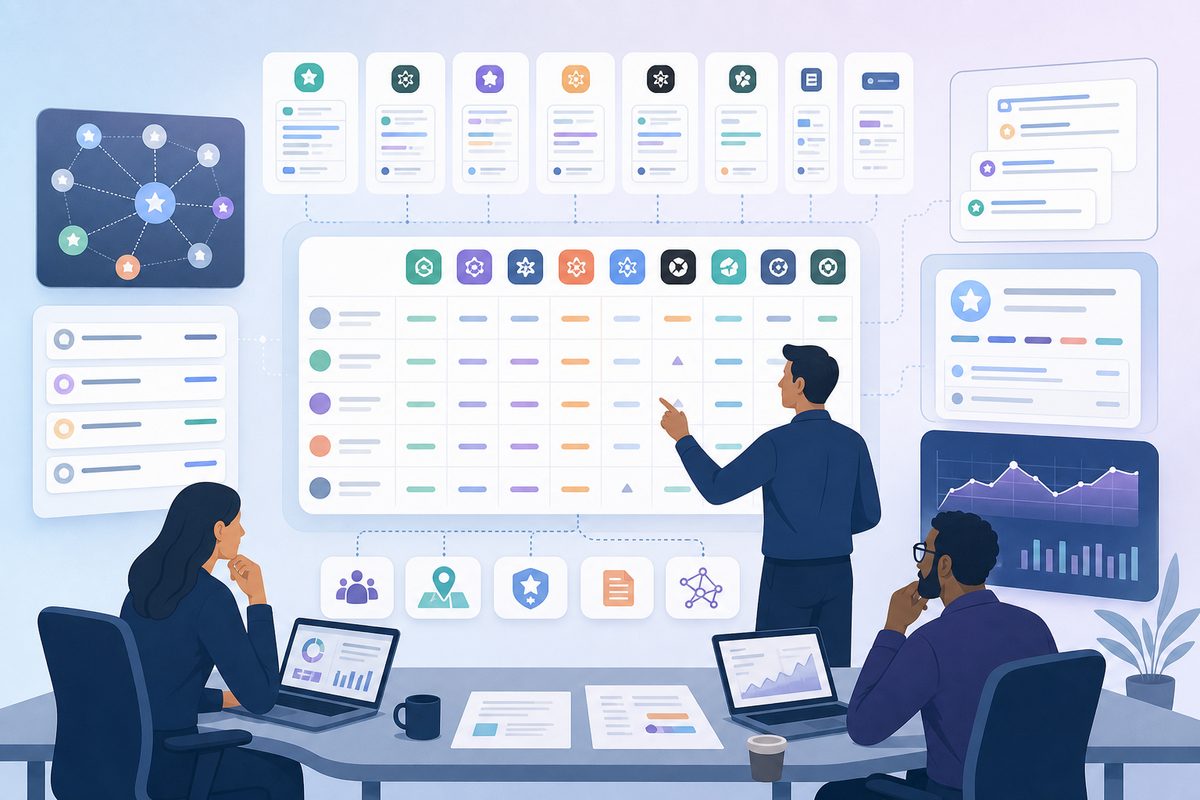
A useful report should be specific enough to create work. “We are not visible in AI search” is too vague. “We are absent from fintech SEO shortlist prompts because AI answers cite competitor case studies and third-party lists, while our fintech proof is buried in uncrawlable PDFs” is actionable.
The Evidence Gap Score: A Better Way to Prioritize Fixes
A missing mention is not always urgent. A missing mention in a high-intent shortlist prompt, supported by competitor citations, is urgent.
Use this simple Evidence Gap Score to prioritize agency AI visibility work:
| Factor | Score | How to judge it |
|---|---|---|
| Commercial intent | 0-5 | Is the prompt close to shortlist, comparison, budget, or RFP behavior? |
| Segment fit | 0-5 | Does the prompt match a service, vertical, market, or buyer type the agency actively wants? |
| Competitor advantage | 0-5 | Are competitors named, ranked higher, or described with stronger proof? |
| Citation deficit | 0-5 | Are competitor sources cited while the agency has no cited evidence? |
| Factual risk | 0-5 | Is the answer wrong, outdated, misleading, or reputation-sensitive? |
| Fix feasibility | 0-5 | Can the agency fix the gap with available content, PR, directory, or technical work? |
Prioritize prompts with high commercial intent, strong segment fit, competitor advantage, citation deficit, and factual risk. Use fix feasibility to separate fast wins from longer authority-building work.
What Agencies Should Measure Beyond Mentions
Agencies should measure mentions, rank position, citations, competitor co-mentions, sentiment, factual accuracy, and prompt coverage. A mention alone can look positive in a dashboard while the answer still sends the buyer to a better-supported competitor.
| Metric | What it answers | Why it matters |
|---|---|---|
| AI share of voice | How often does the agency appear versus competitors? | Shows category presence |
| First mention rate | Is the agency recommended early? | Early names shape recall and shortlist behavior |
| Citation rate | Is the agency supported by a linked source? | Citations create trust and give teams a fix path |
| Competitor overlap | Who appears beside the agency? | Reveals actual shortlist rivals |
| Description accuracy | Is the agency positioned correctly? | Prevents wrong-fit leads and reputation drift |
| Proof coverage | Are case studies, awards, reviews, or client examples cited? | Connects visibility to buyer confidence |
| Prompt coverage | Which buyer prompts produce visibility? | Finds gaps by service, niche, geography, and funnel stage |
| Source quality | Are cited sources authoritative, fresh, and relevant? | Separates durable visibility from weak mentions |
| Change history | Did visibility improve, decline, or fluctuate? | Makes reporting defensible over time |
This is where an AI visibility tool becomes operational. It should show what prompted the mention, what source supported it, what competitor won, and what should change next.
Why Citations Matter More Than Formatting Tricks
Citations matter because AI answer engines may retrieve several plausible sources but cite only a few. When a buyer sees a cited recommendation, that source becomes part of the agency’s proof stack.
A 2026 arXiv preprint, “What Gets Cited: Competitive GEO in AI Answer Engines”, tested 252,000 trials across six LLMs and 18 content factors. The study found that topical relevance and list position were major drivers of first citation, while explicit price information, recent timestamps, completeness, and trust cues also helped. Formatting-only changes had limited impact.
For agencies, the lesson is direct: do not treat answer engine optimization as headline polishing. A stronger agency proof page usually has:
- A clear service category and buyer segment
- Specific industries served
- Named use cases and client situations
- Case study summaries with context and outcomes
- Relevant dates where freshness matters
- Third-party validation where available
- Crawlable, indexable HTML
- Consistent positioning across owned and third-party sources
When citations are weak or missing, use AI citation tracking to find the source gap before rewriting pages blindly.
Where AI Gets Agency Recommendations From
AI systems may use agency websites, directories, review platforms, media articles, partner pages, social profiles, client case studies, podcasts, comparison posts, public knowledge sources, and indexed web pages. The strongest answers often combine owned proof with third-party validation.
A 2025 arXiv preprint, “Generative Engine Optimization: How to Dominate AI Search”, reported that AI search systems showed a strong preference for earned media and authoritative third-party sources in many tested scenarios, while also varying by engine, freshness, language, and query phrasing.
That creates a practical rule for agencies: owned content explains what you do; third-party sources help AI systems decide whether the market believes it.
The best agency visibility programs combine SEO, PR, partnerships, reviews, and reputation management. Publishing a case study is useful. Getting that case study referenced in a respected industry publication, partner ecosystem, podcast recap, analyst note, or credible comparison page is stronger.
How to Build an Agency Prompt Set
An agency prompt set should start with buying scenarios, not vanity keywords. The goal is to model how a real prospect describes their company, constraints, and desired outcome when asking AI for a shortlist.
Build the first version in five steps:
- List services: SEO, PR, content, paid media, demand generation, creative, brand, analytics, GEO, or integrated marketing.
- Add verticals: SaaS, fintech, cybersecurity, healthcare, ecommerce, developer tools, climate tech, professional services, or enterprise software.
- Add market context: startup, Series A, enterprise, regulated, global, local, technical, founder-led, or sales-led.
- Add proof modifiers: case studies, reviews, awards, client examples, pricing, benchmarks, audits, migration work, launches, or niche expertise.
- Add buyer tasks: shortlist, compare, evaluate, recommend, vet, find alternatives, check reputation, or estimate budget.
A strong agency prompt set usually has 50 to 200 prompts per major service line. Multi-brand agencies need separate prompt sets by client, market, language, and competitor set.
For client-heavy teams, the guide on how to evaluate GEO tools for a multi-brand agency gives a more detailed buying checklist.
Should an Agency Use Manual Testing or an AI Visibility Platform?
Manual testing is useful for a first audit, but it breaks down when an agency needs recurring measurement, competitor trends, citation history, and client-ready reports.
| Approach | Best for | Limit | Agency risk |
|---|---|---|---|
| Manual prompt checks | Early discovery and sales demos | Not repeatable, hard to trend | Screenshot-driven reporting |
| Spreadsheet tracking | Small pilots and narrow prompt sets | Labor-intensive, easy to miss citation changes | Inconsistent methodology across clients |
| Generic brand monitoring | Broad mention alerts | Often misses prompt intent and citation paths | False confidence from raw mentions |
| AI visibility platform | Recurring agency service and multi-client reporting | Requires prompt governance and clear ownership | Poor setup can create noisy dashboards |
If you are comparing tools, focus less on whether a platform can “check ChatGPT” and more on whether it can manage prompts, competitors, engines, citations, evidence, and reporting across many clients. The broader tool landscape is covered in the best AI search and LLM monitoring tools in 2026.
A Worked Example: Cybersecurity SEO Agency
A cybersecurity SEO agency can look healthy in traditional rankings but weak in AI shortlists. The gap often appears when prompts include industry proof, technical depth, or comparison language.
| Prompt | Desired outcome | Weak signal to watch | Likely fix |
|---|---|---|---|
| “Best SEO agencies for cybersecurity SaaS” | Named in top three | Competitors cited from listicles | Build and distribute a cybersecurity SEO proof page |
| “SEO agency with technical content case studies” | Relevant case study cited | AI cites a generic services page | Add crawlable case study summaries with outcomes |
| “Compare cybersecurity SEO agencies for startups” | Accurate specialist positioning | Agency described as a generalist | Update service pages, profiles, and third-party descriptions |
| “PR and SEO agency for security vendor launch” | Included for integrated launch work | No mention of PR capability | Create an integrated launch playbook and supporting case study |
| “Is [agency] reputable?” | Positive, factual answer | Outdated founder, client, or review information | Fix public profiles and reputation sources |
The goal is not to force every answer. The goal is to identify prompts where a qualified buyer would reasonably expect the agency to appear, then close the evidence gap.
How to Turn AI Visibility Into a Client-Facing Service
Agencies can package AI visibility as a recurring measurement and optimization service. The defensible version combines prompt monitoring, citation analysis, content fixes, third-party authority building, reputation cleanup, and executive reporting.
A simple monthly deliverable includes:
- Prompt coverage by funnel stage
- AI share of voice versus named competitors
- Top answers where the client is recommended
- Prompts where competitors win
- Incorrect or risky brand descriptions
- Citation sources behind key answers
- Evidence gaps by service, vertical, and geography
- Fix backlog sorted by likely business impact
- Screenshots or answer captures with engine, prompt, market, and date
This works because the deliverable maps AI search visibility to budget language. Leadership does not need a lecture on LLMs. They need to know where the brand is recommended, where it is losing, what evidence is missing, and what the team should fix first.
Pricing and Packaging for Agency Clients
A credible AI visibility offer should be priced around monitoring complexity, number of markets, number of competitors, reporting depth, and whether the agency is also responsible for content and PR fixes.
| Package | Good fit | What to include |
|---|---|---|
| Baseline audit | Prospect, pilot, or quarterly strategy project | 50-100 prompts, 3-5 competitors, citation review, risk summary, fix backlog |
| Monthly monitoring | Retainer client with active SEO, PR, or content work | Weekly or daily prompt tracking, trend reports, competitor movement, source analysis |
| Visibility growth program | Client wants to win AI shortlists in a category | Monitoring plus content briefs, case study upgrades, third-party profile work, PR priorities |
| Multi-market program | Enterprise, multi-brand, or international client | Segmented prompts by market, language, product line, competitors, and buyer role |
Avoid selling “guaranteed ChatGPT recommendations.” Sell a measurable process: prompt coverage, answer outcomes, citation paths, competitor gaps, and fix execution.
What Should Be Fixed First?
Fix prompts closest to revenue first: shortlist, comparison, proof, budget, and reputation prompts. Informational prompts matter, but they should not outrank answers that influence vendor selection before sales hears from the account.
Use this order:
- Wrong facts: outdated services, wrong markets, incorrect leadership, old clients, or misleading descriptions.
- Missing from core shortlist prompts: especially service plus industry combinations.
- Competitors cited with better proof: case studies, awards, benchmarks, reviews, or customer examples.
- Weak third-party footprint: thin directory profiles, no recent media, no partner validation, or inconsistent descriptions.
- Technical access problems: blocked pages, JavaScript-rendered proof, missing indexability, slow pages, or uncrawlable PDFs.
- Content gaps: vague service pages, no buyer-specific proof, no comparison-ready information, or no pricing guidance where buyers expect it.
Google’s helpful, reliable, people-first content guidance asks whether content provides original information, a complete description, and analysis beyond the obvious. That is also a good standard for agency GEO work.
How Location and Market Change Agency Visibility
Location changes agency recommendations because buyers often add market constraints to reduce risk. “Best SEO agency” and “best SEO agency for B2B SaaS in London” can produce different shortlists, citations, and competitor sets.
Agencies should segment prompt tracking by:
- Country
- City or region
- Industry
- Company stage
- Service line
- Buyer role
- Language
- Compliance requirements
- Budget tier
- Client size
This matters for both local agencies and global firms. A large agency may appear for enterprise prompts but disappear for regional startup prompts. A specialist boutique may win niche prompts but lose broad category prompts.
Use market-level reporting to avoid false averages. A 20% AI share of voice across all prompts may hide 60% visibility in one niche and 0% in a market the agency is actively trying to enter.
What an Agency AI Visibility Platform Should Show
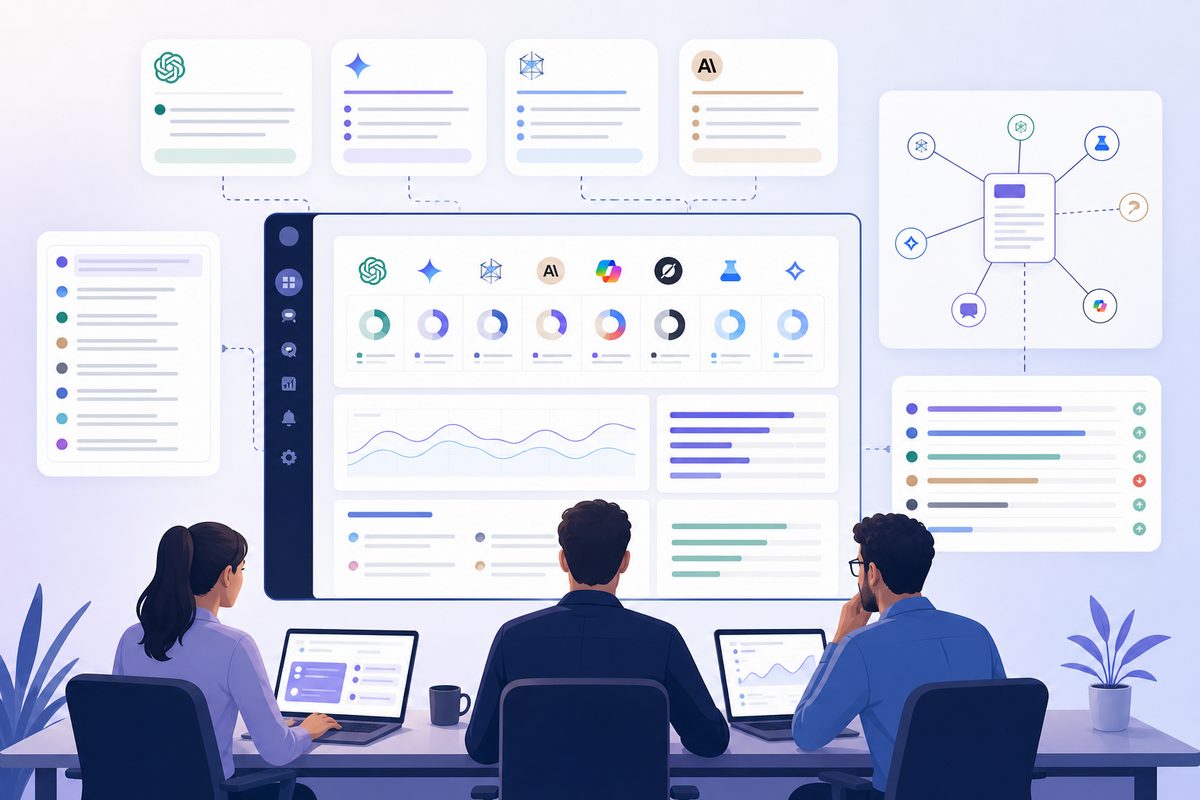
An agency AI visibility platform should show recurring changes across engines, prompts, competitors, citations, sentiment, and recommended fixes. The dashboard must be built for action, not screenshots alone.
| Capability | Why agencies need it |
|---|---|
| Multi-engine tracking | Buyers use more than one AI system |
| Prompt set management | Each client, service, and market needs different prompts |
| Competitor benchmarking | Shortlists are relative |
| Citation mapping | Teams need to know which sources influence answers |
| Source history | Citation changes explain why visibility rises or falls |
| Sentiment and accuracy review | Wrong answers can create reputation risk |
| Client reporting | Agencies need exportable evidence |
| Fix recommendations | Monitoring without action becomes noise |
| Multi-brand workspace | Agencies manage many clients at once |
| Role-based workflow | SEO, PR, content, and account teams own different fixes |
For agencies selling GEO, generative engine optimization, answer engine optimization, or AI reputation monitoring, the platform should separate mentions from citations. A brand mention without a source is a visibility signal. A cited source is an evidence path the team can inspect and improve.
How to Report AI Visibility to Clients and Leadership
Report AI visibility as a buyer decision report, not a technical novelty. The strongest format shows what prospects asked, what the AI recommended, which competitors appeared, which sources were cited, and what changed month over month.
| Reporting field | Example |
|---|---|
| Buyer prompt | “Best PR firms for B2B SaaS funding announcements” |
| Client outcome | Mentioned third, not cited |
| Competitor outcome | Two competitors cited with campaign examples |
| Risk | Client appears less proven for SaaS launches |
| Fix | Publish funding launch case study and pitch trade coverage |
| Owner | PR lead plus content lead |
| Expected impact | Improve proof-based shortlist visibility |
Archive the prompt text, engine, answer, date, market, cited URLs, rank order, and screenshot or answer capture. Without this evidence, client conversations become anecdotal.
What to Do When AI Recommends Competitors
When AI recommends competitors, do not start by rewriting every service page. First, identify why the competitor was recommended.
Check four things:
- Prompt fit: Did the competitor match the service, industry, geography, or buyer stage more closely?
- Proof depth: Did the competitor have stronger case studies, awards, review profiles, pricing clarity, or named examples?
- Source strength: Was the competitor cited from a third-party article, directory, partner page, or analyst-style list?
- Positioning clarity: Is your agency’s niche harder for a model to summarize?
If the competitor wins because the public evidence is stronger, the fix is not keyword stuffing. It is better proof, cleaner entity signals, stronger third-party validation, and more consistent descriptions.
For a deeper playbook, see why AI recommends competitors and how to win back AI shortlists.
Common Mistakes Agencies Make
The biggest mistake is treating AI visibility like a one-time audit. Because answer engines vary by prompt, source mix, and time, the useful question is not “Did we show up once?” It is “How often do we show up for the prompts that match our best buyers?”
Other mistakes include:
- Tracking only the agency name, not service-plus-niche prompts
- Ignoring competitors that appear in the same answer
- Treating citations and mentions as the same metric
- Creating generic “AI SEO” pages with no case studies or buyer proof
- Publishing thin pages for every prompt variation
- Forgetting directories, partner profiles, media, podcasts, and reviews
- Reporting screenshots without a fix backlog
- Over-optimizing for acronyms instead of buyer language
- Making claims like “we can make ChatGPT recommend you” without evidence or caveats
The durable advantage is not jargon. It is a better evidence graph around the agency’s strongest markets.
A 30-Day Rollout Plan for Agencies
A 30-day rollout is enough to move from guessing to a defensible AI search monitoring baseline. The goal is not to “win AI search” in one month. The goal is to know where prospects already see the agency, where competitors win, and which fixes deserve budget.
Days 1-5: Define the market. Pick 3-5 service lines, 3-5 priority industries, and 5-10 real competitors.
Days 6-10: Build prompts. Create shortlist, comparison, proof, reputation, budget, and geography prompts for each segment.
Days 11-15: Run baseline monitoring. Capture engines, answers, positions, mentions, citations, sentiment, screenshots, and cited URLs.
Days 16-20: Classify gaps. Separate factual errors, missing proof, weak citations, technical issues, and competitor advantages.
Days 21-25: Build the fix backlog. Prioritize revenue-adjacent prompts and assign owners across SEO, PR, content, partnerships, account, and leadership.
Days 26-30: Report and repeat. Share trend data, top risks, quick wins, and the next monitoring cycle.
How to Know the Program Is Working
The program is working when visibility improves in commercially meaningful prompts, cited sources become stronger, competitor gaps shrink, and AI descriptions of the agency become more accurate. Traffic is useful, but it is not the only signal.
Track these outcomes over time:
- More appearances in shortlist prompts
- Higher first mention rate for priority services
- Better AI share of voice against real competitors
- More citations from owned and third-party proof assets
- Fewer inaccurate descriptions
- More consistency across engines
- Better coverage in target industries and regions
- Sales teams hearing prospects reference AI-discovered proof
- More qualified prospects arriving with clearer trust in the agency’s niche
The best sign is when AI answers start reflecting the agency’s intended positioning without sounding like ad copy. That means the public evidence around the agency is coherent enough for machines and humans to summarize.
Common Questions
How often should agencies monitor AI visibility?
Agencies should monitor priority prompts at least weekly, and daily for active campaigns, launches, reputation risks, or competitive categories. One-time checks are weak evidence because AI answers vary across engines, wording, location, and time.
Is AI visibility for agencies the same as SEO?
No. SEO remains the foundation because crawlability, content quality, authority, and technical access still matter. AI visibility adds answer-level measurement: whether AI systems recommend the agency, cite its proof, compare it accurately, and include it in buyer shortlists.
Which prompts matter most for an agency?
The most valuable prompts combine service, niche, proof, and buying action. “Best SEO agency for B2B SaaS with cybersecurity case studies” is usually more commercial than “what is SEO?” because it signals shortlist intent.
Can agencies influence ChatGPT recommendations?
Agencies can improve their odds by strengthening crawlable proof, third-party validation, citations, positioning consistency, and content depth. They cannot control every answer, and they should avoid manipulative tactics. The goal is to become a more credible recommendation, not to game a model.
What is the fastest fix when competitors are recommended instead?
Find the cited sources behind the competitor recommendations. If competitors win because they have clearer case studies, stronger directory profiles, fresher third-party mentions, or better niche positioning, fix those evidence gaps first.
What should an AI visibility report include?
A useful report should include prompt text, engine, answer date, market, brand position, competitor positions, cited URLs, sentiment, accuracy issues, screenshots or answer captures, and a prioritized fix backlog.
Can agencies sell AI visibility as a standalone service?
Yes, but it is stronger when paired with content, SEO, PR, reputation, and third-party authority work. Monitoring shows the gap; execution closes it.
The Practical Takeaway
AI visibility for agencies is not a vanity metric. It is a way to see how prospects ask AI to build vendor shortlists before they contact sales, procurement, or a partner manager.
The agencies that benefit will monitor buyer prompts, compare real competitors, inspect citations, and turn findings into a fix backlog. The agencies that struggle will track brand mentions in isolation and miss the prompt patterns that influence RFPs.
The operational question is simple: When your best-fit prospect asks AI who to hire, does the answer name you, cite proof, and describe you correctly?