AI search ads are paid placements that appear inside or near AI-generated search experiences, such as AI Overviews, AI Mode, shopping assistants, conversational search, and sponsored follow-up prompts. They can influence discovery, but they are not the same as organic AI citations or unpaid brand recommendations.
The practical answer for SEO and growth teams is this: AI search ads will change measurement before they replace organic visibility. Brands now need to separate four signals that classic search often blended together: paid placement, answer text, brand mention, and cited source.
What Are AI Search Ads?
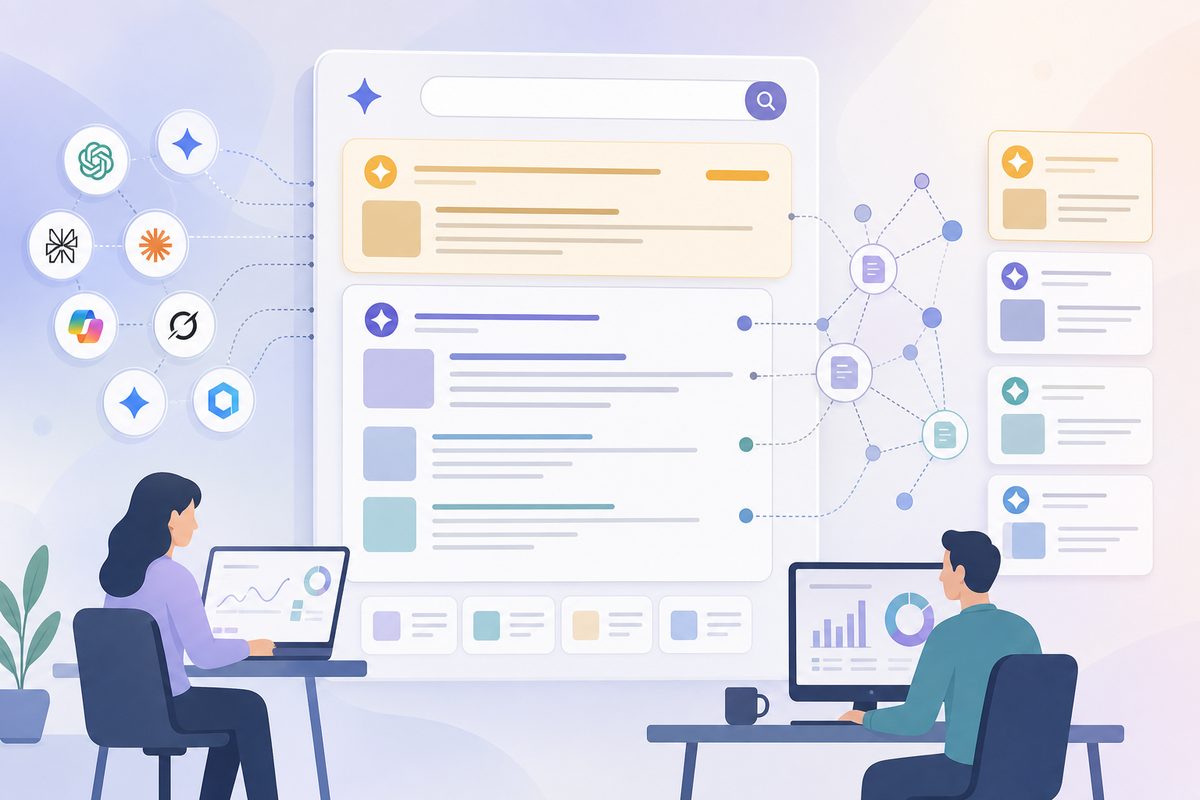
AI search ads are sponsored placements served in AI-powered search results or assistant-style answers. They may appear as labeled ads in AI Overviews, integrated units in AI Mode, sponsored product cards, offers, checkout prompts, or paid follow-up suggestions.
The key distinction is simple:
| Signal | Paid or Earned? | What It Means |
|---|---|---|
| AI search ad | Paid | A platform inserted a sponsored unit or offer |
| AI citation | Earned | The answer links to a source as supporting evidence |
| Brand mention | Usually earned, sometimes paid context | The brand appears in the answer text |
| Recommendation | Usually earned, but must be checked | The answer explicitly suggests a brand, product, or next step |
A classic search ad sits above or below organic results. A sponsored AI answer can appear closer to the decision itself: inside a generated summary, beside a comparison, below an assistant response, or at the moment a user is ready to buy.
That closeness creates the opportunity and the risk. AI search ads can reach high-intent users, but they can also make reporting muddy if teams do not separate paid exposure from earned visibility.
Are AI Search Ads Live in 2026?
Yes, but availability depends on the platform and surface. As of July 3, 2026, the clearest public rollout is in Google Search.
Google announced in May 2025 that Search and Shopping ads in AI Overviews were expanding to desktop in the U.S. and that ads were starting to be tested in AI Mode. Google also said advertisers using Performance Max, Shopping, and Search campaigns with broad match, including AI Max for Search campaigns, could be eligible for those surfaces. See Google's announcement on AI ads in Search, AI Overviews, and AI Mode.
The buying model is important. This is not yet a clean "pay to own the AI answer" channel. In a January 2026 interview, Google's VP of global ads told Business Insider that advertisers could not separately choose AI Mode or AI Overviews as a standalone placement at that phase; Google's systems decide eligibility through existing campaign signals such as targeting, topics, and keywords. Business Insider also reported limited testing of Direct Offers for shoppers closer to purchase.
For marketers, that means AI search advertising is currently less like buying a fixed SERP position and more like making existing campaigns eligible for AI-powered moments.
Where Can AI Search Ads Appear?
AI search ads can show up in several formats. The format matters because each one affects organic visibility differently.
| Format | What Users See | Organic Visibility Risk | What to Track |
|---|---|---|---|
| AI Overview ad | Sponsored unit near an AI summary | Medium | Whether cited sources still get visibility |
| AI Mode ad | Ad below or integrated into a conversational response | High for commercial prompts | Whether the ad appears before neutral evaluation |
| Sponsored product card | Labeled product or offer near a buying answer | Medium | Product visibility, merchant data, and citation support |
| Direct offer or discount | Promotion shown near purchase intent | High for ecommerce | Whether the user skipped comparison research |
| Sponsored follow-up prompt | Paid next question or suggested path | Medium | Whether it changes the next prompt users ask |
| Organic AI citation | Unpaid source link supporting an answer | Opportunity | Citation position, source quality, and answer wording |
For users searching "AI search ads," the most important takeaway is that these are not one format. They are a family of sponsored answer surfaces, and each one needs separate measurement.
Do AI Search Ads Replace AI Citations?
No. AI search ads do not replace AI citations because they serve different jobs. A sponsored unit buys attention. A citation supplies evidence. A brand can have an ad without being cited, be cited without an ad, or appear in both paid and earned layers in the same experience.
Google's Search Central documentation says AI Overviews and AI Mode surface links from Google Search systems and may use "query fan-out" across subtopics and data sources. It also says there are no special technical requirements beyond being indexed, eligible for Google Search with a snippet, and compliant with Search policies. See Google's documentation on AI features and your website.
That means the organic layer still matters. It is just competing inside a denser answer interface.
How Sponsored AI Answers Change Organic Visibility
Sponsored AI answers make visibility harder to interpret. A brand can look present because it bought an ad while still being absent from the answer's evidence layer.
Recent research shows why this matters. A 2026 arXiv study of 55,393 Google AI Overview queries found AI Overview activation of 13.7% overall and 64.7% for question-form queries. It also found that nearly 30% of AI Overview-cited domains did not appear in the co-displayed first-page organic results.
Another 2026 benchmark of 11,500 real-user queries reported that AI Overviews appeared for 51.5% of representative queries and that source overlap between Google Search, AI Overviews, and Gemini was low, with average Jaccard similarity below 0.2.
The implication is clear: AI citations are not just classic rankings with a new label. A page can rank and fail to be cited. A source can be cited without ranking in the visible top organic results. A brand can be mentioned without a link. AI search ads add a paid layer on top of that already-shifting source selection.
For a deeper explanation of the earned layer, see maxaeo's guide to AI search citations.
The Paid-vs-Earned Answer Ledger
A paid-vs-earned answer ledger is a prompt-level record that separates sponsored placement, unpaid brand mention, citation source, answer sentiment, and likely user next step. It prevents teams from mistaking paid distribution for earned recommendation power.
Use one row per prompt, platform, date, and location. The core fields should look like this:
| Ledger Field | Question It Answers | Example Value |
|---|---|---|
| Prompt group | What intent was tested? | Category, comparison, pricing, risk, implementation |
| Ad presence | Did a sponsored unit appear? | Yes, no, unknown |
| Brand mention | Did the brand appear in the answer text? | No mention, neutral mention, recommended |
| Citation status | Was a source cited? | Owned page, third-party page, competitor source, none |
| Citation quality | Does the cited page support the claim? | Strong, partial, stale, mismatched |
| Competitor context | Who appeared in the same answer? | Competitor A first, competitor B cited |
| Sentiment | How was the brand framed? | Positive, neutral, qualified, negative |
| Next step | What did the answer push the user to do? | Compare, click, buy, ask follow-up, visit source |
Three metrics are especially useful:
- Earned answer coverage: the percentage of tracked prompts where the brand appears through an unpaid mention or citation.
- Organic citation share: the percentage of prompts where owned or earned third-party sources are cited without paid placement.
- Sponsored displacement rate: the percentage of prompts where a sponsored unit appears while the brand is absent from unpaid citations.
The sponsored displacement rate is the metric most teams miss. It shows where paid media is masking an organic AI visibility problem.
Worked Example: The B2B SaaS Shortlist Problem
Consider a cloud cost management startup tracking 40 prompts across ChatGPT, Gemini, Perplexity, Claude, Copilot, Google AI Mode, and AI Overviews. The company wants to appear for prompts like "best FinOps tools for Kubernetes teams" and "how to reduce cloud waste in Kubernetes."
This example is illustrative, not an industry benchmark. The point is the classification method.
| Prompt Type | Example Prompt | Observed Answer Pattern | Best Action |
|---|---|---|---|
| Category discovery | "Best cloud cost tools for Kubernetes SaaS teams" | Incumbents listed; startup absent | Build category proof and comparison pages |
| Pain-led research | "How do I reduce Kubernetes cloud waste?" | Educational answer cites docs and engineering blogs | Publish benchmarks, architecture diagrams, and remediation steps |
| Vendor comparison | "Tool A vs Tool B for FinOps" | Two incumbents compared; startup absent | Create neutral alternatives content with evidence |
| Risk evaluation | "Cloud cost tools for SOC 2 SaaS companies" | Security caveats drive the answer | Add compliance docs, implementation notes, and customer proof |
| Commercial query | "Discount cloud cost management software" | Sponsored offer appears | Test paid only after organic gaps are mapped |
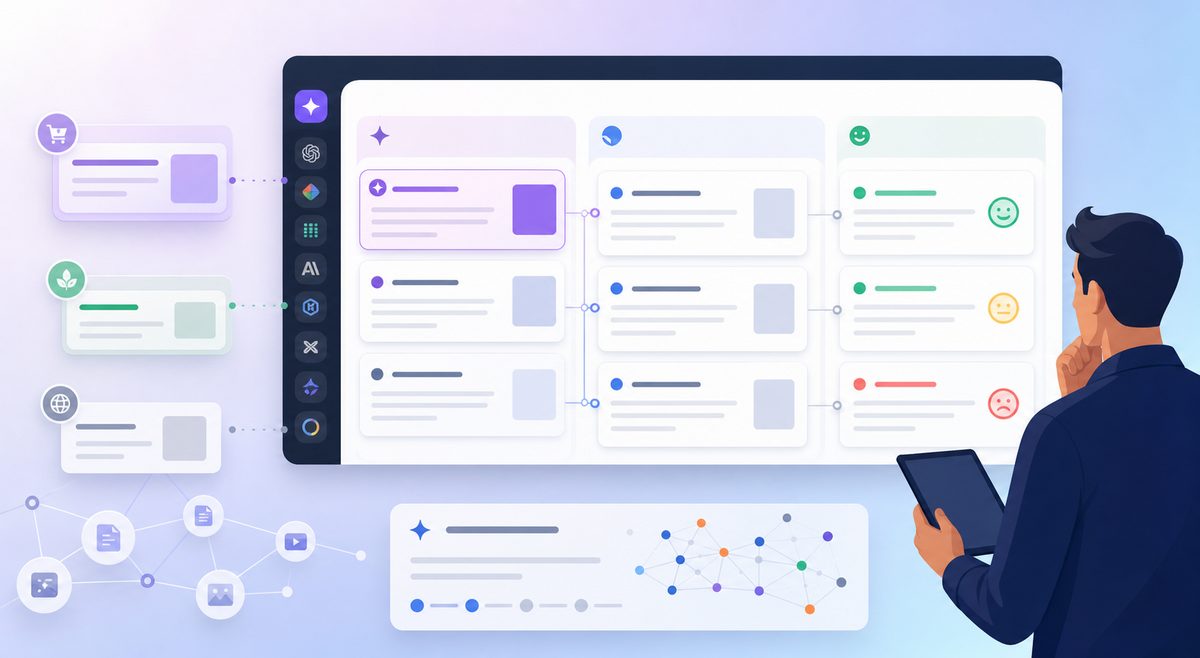
The wrong conclusion is "competitors appear, so buy AI search ads." The better conclusion is more specific: buy ads only where paid placement reaches commercial intent, while SEO, content, and PR fix the neutral prompts that create the shortlist in the first place.
What Should Brands Fix Before Buying AI Search Ads?
Brands should fix earned AI visibility before scaling AI search ads. Paid placement can amplify demand, but it cannot reliably correct weak citations, outdated product descriptions, missing comparison content, or poor third-party validation.
Use this checklist before shifting budget:
- Build a prompt set by intent. Include category, comparison, alternatives, pricing, risk, implementation, integration, and reputation prompts. Start with maxaeo's guide to creating a prompt set for AI brand monitoring.
- Map answer surfaces separately. Track Google AI Overviews, AI Mode, ChatGPT, Perplexity, Gemini, Claude, Copilot, and other relevant assistants as separate channels.
- Separate mention from citation. A brand mention without a source is weaker than a cited claim users can verify.
- Create non-commodity evidence. Publish benchmarks, screenshots, implementation notes, migration examples, pricing explanations, and comparison tables.
- Strengthen third-party corroboration. AI systems often draw from reviews, analyst pages, documentation, partner pages, community discussions, and media coverage.
- Monitor description drift. If assistants describe the product incorrectly, paid exposure may scale the wrong message.
- Run incrementality tests. Measure whether paid AI exposure changes answer inclusion, clicks, pipeline, or only impressions.
Google's generative AI search optimization guide emphasizes unique, useful, non-commodity content and warns against creating pages for every possible query variation just to influence generative AI responses.
The SEO playbook is therefore narrower and stronger: fewer shallow pages, more defensible evidence.
How Should SEO, PR, Content, and Paid Teams Divide the Work?
SEO should own crawlable evidence. PR should own third-party trust signals. Content should own answer completeness. Paid media should own commercial reach and incrementality.
| Team | Owns | AI Visibility Job |
|---|---|---|
| SEO | Crawlability, indexing, internal links, structured content | Make evidence accessible and easy to cite |
| Content | Education, comparisons, alternatives, implementation answers | Answer the prompts buyers actually ask |
| PR/comms | External validation, reputation, expert commentary | Improve how credible third parties describe the brand |
| Paid media | Campaigns, offers, audience testing, incrementality | Test sponsored exposure without hiding organic gaps |
| Product marketing | Positioning, claims, proof, competitive framing | Keep answer-ready claims specific and current |
| RevOps | Attribution, CRM fields, pipeline reporting | Connect AI visibility signals to revenue outcomes |
The teams should share one prompt ledger. Otherwise paid media may celebrate exposure that SEO sees as displacement, while content misses the evidence gaps that caused the brand to be excluded from unpaid answers.
What Paid Media Teams Should Demand From AI Ad Platforms
Paid media teams should demand transparent reporting before moving serious budget into AI answer surfaces. Impressions and clicks are not enough.
Ask platforms and vendors for:
- Surface reporting: Was the ad in AI Overview, AI Mode, shopping, assistant chat, or standard search?
- Label reporting: How was the sponsored unit disclosed to users?
- Prompt or query class: Was the ad triggered by category research, comparison, pricing, or purchase intent?
- Organic separation: Did the brand also appear as an unpaid mention or citation?
- Competitor context: Which competitors appeared in the same answer?
- Answer sentiment: Did the surrounding answer recommend, qualify, or criticize the brand?
- Source visibility: Which URLs were cited above, near, or after the sponsored unit?
- Incrementality: Did the ad create new conversions or capture demand the brand already owned?
Disclosure is not just a platform preference. The FTC's guide to native advertising says advertising can be deceptive when consumers are misled about the commercial nature of content, and that necessary disclosures must be clear and prominent.
AI answer interfaces make this more important because the ad can appear inside a trusted explanatory flow.
How to Track AI Search Ads Without Overreacting
Track AI search ads with a stable prompt set, repeated snapshots, and separate fields for paid placement, unpaid mention, citation, rank, sentiment, source URL, and next-step recommendation. Do not react to one answer. React to repeated patterns across prompts, platforms, and time.
A reliable workflow has five steps:
- Define prompt groups. Use category, problem, comparison, alternatives, pricing, implementation, and reputation prompts.
- Capture the full answer. Store answer text, source links, cited URLs, screenshots, and whether a sponsored unit appeared.
- Classify brand presence. Mark no mention, neutral mention, recommended, top-ranked, cited, or negatively described.
- Compare competitors. Track who appears more often and which sources support them.
- Tie fixes to outcomes. Log content updates, PR wins, review changes, documentation updates, and paid campaign changes.
The dashboard should make one thing obvious: whether paid visibility is compensating for an organic weakness or adding reach on top of a strong earned position.
For measurement stack selection, compare the fields in maxaeo's review of tools to track brand visibility in AI search.
Budget Implications for B2B SaaS and Tech Brands
The budget implication is not "move SEO money to AI ads." It is "stop treating paid search, SEO, PR, and AI visibility as separate dashboards."
| Situation | Better Budget Move |
|---|---|
| Strong organic citations, weak commercial conversion | Test sponsored offers on high-intent prompts |
| Strong rankings, weak AI mentions | Fund AI citation and entity work before more media |
| Frequent mentions, poor sentiment | Fund PR, review response, and content correction |
| Competitors appear in shortlists, brand absent | Build comparison, alternatives, and proof content |
| Ads appear but no organic support | Treat paid as temporary coverage, not a moat |
| Brand cited from stale sources | Update owned pages and earn fresher third-party corroboration |
| Paid clicks rise while pipeline is flat | Audit incrementality and query class, not just CTR |
For founders, the useful question is not "How do we get recommended by ChatGPT?" The sharper question is: Which buying prompts exclude us, which sources caused that exclusion, and which fixes changed the answer?
For companies at different maturity levels, maxaeo's guide to AI search visibility by company stage gives a practical way to prioritize from zero citations to category leadership.
What This Means for Organic Strategy
Organic strategy has to move from page ranking to answer eligibility. A page should not only target a keyword. It should provide a clear claim, proof, source clarity, and a reason for an AI system to cite it.
The most useful organic assets in a sponsored-answer world are:
- Original benchmark pages with methodology
- Comparison pages that acknowledge tradeoffs
- Customer stories with specific use cases
- Integration docs that answer implementation questions
- Pricing and packaging explanations that reduce ambiguity
- Independent reviews, community proof, and analyst validation
- Screenshots, charts, and diagrams with descriptive alt text
- Product documentation that resolves risk, security, and implementation questions
This is the opposite of scaled commodity content. It is product marketing, technical SEO, research, and PR working from the same evidence map.
Frequently Asked Questions
Will AI search ads replace SEO?
No. AI search ads may reduce some organic clicks and create new paid surfaces, but they do not replace the need for crawlable, trustworthy, cited evidence. AI answers still depend on sources, links, entity understanding, and content quality.
Can a brand pay to appear in ChatGPT recommendations?
Brands should not assume there is a universal "pay to be recommended" option across AI assistants. Ad formats, shopping integrations, and commercial placements vary by platform. Organic recommendations still depend on source quality, retrieval, user context, product evidence, and platform rules.
Are AI search ads the same as AI citations?
No. An AI search ad is paid exposure. An AI citation is a source link or referenced page used to support an answer. Reporting should separate ads, mentions, citations, sentiment, and answer position.
Do AI search ads affect organic rankings?
There is no public evidence that buying AI search ads directly improves organic rankings or AI citations. Paid exposure may increase brand interactions and demand, but earned visibility still requires crawlable content, credible sources, and strong evidence.
What should B2B SaaS teams measure first?
Start with AI share of voice, citation share, shortlist rank, answer sentiment, competitor presence, and source quality across buying prompts. Add sponsored displacement rate once ads appear in the tracked surface.
Should startups buy AI search ads early?
Startups should test AI search ads only after mapping organic gaps. If the brand is absent from neutral category and comparison prompts, fix evidence and citations first. If the brand is already cited but loses late-stage commercial prompts, sponsored offers may be worth testing.
Bottom Line
AI search ads are becoming part of AI-powered discovery, especially for commercial, shopping, and high-intent research journeys. They will not make organic visibility obsolete. They will make weak measurement expensive.
The durable advantage is knowing, prompt by prompt, whether a brand is visible because it paid for placement, earned a citation, appeared in the answer text, or was trusted by the sources the model used. That is the difference between buying attention and building recommendation power.