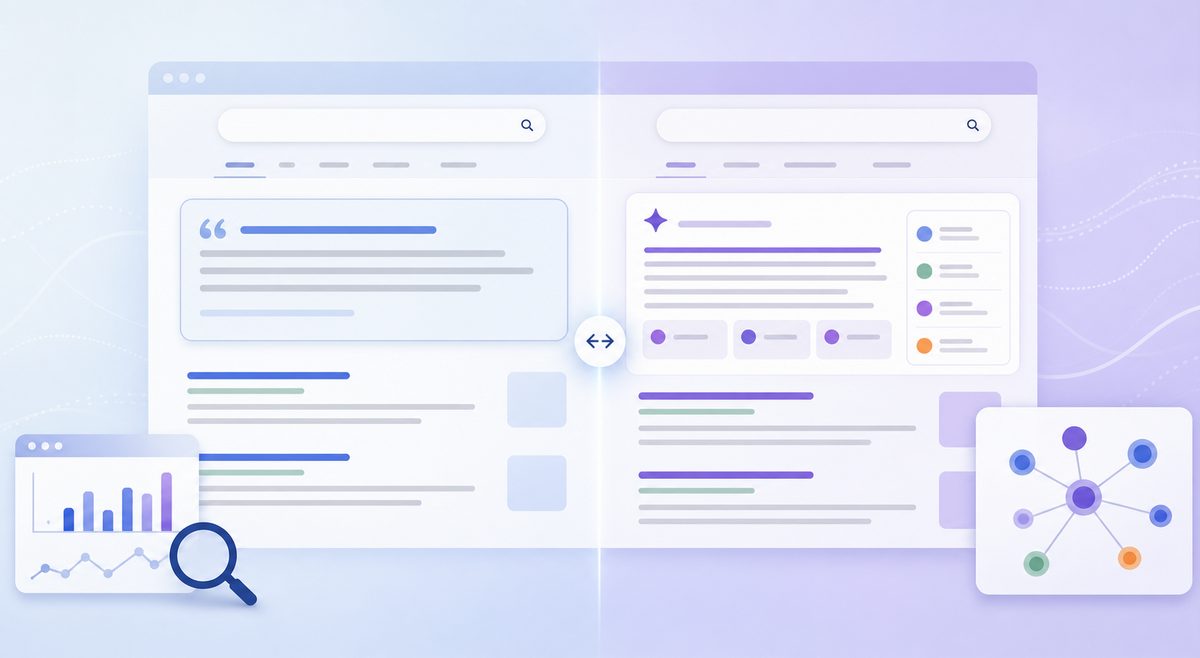
AI Overviews vs featured snippets is no longer a contest for the same slot. A featured snippet quotes one page word-for-word inside a box and sends the click to that page. An AI Overview writes a new paragraph from many pages, then links to a panel of sources beside it. That single move—from extraction to synthesis—rewired how Google selects, credits, and displays the content that used to own position zero. If you built a program around snippet capture, the mechanics you optimized for shifted underneath you. This guide is the tactical migration: what changed at the extraction, sourcing, and synthesis layers, backed by 2025–2026 tracking data, plus a step-by-step plan to carry your old wins into AI answers.
The short version: a side-by-side comparison
Here is the difference in one screen. This table is the fastest way to see why your snippet playbook needs a rebuild, not a tune-up.
| Dimension | Featured snippet | AI Overview |
|---|---|---|
| Introduced | 2014 | May 2024 (rebranded from SGE) |
| How the answer is built | Extracts a verbatim passage | Synthesizes a new answer with generative AI (Gemini) |
| Sources shown | One page | A panel—averaging ~13 |
| Typical length | ~40–60 words | ~250 words |
| Who gets credit | The single quoted page | Several domains at once |
| Your control over wording | High (it's your text) | Low (Google paraphrases) |
| Click destination | That one page | Optional, spread across sources |
The headline: featured snippets rewarded being the single best-extracted answer. AI Overviews reward being one of several trusted, corroborating sources. Everything below explains what that means for your content.
What is a featured snippet?
A featured snippet is a block of text Google pulls verbatim from one ranking page and displays above the standard blue links—the spot long called "position zero." One page is quoted, keeps its own wording and link, and receives the click. Google first showed featured snippets in 2014.
The mechanics are simple and stable. Google identifies a query with a clear informational answer, finds a page that already answers it cleanly, and lifts a paragraph, list, or table straight from that page. Optimization was equally direct: match the question, answer it in 40–60 words right under a matching heading, and out-structure the competition. One page won; one page got the traffic.
What is an AI Overview?
An AI Overview is a Google-generated answer, built by its Gemini models, that synthesizes information from multiple pages and cites them in a side panel. Instead of quoting one source, it reads the top results, extracts facts from several, resolves conflicts by leaning on more authoritative pages, and writes an original summary in a neutral voice. Google launched AI Overviews in May 2024, rebranding the earlier Search Generative Experience, and expanded them aggressively through 2025.
This is retrieval-augmented generation, not extraction. SE Ranking's analysis puts the average AI Overview near 250 words and citing ~13 sources—versus a snippet's single link. So the unit of victory changed. You are no longer trying to be the answer; you are trying to be one of the pages the answer is assembled from. That is the core of modern answer engine optimization.
AI Overviews vs featured snippets: what actually changed
The real change is the pipeline, not the pixels. A featured snippet is a retrieval feature: find the best passage, show it. An AI Overview is a retrieval-plus-generation feature: find several passages, then write something new from them. That distinction sounds academic until you trace what it does to selection, credit, and clicks.
Three things flipped at once:
- Selection went from "one winner" to "a shortlist of corroborating sources."
- Credit went from a single link to a distributed source panel—so visibility is now a share you hold, not a spot you own.
- Wording went from your exact sentence to Google's paraphrase—so your phrasing matters less and your facts, structure, and authority matter more.
Teams that treated the launch as a cosmetic SERP change kept optimizing for extraction alone—and watched their old position-zero pages get absorbed into answers they no longer controlled.
The data: how fast position zero gave way
The transition was abrupt, not gradual. Per Ahrefs' analysis, "Goodbye, Featured Snippets," featured snippets fell from about 18% of searches in January 2025 to roughly 8% by June 2025—an 83% replacement rate in eight months. The decline tracked AI Overview growth with a correlation near 0.9, and the crossover lands on Google's March 2025 core update, when AI Overviews jumped 116% in a single month. This was reallocation, not drift.
The click impact followed. Seer Interactive's CTR study found organic click-through rate on AI Overview queries fell about 61%—from 1.76% in June 2024 to 0.61% by September 2025. Meanwhile coverage kept climbing: Google says AI Overviews now appear on roughly half of US queries, with independent trackers ranging from ~21% to ~60% depending on dataset and vertical.
But volume is only half the story. In the same Seer dataset, brands cited inside an AI Overview earned 35% more organic clicks (and 91% more paid clicks) than uncited brands on those queries. Being the cited source is what protects the click. That reframes the goal from "recover lost sessions" to "be the source the AI names and the higher-intent user trusts." If you're modeling the traffic side, our measurement playbook for AI Overview click loss separates AIO cannibalization from ordinary ranking drops.
Three mechanics that broke the old snippet playbook
Your featured-snippet playbook optimized for one page, one box, one link. AI Overviews changed the three mechanics underneath it: extraction, sourcing, and synthesis. Here is what each now demands.
Extraction: from one verbatim box to passage-level pulls
Featured snippets extracted a whole, clean block—so you optimized whole blocks. AI Overviews extract passages: individual claims, definitions, stats, and steps that can be lifted out of context and recombined. Self-contained sentences beat flowing prose.
The practical rule: every important claim should survive being copy-pasted alone. State the answer first, keep sentences to roughly 15–20 words, and attach a concrete number or date to each key point—data-backed passages get cited more often than purely conceptual ones, because each figure is a verifiable hook. Our guide to extractable AEO content structure breaks this into a repeatable pattern.
Sourcing: from one winner to a source panel and share of voice
This is the biggest shift. A snippet had exactly one winner; an AI Overview names several, so visibility becomes a share of a citation panel rather than a single owned slot. Being "the best page" is no longer enough—you have to be one of the few that agree, corroborate, and carry authority on the topic.
Off-page evidence and topical depth now decide inclusion. Ahrefs found only about 38% of AI Overview citations come from pages ranking in the top 10—so the majority are pulled from further down, or off page one entirely. Ranking well raises your odds, but selection leans just as hard on E-E-A-T signals: authorship, external corroboration, freshness, and consistent entity mentions across the web. Because the answer draws on multiple domains, your goal becomes maximizing AI share of voice—how often you appear across the sources, not whether you "won."
Synthesis: from your words to Google's paraphrase
Snippets showed your sentence. AI Overviews rewrite the answer, so your exact phrasing rarely survives—but your facts, framing, and distinctions can. If your content introduces a clear definition or a memorable framework, the model can carry that idea into its paraphrase even when it drops your wording.
The tactic changes accordingly. Stop chasing the perfect quotable sentence and start owning the concepts an answer must include: name the categories, define the terms, and supply the numbers a synthesized answer can't credibly omit. When the model has to explain your topic, you want your framing to be the one it reaches for. This is where generative engine optimization diverges hardest from classic snippet chasing.
The migration playbook: carrying snippet wins into AI answers
Here is the step-by-step migration for a team that already owns featured snippets and wants those pages cited in AI Overviews. Work it in order—each step builds on the last.
- Inventory your snippet pages. Pull every query where you hold (or recently held) a featured snippet. These are your highest-probability AI Overview candidates, because pages that won snippets are disproportionately cited in AI answers.
- Re-cut answers into standalone passages. Under each question heading, lead with a 40–60 word direct answer, then break supporting points into short, self-contained sentences that each carry a fact or number.
- Add proof the model can't ignore. Attach specific data, dates, and named sources to every claim. Convert vague statements into verifiable ones—each becomes a citation hook.
- Build corroboration off-site. Earn mentions, references, and consistent entity signals elsewhere so independent sources agree with you. AI answers favor brands the wider web already validates.
- Cover the whole question, not one keyword. Add the adjacent sub-questions, comparisons, and edge cases a synthesized answer needs, so you're eligible across the panel, not just the headline query.
- Track citations, not just rankings. Monitor whether AI answers actually mention and link you—by query, by engine, over time—then fix the pages that get skipped.
Steps 1–3 protect your extraction. Steps 4–5 win the sourcing game. Step 6 is how you know it worked.
A worked example from the tracking data
Here is a pattern we see repeatedly across the accounts monitored on our platform—directional, but consistent enough to plan around.
A B2B SaaS blog owned featured snippets for a cluster of "how to" and "what is" queries. When AI Overviews rolled into those queries, the snippets vanished and organic clicks on the cluster fell sharply—the familiar CTR story. But the picture split in two. On pages where the answer was a single flowing paragraph, the brand disappeared from the AI Overview entirely; the answer was synthesized from competitors. On pages already written as short, claim-plus-proof passages, the same brand kept showing up in the source panel—sometimes as one of two or three cited domains.
The lesson wasn't "AI killed our traffic." It was that extraction-ready pages migrated into AI answers, and prose-heavy pages didn't. After re-cutting the prose pages into passages and adding corroborating data, citations returned on several queries within a few weeks—consistent with the typical edit-to-citation lag we observe. The pages that had done the "boring" structural work survived the transition; the ones that relied on a single quotable box did not.
How to measure the shift (and prove it)
Rankings alone won't show you this migration, because the thing you now compete for—inclusion in a synthesized answer—doesn't have a rank. You need three measurements the old snippet dashboards never tracked:
- Citation presence. For your priority queries, does the AI Overview mention or link you at all?
- Share of voice. Of the sources shown, how often is one of them you versus a competitor?
- Description accuracy. When AI answers describe your category, do they use your framing—or someone else's?
This is the gap an AI search monitoring tool fills: watching daily how ChatGPT, Gemini, Perplexity, Google AI Mode, and AI Overviews mention and rank your brand, then flagging the pages to fix. Snippet tracking told you if you owned a box. AI visibility tracking tells you whether you're getting recommended—and by which engine.
What stays the same (don't over-rebuild)
Not everything flipped, and panic wastes budget. The foundations that won you snippets still matter for AI answers: rank on page one, answer the actual question first, and structure content so it's easy to scan.
But ranking is table stakes, not a trophy. With only ~38% of AIO citations coming from top-10 pages, a #1 ranking no longer guarantees the citation—classic SEO gets you eligible; structure and corroboration get you picked. The clean question-and-answer format you already use for snippets is the same format AI systems parse best, so your featured-snippet work is a head start, not wasted effort. Treat the two as complementary goals with shared tactics, not rivals. You're extending the playbook from "be the one quoted page" to "be one of the trusted, corroborated sources."
Common mistakes teams make in the transition
The predictable errors are easy to avoid once named. Watch for these four.
- Measuring only sessions. Judge success by total organic clicks and 2026 reads as pure decline. Weight conversions and citation share, and the same period often reads as a rebalance toward higher-intent traffic.
- Optimizing wording, ignoring facts. Perfecting a quotable sentence is a snippet reflex. AI paraphrases—so invest in verifiable data and clear framing instead.
- Chasing one query's box. AI Overviews draw on whole topics. Thin, single-keyword pages get skipped in favor of comprehensive sources.
- Ignoring off-site corroboration. On-page perfection can't overcome a web that doesn't mention you. AI recommends brands independent sources already agree on—so off-site signals belong in the plan.
Frequently asked questions
Are featured snippets going away completely?
No, but they're shrinking fast. Featured snippets fell from about 18% of searches in January 2025 to roughly 8% by June 2025 as AI Overviews expanded, per Ahrefs. They persist on query types where AI Overviews don't yet appear reliably, so they remain worth winning—especially because snippet-winning pages are disproportionately cited in AI answers.
Is optimizing for featured snippets still worth it in 2026?
Yes. Featured snippet optimization is now the highest-use on-ramp to AI Overview citation, because the same signals—top rankings, direct answers, clean structure—feed both. Pages that won snippets are among the most likely to appear as AI Overview sources, so the work compounds rather than competing with AEO.
How is an AI Overview different from a featured snippet, in one sentence?
A featured snippet quotes one page verbatim and links to it, while an AI Overview synthesizes a new answer from several pages and cites a panel of sources. The practical difference: snippets reward being the single best extract; AI Overviews reward being one of several trusted, corroborating sources.
How do I know if AI Overviews are citing my brand?
Rankings won't tell you—synthesized answers have no rank. You need AI search monitoring that checks, per query and per engine, whether the answer mentions or links you, how your share of the source panel compares to competitors, and whether your framing is described accurately over time.
Does the same playbook work for ChatGPT and Perplexity?
Largely, with tuning. The extraction-and-corroboration principles transfer across answer engines, but each weights sources differently—Perplexity leans on the live web, for example. Winning citations in Perplexity's answers and in Google AI Mode requires tracking each engine separately rather than assuming one score covers all.