Author: maxaeo
If your problem is “AI confuses my brand with another company,” treat it as an entity-disambiguation incident. Preserve the wrong answers, identify which facts crossed between the companies, trace the supporting sources, correct the highest-impact conflicts, and retest the same prompts. Changing random pages before collecting evidence makes the cause harder to isolate.
The mistake may originate on your website, a business directory, an outdated profile, a search result, or the answer engine itself. The objective is therefore not to publish more content. It is to establish a clear, consistently corroborated identity that retrieval and answer systems can distinguish from the other company.
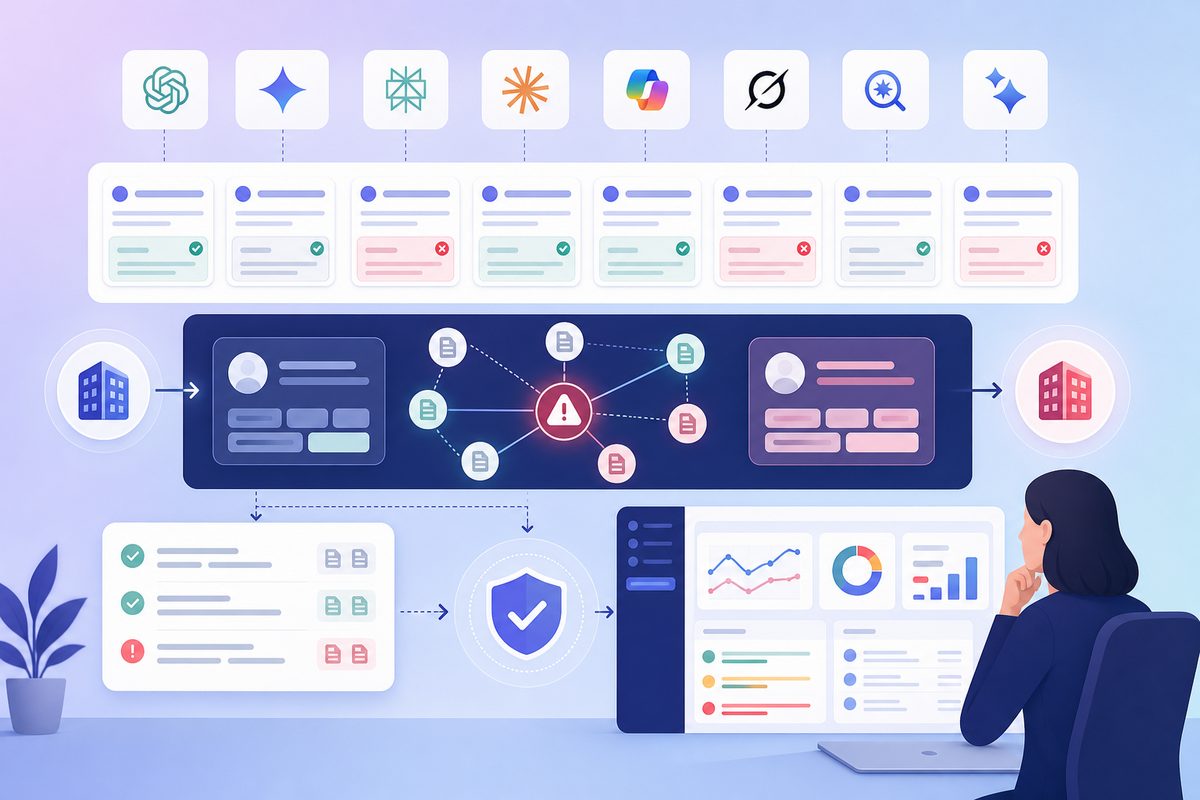
What should I do first when AI confuses my brand with another company?
Follow these five steps before considering a rename or a large content project:
- Capture the failure. Save the exact prompt, answer, engine, model or mode, date, citations, location, language, and account state.
- Classify the mistake. Determine whether the AI substituted the other company, blended attributes, invented a relationship, used stale information, or cited the wrong entity.
- Test disambiguating qualifiers. Add your category, location, founder, product, or domain one at a time.
- Trace the evidence. Inspect cited pages and search for the wrong claims across directories, profiles, articles, databases, PDFs, and archived pages.
- Correct and verify. Align the canonical company page, structured data, official profiles, and influential third-party sources; then rerun the original test.
A qualifier that immediately corrects the answer is useful evidence. It shows which identity attribute the unqualified brand name is missing.
What is an AI brand identity collision?
An AI brand identity collision is a repeatable error in which an answer system resolves a company name to the wrong organization or blends facts from two entities. Unlike a one-off unsupported statement, the mistake usually has a stable signature: the same rival, attribute, source, or qualifying phrase appears across multiple answers.
For a deeper treatment of same-name and similar-name entities, see the brand-name collision disambiguation playbook.
Identity collisions usually appear in five forms:
| Failure type | What the answer does | Example |
|---|---|---|
| Entity substitution | Selects the other company as the primary entity | Describes a laboratory when the user meant a software company |
| Attribute contamination | Uses your name but imports a rival’s facts | Assigns the rival’s location, founder, category, or product to you |
| Relationship invention | Connects two unrelated organizations | Calls them affiliates, former names, or subsidiaries |
| Temporal contamination | Mixes current and historical identities | Treats a rebrand as two separate companies or applies an old business model |
| Citation mismatch | Gives a correct or partly correct answer with an irrelevant citation | Links your name to a page that is entirely about the other business |
This classification determines the fix. A wrong directory association requires source correction; an unclear homepage requires stronger identity copy; a broken rebrand requires continuity signals. None is solved reliably by repeating the brand name across generic blog posts.
Why do AI systems merge similarly named companies?
AI systems confuse brands when the evidence available to them does not establish a stable identity boundary. The shared name creates ambiguity, but inconsistent categories, URLs, locations, people, aliases, and third-party profiles usually determine whether the collision persists.
Depending on the product and mode, an answer may combine information learned during training with live search or retrieval. Errors can enter at several stages:
- Retrieval: The system finds pages about the more prominent or better-documented company.
- Entity resolution: It treats two organizations as one entity or selects the wrong entity for an ambiguous name.
- Synthesis: It retrieves both companies correctly but combines their attributes in the final answer.
- Staleness: It relies on an old name, address, owner, domain, or business description.
- Source propagation: Multiple directories repeat the same incorrect record, making one mistake appear corroborated.
Use this table to connect the observed signal to the most likely investigation:
| Collision signal | Diagnostic test | Likely corrective focus |
|---|---|---|
| Same or nearly identical names | Add category, location, and domain separately | Strengthen the missing distinguishing attribute |
| Homepage uses only slogans | Ask “What is [Brand]?” and inspect the retrieved page | Add a plain company definition |
| Official profiles disagree | Compare name, URL, category, and location field by field | Reconcile owned profiles |
| One directory appears repeatedly | Search the wrong fact together with the brand name | Correct or supersede the directory record |
| Former and current names are disconnected | Query both names and ask whether they are related | Document rebrand continuity |
| Two companies share a founder or product term | Test the shared attribute against each domain | Clarify corporate relationships and ownership |
| Wrong answers occur only without a qualifier | Compare qualified and unqualified accuracy | Improve bare-name entity evidence |
| Answers vary randomly with no stable rival | Repeat the test under controlled conditions | Investigate general answer variance or hallucination |
If the company is absent rather than confused with a specific entity, use a visibility diagnosis instead. The causes and remedies are different from those covered in why a brand may be invisible on ChatGPT.
Is this a hallucination or an entity-disambiguation failure?
A hallucination is an unsupported claim that may vary unpredictably. An entity-disambiguation failure is a recurring identity error in which the same company, attribute, relationship, or source is selected across comparable tests.
| Observed pattern | More likely diagnosis | First action |
|---|---|---|
| The same rival is selected repeatedly | Full entity substitution | Compare identity attributes and retrieved sources |
| Your name appears with the rival’s products or location | Attribute contamination | Locate the source carrying the imported attribute |
| A category or domain qualifier fixes the answer | Ambiguous name resolution | Strengthen unqualified brand evidence |
| A former name is treated as an unrelated company | Entity continuity failure | Connect historical and current identities |
| Different unsupported facts appear on every run | General hallucination or high variance | Increase the sample before editing the site |
| Several systems reuse the same incorrect page | Source-driven collision | Prioritize correction of that source |
| The answer is correct but cites the rival | Citation mismatch | Report the citation and improve supporting source clarity |
Do not classify the problem from one screenshot. A repeatable pattern is what distinguishes an identity collision from ordinary output variability.
How to audit an AI brand collision
1. Create a canonical identity record
Before testing AI answers, document the facts your organization can verify. This prevents the audit team from treating marketing preferences as factual errors.
Include:
- Official display name and legal name
- Canonical domain and preferred homepage URL
- Approved abbreviations, aliases, and former names
- One-sentence category definition
- Primary products or services
- Intended audience
- Headquarters and operating markets
- Founders and current key executives
- Founding year, if publicly verified
- Official social and business profiles
- Parent, subsidiary, or acquisition relationships
- Similarly named companies with no affiliation
- Evidence URL and last-verified date for every critical fact
A useful category definition is specific and factual:
maxaeo is an AI search visibility platform for monitoring how answer engines mention, describe, cite, and recommend brands.
Avoid superlatives such as “leading,” “best,” or “revolutionary” in the canonical definition. They do not help distinguish the entity.
2. Run an ambiguity-controlled prompt set
Test bare-name, attribute, qualifier, and relationship prompts:
Bare-name prompts
[Brand]What is [Brand]?What does [Brand] do?
Attribute prompts
Where is [Brand] based?Who founded [Brand]?What products does [Brand] offer?Who is [Brand] for?
Qualifier prompts
[Brand] + category[Brand] + location[Brand] + founder[Brand] + canonical domain
Relationship prompts
Is [Brand A] related to [Brand B]?What is the difference between [Brand A] and [Brand B]?Compare [Brand A] and [Brand B].
For a practical baseline, run each priority prompt three times per answer engine. This is an operational sample, not statistical proof. Keep language, geography, model or mode, session state, and wording consistent. Then repeat a smaller set in a clean session to check whether personalization changes the result.
3. Record claim-level evidence
A screenshot proves that an error happened. A claim-level log reveals why it happened.
| Field | Example |
|---|---|
| Engine and mode | Answer engine, standard web-enabled mode |
| Date and location | 2026-07-14, United States |
| Exact prompt | “What is Northstar Labs?” |
| Primary entity selected | Northstar Laboratory Services |
| Wrong claim | “Food-testing company based in Austin” |
| Correct claim | “Security workflow software company based in Boston” |
| Citation supporting the error | Business directory URL |
| Qualifier tested | “Northstar Labs security software” |
| Qualified result | Correct entity |
| Evidence file | Screenshot and exported answer ID |
Review citations at the claim level. A source displayed beneath an answer may support only one sentence, not every fact in the response.
For uncited claims, search combinations such as:
"[Brand]" "[wrong category]""[Brand]" "[wrong location]""[Brand]" "[rival founder]""[Brand]" "[rival domain]""[Brand A]" "[Brand B]"site:directory-domain.example "[Brand]"
Also inspect branded search results, official profiles, software or business directories, press pages, PDFs, podcasts, partner pages, app stores, archived pages, and public knowledge bases.
Use the Collision Signature to identify the root cause
The Collision Signature is a five-metric diagnostic framework for separating full substitution, partial blending, source conflict, and weak unqualified identity evidence.
Calculate all five metrics from the same controlled answer set:
- Entity substitution rate
Runs selecting the wrong primary company ÷ all runs
- Attribute contamination rate
Runs selecting your company but importing at least one rival attribute ÷ runs selecting your company
- Citation conflict rate
Cited runs containing at least one contradictory or wrong-entity source ÷ all cited runs
- Qualifier lift
Qualified-prompt accuracy − unqualified-prompt accuracy
- Rival concentration
Wrong runs pointing to the same rival ÷ all wrong runs
Interpret the metrics together:
| Signature | Likely cause | Priority |
|---|---|---|
| High substitution and high rival concentration | Stable same-name collision | Establish a stronger identity boundary |
| High substitution and large qualifier lift | Bare-name ambiguity | Reinforce the qualifier that restores accuracy |
| Low substitution but high contamination | Attribute-level source conflict | Correct the specific category, person, location, or product |
| High citation conflict | Retrievable sources support the mistake | Reconcile cited pages first |
| Low rival concentration and low repeatability | General answer variance | Expand testing before making structural changes |
| High errors after qualification | Canonical evidence is weak or contradictory | Repair owned and external sources together |
These ratios are diagnostic measures, not answer-engine ranking factors or industry benchmarks.
Worked example
Consider a fictional company called Northstar Labs, a Boston security software business. A separate company, Northstar Laboratory Services, performs food testing in Austin.
A constructed 36-run audit produces this Collision Signature:
| Metric | Result | Interpretation |
|---|---|---|
| Entity substitution rate | 9 of 36, or 25% | The rival regularly becomes the primary entity |
| Attribute contamination rate | 6 of 27, or 22% | Some answers select the right name but import rival facts |
| Citation conflict rate | 11 of 24, or 46% | Nearly half of cited answers include conflicting evidence |
| Qualifier lift | 44% to 78%, or +34 percentage points | Adding “security software” materially improves resolution |
| Rival concentration | 7 of 9, or 78% | One specific company dominates the substitutions |
The combined signature points to three correctable problems: the homepage lacks a plain software-category definition, one frequently retrieved directory associates the brand with food testing, and unqualified name evidence is too weak.
The appropriate response is targeted: correct the directory, strengthen the entity-home definition, align official profiles, validate Organization markup, and preserve the same test matrix for verification.
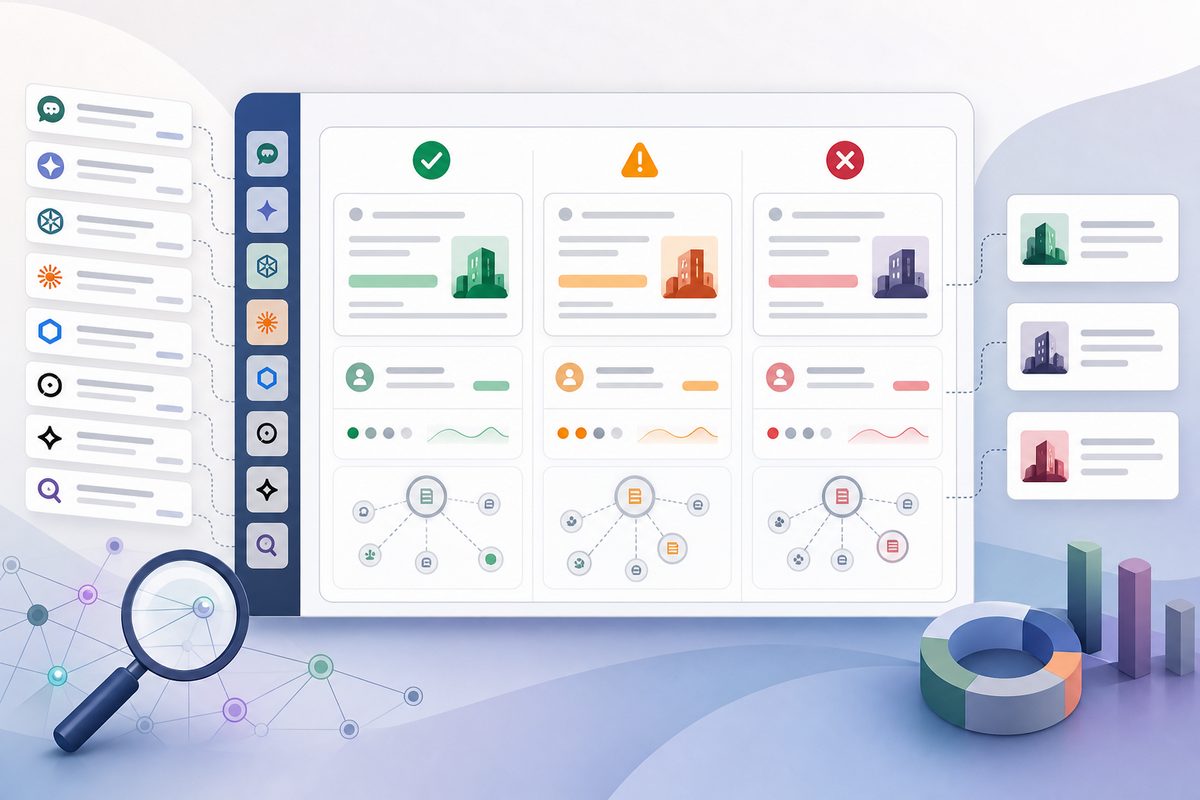
How to fix an AI brand identity collision
1. Freeze the canonical identity packet
Obtain internal agreement on the verified facts in the identity record. Assign an owner to each field and record the supporting source.
Do not let individual teams publish conflicting versions of the company category, founding date, location, or legal relationship. If the facts genuinely differ by market or period, document the scope explicitly instead of forcing one oversimplified answer.
2. Build and prioritize a source-conflict matrix
Compare every influential source against the identity packet:
| Source | Name | Domain | Category | Location | Relationship | Status | Owner |
|---|---|---|---|---|---|---|---|
| Official homepage | Correct | Correct | Ambiguous | Correct | Missing | Update | Web team |
| LinkedIn profile | Correct | Correct | Stale | Correct | Correct | Update | Social team |
| Business directory | Wrong entity | Wrong | Wrong | Wrong | N/A | Correction requested | Communications |
| Press article | Correct | Correct | Correct | Correct | Incorrect parent | Editor contacted | PR |
Prioritize conflicts with this internal triage score:
Priority = recurrence (1–3) × identity severity (1–3) × source reach (1–3)
- Recurrence: How often does the source appear in failing answers?
- Identity severity: Does it alter a critical fact such as domain, ownership, category, founder, or location?
- Source reach: Is the record prominent, syndicated, highly ranked, or reused by other databases?
A score of 27 means the source is repeatedly cited, carries a critical identity error, and has broad reach. A score of 1 may represent an uncited page with a minor outdated description. This score organizes work; it does not estimate an answer engine’s algorithm.
3. Establish one authoritative entity home
Choose a durable homepage or About page as the primary identity reference. It should state, near the top:
- Official company name
- Category
- Primary audience
- Main product or service
- Headquarters or operating scope when relevant
- Canonical domain
- Verified relationship to parent companies, subsidiaries, or former names
The opening should work without slogans or prior brand knowledge:
Northstar Labs is a Boston-based security software company that provides workflow tools for enterprise security teams.
Link this page to leadership, products, contact information, press resources, and official profiles. Those pages should link back using the same official name.
Keep critical identity facts in visible HTML text. Do not place the only clear company definition inside an image, animation, video, or client-side interaction that may not be consistently retrieved.
4. Add one precise identity-boundary statement
When a documented collision causes material confusion, publish a factual distinction on the entity home, FAQ, or contact page:
Northstar Labs is a Boston-based security software company. It is not affiliated with Northstar Laboratory Services, the food-testing company based in Austin.
The statement should identify a decisive boundary—category, geography, ownership, product, or domain. “We are a different company” is not specific enough.
Confirm the wording with brand and legal stakeholders when naming another business. Use the statement on one or two authoritative pages, not sitewide. Unnecessary repetition creates additional co-occurrence between the names.
5. Align Organization structured data with visible facts
Organization markup should repeat facts that users can verify on the page. It should not introduce a new legal name, address, alias, or relationship that the visible content never explains.
A minimal implementation may include:
<script type="application/ld+json">
{
  "@context": "https://schema.org",
  "@type": "Organization",
  "@id": "https://www.example.com/#organization",
  "name": "Northstar Labs",
  "legalName": "Northstar Labs, Inc.",
  "url": "https://www.example.com/",
  "description": "Northstar Labs is a Boston-based security software company.",
  "address": {
    "@type": "PostalAddress",
    "addressLocality": "Boston",
    "addressRegion": "MA",
    "addressCountry": "US"
  }
}
</script>
Adapt the properties to the facts actually published and verified by the organization.
Google’s Organization structured data documentation explains how Google may use administrative details such as a logo, address, contact information, and business identifiers. It does not promise that markup will control an AI-generated answer.
Use sameAs only for profiles that unambiguously represent the same organization. The Schema.org sameAs definition expresses identity equivalence—not partnership, relevance, comparison, or similarity. Never add the rival company, a review page, an article, or a distributor as a sameAs target.
6. Correct owned and external profiles in evidence order
Update sources in this order:
- Pages already cited in wrong answers
- Profiles carrying the wrong domain, category, ownership, or location
- High-ranking pages for the bare brand name
- Syndicated records that spread the mistake elsewhere
- Stale rebrand, acquisition, or leadership pages
- Lower-impact uncited mentions
For each correction:
- Save the original page and error.
- Submit the exact corrected fact with supporting evidence.
- Record the request date, owner, ticket, and response.
- Verify the live page after the publisher makes the change.
- Retest prompts that previously retrieved or cited the source.
Ask independent publishers for factual corrections, not promotional rewrites. If a source cannot be edited, strengthen accurate corroboration on owned pages and other reputable sources rather than marking the conflict resolved.
The AI brand reputation management workflow provides a broader process for assigning evidence, correction, and reporting responsibilities.
7. Preserve aliases and historical continuity
Rebrands, acquisitions, domain migrations, and product-to-company name changes commonly create duplicate or fragmented entities.
State the transition directly:
Northstar Security rebranded as Northstar Labs in March 2025. The company, ownership, and product remain the same.
Support that statement with:
- Appropriate redirects from the former domain
- Updated profile names and URLs
- A dated announcement
- Consistent former-name references
- Verified aliases in structured data
- Updated press and partner materials
Do not erase the old name before external sources have caught up. That can leave two incomplete identities rather than one continuous company history.
If the legal company and commercial brand use different names, explain the relationship once on an About or legal page. Both names should point to the same canonical organization.
8. Reinforce the identity through corroborating pages
After resolving contradictions, repeat the same verified relationships naturally across relevant pages:
- Brand + category on the homepage and About page
- Brand + product names on product pages
- Brand + founders on leadership biographies
- Brand + domain in official profiles
- Brand + former name in the rebrand announcement
- Brand + location on contact and business-profile pages
- Brand + expertise in attributable research, documentation, and author profiles
Consistency matters more than exact wording. Ten pages repeating an identical sentence are less useful than several authoritative pages confirming complementary facts.
Which errors need urgent escalation?
Not every wrong answer is solely an SEO problem. Escalate when the confusion involves:
- A rival or impersonator using your domain, logo, or contact details
- False claims about ownership, insolvency, criminal conduct, safety, or regulation
- Customers being directed to the wrong payment, login, support, or download page
- A counterfeit app, product, or account
- Exposure of personal or confidential information
- A compromised website or profile
- Trademark misuse likely to mislead customers
Preserve dated evidence before reporting the issue. Use the platform’s feedback or abuse channel, contact the publisher or profile owner, and involve security, legal, communications, or customer support as appropriate. Source reconciliation can support the response, but it is not a substitute for incident handling or legal advice.
How to verify that the fix worked
A correction is verified when the original failure declines across repeated, comparable tests—not when one favorable answer appears after an edit.
Rerun the baseline after:
- The canonical page is recrawled
- A cited directory publishes its correction
- An official profile update becomes public
- Search results replace an outdated page
- A rebrand or relationship page is indexed
If refresh timing is unknown, test weekly for eight weeks, then monthly. This is a monitoring cadence, not a prediction of how quickly any search or answer system will update.
Compare:
| Verification metric | Desired change |
|---|---|
| Unqualified prompt accuracy | Increases without requiring category or domain hints |
| Entity substitution rate | Declines toward zero |
| Attribute contamination rate | Declines, especially for critical facts |
| Citation conflict rate | Declines as corrected evidence replaces conflicting pages |
| Qualifier lift | Shrinks because bare-name prompts now resolve correctly |
| Rival concentration | Becomes irrelevant as substitutions disappear |
| Cross-engine consistency | More systems select the same verified entity |
| Description alignment | Category, audience, products, and location converge |
A strong internal QA threshold is:
- Zero full substitutions across two consecutive test rounds
- Zero critical errors involving domain, ownership, category, or legal relationship
- Zero known conflicting citations in priority prompts
- No recurring minor attribute error above the team’s agreed tolerance
These are operational success criteria, not guaranteed ranking thresholds.
How should brand teams monitor identity accuracy?
Track identity accuracy separately from visibility or share of voice. A brand can gain mentions while being described with the wrong products, location, or ownership.
A useful monitoring system should retain:
- Exact prompt and prompt category
- Answer engine, model or mode, date, language, and geography
- Whether the correct primary entity was selected
- Wrong or contaminated attributes
- Full citations and cited passages
- Qualifiers needed to recover the correct identity
- Screenshots or exported answers
- Changes from the previous test
- Open source-correction tickets
Alert on critical identity changes, not every wording variation. “Security workflow software” and “enterprise security operations software” may be acceptable descriptions of the same company. A switch from software to food testing is not.
If you are comparing monitoring platforms, assess whether they preserve citations, support repeatable prompt sets, distinguish correctness from mention volume, and export historical evidence. This comparison of AI search and LLM monitoring tools provides a broader evaluation framework.
What should you avoid?
Do not:
- Publish thin pages for every spelling variation.
- stuff the rival company’s name into sitewide copy.
- Add partners, articles, reviews, or similarly named entities to
sameAs. - Invent unsupported facts to make the company seem more distinctive.
- Change the canonical brand name without a migration plan.
- Remove former names without documenting continuity.
- Create fake profiles or manipulate community databases.
- Treat raw mention growth as success when attribution is wrong.
- Assume Organization schema can override contradictory external evidence.
- Declare the issue fixed after one correct answer.
- Send bulk correction requests without identifying the exact factual error.
- Rename the company before testing less disruptive remedies.
The goal is a coherent evidence trail, not maximum keyword repetition.
Frequently asked questions
Can Organization schema stop AI from confusing two companies?
No. Organization schema can clarify the entity described on your website, but it cannot control an answer engine or automatically overwrite third-party sources.
Use markup alongside visible identity copy, a canonical domain, accurate profiles, verified aliases, and consistent external evidence. Validate the markup whenever company facts change.
Should we rename the company if the collision persists?
Usually not as the first response. Renaming can fragment branded demand, links, reviews, profiles, citations, and historical authority.
Consider a naming change only when the confusion remains commercially harmful after source reconciliation and cannot be resolved with category, geography, product, or domain qualifiers. Evaluate trademark, customer, migration, and search implications together.
Can we ask ChatGPT or another platform to correct the answer?
You can submit feedback or report a specific answer where the platform provides that option. Keep a record of the submission.
Reporting one output does not repair the sources or retrieval paths that produced it. Continue correcting the evidence supporting the mistake and retest other prompts, modes, and answer systems.
How long does entity disambiguation take?
There is no universal timeline. A correction may depend on publisher response times, crawling, indexing, data syndication, retrieval refreshes, and model behavior.
Track observable milestones instead: source corrected, page recrawled, stale result replaced, conflicting citation removed, substitution rate reduced, and accuracy sustained across repeated tests.
Will publishing more articles fix brand confusion?
Only when the articles provide relevant, verified evidence that strengthens the correct entity. Generic posts containing occasional brand mentions do not clarify identity.
Prioritize the entity home, product pages, leadership biographies, contact information, rebrand history, official profiles, and independently corroborated facts before increasing publishing volume.
Can a disclaimer about the other company make the problem worse?
A precise boundary statement on an authoritative page can help users and systems distinguish two entities. Repeating the rival’s name across every page may create unnecessary co-occurrence and dilute the distinction.
Publish the clarification only where it is relevant, factual, and approved.
What if both companies have the same legal name?
Use attributes that remain unique and verifiable: canonical domain, category, headquarters, jurisdiction, registration number where appropriate, founders, products, and operating markets.
Keep legal identifiers on appropriate corporate or compliance pages. Do not expose non-public information merely to create a distinction.
The practical decision rule
When AI confuses your brand with another company, answer four questions:
- Which entity did the system select?
- Which attributes crossed the identity boundary?
- Which sources support or repeat the mistake?
- Which single qualifier restores the correct entity?
Those answers determine whether to fix the entity-home definition, an external profile, Organization markup, a corporate relationship, or historical continuity. Preserve the original prompt set and measure the same failure modes after each correction.
The goal is not one flattering response. It is repeatable, correctly attributed visibility supported by evidence that users, search engines, and answer systems can reconcile.