AI citation source analysis identifies the pages AI answer engines cite, omit, quote, summarize, or appear to rely on when answering buyer questions. The output is not a citation count. It is a prioritized source-fix queue: update this owned page, correct that profile, pitch this publisher, or monitor that low-impact source.
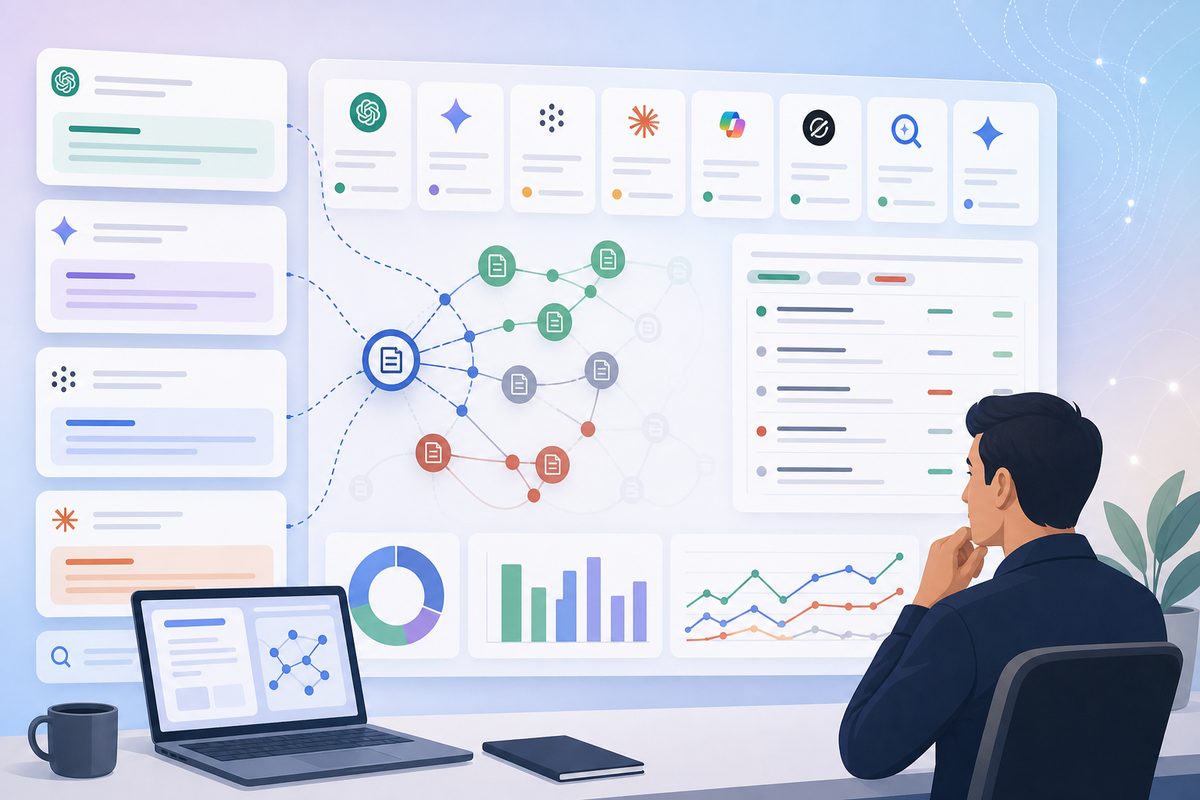
For B2B SaaS and tech brands, the practical question is not “Did ChatGPT, Perplexity, Gemini, Claude, Copilot, Grok, Google AI Mode, or AI Overviews cite us?” The better question is: which sources shaped the recommendation, and which source fixes are most likely to change the next answer?
Quick Answer: What Is AI Citation Source Analysis?
AI citation source analysis is a structured audit of the pages, documents, profiles, reviews, and articles that AI answer engines cite, quote, summarize, or appear to rely on. It separates visibility from influence by showing which sources shape brand recommendations and which fixes can change future answers.
A complete analysis should answer five questions:
- Which sources are cited or surfaced in AI answers?
- Which uncited sources appear to influence the answer text?
- Which sources help competitors get recommended?
- Which sources contain stale, weak, or inaccurate brand facts?
- Which fixes are realistic, high-impact, and measurable?
The goal is not to collect every AI citation. The goal is to identify the few sources that change how your brand is described, ranked, trusted, or omitted.
Citation Tracking vs. Source Analysis vs. Backlink Analysis
These workflows overlap, but they solve different problems.
| Workflow | Primary Question | Main Output | Typical Owner |
|---|---|---|---|
| Citation tracking | Which URLs appear in AI answers? | Citation list, domains, screenshots | SEO, GEO, analytics |
| AI citation source analysis | Which sources influence brand recommendations, and what can we fix? | Source influence scores, fixability scores, action queue | SEO, content, PR, product marketing |
| Backlink analysis | Which sites link to our pages? | Referring domains, anchors, authority signals | SEO, digital PR |
| Content audit | Are our pages useful, accurate, and competitive? | On-page fixes, content roadmap | SEO, editorial, product marketing |
| Reputation audit | Are public claims about us accurate and fair? | Risk log, correction plan | Comms, legal, customer marketing |
Backlinks can affect authority, but they do not prove that an AI answer used a page. A visible AI citation can be useful, but it does not prove that the source changed the answer. Source analysis sits between the two: it looks at citation presence, answer absorption, brand outcome, and fixability together.
Why Citation Count Is Not Enough
Citation count tells you which URLs appeared. It does not tell you whether those URLs changed the answer, repeated stale facts, helped a competitor, or could be fixed within a quarter.
A 2026 arXiv preprint, From Citation Selection to Citation Absorption, analyzed 602 controlled prompts, 21,143 valid search-layer citations, and 18,151 fetched pages. The paper’s useful distinction is that citation selection and citation absorption are different outcomes: a page can be cited without strongly shaping the final answer, while another source can provide the language, evidence, or structure the answer relies on.
That distinction matters in brand work. A low-authority page cited once may be noise. A third-party category page that repeatedly supplies the “best for” rationale may be a priority. A competitor comparison page may never mention you positively, but it can still frame the category in a way that causes AI engines to omit you.
Use citation tracking as the input. Use source analysis to decide what to change.
What Counts as an AI Citation Source?
For analysis, include more than visible footnotes.
| Source Signal | Include? | Label |
|---|---|---|
| Visible citation link in an AI answer | Yes | cited source |
| Source card beside or below an AI answer | Yes | cited source |
| Linked URL in an AI Overview, AI Mode, Perplexity, Copilot, or Gemini response | Yes | cited source |
| Named publication, review site, standard, or report with no visible URL | Yes | named source |
| Repeated uncited claim that matches a known page | Yes, with caution | inferred source |
| Competitor page that supplies category framing | Yes | competitor-controlled source |
| Classic organic ranking with no visible or textual connection to the AI answer | No, unless reflected in the answer | SEO only |
Do not overstate certainty. If the engine does not show a source, label the page as inferred, not proven. Good AI citation source analysis preserves that confidence level instead of turning guesses into facts.
For source taxonomy, the maxaeo guide to AI citation sources, tracking, and source-fix priorities separates owned, earned, third-party, marketplace, review, community, partner, and competitor-controlled sources.
The Source Influence Score Framework
Source Influence Score is a 100-point model for estimating how strongly a page affects AI brand recommendations.
| Factor | Weight | What to Look For |
|---|---|---|
| Citation recurrence | 15 | Appears across engines, prompt clusters, repeats, or weeks |
| Answer absorption | 20 | The answer reuses the page’s facts, examples, structure, comparison logic, or wording |
| Prompt relevance | 15 | The source matches a buyer problem, category, integration, competitor, or use case |
| Brand outcome | 15 | The source affects mention, recommendation, ranking, sentiment, or objection handling |
| Authority and independence | 10 | The source is credible, editorially reviewed, trusted, or neutral |
| Freshness | 10 | Product names, dates, screenshots, pricing, integrations, and positioning are current |
| Evidence density | 10 | The page includes quotable facts, numbers, definitions, tables, steps, or examples |
| Technical retrievability | 5 | Important content is crawlable, indexable, text-based, and internally linked |
Use these tiers:
| Score | Meaning | Treatment |
|---|---|---|
| 80-100 | High influence | Review manually and assign an action |
| 60-79 | Meaningful influence | Add to the source-fix roadmap |
| 40-59 | Possible influence | Monitor or batch with adjacent work |
| 0-39 | Low influence | Ignore unless accuracy or legal risk is high |
The most important judgment is answer absorption. A page has high absorption when the AI answer uses its ranking rationale, feature claims, comparison categories, definitions, or evidence. A page has low absorption when it appears as a link but the answer could have been written without it.
Add Fixability Before Assigning Work
A highly influential source is not always the best first project. If you cannot edit it, reach the publisher, correct the profile, or counterbalance it with better evidence, it may not deserve immediate resources.
Score fixability separately.
| Factor | Weight | High Score Means |
|---|---|---|
| Ownership or access | 25 | Your team controls the page or profile |
| Relationship path | 20 | A partner, customer, marketplace, analyst, or publisher contact can update it |
| Evidence availability | 15 | You already have screenshots, docs, customer proof, benchmarks, or quotes |
| Change complexity | 15 | The fix is content, metadata, schema, linking, or profile data rather than a rebuild |
| Freshness or correction reason | 10 | There is a clear reason to update stale or incomplete information |
| Risk | 10 | The fix has low legal, compliance, and brand-safety risk |
| Recheck velocity | 5 | The source is likely to be recrawled, republished, or reused soon |
Then calculate priority:
Priority Score = (Source Influence Score x Fixability Score x Recommendation Gap) / 100
Use this recommendation gap multiplier:
| AI Answer Outcome | Multiplier |
|---|---|
| Your brand is recommended accurately | 0.5 |
| Your brand is mentioned but not recommended | 1.0 |
| Competitors are recommended and your brand is omitted | 1.5 |
| Your brand is described inaccurately | 2.0 |
This prevents a common mistake: chasing every cited URL instead of fixing the sources that create lost recommendations.
Step-by-Step AI Citation Source Analysis Workflow
Use the same workflow whether you are auditing ChatGPT answers, Perplexity citations, Google AI Overview links, Gemini responses, Copilot answers, Claude web results, or Grok search responses.
1. Build Prompt Clusters Around Buyer Intent
Do not build the prompt set only from exact-match keywords. Use prompts that match how buyers research.
| Prompt Cluster | Example |
|---|---|
| Category shortlist | “Best AI search monitoring tools for B2B SaaS” |
| Problem | “How can a SaaS company find where ChatGPT gets brand facts?” |
| Use case | “Tools to track brand mentions in AI answers” |
| Competitor alternative | “Best alternatives to [competitor] for AI visibility tracking” |
| Integration | “AI visibility tools that work with Google Search Console data” |
| Trust and validation | “Which platforms are credible for generative engine optimization reporting?” |
| Brand-specific | “Is [brand] a good tool for AI citation tracking?” |
For a first audit, use 8-12 prompts, 4-6 engines, and 3 repeated runs. For a board-level or category audit, expand to 40-60 prompts and segment by buying stage, competitor set, country, and language.
2. Capture the Evidence
For every answer, record:
| Field | Why It Matters |
|---|---|
| Engine and surface | Citation behavior differs by platform and UI |
| Model, if visible | Helps explain changes between runs |
| Date, country, and language | AI answers vary by time and location |
| Prompt text | Small wording changes can change sources |
| Response text | Needed for answer absorption analysis |
| Brand mentions and rank | Shows visibility and recommendation strength |
| Cited URLs | Provides visible source evidence |
| Named but unlinked sources | Finds implied authority signals |
| Competitors mentioned | Shows who benefits from the answer |
| Screenshot or export | Preserves evidence for rechecks |
Do not rely only on screenshots. Store URLs, source text excerpts, and normalized domains in a spreadsheet or database so you can compare changes over time.
3. Normalize URLs Before Scoring
Normalize cited URLs before analysis:
- Remove UTM and ad-tracking parameters.
- Resolve redirects.
- Group canonical duplicates.
- Keep page-level URLs separate from domains.
- Separate syndicated copies from original articles.
- Tag login-gated, PDF, JavaScript-heavy, and noindex pages.
- Keep marketplace profiles, review pages, docs, and blog posts as separate source types.
Do not collapse everything into a domain score too early. A product page, integration page, pricing page, analyst article, and review profile can each require a different fix.
4. Classify Each Source by Control Path
Source type determines the action.
| Source Type | Examples | Best Action |
|---|---|---|
| Owned source | Product pages, docs, pricing, comparison pages, blog posts | Rewrite, update, add evidence, improve internal links |
| Third-party profile | G2, Capterra, marketplaces, app stores, directories | Correct categories, screenshots, descriptions, links |
| Editorial source | News, analyst notes, industry blogs, newsletters | Pitch a correction, update, quote, or new angle |
| Partner source | Integration pages, reseller pages, customer stories | Send current copy, proof, screenshots, and links |
| Community source | Forums, Reddit, GitHub, Q&A pages | Add factual public context where appropriate |
| Competitor-controlled source | Competitor comparisons, competitor docs, competitor listicles | Publish stronger evidence and pursue neutral validation |
| Official or standards source | Documentation, standards bodies, public datasets | Align claims with official terminology and cite accurately |
The maxaeo article on page types AI actually cites for SaaS brands is useful when deciding whether a missing source should be a product page, comparison page, integration page, customer proof page, or third-party profile.
5. Score Cited Sources
A cited source should be scored by what it contributes, not just whether it appears.
Ask six questions:
- Does the answer rely on the page’s facts, examples, definitions, or comparison logic?
- Does the page mention your brand, competitors, or category?
- Are the claims current and specific?
- Is the page eligible for crawling, indexing, and snippets where relevant?
- Does the page include extractable evidence such as tables, steps, numbers, definitions, or examples?
- Does the page strengthen or weaken your chance of being recommended?
Google’s AI features guidance says pages need to be indexed and eligible to appear in Search with a snippet to be eligible as supporting links in AI Overviews or AI Mode. It also says there are no additional technical requirements, no special AI file, and no special Schema.org markup required. Important content should be available in text, and structured data should match visible content.
That means schema is a clarity aid, not a shortcut. If a cited page hides key proof in images, stale PDFs, tabs, or vague marketing copy, the citation may exist but the source may still be weak.
6. Score Uncited Sources
Uncited sources are pages that should influence the answer but do not. They often reveal the biggest AI search opportunity.
| Uncited Source Group | What to Check | Common Fix |
|---|---|---|
| Owned product pages | Do they state category, ICP, use cases, integrations, and limits clearly? | Add answer-first copy, proof, comparison tables, and internal links |
| Documentation | Does it prove the feature or integration buyers ask about? | Add plain-language summaries and link from commercial pages |
| Review profiles | Are categories, descriptions, screenshots, and competitors current? | Update profile data and review prompts |
| Marketplace listings | Are product names, tags, categories, and app descriptions accurate? | Clean listing metadata and screenshots |
| Analyst or media coverage | Does it describe the current positioning? | Pitch an update with factual evidence |
| Competitor-cited pages | Do they omit you or frame the category against you? | Earn inclusion, publish a stronger neutral source, or build third-party validation |
A page can rank in Google and still fail as an AI source because it lacks concise definitions, current proof, comparison language, or explicit use-case fit.
Page Signals That Usually Matter Most
The strongest AI citation candidates are easy to retrieve, easy to parse, and easy to trust. They make claims explicit and support those claims with evidence.
A 2025 arXiv preprint, AI Answer Engine Citation Behavior: An Empirical Analysis of the GEO16 Framework, collected 1,702 citations across Brave Summary, Google AI Overviews, and Perplexity, then audited 1,100 unique URLs. The study found associations between citation likelihood and page quality signals such as metadata and freshness, semantic HTML, structured data, evidence, authority, and internal linking.
Treat that as observational evidence, not a guarantee. Google’s documentation still says there is no special schema required for AI features. The practical lesson is simpler: pages with clear structure, visible evidence, current facts, and strong internal links are easier for answer engines to understand.
Prioritize these source-ready elements on owned pages:
- A 40-60 word answer-first definition near the top.
- Clear statements of category, ICP, use cases, integrations, and limitations.
- Tables for comparisons, criteria, plans, features, or source types.
- Current screenshots, dates, product names, and pricing model language.
- Specific proof points: customer examples, benchmarks, docs, quotes, or public data.
- Text-based explanations for important information shown in images or videos.
- Descriptive title tags and H1/H2 structure.
- Internal links from hub pages, docs, comparison pages, and proof pages.
- Structured data that matches visible page content.
- Author, publisher, and update signals where relevant.
Google’s helpful content guidance asks whether content provides original information, complete coverage, clear sourcing, and value beyond rewriting other pages. That standard maps directly to AI citation source analysis: thin summaries rarely become durable source material.
What to Fix on Owned Pages First
Owned pages should function as reliable source material, not only conversion pages.
Fix these first:
| Problem | Why AI Answers Misread It | Source Fix |
|---|---|---|
| Vague category language | The engine cannot map the page to buyer prompts | State the category and use case plainly |
| Missing comparison criteria | Competitor pages supply the ranking logic | Add comparison tables and fit criteria |
| Stale facts | AI repeats old pricing, features, or positioning | Update product facts and visible dates |
| Proof hidden in images | Retrieval systems may miss the evidence | Add text summaries near the media |
| Weak internal links | The source is hard to discover or contextualize | Link from category, docs, and proof hubs |
| Boilerplate titles | Search systems cannot distinguish pages | Write unique, descriptive title elements |
| Unsupported claims | The answer avoids or dilutes the claim | Pair claims with evidence and sources |
Google’s title link guidance recommends concise, descriptive, non-boilerplate title elements and warns against keyword stuffing. That is not only classic SEO hygiene. It also reduces ambiguity about what each page is meant to prove.
For a deeper operating sequence, use the 10-step AI citation audit framework to connect prompt capture, source scoring, content fixes, and rechecks.
How Third-Party Sources Shape Brand Recommendations
Third-party sources often influence AI recommendations because they appear more neutral than vendor pages. Review sites, category lists, analyst articles, news coverage, partner pages, documentation hubs, and community discussions can all shape how AI describes a market.
The risk is that these pages are often stale. They may use an old positioning statement, omit a new feature, compare you against the wrong category, or repeat a competitor’s framing.
Tag third-party sources by relationship path:
| Relationship Path | Examples | Best Action |
|---|---|---|
| Directly editable | Marketplaces, directories, app profiles | Update categories, copy, screenshots, links |
| Customer or partner controlled | Integration pages, case studies, partner listings | Send current proof and suggested copy |
| Editorially reachable | News, analyst notes, industry blogs | Pitch a correction, update, quote, or data point |
| Community-influenced | Forums, Reddit, GitHub, Q&A | Add factual context without promotion |
| Unreachable | Scraped pages, abandoned listicles | Counterbalance with stronger owned and neutral sources |
Do not ask publishers to “help with AI visibility.” Give them a factual reason to update: a new integration, changed packaging, recent funding, benchmark data, customer proof, corrected category language, or a material product change.
When competitor pages dominate citations, use maxaeo’s guide to why AI search engines cite competitor pages instead of yours to separate content gaps from authority gaps.
Worked Example: B2B SaaS Source Queue
This example uses a 60-prompt audit across four AI engines with three repeated runs per prompt, creating 720 answer observations. The numbers are illustrative, but the workflow is the same for a real audit.
The company sells security questionnaire automation. It appears in direct brand prompts but is missing from “best security questionnaire automation tools for SaaS startups.” Competitors appear frequently.
| Source | Status | Influence | Fixability | Gap | Priority |
|---|---|---|---|---|---|
| Competitor comparison page | Cited, competitor-favorable | 86 | 20 | 1.5 | 25.8 |
| Third-party review category page | Cited, omits brand | 78 | 70 | 1.5 | 81.9 |
| Owned security questionnaire guide | Uncited but highly relevant | 72 | 92 | 1.5 | 99.4 |
| Outdated news article | Cited, stale positioning | 64 | 55 | 2.0 | 70.4 |
| Partner integration page | Uncited near-miss | 48 | 80 | 1.0 | 38.4 |
The first action is not the competitor page, even though it has the highest influence. The best first action is the owned guide because it is relevant, highly fixable, and aligned with the lost recommendation prompt.
The second action is the review category page because the brand omission is commercially damaging and fixable through category correction, profile updates, fresh screenshots, and review evidence.
A dashboard that only counts citations would miss that ordering.
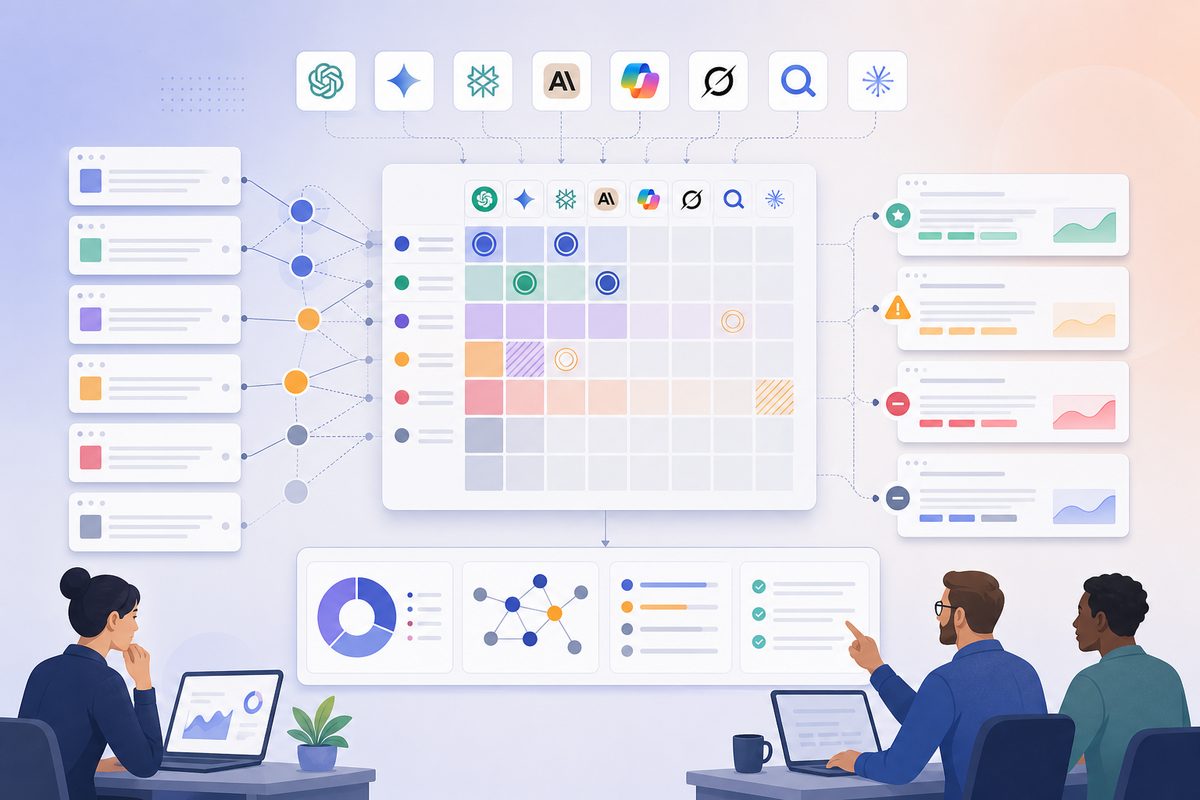
Turn Scores Into an Action Queue
Every high-priority source needs an owner, action, evidence requirement, and recheck date.
| Influence | Fixability | Action |
|---|---|---|
| High | High | Fix immediately: update facts, add proof, improve structure, refresh dates, strengthen links |
| High | Low | Build a relationship path: PR, analyst relations, partner enablement, neutral validation |
| Low | High | Batch into hygiene work: schema cleanup, metadata, clearer definitions, internal links |
| Low | Low | Monitor only unless accuracy, legal, or reputation risk is high |
A useful action row should include:
| Field | Example |
|---|---|
| Source URL | Exact page, not just domain |
| Source type | Owned guide, review profile, analyst article, competitor page |
| Prompt cluster | Category shortlist, competitor alternative, integration |
| Problem | Omits brand, stale pricing, weak category fit |
| Evidence needed | Screenshot, product doc, customer quote, benchmark, corrected copy |
| Owner | SEO, content, PR, partner marketing, product marketing, legal |
| Next action | Update, pitch, correct, create, counterbalance, monitor |
| Recheck date | Usually 2-6 weeks after update or recrawl |
How Often Should Teams Run AI Citation Source Analysis?
Run AI citation source analysis monthly for active GEO programs and weekly during launches, rebrands, funding announcements, pricing changes, major product releases, or reputation events.
| Cadence | Best Use |
|---|---|
| Weekly | Launches, PR campaigns, rebrands, reputation risk |
| Monthly | Standard AI search monitoring and source-fix reporting |
| Quarterly | Executive trend review, AI share of voice, category movement |
| After major updates | Migrations, pricing changes, acquisitions, analyst coverage |
One-time audits find obvious problems. Repeated audits show whether answer wording, cited URLs, brand rank, competitor displacement, and recommendation rate are actually changing.
A 2026 arXiv preprint on Measuring Google AI Overviews analyzed 55,393 trending queries and found that nearly 30% of AI Overview-cited domains did not appear in the co-displayed first-page results. It also found that 11.0% of atomic claims were unsupported by cited pages. The practical lesson: do not assume AI citations mirror classic rankings, and do not assume every cited source fully supports the claim.
Source Quality Risks to Check
Not every cited source deserves trust. Some pages are stale, synthetic, scraped, thin, or commercially biased.
Check high-priority sources for:
- Visible author or publisher identity.
- Clear publication or update date.
- Evidence for the claims used in the AI answer.
- Original reporting, data, screenshots, or analysis.
- Excessive affiliate or lead-generation bias.
- AI-generated summaries with no primary evidence.
- Outdated screenshots, pricing, product names, or categories.
- Contradictions between the page and official product documentation.
A 2026 arXiv audit, Synthetic Sources?, studied ChatGPT, Copilot, Gemini, and Perplexity citations across 712 real-world queries and found evidence of AI-generated sources among cited sources. That reinforces a core rule: verify source quality before treating a citation as a win.
What a Useful Report Should Include
A useful report connects AI search monitoring to decisions.
| Report Section | What It Should Show |
|---|---|
| Executive summary | AI share of voice, recommendation rate, major gains, major risks |
| Prompt set | Category, problem, comparison, competitor, integration, brand prompts |
| Engine view | ChatGPT, Gemini, Perplexity, Claude, Copilot, Grok, AI Mode, AI Overviews |
| Source inventory | Cited, named, inferred, uncited, and competitor-controlled sources |
| Source Influence Score | Pages most likely to shape answers |
| Fixability Score | Pages your team can realistically improve or influence |
| Recommendation Gap | Where competitors are recommended and your brand is missing |
| Accuracy risks | Stale, wrong, unsupported, or reputation-sensitive claims |
| Action queue | Owner, fix, evidence needed, due date, recheck date |
| Outcome tracking | Before-and-after changes in wording, rank, citations, and recommendations |
This is where an AI visibility tool should earn its budget. It should not merely store screenshots. It should connect sources to prompts, brand outcomes, fixability, and next actions. The maxaeo AI visibility tools with citation tracking scorecard gives a buyer-side checklist for evaluating that capability.
Common Mistakes in AI Citation Source Analysis
| Mistake | Why It Fails | Better Approach |
|---|---|---|
| Counting citations only | Misses answer absorption and business impact | Score influence, fixability, and recommendation gap |
| Auditing one prompt | Overfits to one answer variation | Use prompt clusters and repeated runs |
| Ignoring uncited sources | Misses near-miss pages and source gaps | Track candidate sources that should appear |
| Collapsing URLs into domains too early | Hides page-specific fixes | Keep page-level records |
| Treating inferred sources as proven | Overstates evidence | Label confidence level |
| Fixing low-impact owned pages first | Burns content budget | Prioritize by influence x fixability |
| Pitching publishers without evidence | Creates weak outreach | Provide a factual update reason |
| Assuming schema guarantees AI citations | Misreads Google guidance | Use schema to clarify visible content |
| Ignoring source quality | Lets stale or synthetic pages shape answers | Check provenance, freshness, and evidence |
Frequently Asked Questions
Is AI citation source analysis the same as backlink analysis?
No. Backlink analysis studies links between websites. AI citation source analysis studies which pages AI systems cite, summarize, quote, infer, or appear to rely on when answering prompts. Backlinks may influence authority, but they do not show whether a source changed an AI recommendation.
Can I force ChatGPT, Perplexity, or Google AI Overviews to cite my page?
No. You can improve the odds by making pages crawlable, specific, fresh, useful, and evidence-rich, but no ethical SEO or GEO workflow can force an AI engine to cite a page. The practical goal is to become the clearest available source for the prompts that matter.
What source types most often influence B2B SaaS recommendations?
Common sources include owned product pages, documentation, comparison pages, review profiles, marketplace listings, analyst content, news coverage, partner pages, community discussions, and high-authority educational articles. The mix changes by prompt, engine, country, and buyer intent.
Does structured data guarantee AI citations?
No. Structured data does not guarantee AI citations. Google says there is no special schema required for AI Overviews or AI Mode. Structured data is still useful when it accurately matches visible content because it clarifies entities, products, dates, authorship, and page purpose.
How do I know whether a source fix worked?
Rerun the same prompt cluster after the page is updated, recrawled, or republished. Compare recommendation rate, brand rank, cited URLs, answer wording, source absorption, and competitor displacement. A good fix changes the answer, not just the citation list.
How many prompts do I need for a reliable first audit?
Use at least 8-12 prompts across 4-6 engines with 3 repeated runs per prompt. That is enough to identify obvious source patterns. For competitive category reporting, expand to 40-60 prompts across buyer stages, competitor sets, and regions.
Can AI citation source analysis help traditional Google SEO?
Yes, indirectly. It exposes weak definitions, stale facts, thin comparison pages, poor internal links, unclear titles, and missing proof. Those fixes can also improve standard search performance, but AI citation source analysis should be measured by answer changes, not rankings alone.