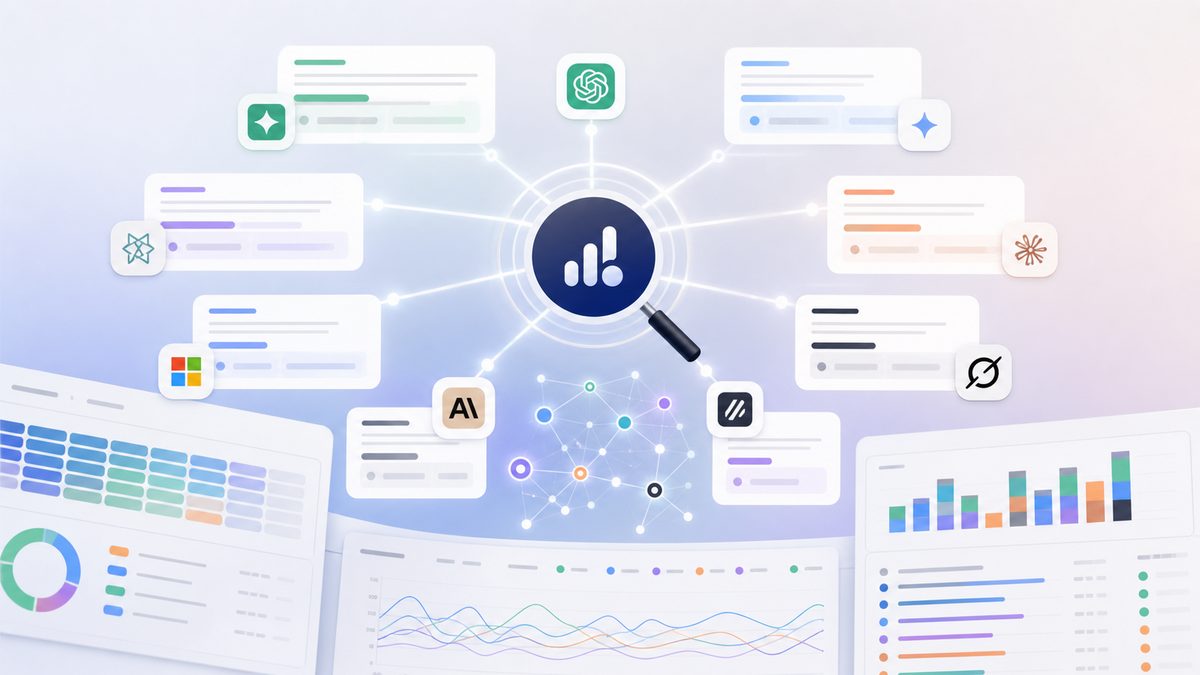
If you are asking which search engines power AI answers, the accurate answer is: not one search engine. ChatGPT, Claude, Gemini, Perplexity, Copilot, and Grok each use a different mix of model knowledge, live web retrieval, search indexes, crawlers, partner feeds, social context, and citation-ranking systems.
That distinction matters for SEO. A brand can rank well in Google and still be missing from Perplexity. It can be indexed by Bing and still be described incorrectly in ChatGPT because the answer cites a stale marketplace page. It can appear in Google AI Overviews but be absent from Claude because Claude selected a different set of supporting sources.
For marketing, SEO, and communications teams, the useful question is not "Is AI search replacing Google?" The useful question is: which retrieval system is gating this answer, and what can we fix this week?
Quick Answer: AI Answers Use Retrieval Stacks, Not One Search Engine
AI answers are powered by retrieval stacks, not one universal search engine. An answer engine may combine model memory, live web searches, partner feeds, first-party crawlers, user-triggered fetches, and citation reranking. The controlling index depends on the product, prompt, geography, login state, and whether the system decides to search.
A traditional search engine returns ranked links. An AI answer engine usually does more work:
- Interprets the prompt.
- Decides whether fresh retrieval is needed.
- Generates one or more internal searches.
- Pulls candidate pages from one or more indexes or tools.
- Filters, reranks, and summarizes sources.
- Selects citations to support parts of the answer.
- Writes a natural-language response.
That is why "ranking number one" is no longer the whole visibility problem. In answer engine optimization, a brand has to be crawlable, retrievable, citable, and accurately describable.
Which Search Engines Power AI Answers by Platform?
The clearest public mappings are Copilot to Bing and Google AI features to Google Search. ChatGPT, Claude, Perplexity, Gemini, and Grok require more care because their source paths may combine public indexes, proprietary crawlers, live fetchers, partner content, and model-side citation selection.
| AI answer surface | Best-supported source path | What is public vs. unknown | First SEO fixes to prioritize |
|---|---|---|---|
| ChatGPT Search | OpenAI says ChatGPT search uses third-party search providers and partner content; OAI-SearchBot controls search visibility | Public: OpenAI uses third-party providers and partners. Unknown: exact provider mix per query | Allow OAI-SearchBot, keep Bing and Google indexation healthy, improve third-party source accuracy |
| Microsoft Copilot and Bing Chat-style answers | Microsoft describes Prometheus as combining Bing index, ranking, and answers with GPT models | Public: Bing is the clearest dependency for web answers | Bingbot access, Bing Webmaster Tools, IndexNow, clear snippets, fresh source pages |
| Google AI Overviews and AI Mode | Google Search index and Google Search eligibility | Public: indexed pages eligible for snippets can appear; query fan-out may run multiple related searches | Googlebot access, indexation, snippet eligibility, internal links, structured data consistency |
| Gemini with Google Search grounding | Google Search grounding connects Gemini models to real-time web content and citations | Public for Gemini API grounding. Consumer Gemini behavior can vary by feature and prompt | Google Search visibility, clean entity facts, source-worthy passages, avoid confusing Google-Extended with Search controls |
| Perplexity | Perplexity documents a first-party Search API and PerplexityBot / Perplexity-User | Public: continuously refreshed index and crawler controls | Allow PerplexityBot, monitor WAF rules, publish concise answer blocks with dates and proof |
| Claude web search | Anthropic documents real-time web search with citations and domain controls | Public: Claude can search and cite. Unknown: named consumer search index provider | Fingerprint citations by prompt cluster, improve canonical pages and earned sources |
| Grok and DeepSearch | xAI describes Grok agents as using internet access; Grok is also integrated with X | Public: internet access and DeepSearch. Unknown: full ranking and source mechanics | Keep web sources indexable, maintain X/entity consistency, monitor sensitive prompts directly |
| Brave-powered agent workflows | Brave offers an independent Search API and LLM context endpoints | Public: useful comparison index and retrieval provider, not proof of powering every AI engine | Use Brave as an overlap test when fingerprinting mixed or undisclosed systems |
Treat this table as a starting map, not a permanent law. AI products change retrieval tools, models, and citation policies often. The right operational move is to combine official documentation with your own citation and server-log evidence.
For the broader ranking layer, MaxAEO's guide to AI search engine ranking across ChatGPT, Perplexity, and Gemini explains how answer engines decide which brands and sources to cite.
What "Powered By" Really Means
When people ask which search engines power AI answers, they often mix four different layers:
| Layer | What it does | SEO implication |
|---|---|---|
| Model knowledge | Information learned during model training | You cannot update it instantly with a sitemap |
| Live search index | Fresh web results retrieved at answer time | Google, Bing, Brave, Perplexity, and other indexes may matter |
| Crawler or fetcher | Bot that accesses pages automatically or after a user request | Robots.txt, WAF, CDN, and IP verification can block visibility |
| Citation selection | Final choice of which URLs appear in the answer | A page can be retrieved but lose because another source is clearer or safer to cite |
This is why a page can be indexed but not cited. Retrieval gets a document into the candidate set. Citation selection decides whether the document is useful enough to support the answer.
ChatGPT Search: Third-Party Providers, Partner Content, and OAI-SearchBot
ChatGPT Search is not publicly mapped to one search engine. OpenAI says ChatGPT search uses third-party search providers and content provided directly by partners, while OAI-SearchBot is the search crawler control for appearing in ChatGPT search answers.
OpenAI's launch post for ChatGPT search says ChatGPT can search the web, show links to relevant sources, and use third-party search providers plus partner content. That means "ChatGPT SEO" should not be reduced to "optimize Bing" or "optimize Google" without checking the actual citations.
OpenAI's crawler documentation is more actionable. The OpenAI crawler docs distinguish:
| OpenAI user agent | Purpose | SEO impact |
|---|---|---|
| OAI-SearchBot | Surfaces websites in ChatGPT search features | Blocking it can prevent pages from appearing in ChatGPT search answers |
| GPTBot | Crawls content that may be used to train OpenAI foundation models | Not the same as ChatGPT search inclusion |
| ChatGPT-User | User-triggered page visits from ChatGPT or Custom GPTs | Not used to determine search appearance |
For brands trying to appear in ChatGPT answers, start with four checks:
- Allow
OAI-SearchBotin robots.txt. - Make sure your CDN and WAF allow OpenAI's published IP ranges.
- Verify that important pages are indexable in both Google and Bing.
- Clean up third-party pages that ChatGPT may cite instead of your official page.
Do not measure one prompt and call it "ChatGPT visibility." Track prompt clusters: category, comparison, alternative, problem, security, pricing, and objection queries.
Microsoft Copilot: Bing Is the Clearest Documented Dependency
Copilot is the easiest major AI answer system to map because Microsoft has publicly described Bing grounding. For web answers in Copilot and Bing-style chat, Bing indexation should be treated as a first-class AI visibility channel.
Microsoft's Search Quality Insights post on Building the New Bing says Prometheus combines the Bing index, Bing ranking, Bing answers, and GPT models. It also describes Bing Orchestrator generating internal queries and grounding answers with Bing data.
The practical implication is direct: if Copilot matters to your buyers, do not treat Bing as a secondary SEO chore. Fix:
- Bingbot access.
- XML sitemap submission.
- Canonical conflicts.
- Slow or blocked JavaScript rendering.
- Thin titles and unclear snippets.
- Stale product, pricing, docs, and comparison pages.
Use IndexNow for important URL changes. IndexNow is not a ranking shortcut; its documentation says a successful response only means the search engine received the URL. Still, it is useful for reducing discovery lag after migrations, product updates, or documentation changes.
For a Copilot-specific workflow, see MaxAEO's guide on improving brand visibility in Microsoft Copilot.
Google AI Overviews, AI Mode, and Gemini: Google Search Is the Main Gate When Grounded
For Google AI Overviews and AI Mode, Google Search is the gate. Google says the same SEO fundamentals apply, and pages must be indexed and eligible to be shown in Google Search with a snippet to appear as supporting links in these AI features.
Google's documentation on AI features and your website states that there are no extra technical requirements to appear in AI Overviews or AI Mode beyond Search eligibility. It also says these features may use query fan-out, issuing multiple related searches across subtopics and data sources.
That changes how SEO teams should think about coverage. A page may rank for the obvious keyword but still miss the AI answer if the system fans out into hidden variants such as:
- "best SOC 2 automation software for startups"
- "vendor risk management tools for SaaS procurement"
- "[brand] alternatives for enterprise"
- "[brand] security documentation"
- "[brand] pricing model"
Gemini needs a narrower statement. The Gemini API documentation for Grounding with Google Search says Google Search grounding connects Gemini models to real-time web content and citations. That is clear for API use cases where the Google Search tool is enabled. Consumer Gemini experiences can vary by feature, prompt, and settings, so monitor Gemini answers directly rather than assuming every answer searched.
One common mistake is confusing Google-Extended with Google Search controls. Google's crawler documentation says Google-Extended can manage whether crawled content may be used for future Gemini model training and some grounding uses, but it does not affect inclusion in Google Search or act as a Google Search ranking signal.
Perplexity: First-Party Search API, PerplexityBot, and User Fetching
Perplexity is closer to a native answer engine than a chatbot with occasional browsing. Its docs describe real-time ranked web results from a continuously refreshed index, plus crawler controls for PerplexityBot and Perplexity-User.
The Perplexity Search API documentation says the API returns ranked web results from a continuously refreshed index, with structured fields such as title, URL, snippet, date, and last updated. It also distinguishes Search API results from Sonar, which returns prose answers with citations.
Perplexity's crawler documentation matters for site owners:
| Perplexity user agent | Purpose | SEO impact |
|---|---|---|
| PerplexityBot | Surfaces and links websites in Perplexity search results | Allow it for Perplexity search visibility |
| Perplexity-User | Supports user-triggered page visits | May ignore robots.txt because the fetch is user requested |
Perplexity tends to reward pages that behave like sources: direct answers, visible dates, named authors or organizations, cited evidence, and concise factual passages. Thin product landing pages often lose to docs, research pages, category comparisons, credible reviews, and community discussions.
A practical test: if the page would look weak as a citation in a board memo, it is probably weak for Perplexity.
Claude: Real-Time Web Search With Citations, but No Public Named Index Map
Claude can search the web and return citations, but Anthropic does not publicly map Claude web search to a named consumer search index. Treat Claude visibility as a citation fingerprinting problem until your own data proves a stronger pattern.
Anthropic's Claude web search documentation says the tool gives Claude access to real-time web content and cited sources. It also explains that Claude may search when a prompt depends on current, changing, or organization-specific information.
What the documentation does not say is equally important: it does not tell marketers that Claude equals Google, Bing, Brave, or any other named index in every case.
The better workflow is to test Claude by prompt cluster:
- Ask the same buyer-intent prompts repeatedly.
- Record cited URLs and claim-level support.
- Compare those URLs against Google, Bing, Brave, and Perplexity results.
- Check server logs for recent bot or fetcher activity.
- Update the official and third-party pages that Claude actually cites.
Claude is important for B2B because buyers often use it for vendor due diligence, summarization, procurement notes, and "compare these options" analysis. In those workflows, the cited source set can shape the shortlist before a user ever visits Google.
Grok: Internet Access, DeepSearch, and X Context
Grok should be treated as a mixed web-and-social answer system. xAI describes Grok 3 models as equipped with internet access, and DeepSearch as an agent that seeks information across a broad corpus of knowledge.
xAI's Grok 3 announcement says Grok agents combine reasoning and tool use with internet access. It also positions DeepSearch as an agent for synthesizing information, including real-time news and X reactions.
For brand teams, that creates a different risk profile from Google or Bing. Grok may retrieve web pages, but it can also reflect social context: executive posts, unresolved complaints, product controversies, community reactions, and fast-moving narratives on X.
The fix list is broader than technical SEO:
- Keep official explanations current.
- Maintain consistent company and product descriptions.
- Update support and incident-response pages.
- Resolve inaccurate third-party profiles.
- Keep X bios, founder posts, and public statements aligned with the current positioning.
- Monitor sensitive prompts such as "Is [brand] trustworthy?" and "What are the main complaints about [brand]?"
For more on multi-step AI agents and source selection, read MaxAEO's analysis of how Deep Research modes change which brands get cited.
The MaxAEO Index Fingerprint Framework
Index fingerprinting is the process of inferring which search index influenced an AI answer by comparing cited URLs against candidate search results, crawler logs, and source freshness. It replaces generic "AI visibility" advice with a repeatable method for deciding whether to fix Google, Bing, Brave, Perplexity, crawler access, or third-party citations first.
Use this when you need to know which search engines power AI answers in your category, not just in theory.
1. Build a Prompt Cluster
Do not test one keyword. Build 30 to 100 prompts that reflect real buyer behavior:
- Category prompts: "best customer onboarding software"
- Comparison prompts: "[brand] vs [competitor]"
- Alternative prompts: "alternatives to [brand]"
- Problem prompts: "how to reduce SaaS churn after onboarding"
- Due-diligence prompts: "is [brand] secure for enterprise?"
- Objection prompts: "[brand] complaints" or "[brand] pricing concerns"
- Local or regional prompts, if buying criteria vary by market
Classic keyword volume is useful, but AI search often exposes low-volume, high-intent questions that never looked important in old keyword tools.
2. Capture Answer Evidence
For every prompt and engine, record:
- Whether your brand is mentioned.
- Position in the shortlist.
- Sentiment and framing.
- Cited URLs.
- Whether each citation supports the attached claim.
- Source type: official, earned media, partner, marketplace, review site, community, competitor, or social.
- Date shown in the source, if visible.
- Whether the answer searched live or appeared to answer from model memory.
This is the base layer of AI share of voice.
3. Build Candidate Index Result Sets
Run equivalent searches in:
- Google.
- Bing.
- Brave Search.
- Perplexity Search API, if available.
- Relevant vertical indexes, such as app marketplaces, docs search, review platforms, or academic search.
Record the top 20 to 30 organic URLs for each query. For AI systems with undisclosed providers, this gives you comparison fingerprints instead of guesses.
Brave is useful here because Brave describes its Search API as using an independent web index with LLM-oriented context endpoints. That does not prove Brave powers a specific AI answer. It makes Brave a useful comparison index when Google and Bing overlap is weak.
4. Calculate Citation-Index Overlap
Use a simple overlap score:
Citation-Index Overlap = AI-cited URLs also present in candidate index results / total AI-cited URLs
Use thresholds as a decision aid:
| Overlap score | Interpretation | Action |
|---|---|---|
| 0.55 or higher | Strong index fingerprint | Prioritize crawl, ranking, and snippet fixes in that index |
| 0.30 to 0.54 | Material influence | Improve index visibility and source quality, but inspect other signals |
| Below 0.30 | Weak signal | Look for proprietary crawlers, partner feeds, social sources, or vertical indexes |
This is not perfect attribution. It is a practical way to decide where work should go first.
5. Check Server Logs and Bot Access
Citations tell you what appeared. Logs tell you what was fetched.
Look for:
OAI-SearchBotChatGPT-UserPerplexityBotPerplexity-UserGooglebotBingbot- Other documented crawlers and fetchers relevant to your stack
Then check whether the important URLs were served with the right status code, canonical, rendered content, and cache behavior. A page that returns 200 to Googlebot but 403 to OAI-SearchBot is not equally visible across answer engines.
6. Assign the Fix Owner
The final output should not be "AI visibility is down." It should be a fix queue:
| Finding | Likely owner | Example fix |
|---|---|---|
| Copilot cites stale pages | SEO / web | Update Bing-visible canonical pages and submit via IndexNow |
| ChatGPT does not cite official pages | Technical SEO | Allow OAI-SearchBot and verify CDN rules |
| Perplexity cites a review profile | Product marketing / PR | Update third-party profile and publish a stronger official comparison page |
| Claude mentions competitor first | Content / PR | Improve third-party validation and answer-specific source pages |
| Grok frames the brand negatively | Comms / support | Address public complaints and publish a clear issue-resolution page |
| Google AI Overview omits the page | SEO / content | Improve Google indexation, internal links, snippet eligibility, and topical coverage |
This is where AI search monitoring becomes operational. A useful report tells the team what to fix, not only what changed.
Why Citation Accuracy Matters More Than Citation Count
AI citation presence is not the same as citation accuracy. A brand can be cited and still be misdescribed, or omitted while a weaker third-party page shapes the answer. Serious GEO measurement has to inspect the claim, not just the link.
The risk is documented. The 2023 paper Evaluating Verifiability in Generative Search Engines found that, across audited generative search engines, only 51.5% of generated sentences were fully supported by citations and 74.5% of citations supported their associated sentence.
A 2026 study, Measuring Google AI Overviews, issued 55,393 trending queries and found that nearly 30% of AI Overview-cited domains did not appear in co-displayed first-page results. It also found that 11.0% of atomic claims were unsupported by the cited pages.
The takeaway is not "AI search is broken." The takeaway is that brand monitoring has to be claim-level. Track whether ChatGPT, Gemini, Perplexity, Claude, Copilot, and Grok describe your company correctly, cite the right sources, and recommend you in the right shortlist.
That is the difference between rank tracking and LLM brand tracking.
Practical SEO Playbook by Answer Engine
The fastest wins come from matching the fix to the retrieval path. Do Bing work for Copilot, Google work for AI Overviews and grounded Gemini answers, crawler-access work for ChatGPT and Perplexity, and source-quality work across every engine.
| Workstream | Helps most with | What to do |
|---|---|---|
| Bing indexation | Copilot, some ChatGPT fingerprints | Verify Bingbot access, submit sitemaps, use IndexNow, improve title and snippet clarity |
| Google indexation | Google AI Overviews, AI Mode, grounded Gemini | Fix canonicalization, internal links, page experience, structured data, and snippet eligibility |
| OAI-SearchBot access | ChatGPT Search | Allow OAI-SearchBot, avoid blocking OpenAI IP ranges, keep official pages text-readable |
| PerplexityBot access | Perplexity | Allow PerplexityBot, check WAF/CDN rules, expose direct answer sections |
| Brave overlap testing | Undisclosed or mixed stacks | Use Brave as a comparison index when Google/Bing overlap does not explain citations |
| Third-party source cleanup | All engines | Update review profiles, marketplaces, partner pages, analyst pages, and comparison pages |
| Entity consistency | All engines | Align company name, category, founders, pricing model, integrations, security claims, and support statements |
| Source-worthy content | All engines | Publish pages with direct answers, proof, examples, dates, visible authorship, and clear citations |
For teams evaluating monitoring platforms, MaxAEO's comparison of the best tools to track brand visibility in AI search covers what to measure across ChatGPT, Perplexity, Gemini, and AI Overviews.
How to Create Source-Worthy Pages for AI Answers
A source-worthy page gives an answer engine a low-risk passage to cite. It states the answer directly, supports it with evidence, avoids exaggerated claims, and makes the entity relationship clear.
Use this structure for pages you want AI systems to cite:
- Start with a 40 to 60 word answer block.
- Name the product category and audience plainly.
- Add specific proof: product data, customer examples, security standards, benchmarks, screenshots, or dated methodology.
- Include comparison language buyers actually use.
- Keep key facts visible in HTML text, not locked inside images.
- Match structured data to visible content.
- Show authorship, ownership, and update dates.
- Link internally from relevant pillar pages and product pages.
- Cite external standards, documentation, or research when claims depend on them.
- Remove vague claims that cannot be verified.
Avoid lines such as "the best platform for modern teams." They are hard to cite because they do not name the measurable fact.
A stronger line is: "MaxAEO monitors brand mentions, citations, rank order, source URLs, and sentiment across ChatGPT, Gemini, Perplexity, Claude, Copilot, Grok, Google AI Mode, and AI Overviews."
That sentence is more citable because it names the product category, tracked surfaces, and measurable outputs.
What to Monitor Weekly
Weekly AI visibility reporting should connect prompts, engines, citations, sentiment, and source ownership to a fixable index or source. The point is to explain why visibility changed and what to do next.
Track these fields for each priority prompt cluster:
| Metric | Why it matters |
|---|---|
| Brand mentioned | Basic inclusion signal |
| Rank in shortlist | Shows whether the brand is recommended or merely named |
| AI share of voice | Measures brand presence across relevant answer sets |
| Citation URL | Reveals which source shaped the answer |
| Citation accuracy | Shows whether the cited page supports the claim |
| Sentiment | Captures favorable, neutral, mixed, or negative framing |
| Source ownership | Separates official, earned, partner, community, competitor, and social sources |
| Index fingerprint | Points to Google, Bing, Brave, Perplexity-native, mixed, or unclear retrieval |
| Fix owner | Assigns the work to SEO, content, PR, product marketing, support, legal, or comms |
The reporting question should be: what changed in the answer, what source caused it, and who can fix it?
Common Mistakes When Optimizing for AI Search Sources
The biggest mistake is optimizing for "AI" as one channel. Each engine has different retrieval controls, source preferences, and citation behavior, so a one-size-fits-all checklist wastes work.
Common failure modes include:
- Blocking OAI-SearchBot or PerplexityBot while expecting citations to improve.
- Treating Google-Extended as a Google Search or AI Overview ranking control.
- Assuming ChatGPT always equals Bing without checking current citations.
- Assuming Claude uses a named public index without evidence.
- Publishing comparison pages with unsupported claims.
- Ignoring third-party profiles that AI systems cite more often than the official site.
- Measuring only whether the brand appears, not whether the description is accurate.
- Optimizing only high-volume keywords while buyers ask low-volume due-diligence prompts.
- Forgetting that Google AI Mode and AI Overviews may use query fan-out.
- Reporting "AI visibility" without separating Google, Bing, Perplexity, social, and partner-source issues.
The durable fix is not a trick. It is crawlability, index coverage, source quality, entity consistency, citation monitoring, and prompt-level reporting.
Frequently Asked Questions
Which search engines power AI answers today?
Which search engines power AI answers depends on the platform. Copilot is clearly tied to Bing. Google AI Overviews and AI Mode use Google Search systems. ChatGPT, Claude, Gemini, Perplexity, and Grok use more mixed or feature-dependent retrieval stacks, so teams should verify citations instead of assuming one provider.
The best answer is engine-specific. Microsoft has publicly described Bing grounding for Copilot. Google documents Google Search eligibility for Search AI features. OpenAI says ChatGPT search uses third-party providers and partner content. Perplexity documents its own search API and crawlers. Claude and Grok require more citation fingerprinting because the exact source path is not fully disclosed for every consumer answer.
Is ChatGPT powered by Bing?
ChatGPT Search should not be treated as simply "Bing with a chatbot." OpenAI says ChatGPT search uses third-party search providers and partner content. Bing may matter in many prompt clusters, but teams should compare actual ChatGPT citations against Bing, Google, Brave, and the cited domains before assigning the fix.
The practical approach is to support both sides: keep Bing and Google indexation healthy, and make sure OAI-SearchBot can access the content you want ChatGPT to surface.
Does Google power Gemini answers?
Sometimes, depending on the Gemini surface and feature. Google documents Google Search grounding for the Gemini API when the google_search tool is enabled. Google also says Google-Extended can affect some Gemini training and grounding uses, but it does not affect Google Search inclusion or ranking.
For SEO teams, the safest approach is to optimize Google Search eligibility and monitor Gemini answers directly by prompt cluster.
Does Google-Extended control AI Overviews?
No. Google says Googlebot is the control for Search crawling, including AI features in Search. Google-Extended is a separate robots.txt token for training future Gemini models and some grounding uses outside normal Search inclusion. It does not affect a site's inclusion in Google Search and is not a Google Search ranking signal.
For AI Overviews and AI Mode, focus on Google Search technical eligibility, snippet controls, useful content, internal links, and source clarity.
Why does Perplexity cite different pages than Google?
Perplexity has its own search and citation workflow. Its docs describe a continuously refreshed first-party Search API and separate crawler controls for PerplexityBot and Perplexity-User. It may select pages that are more concise, more recent, or easier to cite than the pages ranking highest in classic Google results.
If Perplexity visibility matters, test Perplexity directly. Do not infer it from Google rankings alone.
How can a brand improve AI citations?
A brand improves AI citations by making its best evidence easy to retrieve and safer to cite. That means crawlable pages, direct answer blocks, consistent entity information, strong internal links, current third-party profiles, and proof-backed claims.
Then monitor which sources answer engines actually cite. If Claude cites an outdated partner page or Perplexity cites a stale review profile, the fix may be PR, partner operations, or review management rather than on-site SEO.
What is the best metric for AI search visibility?
The best single metric is prompt-level AI share of voice, but it should be paired with citation accuracy, sentiment, and source ownership. A brand mention is not enough if the answer ranks a competitor first, cites a weak source, or describes the product incorrectly.
For serious answer engine optimization, track brand presence, rank order, cited URLs, claim support, sentiment, and index fingerprint together.