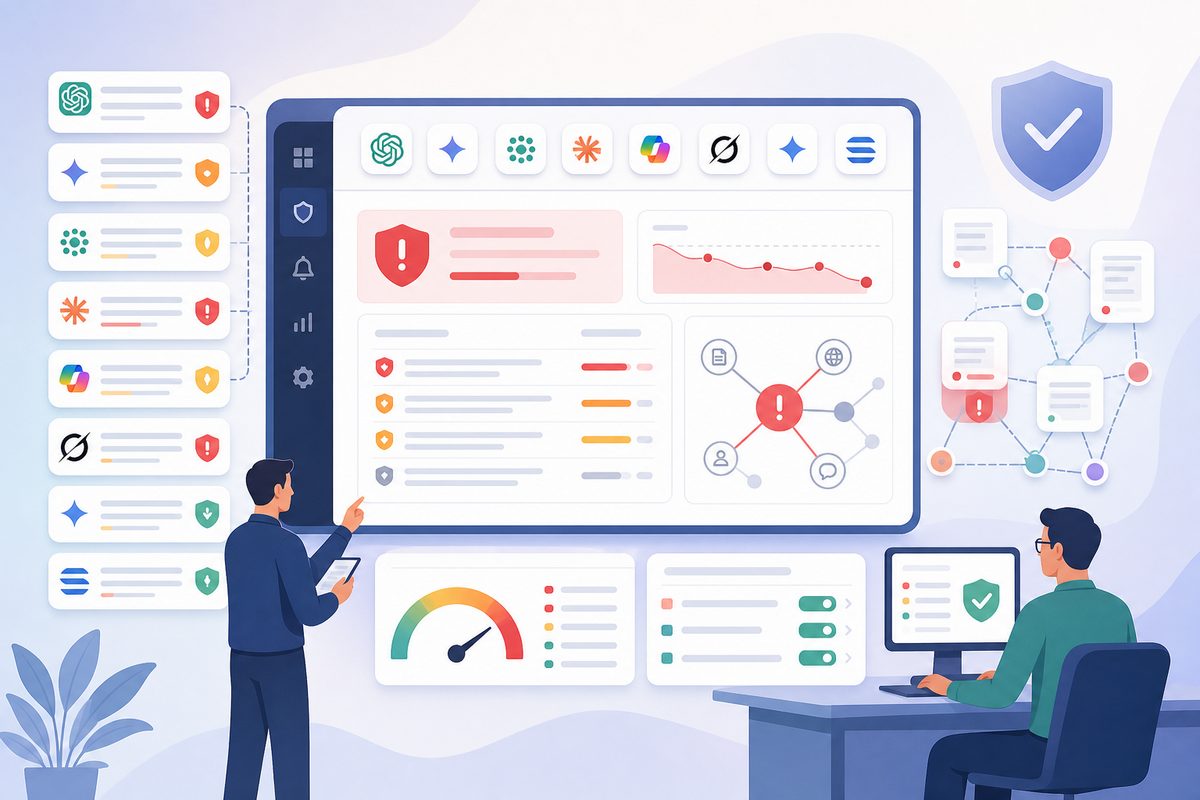
AI answer brand safety is the practice of detecting and correcting AI-generated answers that place a brand in inaccurate, unsafe, outdated, or off-brand contexts. It covers the answer text, cited sources, nearby competitors, implied product category, risk framing, and repeatability across systems such as ChatGPT, Google AI Overviews, Google AI Mode, Gemini, Perplexity, Claude, Copilot, and Grok.
The risk is not only that an answer gets a fact wrong. The larger risk is that a buyer sees your brand attached to the wrong category, a competitor's failure story, a safety issue, a lawsuit, a scam pattern, an outdated acquisition narrative, or a weak third-party source before your team knows it happened.
If you only do one thing, do this: build a fixed prompt set, capture answer snapshots, score the context, inspect the citations, fix the source layer, and rerun the same prompts on a cadence. Random spot checks will miss the patterns that create real reputational risk.
What is AI answer brand safety?
AI answer brand safety means protecting how AI answer engines associate your company with topics, competitors, risks, sources, and recommendations. It tracks whether AI systems describe your brand accurately, recommend it in the right buying context, cite credible sources, and avoid harmful adjacency.
Traditional brand safety asks, "Did our ad appear next to unsafe content?" AI answer brand safety asks, "Did an answer engine use our brand to complete an unsafe or inaccurate narrative?"
That narrative can be subtle. A model may describe a secure developer platform as a data scraping tool, list an enterprise product beside low-quality consumer apps, or cite an old outage post when answering a buying question. Those are not simple sentiment problems. They are association, retrieval, and source-quality problems.
Why AI answer risk is different from ad brand safety
Ad brand safety controls placement. AI answer brand safety controls interpretation. That difference changes the operating model because brands cannot simply block an answer inventory slot the way they might exclude an ad category.
In AI search, a system retrieves sources, compresses them into an answer, and decides which brands belong in the shortlist. A brand can be harmed by the answer text, by the cited source, by nearby competitors, or by the implied category.
| Area | Classic ad brand safety | AI answer brand safety |
|---|---|---|
| Main risk | Ad appears near unsafe media | Brand appears inside an unsafe or inaccurate answer |
| Primary control | Exclusions, allowlists, platform settings | Source quality, entity clarity, citations, answer monitoring |
| Failure mode | Bad placement | Bad association, wrong category, unsafe recommendation logic |
| Detection | Impression and placement reports | Prompt snapshots, citations, sentiment, category fit, repeat failures |
| Owner | Media buying team | SEO, PR, comms, product marketing, legal, docs |
| Success metric | Unsafe placements reduced | Unsafe answer rate reduced and safe visibility increased |
Do not treat this as social listening with a new label. Social listening tracks public conversation. AI answer monitoring tracks synthesized advice that buyers may treat as a shortcut.
Why this matters now
AI answers are becoming a material discovery surface, and their source behavior is not the same as classic organic search.
Google's own documentation says AI Overviews and AI Mode may use a query fan-out technique that issues multiple related searches across subtopics and sources, and that AI Overviews and AI Mode may show different responses and links: Google Search Central on AI features and websites. For brand teams, that means the visible answer may be shaped by pages the buyer never searched for directly.
Recent research points to three practical risks:
| Evidence | Brand-safety implication |
|---|---|
| A 2026 study of 11,500 queries found Google AI Overviews appeared for 51.5% of representative real-user queries and showed low source overlap between Google Search, Gemini, and AI Overviews: How Generative AI Disrupts Search. | You need multi-surface monitoring. A safe Google ranking does not guarantee a safe AI answer. |
| A 2026 brand reputation citation study analyzed 167,551 URL-grounded citations and found 85.7% pointed to third-party sites, not brand-owned sources: How Large Language Models Source Brand Reputation Across Languages and Markets. | Your homepage is only one input. Review sites, media, YouTube, Wikipedia, partner pages, docs, and forums may shape the answer first. |
| Business Insider reported BrightEdge data showing negative brand mentions at 2.3% for Google AI Overviews versus 1.6% for ChatGPT in the studied sample, with Google disputing the framing and methodology: Business Insider on AI brand sentiment data. | Even a low negative rate matters when high-intent buyers ask risk, comparison, and shortlist questions. |
The practical takeaway: brand safety has moved from media placement into answer governance.
AI answer brand safety vs AI reputation management
AI reputation management and AI answer brand safety overlap, but they are not the same job.
| Discipline | Core question | Typical fix |
|---|---|---|
| AI reputation management | Is the AI answer accurate and favorable? | Correct wrong facts, improve source quality, publish reputation assets |
| AI answer brand safety | Is the brand appearing in a safe, category-correct, legally acceptable context? | Remove unsafe adjacency, correct category drift, fix citations, escalate high-risk claims |
| AI search visibility | Does the brand appear in AI answers for relevant prompts? | Build entity clarity, citations, content coverage, and authority |
| Answer engine optimization | Can answer engines understand and cite the brand correctly? | Improve structure, original information, schema, internal links, and source accessibility |
A useful rule: AI reputation asks whether the answer is good. AI answer brand safety asks whether the answer is safe.
For the broader correction workflow, see AI brand reputation management. For the monitoring process, use how to audit what AI says about your brand.
The answer-context-source model
Unsafe AI answers usually come from one of five layers:
- Prompt layer: The user asks a risk-loaded, comparison, legal, compliance, or "what should I avoid" question.
- Retrieval layer: The system pulls pages that are outdated, hostile, synthetic, thin, or only loosely relevant.
- Source layer: The cited or implied sources contain stale facts, weak category language, unresolved incidents, or third-party speculation.
- Synthesis layer: The model compresses mixed evidence into a confident answer and may overstate the relationship.
- Adjacency layer: Your brand appears beside competitors, risks, topics, or use cases that change buyer interpretation.
The unit of work is not a keyword. It is a prompt-risk-source cluster: the prompt that triggers the problem, the risky answer pattern, and the source set that appears to reinforce it.
The six unsafe AI answer patterns to track
Unsafe answers usually fall into six patterns. Each requires different evidence and a different fix.
1. Wrong category placement
Wrong category placement occurs when an AI system compares your brand to tools you do not compete with. For B2B SaaS, this often happens when product pages use broad language such as "AI platform," "workflow automation," or "customer intelligence" without enough entity detail.
A category error changes the competitor set. If an enterprise API monitoring product is grouped with help desk chatbots, the answer will judge it on the wrong criteria. If a compliance product is grouped with generic analytics tools, the model may omit auditability, regulatory fit, and security controls.
Fix this with a clear entity map and category naming system. Start with brand entity mapping, then reinforce the same category language across product pages, docs, review profiles, partner listings, and comparison content. For category-specific guidance, use product category naming for AI search.
2. Harmful topic adjacency
Harmful adjacency happens when an answer places your brand near legally, reputationally, or ethically sensitive topics. For a cybersecurity company, "malware analysis" may be legitimate. For a payments company, "money laundering loopholes" is not a safe buying context.
Generic sentiment scoring misses this. A neutral sentence can still be unsafe if the surrounding answer context is harmful.
Track adjacency around:
- Fraud, scams, phishing, and financial harm.
- Illegal activity, evasion, exploitation, and abuse.
- Privacy violations and surveillance.
- Discrimination, hate, harassment, and extremism.
- Self-harm, unsafe medical advice, and child safety.
- Regulated claims in finance, health, employment, housing, or legal services.
- Industry-specific exclusions, such as "bypass compliance," "scrape personal data," or "avoid audit trails."
3. Competitor-shaped risk framing
This happens when an AI answer explains your category through a competitor's scandal, breach, lawsuit, outage, failed implementation, or pricing backlash. Your brand may be mentioned neutrally, but the buyer's mental frame has shifted toward risk.
Track prompts like:
- "What are the safest alternatives to [competitor]?"
- "Which [category] tools should I avoid?"
- "Is [brand] better than [competitor] after [incident]?"
- "Best [category] tools for regulated companies."
- "What are the risks of using [category] software?"
The fix is not to attack the competitor. The fix is to publish fair comparison content, security proof, customer-fit guidance, and third-party validation that help the answer engine form a cleaner distinction. If models keep citing competitor pages instead of yours, use the workflow in why AI search engines cite competitor pages.
4. Contaminated citations
Citation contamination happens when AI answers rely on outdated, low-quality, hostile, or irrelevant sources to describe your brand. The answer may sound balanced, but the citation trail explains why the model keeps repeating the wrong association.
Common contaminated sources include:
- Old product descriptions on review sites.
- Uncorrected acquisition, rebrand, or pricing pages.
- Marketplace profiles with stale screenshots.
- Partner pages using old positioning.
- Forum threads that compress your category incorrectly.
- News articles about incidents that lack follow-up coverage.
- YouTube videos, docs, changelogs, or tutorials that explain the old product better than the current one.
The correction path is source-first: identify the pages being retrieved, update the sources you control, request corrections where appropriate, and publish stronger canonical evidence.
5. Outdated lifecycle facts
AI systems often struggle after acquisitions, mergers, rebrands, pivots, sunsetting, pricing changes, executive changes, and security incidents. Those events leave a trail of contradictory sources.
Typical lifecycle failures include:
| Event | Unsafe answer pattern |
|---|---|
| Acquisition | AI describes the acquired brand as independent, discontinued, or owned by the wrong parent |
| Rebrand | AI mixes old and new product names in one recommendation |
| Pricing change | AI repeats old free-plan, enterprise-plan, or contract terms |
| Product pivot | AI recommends the brand for a use case it no longer supports |
| Incident resolution | AI cites the incident but not the remediation or current status |
| Market repositioning | AI compares the brand to legacy competitors instead of the current category |
These issues need a canonical timeline page, updated third-party profiles, refreshed boilerplate, and consistent structured data.
6. Prompt injection and source manipulation
Prompt injection is usually discussed as a security issue, but it can become a brand-safety issue when hidden or adversarial instructions influence summaries. A 2026 arXiv study of indirect prompt injection analyzed 1.2 billion URLs from 24.8 million hosts and found 15.3K validated instances across 11.7K pages, with about 70% appearing in non-rendered HTML such as headers, comments, or metadata: Indirect Prompt Injection in the Wild.
For brand teams, the practical risk is answer manipulation. If a third-party page, forum post, document, or hidden page element attempts to steer AI systems toward a reputation claim, your monitoring should flag both the answer and the source.
How to score unsafe AI answers
A good rubric separates discomfort from risk. Not every negative mention deserves escalation, and not every neutral mention is safe.
| Score | Label | What it means | Example |
|---|---|---|---|
| 0 | Safe | Accurate, on-brand, properly categorized, and supported by credible sources | "Brand A is an enterprise API security platform for regulated teams." |
| 1 | Low concern | Minor omission, weak wording, or incomplete nuance | "Brand A is an analytics tool," when analytics is only one feature |
| 2 | Off-brand | Wrong category, weak competitor set, outdated positioning, or missing buyer-fit context | "Brand A is a social listening app," for an AI search monitoring platform |
| 3 | Harmful context | Brand appears beside unsafe topics, failures, irrelevant risk frames, or misleading competitor narratives | "Tools like Brand A are used to bypass compliance checks." |
| 4 | High-risk | False, defamatory, legally sensitive, safety-related, or materially misleading claim | "Brand A was involved in [unverified serious allegation]." |
| 5 | Crisis | Repeated high-risk answer across major AI systems, surfaced in buying prompts, or cited from a durable source | Multiple engines repeat the same false claim in vendor shortlist answers |
Use the same rubric across systems so you can compare patterns instead of debating isolated wording.
The metrics that matter
The main metric is not raw visibility. It is safe visibility: the share of relevant AI answers where the brand appears in the right category, with acceptable context and credible sources.
| Metric | Definition | Why it matters |
|---|---|---|
| Unsafe answer rate | Percentage of tracked answers with score 3 or higher | Shows real reputational exposure |
| Category drift rate | Percentage of brand mentions in the wrong product category | Reveals positioning confusion |
| Harmful adjacency rate | Percentage of answers where surrounding context is unsafe | Catches neutral-but-dangerous mentions |
| Correct citation rate | Percentage of answers citing accurate, current, credible sources | Shows source-layer improvement |
| Third-party citation dependency | Share of citations from non-owned sites | Reveals control risk |
| Safe AI share of voice | Share of relevant answer snapshots where the brand appears safely | Prevents visibility from hiding risk |
| Repeat-failure prompts | Prompts that fail across two or more runs | Separates noise from durable problems |
Use two executive numbers together:
- Unsafe answer rate: unsafe answers divided by all tracked answer snapshots.
- Safe AI share of voice: safe brand appearances divided by all relevant answer snapshots.
A brand can increase AI share of voice and still become less safe. That is why both metrics are needed.
How to audit AI answer brand safety
Start with repeatable prompts, not random checks. A useful audit captures the prompt, answer, sources, neighboring brands, category label, safety risk, severity, and recommended fix for each AI surface.
For a lean weekly baseline, run 100 to 150 answer snapshots. Example: 8 AI surfaces multiplied by 15 to 20 high-risk prompts. Expand the set once you know which surfaces and prompt types create the most unsafe context.
Step 1: Build the prompt universe
Create prompts across six groups:
| Prompt group | Example prompts | Risk detected |
|---|---|---|
| Branded | "What is [brand]?" "Is [brand] trustworthy?" | Fact accuracy, sentiment, source quality |
| Category | "Best [category] tools for [audience]" | Inclusion, category fit, competitor set |
| Comparison | "[brand] vs [competitor]" | Framing, fairness, proof gaps |
| Risk | "Which [category] tools should I avoid?" | Negative adjacency, competitor-shaped narratives |
| Compliance | "Is [brand] safe for [regulated use case]?" | Legal, security, privacy, and claims risk |
| Incident | "Did [brand] have a breach/outage/lawsuit?" | Outdated facts, missing remediation, defamation risk |
Tag each prompt by funnel stage, audience, market, surface, expected category, and risk type.
Step 2: Capture full answer evidence
Save more than the sentence that mentions your brand. Capture:
- Full prompt.
- Full answer.
- AI surface and model name where visible.
- Date, time, country, language, and logged-in state where relevant.
- Citations, source links, and visible source panels.
- Brands mentioned nearby.
- Category label used by the answer.
- Screenshots for high-risk answers.
- Whether the answer appeared in a buying, risk, or informational context.
Step 3: Score the answer
Score each answer from 0 to 5. Do not rely on sentiment alone.
A positive answer can still be unsafe if it recommends the brand for an excluded use case. A neutral answer can be unsafe if it cites a defamatory source. A negative answer may be acceptable if it accurately explains a real limitation.
Step 4: Find the root cause
Group failures by root cause:
| Root cause | What to inspect |
|---|---|
| Weak owned entity | Homepage, product pages, about page, schema, category pages |
| Outdated third-party source | Review profiles, partner listings, marketplace pages, old media |
| Competitor-shaped source layer | Competitor comparison pages, category roundups, analyst pages |
| Missing proof | Security docs, compliance pages, customer stories, benchmark pages |
| Ambiguous positioning | Category naming, use-case pages, docs, sales boilerplate |
| Risk-loaded content | Old blog posts that rank for unsafe terms without clear context |
| Source manipulation | Hidden instructions, spam pages, scraped profiles, synthetic pages |
The goal is to identify the page or source cluster that an answer engine can trust more than your current evidence.
Step 5: Assign fixes by owner
AI answer brand safety is cross-functional, but every ticket needs one owner.
| Owner | Fixes |
|---|---|
| SEO or growth | Prompt set, monitoring, citations, internal linking, schema, reporting |
| Product marketing | Category language, competitor framing, buyer-fit statements, proof points |
| PR and comms | Media corrections, analyst updates, crisis response, current boilerplate |
| Docs or developer relations | Technical accuracy, integrations, changelogs, API capability pages |
| Legal or compliance | Defamation, regulated claims, privacy, safety, takedown or correction requests |
| Customer marketing | Case studies, reviews, testimonials, current customer proof |
Step 6: Rerun the same prompts
Do not declare a fix after publishing one page. Rerun the same prompts on the same surfaces and compare:
- Did the unsafe answer disappear?
- Did the cited source change?
- Did the category label improve?
- Did the same problem move to another surface?
- Did the answer become safer but less visible?
- Did new competitor adjacency appear?
One bad answer may be noise. A repeated bad association across systems is a brand-safety issue.
What to fix first
Prioritize by severity, repetition, and buyer proximity.
| Priority | Fix first when… | Response window |
|---|---|---|
| P0 | False, defamatory, safety-related, legal, financial, or regulated claim appears in a high-intent answer | Same day |
| P1 | Harmful context repeats across two or more systems or appears in vendor-shortlist prompts | 1-3 days |
| P2 | Wrong category placement changes competitor set or buyer criteria | 1-2 weeks |
| P3 | Weak citation, outdated profile, or minor omission affects informational prompts only | 2-4 weeks |
| P4 | Cosmetic wording issue with no buyer risk | Monitor |
The fastest improvements usually come from correcting high-authority stale sources and clarifying owned category pages.
How to correct harmful or off-brand AI associations
Correct the association by changing the evidence an answer engine can retrieve and trust. That means updating owned pages, strengthening third-party evidence, correcting stale profiles, and publishing content that states the right category, use cases, exclusions, and proof points in plain language.
Fix the owned entity first
Start with your own site because it is the source layer you control. Your homepage, product pages, docs, about page, pricing page, security page, and comparison pages should agree on the same category and core use cases.
Use concise statements:
- "[Brand] is a [category] platform for [audience]."
- "It is used for [primary use cases]."
- "It is not designed for [excluded use cases]."
- "It integrates with [systems]."
- "Its strongest fit is [buyer profile]."
- "Its main alternatives are [category-correct competitors], not [adjacent tools]."
This is answer engine optimization, but it is also risk control.
Find and repair the sources behind the bad answer
If an answer cites sources, inspect them. If it does not cite sources, search exact phrases from the answer along with the entities it mentions.
Look for:
- Pages with old product names.
- Review profiles that have not been updated after a pivot.
- Partner listings with stale positioning.
- Forum threads that rank because no better source exists.
- News articles missing a follow-up or correction.
- YouTube descriptions that explain an old feature set.
- Docs pages that use deprecated terminology.
When the issue spans several engines and prompt types, run a structured AI brand mention audit instead of trying to fix one prompt at a time.
Publish corrective assets, not defensive spin
A page that says "we are safe and trustworthy" is weak. A page that explains your security model, data retention policy, compliance coverage, limitations, use cases, and buyer fit is stronger.
Google Search Central's helpful content guidance asks whether content provides original information, comprehensive description, insightful analysis, clear sourcing, and substantial value beyond rewriting other sources: Google Search Central on helpful, reliable, people-first content. The same standard applies to AI answer correction. Models need concrete evidence, not vague reassurance.
High-value corrective assets include:
| Asset | Use it when… | What it should include |
|---|---|---|
| Category definition page | AI places you in the wrong product category | Category name, audience, use cases, non-use cases, alternatives |
| Security and compliance page | Buyers ask safety or regulated-use prompts | Controls, certifications, policies, limitations, update date |
| Comparison page | Competitor narratives shape the answer | Fair criteria, current positioning, proof, fit guidance |
| Incident follow-up page | AI cites an old outage, breach, or controversy | Timeline, remediation, current status, contact path |
| Customer proof page | AI omits evidence or treats you as unproven | Named use cases, measurable outcomes, industry context |
| Docs and technical pages | AI misstates capabilities | API behavior, integrations, limits, changelogs, examples |
| Third-party correction packet | Stale external sources dominate citations | Current boilerplate, screenshots, facts, source URLs to update |
Worked example: a B2B SaaS brand in the wrong risk frame
The following example is a composite based on common B2B SaaS failure patterns. It is not a claim about a specific company.
A compliance automation startup wants to be recommended for "best vendor risk management software for fintechs." It tracks 40 weekly prompts across ChatGPT, Gemini, Perplexity, Claude, and Google AI Overviews.
The brand appears in 11 of 40 answer snapshots. That looks promising until the safety review finds three problems:
| Finding | Evidence to capture | Likely root cause | Fix |
|---|---|---|---|
| Wrong category | Brand grouped with spreadsheet templates | Product pages overuse "workflow" language and under-explain compliance use cases | Publish a category page, glossary, and comparison page |
| Harmful adjacency | Brand appears in answers about avoiding vendor fraud | Old blog post optimized for "fraud risk" lacks clear buyer context | Rewrite the page to distinguish risk education from product claims |
| Weak citation | AI cites a two-year-old marketplace profile | Official docs and security pages are less complete than third-party listings | Update docs, add schema, refresh partner listings, and request corrections |
The first action is not "write more content." The first action is to repair the answer's evidence path: one canonical category page, one security proof page, one "who we are not for" section, and corrected third-party profiles.
What not to do when AI answers look unsafe
Do not flood the web with low-quality rebuttals. Do not create fake reviews. Do not publish doorway pages for every fear-based keyword. Do not pressure partners to remove legitimate criticism if the underlying issue is real.
Those moves can make the source layer worse. They also create trust problems for human readers.
Use three rules:
- If the answer is false, correct it with evidence.
- If the answer is outdated, publish the current facts and update stale sources.
- If the answer is uncomfortable but accurate, fix the product, policy, or customer experience first.
Brand safety is not reputation laundering. It is making sure AI systems have accurate, current, and proportionate evidence.
How to build a 30-day AI answer brand safety program
The goal of the first 30 days is not perfection. It is to find repeatable unsafe patterns and fix the sources that cause them.
Days 1-5: Build the prompt map
Create 50 to 100 prompts across branded, comparison, category, risk, compliance, and incident groups. Tag each prompt by buyer persona, funnel stage, surface, market, expected category, and risk type.
Days 6-10: Capture and score answers
Run the prompt set across target systems. Save answer text, citations, model or surface name, timestamp, screenshots, and source links. Score each answer with the 0-5 rubric.
Do not debate fixes yet. The first pass is evidence gathering.
Days 11-15: Find root causes
Group failures by source, claim, and category. A single stale marketplace profile may explain several bad answers. A vague homepage may explain category drift across several engines.
Prioritize repeated failures over one-off wording issues.
Days 16-23: Ship corrective assets
Update the pages and profiles most likely to be retrieved. Clarify category language. Publish missing proof pages. Add comparison, limitation, and security content where buyers need it.
Also update partner pages, marketplaces, docs, YouTube descriptions, media boilerplate, and old PR templates.
Days 24-30: Rerun and report
Rerun the same prompt set. Report movement in unsafe answer rate, category drift rate, correct citation rate, and safe AI share of voice.
A useful executive summary says: "Here are the prompts where AI created risk, here are the sources causing it, here is what changed, and here is what still needs escalation."
How AI answer brand safety fits into AI risk governance
AI answer brand safety should connect to a broader risk process, especially for regulated industries. NIST's AI Risk Management Framework is designed to help organizations manage risks to individuals, organizations, and society and improve trustworthiness considerations in AI systems: NIST AI Risk Management Framework.
For brand teams, that does not mean turning every unsafe answer into a compliance program. It means giving high-risk answers a clear escalation path.
Use this governance model:
| Risk level | Example | Owner | Action |
|---|---|---|---|
| Low | Minor missing nuance in informational answer | SEO or product marketing | Update page copy and monitor |
| Medium | Wrong category in buying prompt | Product marketing and SEO | Publish category correction and rerun |
| High | Harmful adjacency in comparison or compliance prompt | PR, SEO, legal | Source audit, corrective asset, escalation note |
| Critical | False legal, safety, financial, or defamatory claim | Legal, comms, executive owner | Evidence package, correction request, crisis workflow |
The program works when every risky answer has a source trail, owner, due date, and rerun result.
Frequently Asked Questions
Is AI answer brand safety the same as AI reputation management?
No. AI reputation management focuses on whether AI systems describe the brand accurately and favorably. AI answer brand safety focuses on harmful contexts, wrong categories, unsafe adjacency, risky recommendations, and unreliable source paths. The two overlap, but brand safety is more concerned with where and why the brand appears.
How often should a company monitor AI answer risk?
High-risk brands should monitor daily. Early-stage B2B SaaS companies can start weekly with a fixed prompt set. Increase frequency during launches, incidents, acquisitions, pricing changes, category repositioning, executive changes, and competitor news cycles.
Can a brand force ChatGPT or Google AI Overviews to stop mentioning it in unsafe answers?
Usually no. Brands cannot directly control AI answers across open systems. They can improve the evidence layer by correcting owned content, updating third-party sources, strengthening citations, clarifying category language, and monitoring whether answer patterns change.
What is the fastest fix for wrong AI category placement?
The fastest fix is a clear category page that states what the product is, who it is for, what it replaces, what it does not replace, and how it differs from adjacent categories. Then reinforce the same language across docs, review profiles, partner pages, and comparison content.
Which metric matters most for executives?
Use unsafe answer rate. It is easy to understand: the percentage of tracked AI answers that put the brand in a harmful, inaccurate, or off-brand context. Pair it with safe AI share of voice so leaders do not confuse more visibility with better visibility.
What should we do if an AI answer makes a false legal or safety claim?
Capture the full answer, source links, screenshots, timestamp, surface, prompt, and location settings. Score it as high-risk or crisis, route it to legal and comms, inspect the cited or likely sources, request corrections where appropriate, and publish current evidence that directly addresses the false claim.
The takeaway
AI answer brand safety is now part of search, PR, and brand governance. Buyers ask answer engines for vendor shortlists, risk warnings, compliance fit, and category advice. If those systems use stale sources, weak category language, or competitor-shaped narratives, your brand can be misframed before a buyer reaches your site.
The defense is measurable: track the prompts, save the answers, score the context, inspect the sources, fix the evidence layer, and rerun the same tests. Visibility is useful only when the answer is safe, accurate, and aligned with how the market should understand your brand.