For the query content freshness AI citations, the real question is not “Do newer pages always win?” They do not. The better question is: Is this source current enough for an AI answer engine to trust it for this prompt?
Content freshness affects AI citations most when the facts can expire: pricing, product capabilities, integrations, security claims, benchmark results, competitor comparisons, regulatory details, and “best tool” shortlists. Evergreen definitions and durable frameworks can keep earning citations for much longer if they remain accurate, crawlable, well structured, and authoritative.
The practical answer is not to refresh every page every month. It is to measure citation age by topic, engine, and page type, then set a refresh cadence based on how quickly each answer can become wrong.
What does content freshness mean for AI citations?
Content freshness for AI citations is the degree to which a source’s facts, examples, dates, and evidence are current enough for an AI answer to use safely. It is not the same as a new publish date; it depends on whether the page still proves the claim being answered.
A page updated yesterday can still be weak if it contains generic claims. A page published two years ago can still be cite-worthy if it contains a stable definition, original methodology, and visibly maintained facts.
For AI search, freshness has three layers:
| Freshness layer | What it means | Why it matters for AI citations |
|---|---|---|
| Fact freshness | The claims, examples, screenshots, and numbers are still true | Prevents outdated AI answers and incorrect brand descriptions |
| Document freshness | The page shows a credible publish or last-updated date | Helps systems and users assess whether the source is maintained |
| Retrieval freshness | The updated page is crawled, indexed, and retrievable | A fresh page cannot be cited if the system cannot access the update |
Google’s guidance for generative AI features says its AI experiences rely on core Search systems, retrieval-augmented generation, and query fan-out to retrieve relevant, up-to-date pages from the Search index. That makes freshness part of the retrieval environment, especially for prompts where current information changes the answer. See Google’s guide to optimizing for generative AI features.
Does content freshness affect AI citations?
Yes, but freshness is a validity signal, not a shortcut. AI systems cite sources when they are retrievable, relevant, trusted, specific, and useful for the generated answer. Recency matters most when an older source may be factually expired.
Independent research supports that direction, with limits. The original GEO: Generative Engine Optimization paper found that content changes can increase visibility in generative engine responses, but results vary by domain and query type. A later B2B SaaS citation study, AI Answer Engine Citation Behavior, reported that Metadata and Freshness, Semantic HTML, and Structured Data had strong associations with citation in its corpus of 1,702 citations and 1,100 audited URLs.
The caveat is important: association is not proof that changing a date creates citations. Freshness helps when the page becomes more accurate, more complete, easier to parse, and easier to verify.
What counts as an AI citation?
An AI citation is a visible source, linked reference, source card, cited URL, or named source used to support an AI-generated answer. It may cite your owned page, a third-party article about your brand, a review site, documentation, a community thread, or a competitor page.
That distinction matters because freshness work is not limited to your blog.
| Cited source type | Freshness action |
|---|---|
| Brand-owned page | Update the facts, examples, schema, screenshots, and internal links |
| Documentation | Correct product details and align docs with marketing claims |
| Review or directory page | Update profiles, categories, descriptions, and screenshots where possible |
| Earned media | Pitch corrections, new proof, or updated context to the publisher |
| Competitor-owned page | Audit why that source is fresher, clearer, or more useful for the prompt |
| Community source | Correct stale facts through official documentation and support references |
A stale third-party citation can be more damaging than a stale owned page because the AI answer may treat it as independent validation.
What existing guidance usually misses
Most guidance explains GEO, AEO, AI visibility, structured content, and stale-content cleanup. The missing operating model is how to turn citation data into a maintenance schedule.
| Guidance type | What it covers well | What it often misses |
|---|---|---|
| Broad GEO guides | Definitions, AI citations, entity clarity, structured answers | Refresh thresholds by topic volatility |
| Google documentation | Crawlability, helpful content, dates, structured data | Competitive AI citation cadence |
| Stale-content articles | How to fix outdated facts | How to prioritize before citations decay |
| Academic studies | Retrieval, visibility, citation associations | A workflow content teams can run weekly |
The useful model is: measure citation age, segment by query volatility, refresh only pages with citation use, then re-measure after the crawl-and-citation lag.
What is citation age?
Citation age is the number of days between the AI answer capture date and the cited source’s effective freshness date. The effective freshness date is the most defensible date showing when the cited fact was last substantially reviewed or updated.
Use this formula:
citation age = AI answer capture date - cited source effective freshness date
Example: if an AI answer captured on July 3, 2026 cites a page last substantially updated on June 10, 2026, the citation age is 23 days.
Use this hierarchy for the effective freshness date:
- Visible “last updated” date tied to a real content change.
dateModifiedstructured data if it matches the visible date.- Internal editorial update record if visible dates are missing.
- Original publish date only when no reliable update date exists.
Google’s byline-date documentation says its systems look at multiple factors to estimate when a page was published or significantly updated, and recommends prominent visible dates plus matching datePublished and dateModified structured data. See Google’s byline date guidance.
Track these dates separately:
| Date field | Why it matters |
|---|---|
datePublished |
Shows original publication age |
dateModified |
Signals substantial page update |
| Visible last-updated date | Gives users and crawlers an obvious freshness cue |
| AI answer capture date | Shows when the citation appeared |
| Fact verification date | Shows when the specific claim was last checked |
The last field is often missing. For B2B SaaS pages, it is critical because screenshots, integrations, pricing, packaging, and product claims can change faster than the article itself.
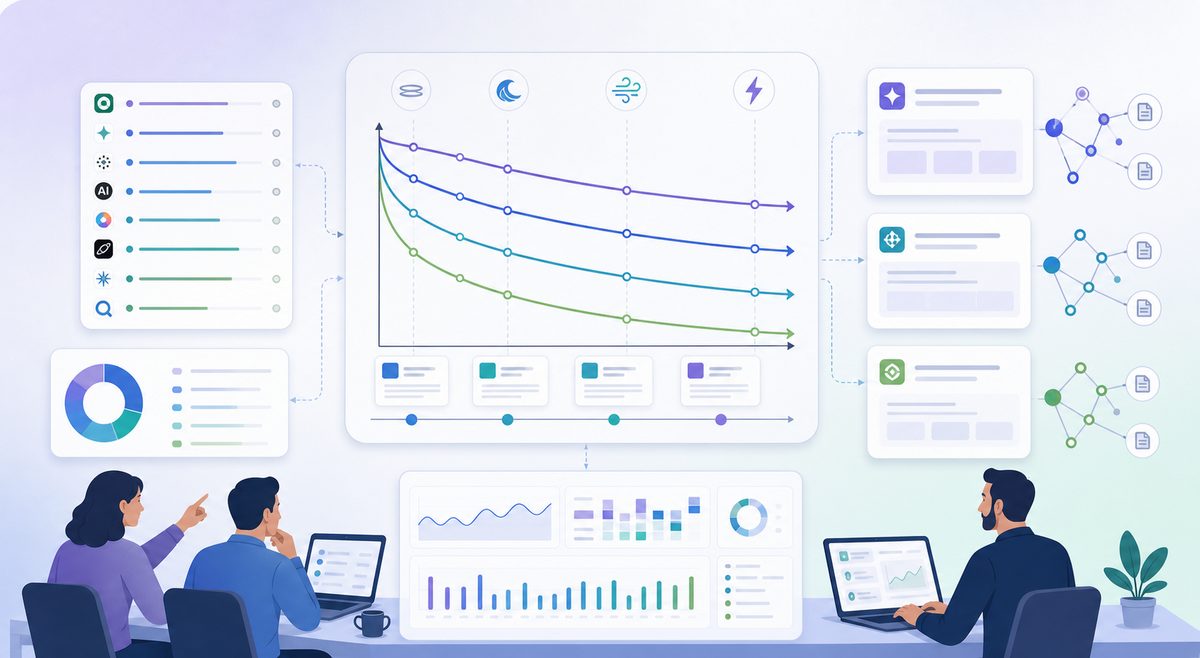
What citation-age data showed in a B2B SaaS sample
A maxaeo field sample found that cited pages were not always new, but fast-moving topics skewed much fresher than evergreen topics. The median cited source age changed sharply by query type.
Method: the sample used 180 commercially relevant B2B SaaS prompts captured across ChatGPT search, Gemini, Perplexity, Claude, Copilot, Grok, Google AI Mode, and Google AI Overviews. Repeated citations were de-duplicated by canonical URL, producing 1,184 cited URL observations. Each observation recorded engine, prompt, cited URL, citation position, source owner, visible date, dateModified where available, effective freshness date, and answer capture date.
This is not a universal ranking study. It is a practical benchmark for setting refresh cadences from observed AI citation behavior.
| Prompt or page type | Median cited source age | Middle 50% range | Refresh implication |
|---|---|---|---|
| Pricing, packaging, feature availability | 38 days | 14-91 days | Review every 2-4 weeks |
| “Best X” and vendor shortlist prompts | 64 days | 22-138 days | Review every 30-45 days |
| Competitor comparison pages | 81 days | 29-167 days | Review every 30-60 days |
| Integration and workflow guides | 126 days | 54-244 days | Review every 60-90 days |
| Strategy frameworks and pillar pages | 312 days | 124-710 days | Review every 90-180 days |
| Glossaries and stable definitions | 497 days | 210-940 days | Review every 180-365 days |
The pattern was not “newest page wins.” The pattern was shorter fact life, shorter citation age.
Fast-changing commercial prompts favored pages with current screenshots, named product versions, updated comparison tables, fresh third-party proof, and visible update dates. Evergreen prompts still cited older pages when the answer needed a durable definition, established framework, or canonical explanation.
How to measure citation age
Measure citation age at the prompt-source level, not just the page level. One page can be fresh for a definition and stale for a pricing claim.
Use this workflow:
- Build the prompt set. Include category, comparison, alternative, integration, pricing, security, and problem-aware prompts.
- Capture AI answers on a schedule. Weekly is enough for evergreen prompts; daily may be needed for pricing, launches, and competitor prompts.
- Record every cited URL. Capture the engine, prompt, answer text, citation order, and screenshot.
- Assign source owner. Mark each source as owned, earned, review site, documentation, community, or competitor.
- Find the effective freshness date. Use visible update dates, structured data, and editorial records.
- Classify fact risk. High-risk facts include pricing, integrations, compliance, product capabilities, and competitor claims.
- Calculate citation age. Use the formula for each cited source.
- Compare against the target window. Treat anything older than the window as freshness debt.
The simplest freshness debt formula is:
freshness debt = max(0, citation age - target freshness window)
A 120-day-old citation on a glossary page may have no debt. A 120-day-old citation on a “best AI visibility tools” prompt usually does.
How should teams set a refresh cadence?
Set refresh cadence by query volatility, citation value, and observed citation age. A page that influences AI share of voice for buying prompts deserves a shorter cadence than a glossary page with low commercial impact.
Use this decision table:
| Volatility tier | Example prompts | Suggested cadence | What to check |
|---|---|---|---|
| Tier 5: very high | “best AI visibility tool,” “maxaeo vs competitor,” pricing, security claims | 14-30 days | Features, screenshots, pricing language, claims, competitor changes |
| Tier 4: high | Integrations, templates, product-led use cases, “get recommended by ChatGPT” | 30-45 days | Workflow accuracy, screenshots, schema, internal links |
| Tier 3: medium | How-to guides, AI search monitoring playbooks, agency reporting | 60-90 days | Steps, examples, cited sources, platform changes |
| Tier 2: low | Answer engine optimization frameworks, category education | 90-180 days | Definitions, examples, supporting evidence |
| Tier 1: very low | Glossary, history, conceptual explainers | 180-365 days | Broken links, outdated examples, schema consistency |
A refresh cadence is not a publishing calendar. It is a risk control for pages that AI systems may cite when describing your brand, category, or competitors.
Updating a page today does not mean ChatGPT, Gemini, Perplexity, or Google AI answers will cite it tomorrow. Use the cadence alongside a measurement window like the one in How Long Until You Show Up in AI Search? A Time-to-Citation Study.
What counts as a real refresh?
A real refresh changes the answer quality, not just the timestamp. AI citations are more likely to improve when the update makes the page easier to retrieve, verify, quote, and trust.
A real refresh should include at least one substantive change:
- Replace expired facts. Update pricing references, screenshots, integration names, benchmark results, model names, compliance claims, and customer counts.
- Add first-hand evidence. Include observed data, screenshots, test conditions, examples, or a named methodology.
- Improve extractable answer blocks. Put the direct answer in the first 40-60 words of important sections.
- Clarify entities. Use consistent product, company, category, and competitor names.
- Update citations. Replace old third-party evidence with current official documentation, research, or primary sources.
- Align visible dates and schema. Make the visible last-updated date match
dateModified. - Strengthen internal links. Link from relevant pillar pages, comparison pages, and diagnostic guides.
Google’s people-first content guidance warns against changing dates to make pages seem fresh when the content has not substantially changed. It also warns against adding or removing content mainly to make a site appear fresh. See Google’s helpful content guidance.
That principle is even more important for AI reputation management. If an AI system cites your page for a product fact, the page should contain the fact, the date it was checked, and enough context for the answer engine to use it safely.
What to refresh by page type
Different page types need different refresh packages. A comparison page does not age the same way as a glossary page.
| Page type | Minimum refresh package |
|---|---|
| Pricing or packaging page | Plan names, price ranges, add-ons, screenshots, disclaimers, schema, internal links |
| Competitor comparison | Competitor positioning, feature table, evidence dates, screenshots, fair limitations, alternatives |
| “Best tools” page | Inclusion criteria, vendor list, category changes, pricing notes, first-hand testing notes |
| Integration guide | API names, UI steps, permissions, screenshots, partner docs, troubleshooting notes |
| Security or compliance page | Certifications, policy dates, data handling claims, audit status, legal review |
| Strategy guide | Platform changes, examples, diagrams, original data, cited studies |
| Glossary page | Definition accuracy, examples, related entities, schema, stale internal links |
The goal is not to make every page look new. The goal is to make every citation-worthy passage current enough for the claim it supports.
How to build a citation-age dashboard
A citation-age dashboard turns AI citations into a maintenance queue. It helps SEO, content, PR, product marketing, and support teams decide which sources need action first.
Track these fields for every cited source:
| Field | Example |
|---|---|
| Prompt | “best AI search monitoring tools for B2B SaaS” |
| Engine | ChatGPT, Gemini, Perplexity, Claude, Copilot, Grok, AI Mode, AI Overviews |
| Brand mentioned | maxaeo, competitor, no brand |
| Cited URL | Canonical source URL |
| Citation position | First, second, third, source card, not visible |
| Source owner | Brand-owned, earned media, review site, documentation, community |
| Effective freshness date | Visible update date or dateModified |
| Citation age | Days since effective freshness date |
| Fact risk | Low, medium, high |
| Revenue relevance | Informational, evaluation, conversion |
| Action | Monitor, refresh, correct, pitch, consolidate, redirect |
The most useful dashboard view is not a raw list of citations. It is a queue sorted by citation use:
citation leverage = prompt value x citation prominence x fact risk x freshness debt
This prevents low-impact housekeeping from consuming the content calendar. A two-year-old glossary citation may be fine. A 120-day-old competitor comparison cited in a “best tools” answer may be urgent.
For source-level diagnosis, use a workflow like GEO Citation Tracking: How to Map AI Citations to Source Fixes.
How to refresh pages that AI already cites
When a page already earns AI citations, refresh it carefully. Preserve the URL, strengthen the answer, and avoid removing the passage that the AI system appears to use.
Use this sequence:
- Capture the current AI answer. Save the prompt, answer text, cited URLs, citation order, and screenshot.
- Identify the cited passage. Find the paragraph, table, or section that supports the AI claim.
- Check whether the claim is still true. If not, replace it and add the verification date.
- Improve the cited passage. Make it more self-contained, specific, and quotable.
- Add current evidence. Use official docs, current screenshots, product notes, or fresh benchmarks.
- Update visible date and structured data. Keep dates honest and consistent.
- Request recrawl where appropriate. Use available search engine tools after substantial updates.
- Re-test after the expected lag. Track whether the page keeps, gains, or loses citations.
Do not rewrite a winning cited page so heavily that the useful passage disappears. AI systems often cite compact, clear sections. Protect the cited block while improving the evidence around it.
How to fix stale AI citations
A stale AI citation happens when an AI answer relies on a source that no longer reflects current facts. The fix depends on whether the stale source is owned, earned, or third-party controlled.
| Stale citation source | Best first action |
|---|---|
| Your own article | Update the cited passage, visible date, schema, and internal links |
| Your product page | Correct the product fact and link to deeper documentation |
| Your documentation | Update docs first, then align marketing content |
| Earned media | Send a concise correction request with proof and a replacement fact |
| Review site | Update the vendor profile and category data where allowed |
| Competitor page | Publish or improve a source that answers the exact prompt better |
For a deeper stale-source workflow, see Outdated AI Citations: How to Find, Prioritize, and Fix Stale Sources. If the problem is specifically wrong product facts, use the approach in AI Answers Outdated Information? How to Fix Stale Product Facts.
How to refresh pages that competitors get cited for
When competitors get the citation, compare freshness, specificity, and source fit before rewriting your page. Often the competitor page wins because it answers the exact sub-question with fresher proof.
Run a citation gap audit:
| Check | What to compare |
|---|---|
| Query fit | Does their page answer the exact prompt better? |
| Citation age | Is their source fresher for the fact being answered? |
| Evidence | Do they show screenshots, data, docs, or third-party validation? |
| Entity clarity | Is their brand, category, and use case clearer? |
| Passage quality | Is their answer block easier to quote? |
| Authority | Is the cited source third-party, editorial, or category-level? |
| Technical access | Is your equivalent page crawlable, indexable, and text-visible? |
If your page is older but more accurate, freshness may not be the issue. The issue may be retrieval, source fit, or authority. AI systems need to find the right passage for the prompt. For a deeper diagnostic, see Why AI Search Engines Cite Competitor Pages Instead of Yours.
A useful rule: do not refresh until you know which source you are trying to displace and why it was selected.
When freshness will not improve AI citations
Freshness will not fix a page that is irrelevant, inaccessible, thin, unsupported, or misaligned with the prompt. A current page can still lose if it fails basic retrieval and trust tests.
Do not expect a date update to help when:
- The page is blocked, noindexed, rendered poorly, or missing important text.
- The prompt intent does not match the page.
- The answer requires third-party validation, but your source is only brand-owned.
- The page lacks clear definitions, tables, examples, or evidence.
- The brand entity is ambiguous.
- The page targets many prompt variants without substance.
- The competitor source is more authoritative for that answer type.
- The update changes style but not the facts, evidence, or answer usefulness.
This is where classic SEO still matters. Google says generative AI features in Search rely on foundational SEO practices: crawlability, internal links, textual content, structured data that matches visible content, and helpful people-first pages. There is no special schema that guarantees inclusion in AI Overviews or AI Mode.
Freshness is one layer of answer engine optimization. It does not replace technical SEO, authority, entity clarity, or content quality.
A refresh cadence for B2B SaaS AI visibility
B2B SaaS teams should review commercially sensitive AI-search assets monthly, tactical guides quarterly, and evergreen assets twice a year. Adjust the timing using your own citation-age distribution.
A practical cadence looks like this:
| Asset type | Default cadence | Trigger for faster refresh |
|---|---|---|
| Pricing and packaging pages | 14-30 days | Any pricing, plan, or packaging change |
| Competitor comparison pages | 30-45 days | Competitor launch, positioning change, new AI citation |
| “Best tools” and alternatives pages | 30-45 days | New category entrant or AI shortlist change |
| Product feature pages | 30-60 days | Feature release, UI change, integration change |
| Security and compliance pages | 30-60 days | Policy, certification, or customer requirement change |
| Integration guides | 60-90 days | API, workflow, or partner documentation change |
| GEO/AEO strategy guides | 90-180 days | Platform behavior or measurement method change |
| Glossary and definition pages | 180-365 days | Term meaning shifts or SERP intent changes |
Teams using AI search monitoring should track not only whether the brand appears, but how the answer describes the brand. A stale citation can create an outdated description even when visibility looks strong.
That is why reporting should combine AI share of voice, cited source age, stale citation rate, sentiment, competitor overlap, and LLM brand tracking in the same view.
What should be reported to executives?
Report freshness as business risk, not editorial activity. Executives do not need a list of refreshed URLs. They need to know whether AI answers describe the company accurately and include it in the right buying moments.
Use five metrics:
| Metric | What it answers |
|---|---|
| AI share of voice | How often do AI answers mention us versus competitors? |
| Citation freshness | Are cited sources current enough for the prompt type? |
| Stale citation rate | How often do AI answers rely on outdated sources? |
| Citation recovery rate | After refreshes, how often do citations improve or return? |
| Recommendation presence | Do AI systems include us in shortlists for buying prompts? |
This framing connects content maintenance to revenue defense. If a stale source says your product lacks an integration that now exists, the issue is not “old blog content.” It is lost shortlist eligibility.
The recommended workflow
The best workflow is measure, prioritize, refresh, and re-measure. Do not start with the editorial calendar. Start with the AI answers that affect brand perception and buying behavior.
- Define the prompt set. Include category, comparison, alternative, integration, and problem-aware prompts.
- Capture answers daily or weekly. Track ChatGPT, Gemini, Perplexity, Claude, Copilot, Grok, Google AI Mode, and AI Overviews where relevant.
- Extract cited sources. Record cited URLs, citation order, answer language, and brand mentions.
- Calculate citation age. Use visible dates,
dateModified, and last substantial update records. - Segment by volatility. Separate fast-changing commercial topics from evergreen education.
- Prioritize by business impact. Focus on pages tied to shortlists, comparisons, and product facts.
- Refresh substantively. Update facts, evidence, structure, screenshots, internal links, and schema.
- Re-test after lag. Track citation recovery and changes in AI share of voice.
This turns content freshness from a vague SEO chore into an AI visibility control system.
Common questions
Is content freshness a ranking factor for AI citations?
Freshness can influence AI citations when the prompt requires current information, but it is not a standalone ranking factor that overrides relevance, authority, crawlability, or evidence. Treat it as a validity and trust signal inside a broader retrieval and generation process.
How often should B2B SaaS pages be refreshed for AI search?
Refresh high-volatility commercial pages every 14-45 days, tactical guides every 60-90 days, and evergreen strategy pages every 90-180 days. Use your own citation-age data to adjust the cadence by topic, engine, and business impact.
Should I change the date on a page to make it look fresh?
No. Change the date only after a substantial update. A real refresh should update facts, examples, screenshots, evidence, structure, or source citations. Date-only freshness can reduce trust and does not solve citation quality.
Which pages should be refreshed first?
Start with pages that influence revenue-relevant AI answers: competitor comparisons, alternatives pages, “best tools” pages, pricing explanations, integrations, security pages, and product capability pages. Prioritize pages already cited by AI engines or close substitutes for competitor-cited pages.
Can fresh content help get recommended by ChatGPT?
Fresh content can help when ChatGPT or another AI system retrieves web sources for current buying, product, or comparison questions. It still needs clear entity signals, strong evidence, crawlability, and answer-ready passages to be selected and cited.
What is the difference between content freshness and citation age?
Content freshness describes how current a page’s facts and evidence are. Citation age measures how old a cited source is at the moment an AI answer uses it. A page can be fresh without being cited, and a citation can be old without being wrong.
Final takeaway
Content freshness AI citations are best managed with citation-age data, not guesswork. Refreshing everything is expensive and imprecise. Refreshing the sources that AI engines cite, or should cite, is measurable.
The operating rule is simple:
Shorter fact life = shorter refresh cadence.
Higher business impact = higher refresh priority.
No substantive update = no date change.
For B2B SaaS teams, the goal is not to look new. The goal is to be the most current, useful, and verifiable source when AI systems decide which brands to mention, cite, and recommend.