AI search issue triage is how marketing, SEO, PR, and product teams decide which AI answer problems need action now, which should be monitored, and which are harmless answer variation. The goal is not to chase every changed response. The goal is to protect pipeline, brand trust, and decision-maker attention with evidence.
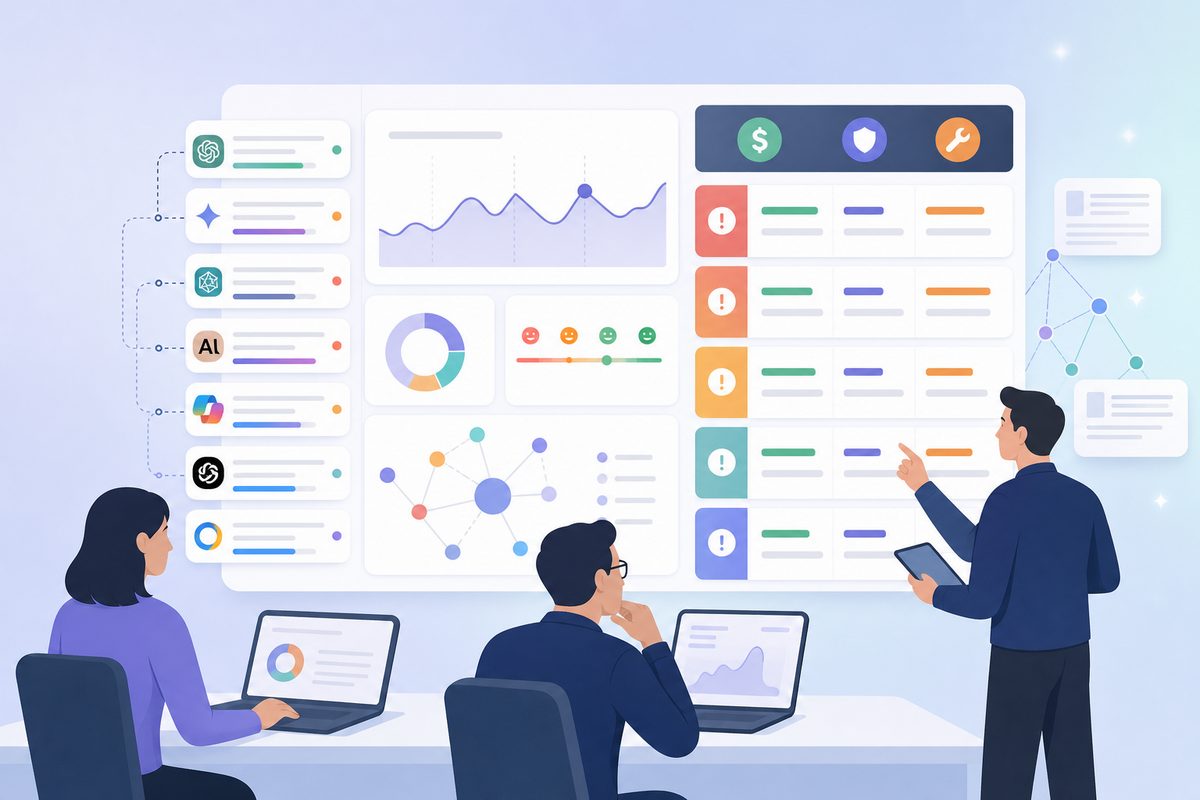
A good triage system turns scattered screenshots from ChatGPT, Perplexity, Gemini, Claude, Copilot, Grok, Google AI Mode, and AI Overviews into a ranked issue queue. It separates a one-off odd answer from a recurring buyer-facing problem that affects shortlists, citations, product understanding, or reputation.
What Is AI Search Issue Triage?
AI search issue triage is a repeatable scoring workflow for ranking AI answer problems by business impact, trust risk, recurrence, and repair path. It helps teams decide what to fix first, who owns the fix, what evidence is required, and when an issue should be escalated.
This matters because AI search answers are not stable like a single blue-link ranking. Google says AI Overviews and AI Mode can use query fan-out, issuing multiple related searches across subtopics and sources, and that links may vary between AI features and classic search in its AI features documentation.
Independent research shows why one screenshot is not enough. A 2026 preprint by Grossman et al. analyzed 11,500 queries and found that Google Search, AI Overviews, and Gemini retrieved substantially different sources, with less consistency across repeated runs and minor query edits (Grossman et al., 2026). Another 2026 paper argues that AI search visibility should be measured as a distribution across runs, prompts, and time, not as a single snapshot (Schulte, Bleeker, and Kaufmann, 2026).
A single answer change is a signal. It becomes an issue when it is repeated, commercially important, reputation-sensitive, or tied to a source that can be repaired.
The 5-Minute AI Search Issue Triage Workflow
Use this workflow when an AI engine gives a wrong, missing, stale, or commercially damaging answer about your brand.
- Capture the answer. Save the prompt, platform, market, date, answer text, brand position, competitors, citations, and screenshot.
- Confirm recurrence. Test at least three prompt variants and, when possible, more than one engine or day.
- Classify the issue. Label it as omission, wrong fact, stale citation, competitor displacement, negative framing, hallucination, or compliance risk.
- Score priority. Rate revenue exposure, reputation risk, and fixability from 1 to 5.
- Assign severity. Convert the score into P0, P1, P2, P3, or P4.
- Route ownership. Send the issue to SEO, content, PR, product marketing, support, legal, or an executive sponsor.
- Repair the source layer. Update owned pages, cited third-party pages, entity facts, comparison content, or public profiles.
- Retest and close. Re-run the prompt set after changes are indexed or citations shift. Mark the issue resolved only when the answer pattern improves.
The practical rule: do not escalate until the issue is material and repeatable, unless it creates legal, safety, security, privacy, financial, or executive-level risk.
What Counts as an AI Search Issue?
Not every imperfect answer deserves a fix. Triage starts by naming the issue type.
| Issue type | Example | Typical risk |
|---|---|---|
| Brand omission | Your brand is absent from a buyer shortlist where direct competitors appear | Revenue loss |
| Competitor displacement | A weaker-fit competitor is recommended above your brand for your core use case | Pipeline and category risk |
| Wrong product fact | The answer says you lack a feature, integration, market, or customer segment you actually serve | Reputation and sales friction |
| Stale citation | Perplexity or AI Overviews cite an outdated review, old pricing page, or deprecated docs page | Trust and conversion risk |
| Misleading comparison | The answer frames your product against the wrong competitors or category | Positioning risk |
| Negative unsupported claim | The answer claims poor security, bad reviews, legal issues, or customer risk without support | High reputation risk |
| Hallucinated fact | The answer invents pricing, customers, leadership, locations, or capabilities | Accuracy risk |
| Low-risk variation | A single run uses vague wording but does not affect buyer understanding | Watch only |
The highest-priority issues usually combine three signals: buyer intent, repeated occurrence, and a visible source path.
Build an Evidence Packet Before Scoring
A useful AI search issue ticket should contain enough evidence for another person to reproduce the problem. Screenshots alone are weak because they hide the prompt, location, timing, and citation context.
Capture these fields:
| Field | What to record |
|---|---|
| Prompt | Exact query or conversational prompt |
| Prompt cluster | Category, comparison, pricing, alternative, problem/solution, or brand query |
| Engine | ChatGPT, Perplexity, Gemini, Claude, Copilot, Grok, AI Mode, AI Overviews, or another system |
| Date and market | Date, country, language, and device when relevant |
| Brand position | Recommended, mentioned, ignored, misdescribed, or negatively framed |
| Competitors | Which competitors appear and how they are ranked or described |
| Answer text | The exact sentence or passage causing the issue |
| Citations | Cited URLs, domains, publication dates, and whether the source is owned or third-party |
| Recurrence | Number of runs, prompt variants, engines, or days where the issue appears |
| Business context | ICP fit, funnel stage, sales relevance, and customer risk |
| Suggested owner | SEO, content, PR, product marketing, support, legal, or executive sponsor |
For important prompts, use three variants before scoring:
- Literal buyer query: “Best AI search monitoring tools for B2B SaaS”
- Natural-language query: “What tools help SaaS teams see how AI search describes their brand?”
- Comparison query: “MaxAEO vs other AI visibility tools for tracking ChatGPT and Perplexity mentions”
A dedicated AI visibility tool should preserve answer history, citations, brand rank, competitors, sentiment, and prompt clusters. Without that history, teams end up debating anecdotes instead of repairing sources.
The Revenue, Reputation, and Fixability Scorecard
The simplest useful model scores each AI search issue on three axes:
Priority score = (Revenue exposure x 0.4) + (Reputation risk x 0.4) + (Fixability x 0.2)
Use a 1-5 score for each axis.
| Score | Revenue exposure | Reputation risk | Fixability |
|---|---|---|---|
| 1 | Low-intent query with no ICP fit | Minor wording issue | No visible source or clear action path |
| 2 | Early research query | Generic or incomplete positioning | Requires multiple third-party changes |
| 3 | Mid-funnel category query | Incorrect but not materially harmful | Fixable through owned content and internal links |
| 4 | Comparison, alternative, shortlist, or pricing query | Misstates product, pricing, market, or customer fit | Fixable source is known and reachable |
| 5 | Bottom-funnel query tied to pipeline or key accounts | Legal, security, privacy, safety, executive, or major customer risk | High-control source can be repaired quickly |
Add a confidence label before assigning severity:
| Confidence | Evidence threshold |
|---|---|
| Low | One run, one prompt, no visible citation, no buyer context |
| Medium | Repeats across prompt variants, engines, or days |
| High | Repeats across multiple engines or days, affects buyer prompts, and has a visible source pattern |
A high-risk false claim can be a P0 even with low recurrence. For everything else, recurrence prevents the team from treating normal AI answer variation as an emergency.
Step 1: Score Revenue Exposure
Revenue exposure measures whether the AI answer can influence qualified demand. A wrong answer on a buying prompt matters more than a strange answer on a broad educational query.
Use funnel role as the first filter:
| Prompt type | Examples | Revenue score guidance |
|---|---|---|
| Definition | “What is AI search monitoring?” | 1-2 |
| Problem/solution | “How do I track brand mentions in ChatGPT?” | 2-3 |
| Category | “Best AI visibility tools” | 3-4 |
| Comparison | “MaxAEO vs Profound” | 4 |
| Alternative | “Profound alternatives for startups” | 4 |
| Pricing or vendor selection | “AI search monitoring pricing” | 4-5 |
| Account-specific | “Is [brand] good for enterprise security teams?” | 5 |
Then ask five business questions:
| Question | Why it matters |
|---|---|
| Would an ICP buyer ask this before booking a demo? | Buyer intent raises priority. |
| Does the answer recommend or exclude vendors? | Shortlist visibility can shape pipeline before a site visit. |
| Is a direct competitor ranked above the brand? | AI share of voice can shift category perception. |
| Does the prompt map to an existing converting page? | Existing assets make source repair easier. |
| Does the issue appear across more than one engine? | Cross-engine recurrence increases confidence. |
This is where AI search differs from classic SEO. A page can hold organic rankings and still lose visibility inside generated answers. For measurement differences, see AI Search vs SEO: What Changes, What Still Works, and How to Measure It.
A practical rule: if the prompt could appear in a sales call, analyst briefing, agency audit, board question, or competitor evaluation, score revenue exposure at least 3.
Step 2: Score Reputation Risk
Reputation risk measures whether the answer damages trust, spreads a false fact, or changes how buyers understand the brand. In AI reputation management, a confident wrong answer can be worse than no mention because the user may treat the response as synthesized consensus.
High-risk reputation issues include:
| Issue | Example | Typical score |
|---|---|---|
| Vague positioning | “The company works in AI marketing” | 2 |
| Wrong category | “Mainly an SEO writing tool” when the product is an AI visibility platform | 3-4 |
| Wrong customer fit | “Best for small blogs” when the product serves B2B marketing teams | 3-4 |
| Fabricated feature gap | “Does not track Perplexity” when it does | 4 |
| Stale pricing | Cites old pricing or discontinued packaging | 3-4 |
| Unsupported negative claim | Says the brand has security, legal, or reliability issues without evidence | 5 |
| Regulated-topic error | False claim involving privacy, safety, finance, healthcare, or legal risk | 5 |
Citation quality problems are well documented. Liu, Zhang, and Liang found that only 51.5% of generated sentences in audited generative search responses were fully supported by citations, while 74.5% of citations supported the sentence they were attached to (Liu, Zhang, and Liang, 2023). A 2026 AI Overviews study decomposed responses into 98,020 atomic claims and found that 11.0% were unsupported by cited pages (Xu, Iqbal, and Montgomery, 2026).
Score reputation risk by user harm and business consequence. “Slightly incomplete” is not the same as “materially false.” A wrong enterprise-readiness claim, a fabricated security limitation, or an outdated pricing citation should move faster than weak phrasing on a top-funnel definition query.
For a repair workflow focused on false brand answers, use Fix Wrong AI Answer About My Brand: A Source Repair Workflow.
Step 3: Score Fixability
Fixability measures how quickly your team can change the evidence that answer engines appear to use. The best fixes usually start with cited sources, owned pages, and entity consistency. The hardest fixes involve no visible source, unavailable third-party content, or broad market perception.
Do not confuse “we can publish a post” with “we can repair the answer.” The fix must target the source pattern behind the issue.
| Source pattern | Fixability | First action |
|---|---|---|
| Owned page is cited and outdated | 5 | Update visible copy, add an answer block, improve internal links, request re-indexing where appropriate |
| Owned page is missing a key fact | 4 | Add the fact in crawlable text, align title/H1/body/schema, link from related pages |
| Third-party article cites old positioning | 3 | Request correction, publish a clearer owned source, brief PR or partner team |
| Review, directory, or marketplace page is stale | 3 | Update profile, add proof, correct category, respond where relevant |
| Competitor page frames the comparison | 2-3 | Publish a stronger comparison or alternative page with evidence |
| No citation is shown | 2 | Strengthen entity facts across site, profiles, docs, reviews, and earned mentions |
| Model repeats a false claim with no visible source | 1 | Document recurrence, prepare evidence, escalate through platform, legal, or PR path if severe |
The same logic applies to AI citations. If the cited URL is stale, the issue is not only the answer; it is the evidence layer. For source mapping, use GEO Citation Tracking: How to Map AI Citations to Source Fixes and Outdated AI Citations: How to Find, Prioritize, and Fix Stale Sources.
Convert Scores Into Priority, Owners, and SLAs
A triage matrix turns AI search monitoring into operating discipline. Each issue gets a severity level, owner, service-level expectation, and evidence requirement.
| Priority | Definition | Typical owner | SLA |
|---|---|---|---|
| P0 | False or harmful claim with legal, security, privacy, safety, executive, or major customer risk | Comms, legal, executive sponsor | Same day |
| P1 | High-intent buyer prompt excludes the brand, recommends the wrong competitor, or misstates core product fit | SEO, product marketing, demand gen | 2-5 business days |
| P2 | Recurring inaccurate description on mid-funnel prompts | Content, SEO, PR | 1-2 weeks |
| P3 | Low-risk omission, weak citation, or outdated minor detail | Content or web team | Monthly batch |
| P4 | Single-run variation with no buyer impact | Monitoring owner | Watch only |
Routing matters as much as scoring. SEO should not own every AI search issue.
| Issue owner | Best-fit problems |
|---|---|
| SEO/content | Owned-page gaps, internal links, answer blocks, comparison pages, schema alignment |
| Product marketing | Positioning, category definition, use cases, ICP fit, competitor framing |
| PR/comms | Earned media, analyst narratives, outdated third-party mentions, public correction paths |
| Support/customer success | Recurring customer confusion, docs gaps, onboarding misunderstandings |
| Legal/security | Claims about compliance, privacy, safety, contracts, regulated risk |
| Executive sponsor | P0 issues, strategic category risk, major account exposure |
Executives should see P0 issues and persistent P1 patterns, not every prompt log.
Worked Example: A SaaS Brand Losing AI Shortlist Visibility
This composite example reflects a common B2B SaaS pattern: the company has good web pages, but AI search answers rely on stale third-party summaries and incomplete category signals.
Assume a customer support SaaS company monitors 120 buyer prompts across ChatGPT, Perplexity, Gemini, Claude, Copilot, Grok, Google AI Mode, and AI Overviews. In one weekly review, four issues appear:
| Issue | Evidence | Revenue | Reputation | Fixability | Score | Priority |
|---|---|---|---|---|---|---|
| Brand missing from “best support automation tools for B2B SaaS” in 5 of 8 engines | Competitors recommended; no brand mention | 5 | 3 | 3 | 3.8 | P1 |
| Gemini says the product is “mainly for ecommerce” | Repeats across four prompt variants | 4 | 4 | 4 | 4.0 | P1 |
| Perplexity cites a 2023 review page with old pricing | Source URL visible | 4 | 3 | 5 | 3.8 | P1 |
| Claude describes the company as “early-stage” | One run only; no citation | 1 | 2 | 1 | 1.4 | P4 |
The first three deserve action. The fourth should be watched, not escalated.
The recommended repair order is:
- Fix the outdated pricing citation because the source is visible and repairable.
- Clarify category and customer fit on the homepage, product pages, about page, review profiles, and directory listings.
- Build or improve comparison and category pages that answer shortlist prompts directly.
- Monitor the “early-stage” claim until it repeats, gains citations, or appears in a buyer context.
This is the main value of AI search issue triage: it prevents a team from chasing every unusual response while still surfacing problems that can affect pipeline and trust.
What to Fix First: Source Repair Beats Prompt Chasing
The strongest fix is usually better evidence, not more prompts. Answer engines need clear, consistent, verifiable sources that explain who the brand serves, what it does, how it compares, and why it should be recommended.
Start with owned assets because they are controllable:
- Homepage
- Product pages
- Use-case pages
- Pricing pages
- Comparison pages
- Alternatives pages
- Docs and help center pages
- Customer proof pages
- About page
- Review and directory profiles you can edit
For each page, make core facts visible in text. Google’s AI features guidance says existing SEO fundamentals still apply, important content should be available in textual form, and structured data should match visible text. It also says there is no special schema required to appear in AI Overviews or AI Mode.
Then move to third-party sources. Review sites, directories, analyst pages, partner pages, podcast notes, newsletters, and media articles often shape AI brand summaries. If the external source is wrong, ask for a correction and publish a clearer owned source that answer engines can find.
A useful source repair checklist:
- State the entity clearly. Define the brand, category, ICP, product, and primary use cases.
- Correct stale facts. Update pricing, packaging, integrations, customers, leadership, and dates.
- Add answer-ready blocks. Use short, direct sections that answer buyer prompts in 40-80 words.
- Support claims with proof. Add customer examples, product screenshots, docs links, reviews, or public references.
- Align internal links. Link from high-authority pages to the corrected source.
- Update structured data only when it matches visible content.
- Retest after indexing or citation changes. Do not close the issue just because a page was edited.
How to Verify That a Fix Worked
A fix is not complete when the page is published. It is complete when the answer pattern improves or the risk is downgraded.
Use four post-fix states:
| State | Meaning | Next action |
|---|---|---|
| Resolved | The issue no longer appears across the monitored prompt set | Close and keep monthly watch |
| Improved | The answer is better, but some engines still show stale wording | Keep the issue open and strengthen source coverage |
| Unchanged | The answer pattern did not move after the source was updated and rechecked | Re-map citations and inspect third-party sources |
| Regressed | The issue worsened or spread to new prompts | Escalate priority and broaden ownership |
Retest the same prompt variants used in the original evidence packet. If the issue involved citations, compare cited URLs before and after the fix. If the problem had no visible citation, compare wording, entity facts, competitor mentions, and brand inclusion across engines and days.
Operating Cadence: Daily Alerts, Weekly Triage, Monthly Readout
The right cadence keeps AI search work measurable without turning it into daily chaos.
| Cadence | Purpose | Output |
|---|---|---|
| Daily alerts | Catch urgent reputation, citation, or shortlist changes | P0/P1 candidates |
| Weekly triage | Score issues, assign owners, check fix progress | Ranked issue queue |
| Monthly readout | Summarize movement for leadership | AI share of voice, risk, repairs, blockers |
| Quarterly review | Revisit prompt clusters and business priorities | Updated monitoring set |
A useful tool workflow should support four views:
| View | What it answers |
|---|---|
| Prompt cluster | Where do buyers ask questions that should include us? |
| Brand rank | Are we recommended, mentioned, ignored, or displaced? |
| Citation map | Which URLs shape the answer? |
| Issue queue | What should be fixed first, by whom, and by when? |
This is the practical bridge between answer engine optimization and operations. Strategy says “get recommended by ChatGPT.” Triage decides which source, page, citation, or narrative gets the next sprint.
How to Report AI Search Issue Triage to Leadership
Leadership reporting should translate AI answer problems into business language. Avoid long prompt logs unless executives ask for them. Show what changed, why it matters, what shipped, and what remains blocked.
A monthly readout can fit on one page:
| Metric | Example executive wording |
|---|---|
| AI share of voice | “We appeared in 42% of monitored buyer shortlists, up from 34% last month.” |
| High-risk issues | “Two P1 issues remain: one outdated citation and one competitor comparison gap.” |
| Reputation accuracy | “Incorrect product-category descriptions fell from 11 recurring prompts to 3.” |
| Fix velocity | “Seven source repairs shipped; four were reflected in AI answers within two weeks.” |
| Citation quality | “Outdated third-party citations dropped from 9 to 4 across tracked prompt clusters.” |
| Blockers | “Two directory profiles require vendor updates; PR owns follow-up.” |
Do not overpromise attribution. AI search visibility is not a clean last-click channel. The stronger argument is risk-adjusted: when buyers use answer engines to build vendor shortlists, the brand needs to be accurately represented, credibly cited, and present for prompts that influence consideration.
Common Mistakes That Turn Triage Into Noise
AI search triage fails when teams treat every answer change as equally meaningful. The discipline is to preserve context, compare patterns, and fix sources before debating opinions.
Avoid these mistakes:
- Reacting to one screenshot. Repeat the prompt, test variants, and compare engines before escalating.
- Ignoring buyer intent. A lost mention matters more on a comparison query than on a broad definition query.
- Treating citations as decoration. The cited page may be the repair path.
- Assigning every issue to SEO. PR, product marketing, support, legal, and executives each own different issue types.
- Publishing generic GEO content. Google’s helpful content guidance asks whether content provides original information, complete coverage, and insight beyond the obvious.
- Creating scaled pages with no added value. Google’s spam policies define scaled content abuse as producing many unoriginal pages mainly to manipulate rankings.
- Closing issues after publishing, not after verification. The answer pattern must improve before the issue is resolved.
- Ignoring third-party profiles. Review sites, directories, partner pages, and media summaries can influence answers more than a new blog post.
- Using one score without confidence. Revenue, reputation, and fixability matter, but recurrence determines whether the evidence is strong enough to act.
The strongest programs use AI search issue triage to reduce work, not create more of it. They act when the issue is material, repeated, and fixable enough to justify the effort.
FAQ
What is AI search issue triage?
AI search issue triage is the process of ranking AI answer problems by revenue exposure, reputation risk, recurrence, and fixability. It helps teams decide which wrong answers, missing brand mentions, stale citations, or competitor displacements need action first.
How often should teams triage AI search issues?
Most teams should monitor important prompts daily and triage issues weekly. Daily alerts catch urgent reputation or buyer-shortlist problems, while weekly scoring prevents overreaction to normal AI answer variation. High-risk industries should add same-day escalation for false claims involving legal, security, privacy, health, finance, or safety topics.
What is the difference between AI search monitoring and issue triage?
AI search monitoring collects evidence: prompts, answers, brand mentions, rankings, competitors, citations, and changes over time. Issue triage decides what the evidence means, how severe the problem is, who owns the fix, and when action should happen.
Should every wrong AI answer be fixed?
No. Some wrong or weak AI answers should only be watched. Fix issues when they repeat, affect buyer prompts, create reputation risk, or point to a source you can realistically repair. A single low-impact answer with no citation and no recurrence is usually a P4.
Who should own AI search issue triage?
Marketing or SEO usually runs the triage process, but ownership depends on the issue. SEO and content handle owned-source repairs. Product marketing owns positioning and comparison gaps. PR handles earned media and analyst narratives. Support owns recurring customer confusion. Legal and executives handle high-risk false claims.
How does triage help a brand get recommended by ChatGPT and other answer engines?
Triage focuses effort on the prompts and sources most likely to influence recommendations. Instead of publishing random AI content, teams repair cited sources, clarify entity facts, strengthen proof points, and improve pages tied to buyer shortlists. That increases the chance that answer engines understand and recommend the brand where it is genuinely relevant.