AI search CRM attribution is the process of recording how buyers used ChatGPT, Perplexity, Gemini, Claude, Copilot, Grok, or Google AI Overviews before they became a lead, opportunity, or customer. It turns invisible AI-assisted research into structured CRM evidence: prompt, engine, vendors shown, brand mention, influence level, and revenue outcome.
For B2B teams, this matters because AI discovery often happens before analytics can see a click. A buyer may ask ChatGPT for "best SOC 2 automation tools for startups," copy a vendor name, search that brand later, click a retargeting ad, and book a demo from a branded query. Standard reporting may call that "paid search" or "organic search." The first commercial influence came from AI.
The goal is not to claim every AI mention as pipeline source. The goal is to answer a more useful question: which buyer prompts and answer engines are shaping real opportunities, and what should marketing fix next?
What Buyers Mean When They Search "AI Search CRM Attribution"
Most people searching this topic are not looking for another definition of dark funnel attribution. They want an operating model that connects four things:
- AI search monitoring: where the brand appears in AI answers.
- CRM evidence: what real buyers say during sales calls.
- Pipeline reporting: how much opportunity value is AI-researched, AI-assisted, or AI-sourced.
- Optimization work: which sources, comparison pages, third-party mentions, and category narratives need to change.
A strong AI search CRM attribution setup should help a revenue team answer:
- Did the buyer use an AI answer engine during vendor research?
- Which engine did they use?
- What did they ask?
- Which vendors appeared beside us?
- Was our brand mentioned, omitted, misdescribed, or recommended?
- Did the AI answer influence the shortlist, the demo request, or the final decision?
- Which prompts should we monitor in an AI visibility tool like MaxAEO?
That is the commercial workflow. CRM fields alone are not enough. AI search dashboards alone are not enough. The value appears when buyer-confirmed prompts from sales are tracked against live AI answers.
What Is AI Search CRM Attribution?
AI search CRM attribution is a CRM measurement layer for AI-assisted buying journeys. It records whether a prospect used an AI answer engine, what they asked, which vendors appeared, whether the brand was mentioned, and how strongly that AI interaction influenced the opportunity.
It is a supplement to UTMs, first-touch attribution, last-touch attribution, web analytics, and self-reported attribution. It is not a replacement for them.
The useful unit is not:
"ChatGPT drove this deal."
The useful unit is:
"The buyer used ChatGPT to build a vendor shortlist, ChatGPT mentioned three tools, our brand appeared in the top group, and the buyer repeated the same comparison language on the discovery call."
That turns a call anecdote into reportable evidence.
Why Referrer Analytics Miss AI Influence
Referrer analytics miss AI influence because many AI-assisted buyers never click directly from an AI answer. They copy a brand name, search it later, visit directly, ask a colleague, return through a different channel, or click a non-AI source after the shortlist has already been shaped.
This is already visible in search behavior. Pew Research Center found that Google users who saw an AI summary clicked a traditional search result in 8% of visits, compared with 15% when no AI summary appeared. Users clicked a link inside the AI summary in only 1% of visits, according to Pew's July 2025 analysis of Google AI summaries.
AI referral traffic also has a baseline-growth problem. A 2026 log-based natural experiment on ChatGPT referrals reported that total ChatGPT referrals grew 5.7x, while untreated pages on the same domain grew 3.5x. The estimated treatment effect was closer to 1.8-2.3x and remained suggestive under a conservative placebo test in the AEO referral traffic study.
The implication is simple: AI referrals are useful but incomplete. CRM attribution adds buyer-confirmed evidence that referrer data cannot capture.
The Prompt-to-Pipeline Evidence Model
MaxAEO uses a simple evidence model for AI search CRM attribution:
| Layer | Evidence captured | Best source | Commercial use |
|---|---|---|---|
| Buyer prompt | What the buyer asked an AI engine | Sales call, form, chat, transcript | Reveals real category language |
| AI answer | Which brands, citations, and claims appeared | AI search monitoring | Shows visibility and competitive framing |
| CRM influence | Whether the AI answer affected the opportunity | CRM fields and rep notes | Supports pipeline reporting |
| Source fix | Which cited or missing sources need work | AI citation tracking and content review | Guides GEO, PR, and content priorities |
This model prevents two common errors.
First, it avoids analytics-only attribution, where teams count only visible AI referrals and miss buyers who came back through direct, branded search, email, or paid retargeting.
Second, it avoids anecdote-only attribution, where a rep hears "ChatGPT recommended you" but the evidence never becomes structured enough to report.
The Minimum CRM Field Set for AI Search Influence
The minimum field set should capture five things: whether AI was used, which engine was used, what the buyer asked, which vendors appeared, and how confident the team is that AI influenced the opportunity.
Start at the opportunity or deal level. Lead-level capture can help early, but opportunity records are where stage, amount, close date, and outcome live.
| Field | Type | Example values | Why it matters |
|---|---|---|---|
| AI Research Used | Picklist | Yes, No, Unsure | Creates the reporting denominator. |
| AI Engine Used | Multi-select | ChatGPT, Perplexity, Gemini, Claude, Copilot, Grok, Google AI Overviews, Google AI Mode, Other | Shows which engines influence buyers. |
| Buyer Prompt | Long text | "best AI search visibility tools for B2B SaaS" | Reveals real commercial language. |
| Prompt Intent | Picklist | Category research, vendor shortlist, comparison, pricing, implementation, risk review | Connects prompts to funnel stage. |
| AI Recommended Vendors | Long text or related list | maxaeo, Profound, Peec AI, Otterly | Captures the competitive shortlist. |
| Our Brand Mentioned | Picklist | Yes, No, Buyer unsure | Separates AI usage from brand visibility. |
| Brand Framing | Picklist | Recommended, Neutral, Missing, Misdescribed, Negative | Shows whether the AI answer helped or hurt. |
| AI Citation Recalled | Long text | "It cited a best tools article and a Reddit thread" | Helps investigate source influence. |
| Influence Level | Picklist | Observed, Assisted, Decisive, Disqualified, Unknown | Prevents over-crediting. |
| Confidence | Picklist | Low, Medium, High | Keeps reporting honest. |
| Evidence Note | Text | "Buyer said Perplexity put maxaeo in the top three." | Gives RevOps an audit trail. |
Do not create 30 fields on day one. A useful AI search CRM attribution update should take under 45 seconds after a discovery call.
Salesforce and HubSpot Field Mapping
Salesforce and HubSpot can support AI search CRM attribution without custom objects at the start. Use opportunity or deal properties first. Add automation only after the team knows which fields reps complete consistently.
| Field concept | Salesforce implementation | HubSpot implementation | Setup note |
|---|---|---|---|
| AI Research Used | Opportunity picklist | Deal property dropdown | Make required after discovery stage if adoption is strong. |
| AI Engine Used | Opportunity multi-select picklist | Deal multi-checkbox | Keep values controlled. |
| Buyer Prompt | Long Text Area | Multi-line text | Allow paraphrases when exact prompts are unavailable. |
| AI Recommended Vendors | Text Area or competitor related list | Multi-line text or custom competitor property | Normalize names during weekly cleanup. |
| Our Brand Mentioned | Opportunity picklist | Deal property dropdown | Use Yes, No, Buyer unsure. |
| Brand Framing | Opportunity picklist | Deal property dropdown | Track missing and negative answers, not only recommendations. |
| Influence Level | Opportunity picklist | Deal property dropdown | Tie each value to a written definition. |
| Confidence | Picklist | Dropdown | Require when influence is Assisted or Decisive. |
| Evidence Note | Text Area | Multi-line text | Include transcript timestamp when available. |
A good first automation is a task for marketing ops when Brand Framing = Misdescribed or Our Brand Mentioned = No on a high-value opportunity. That creates an action path for content, PR, and AI citation work.
Avoid auto-filling prompt fields from guesswork. A session source of chatgpt.com proves a click from ChatGPT. It does not prove the buyer prompt, the answer shown, the vendors recommended, or the decision influence.
How Sales Teams Should Capture Buyer Prompts Without Slowing Calls
Sales should use one natural discovery question, one optional follow-up, and one post-call CRM update.
Ask:
"Before this call, did you use ChatGPT, Perplexity, Gemini, Google AI Overviews, or another AI tool to research vendors or build your shortlist?"
If the answer is yes, ask:
"Do you remember roughly what you asked or which vendors it recommended?"
That is enough for most opportunities. Exact prompt text is ideal, but a close paraphrase is still useful. Buyers often remember the category phrase, the competitor set, and the framing: "best for startups," "enterprise-ready," "easy to implement," "cheaper than," or "stronger for compliance."
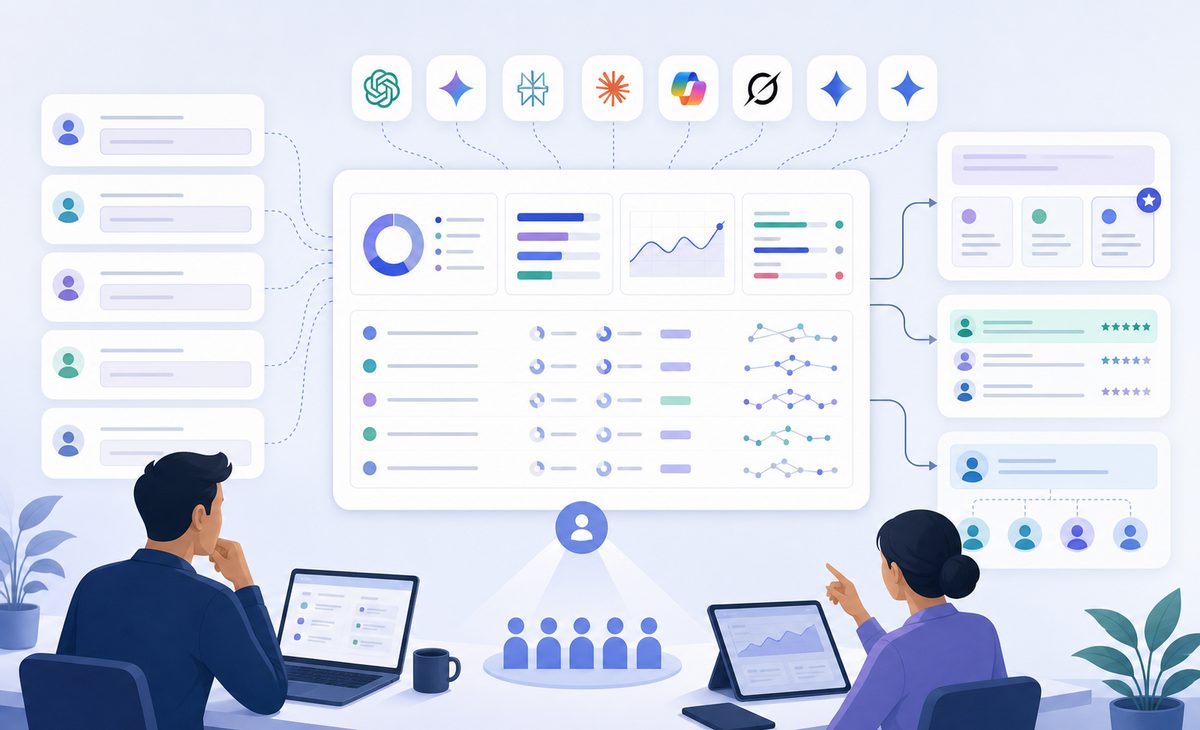
Use call transcripts to reduce rep workload. If the team uses Gong, Clari, Chorus, ZoomInfo, Fireflies, or another conversation intelligence platform, RevOps can search for phrases such as:
- "ChatGPT recommended"
- "Perplexity said"
- "Gemini showed"
- "AI Overview mentioned"
- "I asked AI"
- "AI shortlist"
- "compared you against"
- "best tools for"
- "alternatives to"
- "who should we evaluate"
The clean workflow is: rep asks, transcript captures, CRM stores the structured evidence.
How to Score AI Influence Without Overclaiming Revenue
AI search CRM attribution should report influence, not pretend to prove single-touch causality. An AI answer may introduce a brand, reinforce trust, create a competitor shortlist, or misposition a company. It rarely acts alone.
Use this influence scale:
| Influence level | Definition | Revenue reporting treatment |
|---|---|---|
| Observed | Buyer used an AI engine, but no clear brand or shortlist influence was stated. | Count in AI-researched opportunities. |
| Assisted | AI answer mentioned the brand, category, competitor, or source that shaped the buyer's research. | Count in AI-assisted pipeline. |
| Decisive | Buyer says the AI answer introduced the brand or materially changed the shortlist. | Count in high-confidence AI-influenced pipeline. |
| Disqualified | AI answer created a wrong fit, wrong positioning, negative perception, or competitor preference. | Count in AI reputation and source-fix workflow. |
| Unknown | Evidence is too vague to classify. | Exclude from influenced revenue totals. |
Then add confidence:
| Confidence | Required evidence | Example |
|---|---|---|
| High | Buyer names the engine, prompt or prompt theme, vendor set, and influence | "ChatGPT recommended maxaeo for AI search monitoring, so we booked the demo." |
| Medium | Buyer confirms AI use and vendor influence but cannot recall exact prompt | "Perplexity had you and two competitors on the shortlist." |
| Low | Buyer vaguely mentions AI research without clear impact | "Someone used AI during research, but I am not sure what it said." |
This distinction protects credibility. "We appeared in ChatGPT" is not the same as "ChatGPT introduced the buyer to us."
How CRM Answers Connect With AI Search Monitoring
CRM answers tell teams what real buyers asked. AI search monitoring tells teams what answer engines said in response. The commercial value appears when those datasets meet.
Google explains that AI experiences in Search use systems such as query fan-out, where related searches help generate richer responses, in its AI features and your website guidance. That means a buyer's single prompt can cause an answer engine to evaluate several related queries, sources, entities, and comparison angles.
A practical workflow looks like this:
- Sales captures the buyer prompt in the CRM.
- Marketing groups similar prompts into prompt families.
- MaxAEO monitors those prompt families across ChatGPT, Perplexity, Gemini, Claude, Copilot, Grok, Google AI Mode, and AI Overviews.
- The team compares CRM influence data with AI share of voice, rank, sentiment, competitor mentions, and citations.
- Content, PR, product marketing, and SEO fix the sources and messages answer engines rely on.
For source-level investigation, use AI Citation Tracking: How to Find and Fix the Sources Behind AI Answers. For the broader optimization workflow, pair CRM evidence with How to Optimize for AI Search: The GEO Checklist.
What an AI Search CRM Attribution Report Should Show
The best report joins CRM evidence with answer-engine visibility. It should show where buyers are asking, where the brand appears, how competitors are framed, and whether AI-assisted opportunities behave differently from similar opportunities.
| Metric | Source | Why leadership cares |
|---|---|---|
| AI-researched opportunities | CRM | Shows how often buyers use AI during vendor research. |
| AI-assisted pipeline | CRM | Quantifies influence without calling it source. |
| High-confidence AI-influenced pipeline | CRM | Gives budget owners cleaner proof. |
| Top buyer prompt families | CRM and call transcripts | Reveals real commercial demand language. |
| Brand-mentioned rate | CRM and MaxAEO | Shows whether the brand appears where buyers ask. |
| AI share of voice by prompt family | MaxAEO or another AI visibility tool | Shows competitive presence in AI answers. |
| Competitor co-mentions | AI search monitoring | Reveals who appears beside the brand. |
| Brand sentiment and framing | AI search monitoring | Flags positioning problems. |
| AI citations for priority prompts | AI citation tracking | Identifies sources to strengthen or fix. |
| Closed-won deals with Decisive influence | CRM | Shows high-confidence commercial impact. |
A 2026 AI Overviews measurement study issued 55,393 trending queries across 19 categories and found overall AI Overview activation of 13.7%, rising to 64.7% for question-form queries. It also found that nearly 30% of cited domains did not appear in first-page organic results, according to the Google AI Overviews study.
That supports a practical reporting point: traditional rankings and AI citations overlap, but they are not the same visibility surface.
Build vs Buy: When You Need an AI Visibility Tool
A spreadsheet and CRM fields are enough for the first pilot. A dedicated AI visibility tool becomes useful when the team needs repeatable monitoring across engines, prompts, competitors, citations, and sentiment.
| Need | Manual CRM process | AI visibility platform |
|---|---|---|
| Capture buyer prompts | Strong | Weak unless connected to CRM or sales notes |
| Monitor the same prompts daily | Weak | Strong |
| Compare ChatGPT, Perplexity, Gemini, and AI Overviews | Weak | Strong |
| Track citations and source changes | Weak | Strong |
| Tie AI visibility to pipeline | Medium | Strong when CRM evidence is integrated |
| Diagnose brand omissions or misdescriptions | Medium | Strong |
| Report competitor share of voice | Weak | Strong |
If the team is evaluating platforms, compare prompt coverage, engine coverage, citation tracking, sentiment scoring, historical data, exports, and CRM workflow fit. MaxAEO's related guides cover AI search visibility tools and brand visibility tracking across ChatGPT, Perplexity, Gemini, and AI Overviews.
A 30-Day Rollout Plan for Revenue Teams
A 30-day rollout should prove whether buyers are using AI during vendor research before RevOps invests in heavy automation. Start with one segment, one sales team, one field set, one weekly report, and one owner for prompt cleanup.
Days 1-3: Choose the Pilot Segment
Pick a segment where buyers do active vendor research: cybersecurity, martech, DevOps, data infrastructure, HR tech, fintech, compliance software, or B2B SaaS with a defined competitor set.
Avoid rolling out to every sales motion at once. Enterprise procurement, PLG expansion, and founder-led mid-market deals may show different AI research patterns.
Days 4-7: Add the Minimum CRM Fields
Create the fields listed above on opportunity or deal records. Make AI Research Used and AI Engine Used reportable. Keep Buyer Prompt optional at first, but train reps to capture it whenever possible.
Do not require "AI Research Used" before a discovery conversation has happened. Required fields too early create bad data.
Days 8-10: Train Reps With Two Questions
Do not give sales a long enablement deck. Give them the exact question, the exact follow-up, and examples.
Good evidence note:
"Buyer said Perplexity listed maxaeo, Profound, and Otterly when they asked for AI search monitoring tools for B2B SaaS."
Weak evidence note:
"AI."
The difference matters. One note can support reporting and optimization. The other cannot.
Days 11-20: Review Calls and Clean Fields
RevOps or marketing ops should audit 10-20 relevant calls per week. Correct field misuse, normalize engine labels, merge duplicate competitor names, and identify recurring prompt families.
Prompt cleanup is important. These are the same idea and should be grouped:
- "best AI search visibility tools"
- "tools to track brand mentions in ChatGPT"
- "AI search monitoring software"
- "LLM visibility platform for SaaS"
Days 21-25: Build the First Report
Report counts before revenue. Start with:
- AI-researched opportunities
- Top engines mentioned
- Top prompt themes
- Brand-mentioned rate
- Competitor-mentioned rate
- Misdescribed or missing-brand examples
- Rep completion rate
Do not present influenced revenue until the confidence rules are stable.
Days 26-30: Connect Prompts to Monitoring
Add the top 10 prompt families to MaxAEO or another AI search monitoring workflow. Track brand mentions in ChatGPT, Perplexity, Gemini, Google AI Overviews, and other engines that matter to the segment.
A useful pilot often produces uncomfortable findings: the brand is missing from important shortlists, a competitor owns a phrase sales never prioritized, or an old comparison article is shaping the wrong positioning. Those are the findings that make AI search CRM attribution worth doing.
Example: From Sales Call to Source Fix
Imagine a buyer says:
"We asked ChatGPT for the best AI search monitoring tools for B2B SaaS. It mentioned two competitors and said maxaeo was mostly for brand mentions, not CRM-level attribution."
The CRM record should capture:
| Field | Value |
|---|---|
| AI Research Used | Yes |
| AI Engine Used | ChatGPT |
| Buyer Prompt | best AI search monitoring tools for B2B SaaS |
| Prompt Intent | Vendor shortlist |
| AI Recommended Vendors | maxaeo, competitor A, competitor B |
| Our Brand Mentioned | Yes |
| Brand Framing | Misdescribed |
| Influence Level | Assisted |
| Confidence | High |
| Evidence Note | Buyer said ChatGPT framed maxaeo as brand-mention tracking, not CRM attribution. |
The follow-up workflow:
- Add the prompt to AI search monitoring.
- Check whether ChatGPT still gives the same framing.
- Identify the citations or sources behind the answer.
- Update product pages, comparison pages, documentation, third-party profiles, and PR targets to clarify maxaeo's CRM attribution use case.
- Recheck the same prompt after source changes have been indexed and recrawled.
This is where CRM attribution becomes operational. It does not just report the past. It tells the team what to fix.
Common Mistakes That Pollute AI Attribution Data
The biggest mistake is turning AI search CRM attribution into another vague self-reported field. "Heard about us from AI" is too broad to guide budget, content, or sales strategy.
Watch for these failure modes:
- Over-crediting AI: A mention in ChatGPT is not automatically pipeline source.
- Collecting engine names without prompts: "Perplexity" is useful; the prompt is more useful.
- Mixing evidence types: Buyer-recalled answers and monitored answers are related, but not identical.
- Letting reps write notes only: Notes help, but picklists create trend data.
- Ignoring negative influence: AI answers can omit, misdescribe, or disqualify the brand.
- Tracking only one prompt: Buyers ask with modifiers such as "for startups," "enterprise," "pricing," "alternatives," "integrates with," and "SOC 2 ready."
- Reporting revenue too early: Wait until field completion and confidence scoring are consistent.
- Failing to assign owners: Marketing should own prompt taxonomy, RevOps should own field quality, sales should own call capture, and content or PR should own source fixes.
Frequently Asked Questions
What is AI search CRM attribution?
AI search CRM attribution is the practice of recording AI-assisted vendor research in CRM records. It captures the buyer's AI engine, prompt, recommended vendors, brand mention, influence level, and confidence so revenue teams can report AI-assisted pipeline more accurately.
How is AI search CRM attribution different from UTM attribution?
UTM attribution tracks sessions and campaigns. AI search CRM attribution tracks buyer-reported influence that may happen before a session exists. It is designed for cases where a buyer used ChatGPT, Perplexity, Gemini, or AI Overviews but later visited through direct, branded search, paid search, or another channel.
Should AI search count as first-touch attribution?
Usually no. Count AI search as first touch only when the buyer clearly says the AI answer introduced the brand and caused the first meaningful visit or conversation. In most cases, report it as AI-assisted pipeline with confidence levels.
What is the best first CRM field for AI search influence?
The best first field is AI Research Used with values for Yes, No, and Unsure. It creates a clean denominator. After that, add AI Engine Used, Buyer Prompt, Our Brand Mentioned, and Influence Level.
How many buyer prompts should a team monitor?
Start with the top 10 prompt families from CRM notes and call transcripts. Expand only when the team sees repeated buyer language. A narrow list of real commercial prompts is more useful than hundreds of synthetic prompts that never appear in sales conversations.
Can this work without MaxAEO?
Yes. The CRM field structure can work with any disciplined RevOps process. MaxAEO strengthens the workflow by monitoring the same buyer prompts across major answer engines, tracking AI share of voice, citations, sentiment, competitors, and brand framing over time.
How does this help a brand get recommended by ChatGPT?
It identifies the prompts that matter commercially and shows whether the brand appears for them. Once the team knows the prompt, competitor set, citations, and framing, it can improve entity clarity, comparison content, third-party mentions, source quality, and product positioning for those exact buying situations.
Key Takeaway
AI search CRM attribution gives revenue teams a practical way to measure demand that web analytics misses. The winning setup is small: ask one discovery question, capture the buyer prompt, classify the influence level, and connect those prompts to daily AI search monitoring.
That creates a defensible revenue loop: buyer language from sales, visibility data from answer engines, source fixes from marketing, and cleaner pipeline reporting for leadership.