
An AI reputation response plan is a documented workflow for finding risky AI answers about your brand, proving why they appear, prioritizing the issue, assigning an owner, repairing the sources behind the answer, and measuring whether AI visibility, sentiment, citations, and recommendations improve.
The key unit is not a screenshot. It is a recurring answer pattern. If ChatGPT, Gemini, Perplexity, Claude, Copilot, Grok, Google AI Mode, or AI Overviews repeatedly says the same wrong thing, omits your brand from the same shortlist, or frames a competitor as safer, that pattern belongs in a response backlog.
The goal is not to control every AI answer. The goal is to make accurate, current, well-supported information easier for answer engines to find, cite, and reuse.
What Is an AI Reputation Response Plan?
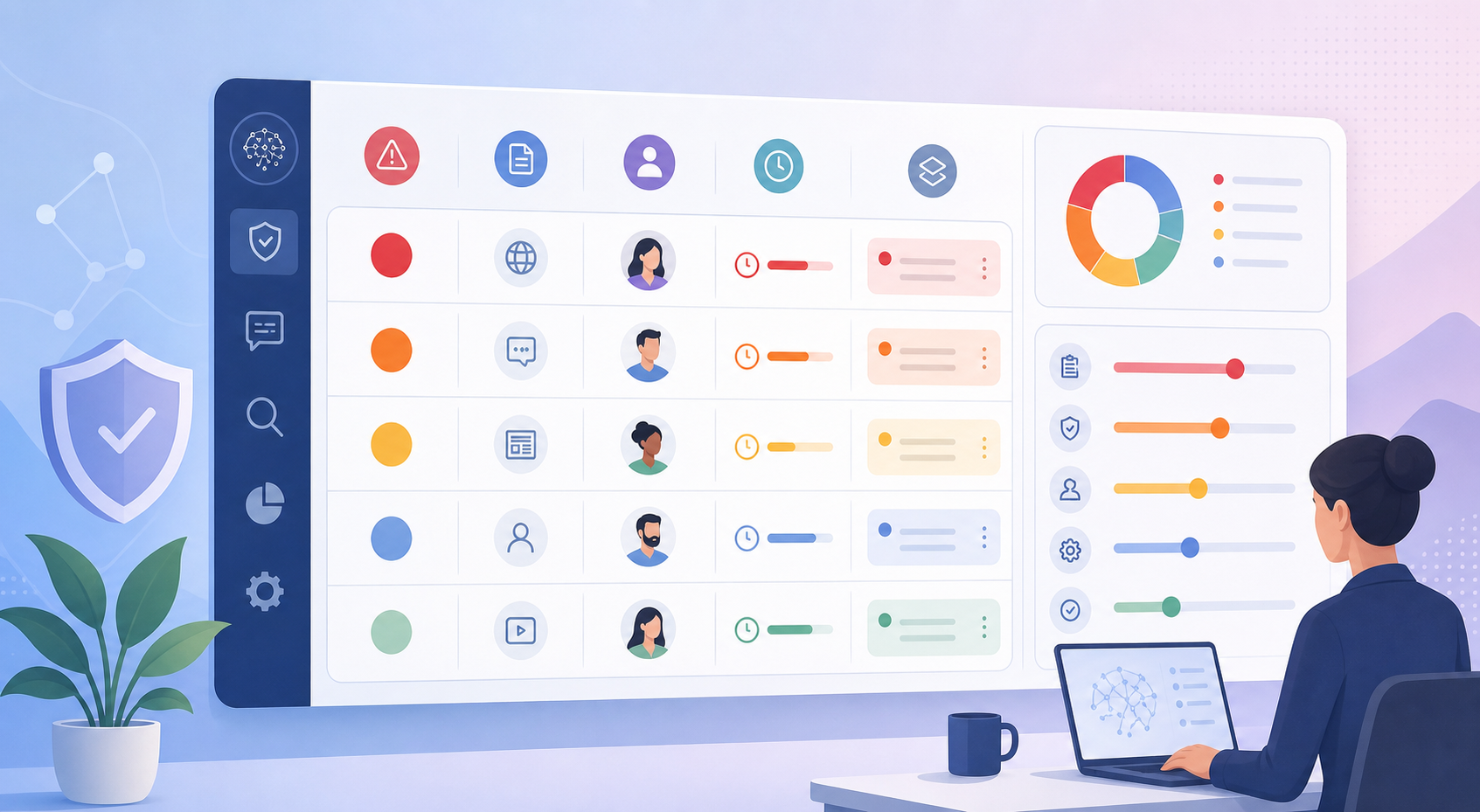
An AI reputation response plan is a cross-functional operating system for AI search risk. It turns wrong facts, stale citations, negative framing, missing brand mentions, and competitor-led narratives into prioritized tasks with evidence, owners, SLAs, source fixes, and retesting dates.
A strong plan answers six questions:
- What did the AI answer say?
- Where did it appear?
- Which sources seem to support it?
- How close is the prompt to a buying decision?
- Who owns the fix?
- How will the team know the issue improved?
That is the difference between AI reputation monitoring and an AI reputation response plan. Monitoring tells you something happened. A response plan tells the team what to do next.
For broader context on the discipline, see MaxAEO's guide to AI brand reputation management.
The AI Reputation Response Plan in One Page
Use this short version when you need to explain the process to leadership:
- Monitor repeatable prompt clusters: brand, category, competitor, comparison, pricing, security, alternatives, integration, and use-case prompts.
- Group observations into answer patterns: do not create one issue for every prompt variation.
- Classify the issue: wrong fact, stale source, negative framing, missing mention, competitor framing, or legal/compliance risk.
- Score severity: weigh buyer proximity, frequency, source strength, revenue exposure, and fixability.
- Assign an owner: content, product marketing, PR, legal, customer marketing, partnerships, or leadership.
- Repair the evidence layer: update owned pages first, then third-party profiles, review sites, partner pages, analyst pages, and high-ranking source material.
- Retest the same cluster: measure claim accuracy, sentiment, citation quality, mention rank, recommendations, and AI share of voice.
Why AI Reputation Problems Need a Different Playbook
Classic reputation monitoring tracks what people publish. AI reputation response work tracks what answer engines synthesize, omit, and repeat.
A social post has an author, timestamp, platform, and URL. An AI answer may blend brand pages, review sites, news articles, community posts, comparison pages, documentation, and competitor content into one confident recommendation. Sometimes it cites sources. Sometimes it does not. Sometimes the cited source does not support the claim.
That last point is not theoretical. A 2023 study on generative search verifiability found that only 51.5% of generated sentences were fully supported by citations, and only 74.5% of citations supported the sentence they were attached to in the evaluated systems (Liu, Zhang, and Liang, arXiv).
That is why a response plan must audit claims and sources, not just sentiment.
What Current AI Reputation Guides Often Miss
Most AI reputation and online reputation guides cover monitoring, sentiment labels, review management, crisis response, content freshness, and source cleanup. Those are useful, but they often stop before operations.
The missing layer is backlog design.
Marketing teams do not need another alert stream unless it tells them whether to publish a correction, update a product page, ask a third-party profile to refresh stale data, brief PR, involve legal, or do nothing yet.
A useful AI reputation response plan gives every issue:
| Field | Why it matters |
|---|---|
| Prompt cluster | Shows whether the issue is isolated or recurring |
| Engine and mode | Separates ChatGPT, Gemini, Perplexity, AI Overviews, AI Mode, and other surfaces |
| Answer pattern | Captures the repeated claim, omission, or framing |
| Source trail | Identifies pages that may be feeding the answer |
| Severity score | Prevents overreaction to one-off outputs |
| Owner | Makes the issue operational |
| Fix type | Connects the issue to a real action |
| Retest date | Turns the fix into a measurable experiment |
The Six AI Reputation Issue Types
Classify every backlog item into one primary issue type. The type determines ownership, evidence, and the likely fix.
| Issue type | What it looks like in AI answers | First owner | Typical response |
|---|---|---|---|
| Wrong fact | Incorrect pricing, feature, customer, funding, market, location, certification, integration, or compliance claim | Product marketing | Correct canonical source pages, align schema, refresh third-party profiles |
| Stale source | AI cites old pricing, old product limits, old reviews, past incidents, or outdated documentation | Web, product marketing, or comms | Publish dated updates, improve source freshness, request profile refreshes |
| Negative framing | Brand is described as risky, outdated, limited, expensive, unstable, or controversial without current context | PR or comms | Add resolution context, customer proof, current product evidence, review responses |
| Missing mention | Competitors appear in shortlist answers, but the brand is absent despite category fit | SEO or growth | Build AI-ready category, comparison, alternative, and use-case source pages |
| Competitor framing | The brand is defined through a rival's strengths or narrative | Product marketing | Clarify positioning, publish comparison proof, update sales and web messaging |
| Regulated or legal risk | AI states misleading claims about compliance, safety, privacy, employment, finance, or legal status | Legal | Preserve evidence, assess harm, correct official sources, coordinate comms |
Do not create a separate backlog item for every prompt. If 14 prompts produce the same stale SSO claim, that is one issue with 14 observations.
How to Score Severity Without Overreacting
Severity should combine commercial impact and evidence quality. A negative answer from one low-intent prompt is not automatically urgent. A repeated, sourced, bottom-funnel answer that recommends a competitor is.
Use the MaxAEO Response Backlog Score:
(buyer proximity x 2) + frequency + source strength + revenue exposure + fixability
Score each factor from 1 to 5. Because buyer-stage prompts are more commercially sensitive, buyer proximity is weighted twice. Total scores range from 6 to 30.
| Factor | 1 point | 3 points | 5 points |
|---|---|---|---|
| Buyer proximity | Broad informational prompt | Category or use-case research | Vendor comparison, pricing, shortlist, RFP, or alternative prompt |
| Frequency | One-off answer | Repeats in one engine or prompt family | Repeats across engines, runs, and prompt variants |
| Source strength | Uncited or obviously unsupported | Weak or ambiguous source | Cited, ranking, trusted, or repeatedly used source |
| Revenue exposure | Low-value segment | Moderate product or region | Strategic category, enterprise segment, or active pipeline |
| Fixability | No clear influence path | Some owned or third-party influence | Clear owned source and external source repair path |
Priority Bands and SLAs
Use the score to avoid two bad habits: treating every negative answer as a crisis, and letting serious buyer-stage errors sit in a dashboard.
| Score | Priority | SLA | Response pattern |
|---|---|---|---|
| 24-30 | P0 | 24-48 hours | Executive-visible issue, evidence preservation, source correction, daily retesting |
| 18-23 | P1 | 5 business days | Owned content update, PR or proof asset, third-party source repair, weekly retesting |
| 12-17 | P2 | 2-4 weeks | Clustered content fix, citation improvement, source freshness work, monthly retesting |
| 6-11 | P3 | Monitor | Keep in watchlist unless frequency, buyer proximity, or revenue exposure increases |
Build the Evidence Packet Before Assigning Work
An evidence packet stops the team from debating impressions. It gives content, PR, legal, and leadership the same facts.
Include these fields for every P0, P1, and P2 issue:
- Prompt cluster: the grouped query type, not just one prompt.
- Exact prompt examples: include the highest-risk examples.
- Engine and mode: ChatGPT, Gemini, Perplexity, Claude, Copilot, Grok, AI Mode, AI Overviews, or another surface.
- Date and market: record time, country, language, and device context when relevant.
- Answer excerpt: capture the specific claim, omission, or recommendation.
- Mention rank: where the brand appears in a shortlist or comparison.
- Sentiment label: positive, neutral, weak, negative, or mixed.
- Cited URLs: include cited and likely uncited source pages.
- Claim status: true, false, stale, unsupported, misleading, or incomplete.
- Competitors named: record which competitors benefit from the answer.
- Funnel stage: informational, evaluative, comparison, purchase-ready, post-sale.
- Business exposure: affected product, segment, region, or sales motion.
- Recommended owner: one accountable team, not a distribution list.
- Proposed fix: source repair, positioning update, PR action, legal review, or monitoring.
- Retest date: when the same prompt cluster will be measured again.
For repeatable monitoring, avoid relying on manual screenshots alone. Use a structured workflow like MaxAEO's guide to tracking ChatGPT brand mentions so observations can be compared over time.
Map Each Issue to the Right Owner
AI reputation work fails when every issue lands on SEO. Search and content teams can influence many AI answers, but they cannot fix product truth, public controversy, compliance language, customer proof, or stale partner profiles alone.
| Backlog signal | First owner | Support teams |
|---|---|---|
| Wrong product feature or pricing | Product marketing | Web, sales enablement, product |
| Old incident without resolution context | Comms | Support, legal, executive team |
| Weak category association | Content marketing | SEO, product marketing |
| Missing comparison or alternative presence | SEO or growth | Product marketing, demand gen |
| Missing customer proof | Customer marketing | PR, sales, customer success |
| Stale review or marketplace profile | Partnerships or comms | Customer success, product marketing |
| Poor AI share of voice | SEO or growth | Content, PR, demand gen |
| Misleading legal, privacy, or compliance claim | Legal | Comms, product marketing, security |
If a backlog item has no named owner, it is not a plan. It is a report.
Choose the Right Response Lane
Not every AI reputation issue needs the same fix. Assign one primary response lane before work starts.
| Response lane | Use when | First action |
|---|---|---|
| Factual correction | AI states something false or stale | Update the canonical source, then repair external evidence |
| Context correction | AI mentions a real issue but omits resolution or current status | Publish a clear update with dates, scope, and outcome |
| Visibility expansion | Brand is absent from relevant shortlists | Build or improve category, use-case, comparison, and proof pages |
| Source credibility repair | AI relies on weak, old, or imbalanced sources | Improve citation-worthy owned pages and refresh third-party profiles |
| Risk escalation | Claim could create legal, regulatory, safety, or investor risk | Preserve evidence and route to legal or leadership before publishing |
This is where sentiment becomes useful. A "negative" label is too vague. The actionable question is: what evidence would a better answer need?
Turn Negative Sentiment Into Fix Types
Negative AI sentiment usually points to one of five fix types:
- Evidence gap: The answer lacks current proof. Add customer outcomes, benchmarks, certifications, dated product updates, implementation details, or support data.
- Context gap: The answer mentions a real issue but omits resolution. Publish a dated explanation of what changed, what was fixed, and what remains true.
- Source imbalance: Competitor, review, or forum content dominates the answer. Build credible owned sources and improve third-party source coverage.
- Terminology mismatch: The answer misclassifies the company or product category. Clarify use cases, ICP, product boundaries, integrations, and alternatives.
- True weakness: The answer reflects a real product or service limitation. Escalate it internally and do not publish reputation theater.
For source-to-brief workflows, pair this with AI search sentiment analysis so repeated framing patterns become content, PR, or product marketing briefs.
Fix Wrong AI Answers With Source Repair
Wrong AI answers usually persist because the public evidence layer is stale, ambiguous, thin, or contradictory. Prompting a model differently may expose the issue, but it rarely solves it.
Start with owned sources:
- Product pages
- Pricing pages
- Security and compliance pages
- Integration pages
- Comparison and alternatives pages
- Changelog or release notes
- Help center and documentation
- About, leadership, location, and company facts pages
Then repair external sources:
- Review profiles
- Marketplace listings
- Partner directories
- Analyst or category pages
- Community answers
- High-ranking listicles and comparisons
- News or PR pages where updates are possible
Google's AI feature guidance says the same foundational Search best practices apply to AI Overviews and AI Mode, and that supporting pages need to be indexed and eligible for Search snippets. The same page also says important content should be available in text and that structured data should match visible content (Google Search Central).
For stale product facts, this is usually the highest-use sequence: correct the canonical page, make the fact crawlable, add date context, align schema, update internal links, then refresh third-party profiles.
Create AI-Ready Source Pages for Repeat Claims
An AI-ready source page is a crawlable, citation-friendly page that answers a specific entity, product, category, comparison, or proof question with current facts, clear sourcing, and minimal ambiguity.
It should answer:
- What does the product do?
- Who is it for?
- What category does it belong to?
- What features, integrations, controls, or pricing model are current?
- What proof supports each claim?
- What changed since older sources were published?
- Which competitors, alternatives, or adjacent categories are genuinely relevant?
- What should not be inferred from the page?
For deeper execution, use MaxAEO's guide to AI-ready content.
Google's helpful content guidance emphasizes original information, comprehensive coverage, clear sourcing, expertise, and substantial value compared with other search results (Google Search Central). AI-ready pages should meet the same standard.
Prioritize Missing Mentions by Prompt Cluster
A missing mention is not always a reputation problem. Sometimes the brand is not relevant. Sometimes the prompt is too broad. Sometimes the category fit is real, but the AI evidence pool does not connect the brand to that use case.
Score missing mentions only after clustering prompts:
| Prompt cluster | Example | How to judge the absence |
|---|---|---|
| Broad category | "best CRM tools" | Absence may be acceptable unless the brand is a category leader |
| Segment-specific | "best CRM for B2B SaaS startups" | Absence matters if the brand has clear fit and proof |
| Competitor alternative | "HubSpot alternatives for SaaS teams" | Absence is high value if the brand competes directly |
| Use-case | "CRM with enterprise SSO and SOC 2" | Absence matters if the capability is true and sourced |
| Purchase-ready | "shortlist CRM vendors for a 200-person SaaS company" | Absence deserves faster review because buyer proximity is high |
Track AI share of voice by cluster: whether the brand appears, where it ranks, which competitors appear, and whether the answer recommends the brand. For measurement mechanics, see MaxAEO's guide to AI search share of voice.
Treat Competitor Framing as Positioning Debt
Competitor framing happens when an AI answer explains your brand mostly through another company's narrative. The answer may not be negative, but it can still shape shortlists.
Common patterns include:
- "A cheaper alternative to X"
- "Similar to Y but less mature"
- "Good for small teams, while Z is better for enterprise"
- "Known mainly for one feature" after the product has expanded
- "A niche tool" after the company has moved upmarket
The fix is not a defensive rebuttal page. The fix is consistent positioning across category pages, comparison pages, customer stories, analyst language, partner content, executive commentary, and sales enablement.
The operating question is simple: what source would an answer engine need to describe the brand accurately without borrowing a competitor's frame?
A Worked Example: From Wrong Citation to Source Repair
A B2B SaaS company monitors 120 weekly prompt runs across ChatGPT, Gemini, Perplexity, Claude, Copilot, Grok, AI Mode, and AI Overviews. In one week, 14 answers say the company lacks enterprise SSO. Six cite a 2022 review profile. Four recommend a competitor as the safer enterprise option.
This should become one P1 backlog item, not 24 separate complaints.
The severity score might look like this:
| Factor | Score | Reason |
|---|---|---|
| Buyer proximity | 5 | Appears in vendor comparison and enterprise shortlist prompts |
| Frequency | 3 | Repeats across several prompts and engines |
| Source strength | 4 | A stale third-party review page is being cited |
| Revenue exposure | 4 | Enterprise segment is commercially important |
| Fixability | 5 | Current SSO documentation exists and third-party profile can be updated |
Formula: (5 x 2) + 3 + 4 + 4 + 5 = 26
That is P0 by score, but the team can downgrade to P1 if no active deals or regulated claims are involved. The response should be specific:
- Update the enterprise security page with current SSO support.
- Add a dated changelog or release note.
- Add SSO language to comparison and alternatives pages.
- Request a refresh on the stale third-party review profile.
- Update sales enablement so public claims match private sales claims.
- Retest the same prompt cluster for two to four weeks.
The expected outcome is not instant perfection. The expected outcome is a measurable decline in the wrong SSO claim and an increase in current citations.
How Often Should Teams Review the Backlog?
Review cadence should match issue severity and answer volatility.
| Priority | Review cadence | Retest pattern |
|---|---|---|
| P0 | Daily until stabilized | Same prompts, same engines, same market, plus high-risk variants |
| P1 | Weekly | Same cluster plus competitor and shortlist variants |
| P2 | Every 2-4 weeks | Cluster-level trend review |
| P3 | Monthly or quarterly | Monitor for frequency or buyer-stage changes |
Do not declare victory after one clean answer. A 2026 study of Google Search, Gemini, and AI Overviews introduced a benchmark of 11,500 user queries and found that AI Overviews were generated for 51.5% of representative real-user queries in the dataset. The same study found that AI Overviews were less consistent across repeated runs and less robust to minor query edits (Grossman et al., arXiv).
A fix is confirmed when the bad answer pattern declines across repeated runs, not when one prompt looks better.
What to Do in the First 30 Days
The first month should produce a working backlog and a response rhythm. Do not try to build a perfect governance system first.
Week 1: Define the Test Set
Build 25-50 prompt clusters across:
- Brand prompts
- Category prompts
- Competitor prompts
- Comparison prompts
- Alternative prompts
- Pricing prompts
- Security and compliance prompts
- Integration prompts
- Use-case prompts
- Buying committee prompts
For B2B brands, include prompts a buyer would ask before a demo, before an RFP, and before a renewal.
Week 2: Collect and Classify
Run the prompt set across the engines that matter for your market. Classify each issue as wrong fact, stale source, negative framing, missing mention, competitor framing, or regulated risk.
Capture sources and answer excerpts immediately. If an answer affects legal, compliance, safety, investor relations, or an active enterprise deal, preserve the full evidence packet before editing anything.
Week 3: Score and Assign
Use the MaxAEO Response Backlog Score to label each issue P0-P3. Assign one owner per issue. Add a due date, fix type, expected metric movement, and retest date.
Do not allow "SEO" to become the default owner for every issue. Product marketing, PR, legal, customer marketing, partnerships, and leadership all have roles.
Week 4: Ship and Retest
Ship the highest-use fixes first:
- Correct canonical owned pages.
- Add current proof and date context.
- Align schema with visible page content.
- Improve internal links to the corrected source.
- Refresh third-party profiles where possible.
- Publish comparison or category content only where the prompt cluster justifies it.
- Retest the same clusters and report movement.
The 30-day outcome should be a prioritized response backlog, not a pile of disconnected screenshots.
What to Report to Leadership
Leadership does not need a list of pages updated. They need to know whether AI answers changed in commercially meaningful places.
Report these five metrics weekly:
| Metric | What it tells leadership |
|---|---|
| Critical issue count | Whether serious AI reputation risk is growing or shrinking |
| Mean backlog score | Whether remaining issues are lower severity |
| AI share of voice | Whether the brand appears more often in target clusters |
| Sentiment mix | Whether negative or weak framing is declining |
| Citation quality | Whether answer engines use current, accurate sources |
Add a short narrative for P0 and P1 items:
- What was observed
- Why it matters
- What source appears to drive it
- What was fixed
- What changed after retesting
- What still needs outside influence
- What decision, if any, leadership must make
For executive reporting structure, use MaxAEO's guide to AEO dashboard metrics.
Common Mistakes That Slow Response Work
The most common mistake is treating AI reputation as a content-only problem. Some fixes require product truth, legal review, PR credibility, customer proof, partner updates, or executive decisions.
Avoid these mistakes:
- Chasing one-off screenshots: Screenshots are evidence, but they do not show frequency or trend.
- Ignoring citations: A negative answer grounded in a trusted source requires a different fix from an uncited hallucination.
- Overwriting with hype: Exaggerated claims can weaken trust and create new contradictions.
- Skipping third-party sources: Review pages, partner listings, marketplaces, forums, documentation, and news often influence AI answers.
- Measuring mentions only: A brand can appear often and still be framed poorly.
- Publishing defensive content too quickly: If the AI answer reflects a real weakness, fix the business issue or add honest context.
- Declaring victory too early: Retest across engines, prompt variants, and buyer stages before closing the issue.
When to Escalate to Legal, PR, or Executives
Escalate when an AI answer creates material risk, not merely when it is unflattering.
Legal should review claims involving defamation, regulated industries, compliance, privacy, safety, employment, financial performance, customer commitments, or contractual obligations.
PR should lead when the issue is driven by news coverage, public controversy, analyst commentary, social narratives, or a visible customer incident.
Executives should be involved when the answer affects a strategic product, active sales cycle, public company disclosure, investor narrative, major customer segment, or board-level risk.
A 2026 Business Insider report on BrightEdge data found that Google AI Overviews showed negative brand sentiment at a higher rate than ChatGPT in the studied period, while Google disputed the methodology and said the difference was under one percentage point (Business Insider). The practical takeaway is cautious: measure your own category, your own prompts, and your own source ecosystem before applying platform-wide claims.
AI Reputation Response Plan Template
Use this template for each backlog item:
| Field | Entry |
|---|---|
| Issue name | Short label for the recurring answer pattern |
| Priority | P0, P1, P2, or P3 |
| Score | Buyer proximity x 2 + frequency + source strength + revenue exposure + fixability |
| Issue type | Wrong fact, stale source, negative framing, missing mention, competitor framing, regulated risk |
| Prompt cluster | Grouped prompt family |
| Engines observed | ChatGPT, Gemini, Perplexity, Claude, Copilot, Grok, AI Mode, AI Overviews, etc. |
| Answer pattern | The repeated claim, omission, or framing |
| Cited sources | URLs cited or repeatedly associated with the answer |
| Claim status | True, false, stale, unsupported, misleading, incomplete |
| Business risk | Segment, product, region, sales stage, or customer group affected |
| Owner | One accountable team or person |
| Support teams | Teams needed to complete the fix |
| Fix lane | Factual correction, context correction, visibility expansion, source repair, escalation |
| Source fixes | Owned and third-party pages to update |
| Retest plan | Prompts, engines, date, and success metric |
| Status | Open, fixing, retesting, monitoring, closed |
FAQ
What is the difference between AI reputation management and an AI reputation response plan?
AI reputation management is the broader practice of monitoring and improving how AI systems describe a brand. An AI reputation response plan is the operational workflow that turns detected issues into prioritized fixes, owners, deadlines, source repairs, and measurable outcomes.
How many prompts should a B2B company track?
Start with 25-50 high-value prompt clusters, then expand after you know which clusters create risk or opportunity. Include brand, category, competitor, comparison, alternatives, use-case, pricing, security, integration, and buying committee prompts.
Should every negative AI answer be fixed?
No. Fix repeated, high-impact, evidence-backed issues first. A one-off answer from a low-intent prompt may only need monitoring. A repeated negative comparison in a vendor shortlist prompt deserves a backlog item.
Can content alone improve AI reputation?
Content helps, but it is rarely enough. Strong AI reputation work also uses product marketing clarity, PR, customer proof, updated third-party profiles, review operations, legal review, accurate source pages, and consistent internal linking.
How do teams know whether a fix worked?
Retest the same prompt cluster across engines and variants. Look for changes in claim accuracy, sentiment, citation quality, mention rank, AI share of voice, and whether the brand is recommended more often in relevant shortlists.
Who should own the AI reputation response plan?
AEO, SEO, or growth can own the operating cadence, but issue ownership should follow the problem. Product marketing owns product facts and positioning. PR owns public narrative. Legal owns regulated risk. Customer marketing owns proof. Leadership owns strategic tradeoffs.
The Practical Standard
An AI reputation response plan should make the next action obvious. If the team sees a wrong AI answer and still has to ask who owns it, how severe it is, what source caused it, or when to retest it, the plan is not finished.
The strongest teams treat AI reputation like a cross-functional backlog. They monitor repeatable prompt clusters, group issues by answer pattern, score severity, repair sources, assign owners, and report movement in business terms.
That is how brand mentions in ChatGPT, Gemini, Perplexity, Claude, Copilot, Grok, Google AI Mode, and AI Overviews become manageable work instead of random anxiety.