
By maxaeo.ai | Published 2026-10-01 | Updated 2026-10-01
An AI engine competitive analysis framework is a repeatable method for measuring how your brand and competitors appear in ChatGPT, Perplexity, Gemini, Google AI Overviews, and other answer engines. It compares more than mentions: it evaluates recommendation position, sentiment, citations, prompt coverage, and the evidence supporting each brand.
Traditional SEO competitor analysis focuses on rankings and traffic. AI search requires a wider model because one answer may mention several brands, cite different sources, and position each competitor differently. A reliable framework connects the buyer prompt, generated answer, cited evidence, and resulting competitive action.

What should an AI engine competitive analysis framework measure?
The framework should separate presence, prominence, evidence, and perception. A brand can be mentioned frequently but rarely recommended, or recommended often without strong supporting citations.
Use these core metrics:
| Metric | Formula or definition | What it reveals |
|---|---|---|
| Mention rate | Answers mentioning your brand ÷ eligible answers | Basic visibility |
| Recommendation rate | Answers recommending your brand ÷ eligible answers | Commercial consideration |
| Share of voice | Your brand mentions ÷ all tracked brand mentions | Relative competitive presence |
| Recommendation position | Average position in lists or answer sections | Prominence |
| Citation share | Your supporting citations ÷ category citations | Evidence ownership |
| Sentiment and framing | Positive, neutral, negative, or use-case framing | Brand perception |
| Factual accuracy | Correct product claims ÷ reviewed claims | Information quality |
| Prompt coverage | Prompts with a brand mention ÷ tracked prompts | Topic and intent reach |
These signals should not be compressed into one score too early. Measurement guidance from MaxAEO similarly distinguishes mention rate from competitive share because a brand can appear in many answers while receiving a smaller proportion of total competitor mentions. (maxaeo.ai)
How do you define the competitive set?
Start with the brands that AI engines actually place in the same answers as you, not only the companies listed in your traditional SEO competitor report.
For a SaaS category, divide competitors into four groups:
- Direct competitors: Products solving the same core problem.
- Alternative solutions: Different products that buyers may use instead.
- Default comparison brands: Companies AI engines repeatedly use as reference points.
- Emerging substitutes: New tools, agencies, platforms, or internal workflows appearing in buyer prompts.
Track three to five primary competitors at the beginning. Add a brand only when it appears repeatedly in relevant answers or is strategically important to your market.
Your dataset should record the engine, country, language, model surface, prompt, date, and competitor set. Without these controls, a change in output may reflect a different search environment rather than a real visibility gain or loss.
How should you build the prompt panel?
A strong prompt panel represents the buyer journey instead of repeating commercial keywords. Use six prompt clusters:
- Category discovery: “What are the best tools for…?”
- Problem-aware research: “How can a SaaS company improve…?”
- Use-case evaluation: “Which platform is best for…?”
- Alternatives: “What are the best alternatives to…?”
- Head-to-head comparison: “Brand A vs. Brand B for…”
- Decision prompts: “Which solution should an enterprise team choose?”
For an initial benchmark, use 30–50 stable prompts across at least four AI engines. Keep the wording unchanged for trend reporting, while reviewing the prompt set quarterly as buyer language and product categories evolve. This approach is consistent with practical GEO benchmarking guidance that recommends fixed prompts, preserved raw answers, and prompt-level analysis. (maxaeo.ai)
Tag every prompt by funnel stage, audience, geography, language, and business problem. This lets you distinguish a broad awareness gap from a high-intent buying gap.
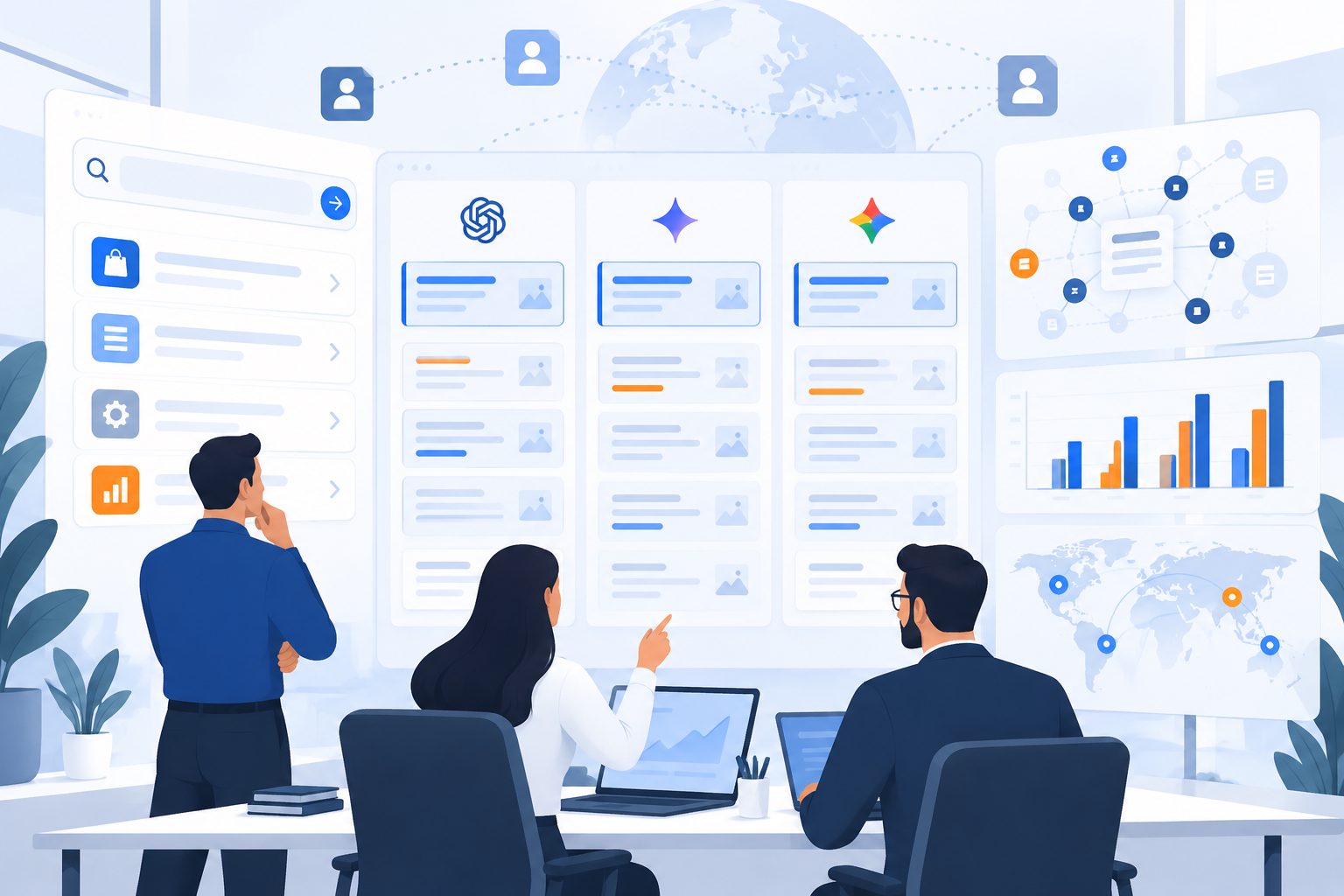
How do you calculate competitor share in AI responses?
Calculate competitor share separately for each engine before combining the results.
Engine Share of Voice (%) =
Your Brand Mentions in One Engine
÷
Total Tracked Brand Mentions in That Engine
× 100
For example, if your brand receives 24 mentions and three competitors receive 76 combined mentions, your share of voice is:
24 ÷ (24 + 76) × 100 = 24%
Do not average platform percentages when the engines have different numbers of prompts. Aggregate the underlying mention events instead:
Combined Share =
Total Brand Mentions Across Engines
÷
Total Tracked Brand Mentions Across Engines
× 100
Also report mention rate separately. Share of voice answers, “How much of the competitive conversation do we own?” Mention rate answers, “How often do we appear at all?” Keeping both prevents an attractive but misleading headline metric. (maxaeo.ai)
Which original metrics reveal the real competitive gap?
Share of voice is useful, but it does not explain why a competitor wins. Add two diagnostic metrics to your benchmark.
1. Competitor Replacement Rate
Competitor Replacement Rate measures how often a competitor appears in prompts where your brand is absent:
Replacement Rate =
Prompts Featuring Competitor but Not Your Brand
÷
Eligible Prompts
× 100
This identifies direct content and positioning gaps. A competitor with modest overall share but a high replacement rate in enterprise prompts may represent a more urgent threat than a broadly visible brand that rarely appears in your core buying scenarios.
2. Evidence-to-Position Gap
Evidence-to-Position Gap compares how well a competitor is supported by citations with how prominently it is recommended.
A competitor with high position but low citation support may be benefiting from familiar brand language or repeated mentions. A competitor with moderate position but strong citation conversion may have a durable evidence advantage.
Review both together:
| Pattern | Likely interpretation | Priority |
|---|---|---|
| High share, high citations | Established evidence advantage | Study and differentiate |
| High share, low citations | Familiarity or answer-pattern advantage | Improve positioning |
| Low share, high citations | Strong evidence but weak prompt coverage | Expand topic reach |
| Low share, low citations | Broad visibility and authority gap | Rebuild foundation |
This two-metric view is an original way to avoid treating every competitor lead as a generic “create more content” problem.
How do you trace the source of a competitor’s advantage?
Use a four-layer investigation:
- Prompt layer: Find the exact questions where the competitor appears and your brand does not.
- Answer layer: Record whether it is mentioned, recommended, ranked early, or framed as a specialist, budget option, or enterprise choice.
- Citation layer: Capture every cited domain and URL.
- Evidence layer: Read the cited material and identify the facts the AI appears to reuse.
Common evidence types include review websites, comparison pages, product documentation, industry publications, Reddit discussions, and the competitor’s own website. A competitor may win because its homepage is strong, but it may also win because third-party sources describe its use cases more clearly.
Use the competitor share in AI responses measurement framework for a prompt-to-citation workflow, then apply the GEO competitor benchmarking scorecard when you need a weighted reporting model.
How do you turn findings into an action plan?
Prioritize gaps with this formula:
Opportunity Score =
Prompt Value × Competitor Lead × Citation Recoverability
Score each factor from 1 to 5.
- Prompt Value: How close is the query to a buying decision?
- Competitor Lead: How consistently does the competitor outperform you?
- Citation Recoverability: Can you create or improve a credible source?
Then assign every opportunity an owner, asset, success metric, and review date.
| Observed gap | Likely action | Validation metric |
|---|---|---|
| Competitor owns comparison prompts | Publish a balanced comparison or decision guide | Recommendation rate |
| Competitor has stronger citations | Improve evidence-backed pages and third-party coverage | Citation conversion |
| Your product is misrepresented | Align facts across authoritative pages | Factual error rate |
| Visibility is weak in one engine | Study that engine’s cited-source pattern | Engine-level share |
| Strong mentions appear late in answers | Clarify audience and differentiation | Recommendation position |
Do not automatically change content after one answer. AI outputs vary, so prioritize patterns repeated across prompts and monitoring periods. A cross-engine tracker should preserve the original answer, citation URLs, timestamp, and extracted metric for auditability. (maxaeo.ai)
How can MaxAEO support this framework?
MaxAEO monitors brand and competitor visibility across eight AI engines, including ChatGPT, Gemini, Perplexity, Claude, Copilot, Grok, Google AI Mode, and Google AI Overviews. Its daily monitoring covers mentions, competitive ranking, recommendation position, sentiment, citations, and original AI answers. (maxaeo.ai)
Teams can compare competitor mention rates, cited domains, sentiment, and recommendation patterns across English and Chinese markets. MaxAEO also provides a free AI visibility diagnostic: enter a brand name, website, and competitor information to generate an initial report without installing tracking code.
For ongoing measurement, use the cross-engine AI visibility tracker framework to keep engine-level results visible beneath any combined score.
Frequently asked questions
Is competitor share the same as mention rate?
No. Mention rate measures how many eligible answers include your brand. Competitor share measures your proportion of all tracked brand mentions within a defined competitor set.
How many AI engines should be included?
Include the engines that influence your buyers. A smaller set with stable prompts, raw answers, and daily or weekly monitoring is more useful than a larger set with inconsistent data.
Are SEO competitors always AI competitors?
No. AI engines may recommend publishers, marketplaces, agencies, internal workflows, or alternative products that do not compete with you in traditional search results.
How often should the analysis run?
Run prompts daily when monitoring changes matters, but interpret trends over multiple observations. Use monthly summaries for strategic reporting and review the prompt set quarterly.
Can a single score replace prompt-level analysis?
No. A composite score helps with reporting, but prompt-level results explain which buyer questions competitors own, what evidence supports them, and what action is most likely to close the gap.