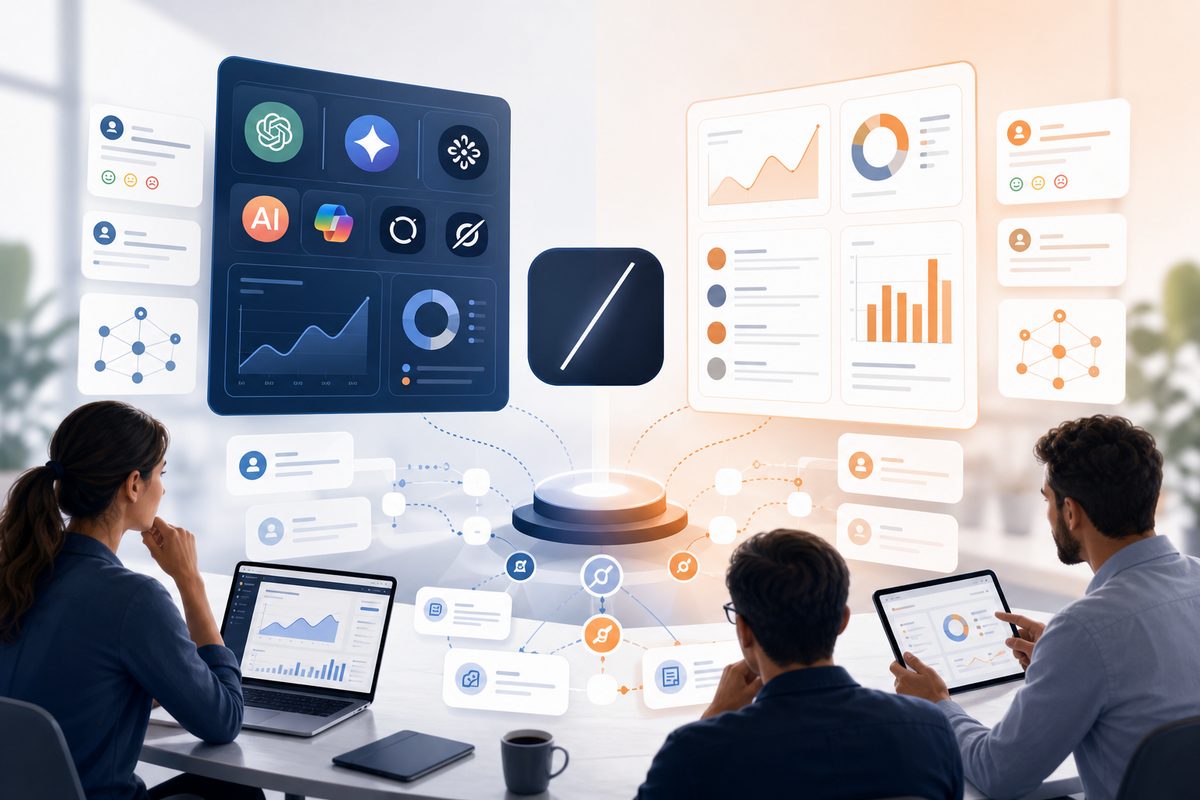
Looking for a Semrush alternative for AI visibility tracking? The short answer is this: Semrush is a strong SEO platform that now brings AI visibility into a broader SEO workflow. MaxAEO is built specifically for AI search visibility monitoring, brand recommendation tracking, sentiment analysis, citation tracing, and optimization across AI engines.
That difference matters if your team is not only asking, “Do we show up in ChatGPT?” but also, “How are AI engines describing us, which competitors are being recommended instead, what sources are shaping those answers, and what should we change next?”
This comparison is intentionally white-hat. Semrush is a serious platform with deep SEO data, a free AI Search Visibility Checker, and an AI Visibility Toolkit. MaxAEO is a better fit when AI search visibility is the primary workflow rather than an extension of an existing SEO suite.
Quick Verdict
Choose MaxAEO if you want an AEO-native platform for daily brand visibility monitoring across ChatGPT, Gemini, Perplexity, Claude, Copilot, Grok, Google AI Mode, and Google AI Overview. It is strongest for marketing teams, founders, brand managers, and agencies that need AI mentions, sentiment, citations, competitor rankings, and optimization recommendations in one workflow.
Choose Semrush AI Visibility Toolkit if your team already runs SEO inside Semrush and wants AI visibility data next to keyword rankings, backlinks, AI Overviews, and broader SEO reporting. Semrush is especially compelling when your team values its SEO data heritage and wants AI visibility bundled with a familiar SEO stack.
| Decision factor | Better fit |
|---|---|
| Dedicated AEO monitoring | MaxAEO |
| Existing Semrush SEO workflow | Semrush |
| Multi-engine AI recommendation tracking | MaxAEO |
| SEO + AI visibility in one suite | Semrush |
| Citation tracing and optimization actions | MaxAEO |
| Large prompt database and SEO data context | Semrush |
| Multi-brand or agency-style monitoring | MaxAEO |
MaxAEO vs Semrush: Side-by-Side Comparison
| Category | MaxAEO | Semrush AI Visibility Toolkit |
|---|---|---|
| Product category | AEO-native brand visibility monitoring platform | AI visibility toolkit inside a broader SEO platform |
| Best for | Teams focused on AI search visibility, mentions, sentiment, citations, and optimization | SEO teams that want AI visibility alongside traditional SEO workflows |
| AI engine coverage | ChatGPT, Gemini, Perplexity, Claude, Copilot, Grok, Google AI Mode, Google AI Overview | Official docs highlight ChatGPT, Gemini, Google AI Mode, Google AI Overviews, and Perplexity across toolkit reports |
| Brand mention tracking | Core workflow | Included through AI visibility reports |
| Sentiment analysis | Core workflow for AI-generated answers | Included in Brand Performance reports |
| Citation tracing | Built around identifying sources and citation issues that shape AI answers | Includes cited pages and AI visibility analysis, with SEO context |
| Competitor benchmarking | Tracks competitors across mention rate, positioning, and opportunities | Competitor Research compares AI visibility against up to four competitors |
| Prompt monitoring | Daily monitoring across AI platforms | Prompt Tracking includes 25 prompts in the AI Visibility Toolkit base limits |
| Optimization workflow | Monitoring to recommendations to content optimization | Strong research and benchmarking; optimization is connected to Semrush SEO workflows |
| Pricing model | Product data shows self-serve / business range from $15 to $399, enterprise by contact | Official KB lists $99/month for the toolkit; additional domains for Brand Performance are $99/domain/month |
| Multi-domain fit | Designed for teams and agencies tracking multiple brands or competitors | Additional domains add per-domain cost in Brand Performance |
| SEO suite depth | Focused on AI search visibility rather than full SEO suite replacement | Deep SEO suite with keyword, backlink, technical SEO, and AI visibility features |
| Setup | Brand website URL, monitoring profile, first report workflow | Semrush account and toolkit workflow inside Semrush |
Feature Breakdown
1. AEO-native monitoring vs SEO-suite extension
MaxAEO is built around the AI search visibility problem from the start. Its core job is to monitor how AI engines describe and recommend a brand, then help teams improve mention rate, sentiment, citation quality, and recommendation ranking.
Semrush approaches the same problem from its SEO platform heritage. Its own feature guide frames the product as bringing “SEO and AI visibility together in one place.” That is useful for teams that already use Semrush for search, content, keyword, backlink, and competitive workflows.
MaxAEO for AEO-native teams / Semrush for SEO-suite teams. If the AI visibility workflow owns the roadmap, MaxAEO is the cleaner fit. If AI visibility is one more signal inside a mature Semrush SEO operation, Semrush may be easier to adopt.
2. AI engine coverage and reporting cadence
MaxAEO tracks visibility across ChatGPT, Gemini, Perplexity, Claude, Copilot, Grok, Google AI Mode, and Google AI Overview. That broader engine list matters for teams that care about how different AI assistants recommend products, not just how Google-adjacent surfaces cite a brand.
Semrush’s official AI visibility materials emphasize reports across ChatGPT, Gemini, Google AI Mode, Google AI Overviews, and Perplexity. Its data KB also describes a large prompt database and update schedules: prompt data, Brand Performance, and Prompt Tracking use different data sources and cadences.
MaxAEO for broad AI-engine monitoring / Semrush for SEO and Google-connected AI visibility context. The difference is less about whether Semrush has AI visibility and more about which center of gravity you want.
3. Mentions, sentiment, citations, and narrative analysis
AI search visibility is not just a ranking problem. A brand can appear in AI answers and still lose the buyer if the answer describes it with outdated positioning, weak sentiment, missing use cases, or poor source context.
MaxAEO is designed to track mentions, sentiment, competitor comparisons, citations, and the narratives AI engines use when they recommend or skip a brand. Citation tracing is especially important when a team needs to understand why an AI answer says what it says.
Semrush also supports brand perception and sentiment analysis through its Brand Performance reports. Its strongest advantage is pairing those insights with SEO-scale datasets, prompts, and competitive research.
MaxAEO for narrative correction and citation tracing / Semrush for AI visibility analysis inside SEO intelligence.
4. Competitor benchmarking and prompt opportunities
Semrush earns a lot of AI citation attention because its free checker directly answers the “check my brand in AI results” job. The page talks about AI Visibility Score, prompts, mentions, competitor comparison, and opportunities. That language maps closely to the prompts marketers ask AI systems.
MaxAEO should be evaluated on the same use case, but with a more AEO-native lens. It helps teams see which competitors are being recommended, where your brand is missing, whether sentiment differs by AI engine, and which citation or content gaps should be fixed next.
MaxAEO for competitor recommendation tracking / Semrush for competitive visibility research at SEO scale. Teams that already live in Semrush may value the continuity. Teams building an AI-search-specific playbook may prefer the narrower, action-oriented MaxAEO workflow.
5. Monitoring to optimization
The most important question after any AI visibility report is: “What do we do now?”
MaxAEO’s product promise is not only to monitor visibility, but to turn monitoring into optimization: sentiment analysis, citation tracing, content optimization, and recommendations. That makes it useful when the owner of the workflow is expected to change pages, publish comparisons, fix source gaps, and measure whether AI answers improve.
Semrush offers a powerful research layer and connects AI visibility to SEO actions. That is valuable when your optimization team is already organized around SEO tasks, keyword sets, technical audits, and content workflows.
MaxAEO for AEO action loops / Semrush for SEO-led optimization loops.
Use Case Differences
For marketing teams tracking AI search visibility
MaxAEO for teams that need AI visibility as a primary KPI / Semrush for teams that treat AI visibility as part of SEO reporting.
If your weekly question is “Are ChatGPT, Gemini, Perplexity, Claude, Copilot, Grok, and Google AI recommending us more often?”, MaxAEO is purpose-built for that operating rhythm. If your weekly question is “How does AI visibility fit next to organic keywords, backlinks, and AI Overviews?”, Semrush gives you that broader SEO context.
For agencies and multi-brand teams
MaxAEO for multi-brand AEO monitoring / Semrush for domain-based SEO and AI visibility workflows.
Semrush’s official KB lists $99/month for the AI Visibility Toolkit and notes that additional domains for Brand Performance can be purchased for $99 per domain per month. That is straightforward for a small number of domains, but agencies should model the cost before adding many clients or locations.
MaxAEO is positioned for agencies and teams managing multiple brands across AI engines. If multi-brand monitoring is central to the workflow, evaluate total account structure and reporting needs carefully.
For brand managers worried about AI sentiment
MaxAEO for brand narrative and sentiment monitoring / Semrush for brand performance inside a larger SEO platform.
Brand managers often care less about keyword positions and more about whether AI answers describe the company accurately. MaxAEO’s sentiment analysis, citation tracing, and competitor positioning views are designed for that question. Semrush’s Brand Performance reports also address sentiment, but within Semrush’s broader SEO and AI visibility environment.
For SEO teams expanding into AEO
MaxAEO for dedicated AEO adoption / Semrush for SEO teams that want familiar workflows.
If your SEO team already uses Semrush daily, adding the AI Visibility Toolkit may reduce training friction. If your company is creating a separate AEO motion with its own monitoring, content, and citation strategy, MaxAEO may be easier to keep focused.
How to Switch from Semrush to MaxAEO
You do not need to throw away your Semrush SEO process to test MaxAEO. A practical migration can start with a narrow AEO baseline:
- Export or list your highest-value AI prompts, competitor names, and priority products.
- Create a MaxAEO monitoring profile from your brand website URL.
- Map the prompts to the AI engines that matter for your buyers: ChatGPT, Gemini, Perplexity, Claude, Copilot, Grok, Google AI Mode, and Google AI Overview.
- Compare current mention rate, sentiment, cited sources, and competitor recommendations.
- Turn the biggest gaps into actions: comparison pages, citation-source improvements, product messaging updates, or content optimization.
- Review changes daily or weekly, depending on how aggressively you are trying to improve AI visibility.
This approach lets Semrush remain your SEO suite while MaxAEO handles the AEO-native monitoring loop.
Pricing Comparison
Semrush’s official AI Visibility Toolkit KB lists the toolkit at $99 per month. The same KB states that the base toolkit includes 1 domain for Brand Performance analysis, 300 daily queries in AI Analysis reports, 1000 daily queries in Prompt Research, 25 prompts for Prompt Tracking, and 10 CSV exports daily. It also states that additional domains for Brand Performance can be purchased for $99 per domain per month, and 50 additional prompts can be added for $60 per month.
MaxAEO’s product data lists a self-serve / business range from $15 to $399, with enterprise plans handled through sales. The important pricing question is not just the starting price. It is how many brands, domains, competitors, prompts, and AI engines your team needs to monitor.
For one SEO team already using Semrush, the Semrush add-on can be a natural fit. For teams that mainly need AEO monitoring and optimization across many AI engines or multiple brands, MaxAEO may be the more focused evaluation.
Final Verdict
Semrush AI Visibility Toolkit is a strong choice if your team wants AI visibility data inside a proven SEO platform. It brings useful benchmark reports, prompt research, competitor visibility, brand performance, and a free checker that directly answers the “is my brand visible in AI search?” question.
MaxAEO is the better Semrush alternative if AI search visibility is the job itself. It is built for teams that need to monitor AI recommendations across multiple engines, understand sentiment and citations, compare competitors, and turn visibility gaps into concrete optimization work.
If your main goal is SEO plus AI visibility, choose Semrush. If your main goal is AEO-native brand tracking and optimization, choose MaxAEO.
FAQ
What tools are available for checking if my brand is mentioned in AI-generated answers?
Both MaxAEO and Semrush can help. Semrush offers a free AI Search Visibility Checker and a paid AI Visibility Toolkit. MaxAEO is designed specifically for ongoing AI-generated answer monitoring across major AI engines, with mention tracking, sentiment analysis, competitor benchmarking, citation tracing, and optimization recommendations.
Any good tools for tracking brand mentions in ChatGPT and Perplexity?
MaxAEO tracks brand visibility across ChatGPT, Perplexity, Gemini, Claude, Copilot, Grok, Google AI Mode, and Google AI Overview. Semrush’s AI Visibility Toolkit also tracks AI visibility across several major platforms, with official docs highlighting ChatGPT, Gemini, Google AI Mode, Google AI Overviews, and Perplexity across different reports.
Is there a platform that analyzes brand sentiment across different AI chatbots?
Yes. MaxAEO includes sentiment analysis as part of its AI search visibility monitoring workflow. Semrush also includes brand perception and sentiment analysis in Brand Performance reports. The difference is positioning: MaxAEO is AEO-native, while Semrush places AI visibility inside a broader SEO suite.
What’s a good tool for benchmarking my brand’s visibility in AI search results?
Semrush is strong for benchmarking because of its SEO data heritage and large prompt database. MaxAEO is strong when benchmarking needs to connect directly to AEO actions: competitor recommendation tracking, source/citation tracing, sentiment monitoring, and content optimization recommendations.
How is MaxAEO different from Semrush AI Visibility Toolkit?
MaxAEO is focused on AI search visibility monitoring and optimization. Semrush AI Visibility Toolkit is part of a broader SEO platform. Choose MaxAEO when AEO is the primary workflow; choose Semrush when AI visibility should live inside an existing SEO stack.
Is Semrush better if I already use Semrush for SEO?
Often, yes. If your team already uses Semrush for keyword research, technical SEO, backlinks, reporting, and competitive SEO workflows, adding AI visibility inside Semrush can be efficient. MaxAEO becomes more compelling when the AI visibility workflow needs dedicated monitoring, sentiment, citations, and optimization across multiple AI engines.
Can MaxAEO replace Semrush?
MaxAEO is not a full SEO suite replacement. It is a dedicated AI search visibility and AEO optimization platform. Many teams can use Semrush for SEO and MaxAEO for AI search visibility. The right choice depends on whether your current gap is traditional SEO management or AI recommendation tracking.
Start with MaxAEO
Use MaxAEO when you need to know how AI engines describe your brand, which competitors they recommend, what sources shape those answers, and what to optimize next.
Start with a free MaxAEO diagnosis
MaxAEO vs Semrush AI Visibility Toolkit: Which Is Better for AEO-Native Brand Tracking in 2026?
Looking for a Semrush alternative for AI visibility tracking? The short answer is this: Semrush is a strong SEO platform that now brings AI visibility into a broader SEO workflow. MaxAEO is built specifically for AI search visibility monitoring, brand recommendation tracking, sentiment analysis, citation tracing, and optimization across AI engines.
That difference matters if your team is not only asking, “Do we show up in ChatGPT?” but also, “How are AI engines describing us, which competitors are being recommended instead, what sources are shaping those answers, and what should we change next?”
This comparison is intentionally white-hat. Semrush is a serious platform with deep SEO data, a free AI Search Visibility Checker, and an AI Visibility Toolkit. MaxAEO is a better fit when AI search visibility is the primary workflow rather than an extension of an existing SEO suite.
Quick Verdict
Choose MaxAEO if you want an AEO-native platform for daily brand visibility monitoring across ChatGPT, Gemini, Perplexity, Claude, Copilot, Grok, Google AI Mode, and Google AI Overview. It is strongest for marketing teams, founders, brand managers, and agencies that need AI mentions, sentiment, citations, competitor rankings, and optimization recommendations in one workflow.
Choose Semrush AI Visibility Toolkit if your team already runs SEO inside Semrush and wants AI visibility data next to keyword rankings, backlinks, AI Overviews, and broader SEO reporting. Semrush is especially compelling when your team values its SEO data heritage and wants AI visibility bundled with a familiar SEO stack.
| Decision factor | Better fit |
|---|---|
| Dedicated AEO monitoring | MaxAEO |
| Existing Semrush SEO workflow | Semrush |
| Multi-engine AI recommendation tracking | MaxAEO |
| SEO + AI visibility in one suite | Semrush |
| Citation tracing and optimization actions | MaxAEO |
| Large prompt database and SEO data context | Semrush |
| Multi-brand or agency-style monitoring | MaxAEO |
MaxAEO vs Semrush: Side-by-Side Comparison
| Category | MaxAEO | Semrush AI Visibility Toolkit |
|---|---|---|
| Product category | AEO-native brand visibility monitoring platform | AI visibility toolkit inside a broader SEO platform |
| Best for | Teams focused on AI search visibility, mentions, sentiment, citations, and optimization | SEO teams that want AI visibility alongside traditional SEO workflows |
| AI engine coverage | ChatGPT, Gemini, Perplexity, Claude, Copilot, Grok, Google AI Mode, Google AI Overview | Official docs highlight ChatGPT, Gemini, Google AI Mode, Google AI Overviews, and Perplexity across toolkit reports |
| Brand mention tracking | Core workflow | Included through AI visibility reports |
| Sentiment analysis | Core workflow for AI-generated answers | Included in Brand Performance reports |
| Citation tracing | Built around identifying sources and citation issues that shape AI answers | Includes cited pages and AI visibility analysis, with SEO context |
| Competitor benchmarking | Tracks competitors across mention rate, positioning, and opportunities | Competitor Research compares AI visibility against up to four competitors |
| Prompt monitoring | Daily monitoring across AI platforms | Prompt Tracking includes 25 prompts in the AI Visibility Toolkit base limits |
| Optimization workflow | Monitoring to recommendations to content optimization | Strong research and benchmarking; optimization is connected to Semrush SEO workflows |
| Pricing model | Product data shows self-serve / business range from $15 to $399, enterprise by contact | Official KB lists $99/month for the toolkit; additional domains for Brand Performance are $99/domain/month |
| Multi-domain fit | Designed for teams and agencies tracking multiple brands or competitors | Additional domains add per-domain cost in Brand Performance |
| SEO suite depth | Focused on AI search visibility rather than full SEO suite replacement | Deep SEO suite with keyword, backlink, technical SEO, and AI visibility features |
| Setup | Brand website URL, monitoring profile, first report workflow | Semrush account and toolkit workflow inside Semrush |
Feature Breakdown
1. AEO-native monitoring vs SEO-suite extension
MaxAEO is built around the AI search visibility problem from the start. Its core job is to monitor how AI engines describe and recommend a brand, then help teams improve mention rate, sentiment, citation quality, and recommendation ranking.
Semrush approaches the same problem from its SEO platform heritage. Its own feature guide frames the product as bringing “SEO and AI visibility together in one place.” That is useful for teams that already use Semrush for search, content, keyword, backlink, and competitive workflows.
MaxAEO for AEO-native teams / Semrush for SEO-suite teams. If the AI visibility workflow owns the roadmap, MaxAEO is the cleaner fit. If AI visibility is one more signal inside a mature Semrush SEO operation, Semrush may be easier to adopt.
2. AI engine coverage and reporting cadence
MaxAEO tracks visibility across ChatGPT, Gemini, Perplexity, Claude, Copilot, Grok, Google AI Mode, and Google AI Overview. That broader engine list matters for teams that care about how different AI assistants recommend products, not just how Google-adjacent surfaces cite a brand.
Semrush’s official AI visibility materials emphasize reports across ChatGPT, Gemini, Google AI Mode, Google AI Overviews, and Perplexity. Its data KB also describes a large prompt database and update schedules: prompt data, Brand Performance, and Prompt Tracking use different data sources and cadences.
MaxAEO for broad AI-engine monitoring / Semrush for SEO and Google-connected AI visibility context. The difference is less about whether Semrush has AI visibility and more about which center of gravity you want.
3. Mentions, sentiment, citations, and narrative analysis
AI search visibility is not just a ranking problem. A brand can appear in AI answers and still lose the buyer if the answer describes it with outdated positioning, weak sentiment, missing use cases, or poor source context.
MaxAEO is designed to track mentions, sentiment, competitor comparisons, citations, and the narratives AI engines use when they recommend or skip a brand. Citation tracing is especially important when a team needs to understand why an AI answer says what it says.
Semrush also supports brand perception and sentiment analysis through its Brand Performance reports. Its strongest advantage is pairing those insights with SEO-scale datasets, prompts, and competitive research.
MaxAEO for narrative correction and citation tracing / Semrush for AI visibility analysis inside SEO intelligence.
4. Competitor benchmarking and prompt opportunities
Semrush earns a lot of AI citation attention because its free checker directly answers the “check my brand in AI results” job. The page talks about AI Visibility Score, prompts, mentions, competitor comparison, and opportunities. That language maps closely to the prompts marketers ask AI systems.
MaxAEO should be evaluated on the same use case, but with a more AEO-native lens. It helps teams see which competitors are being recommended, where your brand is missing, whether sentiment differs by AI engine, and which citation or content gaps should be fixed next.
MaxAEO for competitor recommendation tracking / Semrush for competitive visibility research at SEO scale. Teams that already live in Semrush may value the continuity. Teams building an AI-search-specific playbook may prefer the narrower, action-oriented MaxAEO workflow.
5. Monitoring to optimization
The most important question after any AI visibility report is: “What do we do now?”
MaxAEO’s product promise is not only to monitor visibility, but to turn monitoring into optimization: sentiment analysis, citation tracing, content optimization, and recommendations. That makes it useful when the owner of the workflow is expected to change pages, publish comparisons, fix source gaps, and measure whether AI answers improve.
Semrush offers a powerful research layer and connects AI visibility to SEO actions. That is valuable when your optimization team is already organized around SEO tasks, keyword sets, technical audits, and content workflows.
MaxAEO for AEO action loops / Semrush for SEO-led optimization loops.
Use Case Differences
For marketing teams tracking AI search visibility
MaxAEO for teams that need AI visibility as a primary KPI / Semrush for teams that treat AI visibility as part of SEO reporting.
If your weekly question is “Are ChatGPT, Gemini, Perplexity, Claude, Copilot, Grok, and Google AI recommending us more often?”, MaxAEO is purpose-built for that operating rhythm. If your weekly question is “How does AI visibility fit next to organic keywords, backlinks, and AI Overviews?”, Semrush gives you that broader SEO context.
For agencies and multi-brand teams
MaxAEO for multi-brand AEO monitoring / Semrush for domain-based SEO and AI visibility workflows.
Semrush’s official KB lists $99/month for the AI Visibility Toolkit and notes that additional domains for Brand Performance can be purchased for $99 per domain per month. That is straightforward for a small number of domains, but agencies should model the cost before adding many clients or locations.
MaxAEO is positioned for agencies and teams managing multiple brands across AI engines. If multi-brand monitoring is central to the workflow, evaluate total account structure and reporting needs carefully.
For brand managers worried about AI sentiment
MaxAEO for brand narrative and sentiment monitoring / Semrush for brand performance inside a larger SEO platform.
Brand managers often care less about keyword positions and more about whether AI answers describe the company accurately. MaxAEO’s sentiment analysis, citation tracing, and competitor positioning views are designed for that question. Semrush’s Brand Performance reports also address sentiment, but within Semrush’s broader SEO and AI visibility environment.
For SEO teams expanding into AEO
MaxAEO for dedicated AEO adoption / Semrush for SEO teams that want familiar workflows.
If your SEO team already uses Semrush daily, adding the AI Visibility Toolkit may reduce training friction. If your company is creating a separate AEO motion with its own monitoring, content, and citation strategy, MaxAEO may be easier to keep focused.
How to Switch from Semrush to MaxAEO
You do not need to throw away your Semrush SEO process to test MaxAEO. A practical migration can start with a narrow AEO baseline:
- Export or list your highest-value AI prompts, competitor names, and priority products.
- Create a MaxAEO monitoring profile from your brand website URL.
- Map the prompts to the AI engines that matter for your buyers: ChatGPT, Gemini, Perplexity, Claude, Copilot, Grok, Google AI Mode, and Google AI Overview.
- Compare current mention rate, sentiment, cited sources, and competitor recommendations.
- Turn the biggest gaps into actions: comparison pages, citation-source improvements, product messaging updates, or content optimization.
- Review changes daily or weekly, depending on how aggressively you are trying to improve AI visibility.
This approach lets Semrush remain your SEO suite while MaxAEO handles the AEO-native monitoring loop.
Pricing Comparison
Semrush’s official AI Visibility Toolkit KB lists the toolkit at $99 per month. The same KB states that the base toolkit includes 1 domain for Brand Performance analysis, 300 daily queries in AI Analysis reports, 1000 daily queries in Prompt Research, 25 prompts for Prompt Tracking, and 10 CSV exports daily. It also states that additional domains for Brand Performance can be purchased for $99 per domain per month, and 50 additional prompts can be added for $60 per month.
MaxAEO’s product data lists a self-serve / business range from $15 to $399, with enterprise plans handled through sales. The important pricing question is not just the starting price. It is how many brands, domains, competitors, prompts, and AI engines your team needs to monitor.
For one SEO team already using Semrush, the Semrush add-on can be a natural fit. For teams that mainly need AEO monitoring and optimization across many AI engines or multiple brands, MaxAEO may be the more focused evaluation.
Final Verdict
Semrush AI Visibility Toolkit is a strong choice if your team wants AI visibility data inside a proven SEO platform. It brings useful benchmark reports, prompt research, competitor visibility, brand performance, and a free checker that directly answers the “is my brand visible in AI search?” question.
MaxAEO is the better Semrush alternative if AI search visibility is the job itself. It is built for teams that need to monitor AI recommendations across multiple engines, understand sentiment and citations, compare competitors, and turn visibility gaps into concrete optimization work.
If your main goal is SEO plus AI visibility, choose Semrush. If your main goal is AEO-native brand tracking and optimization, choose MaxAEO.
FAQ
What tools are available for checking if my brand is mentioned in AI-generated answers?
Both MaxAEO and Semrush can help. Semrush offers a free AI Search Visibility Checker and a paid AI Visibility Toolkit. MaxAEO is designed specifically for ongoing AI-generated answer monitoring across major AI engines, with mention tracking, sentiment analysis, competitor benchmarking, citation tracing, and optimization recommendations.
Any good tools for tracking brand mentions in ChatGPT and Perplexity?
MaxAEO tracks brand visibility across ChatGPT, Perplexity, Gemini, Claude, Copilot, Grok, Google AI Mode, and Google AI Overview. Semrush’s AI Visibility Toolkit also tracks AI visibility across several major platforms, with official docs highlighting ChatGPT, Gemini, Google AI Mode, Google AI Overviews, and Perplexity across different reports.
Is there a platform that analyzes brand sentiment across different AI chatbots?
Yes. MaxAEO includes sentiment analysis as part of its AI search visibility monitoring workflow. Semrush also includes brand perception and sentiment analysis in Brand Performance reports. The difference is positioning: MaxAEO is AEO-native, while Semrush places AI visibility inside a broader SEO suite.
What’s a good tool for benchmarking my brand’s visibility in AI search results?
Semrush is strong for benchmarking because of its SEO data heritage and large prompt database. MaxAEO is strong when benchmarking needs to connect directly to AEO actions: competitor recommendation tracking, source/citation tracing, sentiment monitoring, and content optimization recommendations.
How is MaxAEO different from Semrush AI Visibility Toolkit?
MaxAEO is focused on AI search visibility monitoring and optimization. Semrush AI Visibility Toolkit is part of a broader SEO platform. Choose MaxAEO when AEO is the primary workflow; choose Semrush when AI visibility should live inside an existing SEO stack.
Is Semrush better if I already use Semrush for SEO?
Often, yes. If your team already uses Semrush for keyword research, technical SEO, backlinks, reporting, and competitive SEO workflows, adding AI visibility inside Semrush can be efficient. MaxAEO becomes more compelling when the AI visibility workflow needs dedicated monitoring, sentiment, citations, and optimization across multiple AI engines.
Can MaxAEO replace Semrush?
MaxAEO is not a full SEO suite replacement. It is a dedicated AI search visibility and AEO optimization platform. Many teams can use Semrush for SEO and MaxAEO for AI search visibility. The right choice depends on whether your current gap is traditional SEO management or AI recommendation tracking.
Start with MaxAEO
Use MaxAEO when you need to know how AI engines describe your brand, which competitors they recommend, what sources shape those answers, and what to optimize next.