
The best answer engine optimization services help a brand become easier for AI systems to understand, cite, compare, and recommend. They combine AEO strategy, AI visibility tracking, citation-source analysis, content restructuring, entity consistency, and ongoing measurement across engines such as ChatGPT, Perplexity, Gemini, Claude, Copilot, Grok, and Google AI answer surfaces.
For SaaS buyers, the key question is not “Who promises AI rankings?” It is “Which provider can prove where we appear today, why competitors are being mentioned, which sources AI engines trust, and what to change next?”
Author: maxaeo.ai. Published and modified: August 24, 2026.
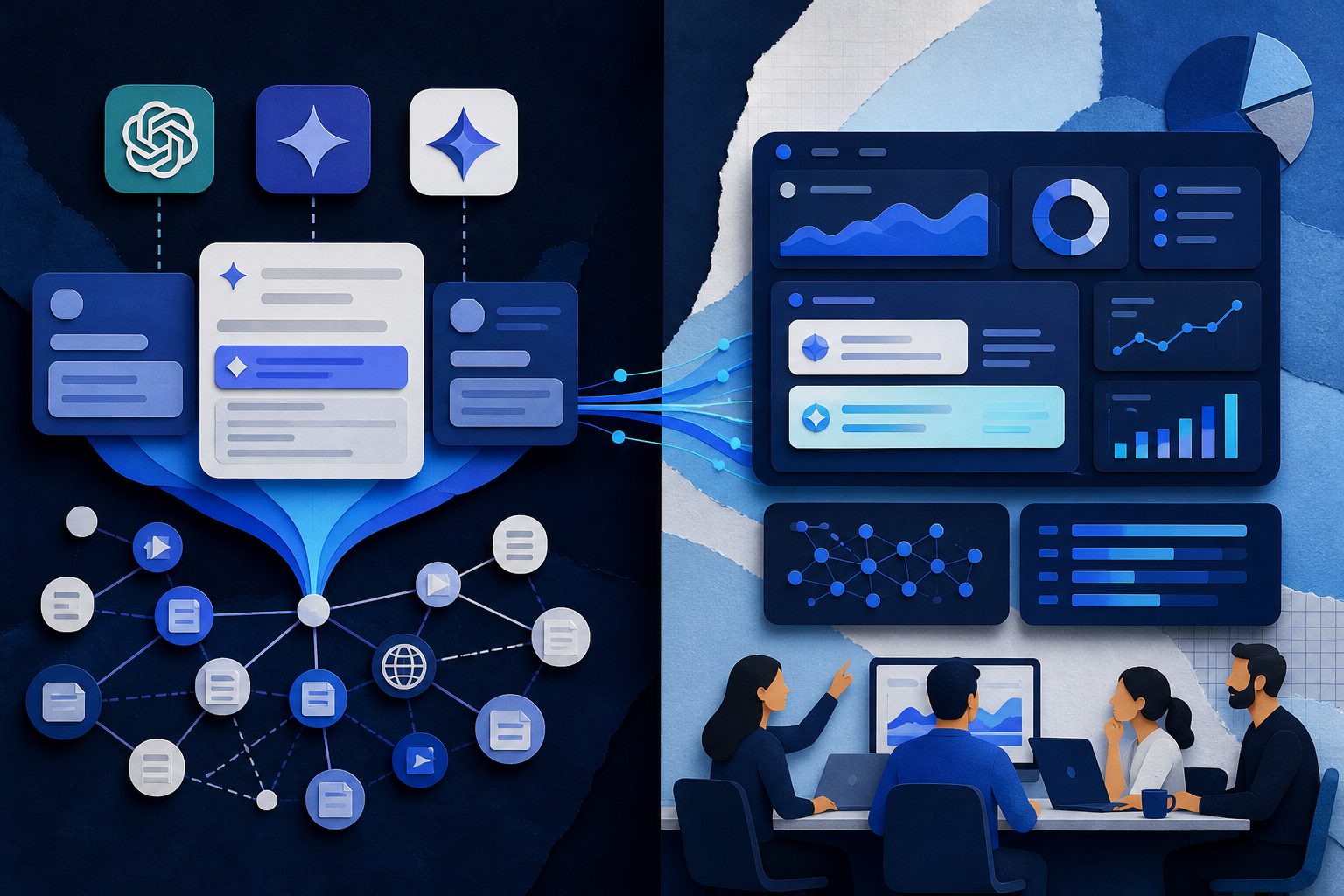
What Are Answer Engine Optimization Services?
Answer engine optimization services are strategy, content, and measurement programs designed to improve how a brand appears in AI-generated answers. They focus on mentions, citations, recommendations, sentiment, factual accuracy, and competitive positioning—not only traditional keyword rankings.
AEO overlaps with SEO, but it is not a simple rebrand. Google still rewards helpful, reliable, people-first content, as described in Google Search Central’s guidance on helpful content. AI answer engines add another layer: they synthesize information from multiple sources, compress comparisons, and may recommend a short list of brands without sending users to ten blue links.
A strong AEO service usually covers four jobs:
- Diagnose visibility across AI engines and prompt types.
- Map citation sources that AI answers rely on.
- Create or improve answer-ready content that is clear, factual, and structured.
- Measure change over time against competitors and buyer-intent questions.
This is why AEO services are especially relevant for SaaS teams. A buyer may ask, “What is the best tool for AI search visibility?” or “Which platform should a B2B SaaS team use for brand monitoring?” If the answer engine names competitors but not your product, the lost opportunity may never appear in your classic SEO dashboard.
What Should the Best Answer Engine Optimization Services Include?
The best answer engine optimization services should include baseline measurement, prompt research, citation analysis, content recommendations, entity cleanup, competitive benchmarking, and repeatable reporting. If a provider only sells blog posts or schema markup, it is likely incomplete.
Use this service checklist before signing a retainer:
| Service component | What it should answer | Why it matters |
|---|---|---|
| AI visibility audit | Where does the brand appear today? | Establishes a measurable baseline |
| Prompt portfolio | Which buyer questions should be monitored? | Connects AEO to real demand |
| Engine coverage | Which AI systems are tracked? | Different engines cite different sources |
| Citation tracking | Which domains and pages influence answers? | Reveals where authority is being formed |
| Competitor comparison | Who is recommended instead? | Prioritizes fixes by lost visibility |
| Sentiment and accuracy review | Is the brand described correctly? | Protects positioning and trust |
| Content optimization plan | What should be rewritten, added, or consolidated? | Converts diagnosis into action |
| Trend reporting | Are mentions, rank, and citations improving? | Separates progress from anecdotes |
MaxAEO fits the measurement and optimization layer of this workflow. It monitors brand visibility across eight AI engines, including ChatGPT, Gemini, Perplexity, Claude, Copilot, Grok, Google AI Mode, and Google AI Overview. It tracks mentions, citation sources, sentiment, competitor visibility, recommendation position, and daily trend lines. Teams can also generate a free AI visibility diagnosis from maxaeo.ai.
AEO Services vs. AEO Tools: Which Do You Need?
Choose an AEO service when you need strategy and execution; choose an AEO tool when you need continuous visibility data. Most mature teams need both: a platform for measurement and a workflow for acting on the findings.
A service provider may help with content briefs, technical recommendations, source outreach, comparison pages, documentation cleanup, and entity consistency. A tool shows whether those actions changed AI answers.
For example, a SaaS company may publish better use-case pages but still fail to appear in Perplexity because review sites, Reddit threads, or third-party comparisons are shaping the answer. Without citation tracking, the team may keep producing owned content while ignoring the sources that AI systems actually use.
That is why buyers should avoid separating “strategy” from “measurement.” A practical AEO stack starts with visibility data, turns gaps into content and citation work, then checks whether AI answers changed.
For a deeper platform-selection approach, see MaxAEO’s guide to choosing an answer engine optimization tool. For SaaS-specific evaluation criteria, the guide to best answer engine optimization tools for SaaS teams is the more focused companion.
The Original AEO Service Fit Score
The AEO Service Fit Score is a practical way to compare providers on evidence, coverage, execution, and accountability. Score each vendor from 0 to 3 across five dimensions, then prioritize the provider with the strongest total—not the loudest promise.
| Dimension | 0 points | 1 point | 2 points | 3 points |
|---|---|---|---|---|
| Baseline visibility | No audit | Manual sample | Engine-level snapshot | Repeatable prompt and engine baseline |
| Citation intelligence | No source tracking | Generic source advice | Domain-level citation review | URL-level citation analysis with competitor comparison |
| Prompt strategy | Uses SEO keywords only | Basic question list | Intent-based prompt clusters | Buyer-stage prompts by persona, use case, and competitor set |
| Execution quality | Content volume only | On-page edits | Content plus entity fixes | Prioritized fixes tied to citation gaps and AI answer behavior |
| Measurement | Narrative reports | Monthly screenshots | Trend reporting | Daily or frequent tracking with mentions, sentiment, rank, and source changes |
Interpretation:
- 0–5: Not a real AEO service; mostly repackaged SEO.
- 6–9: Useful for experimentation, but lacks reliable measurement.
- 10–12: Solid for teams with internal content resources.
- 13–15: Strong fit for brands treating AI search as a strategic acquisition channel.
This scorecard reflects a common buyer problem: many AEO pitches list platforms like ChatGPT, Gemini, Perplexity, and Google AI Overviews, but do not explain how they measure progress. In AEO, measurement quality is not a reporting detail. It determines whether the strategy can be trusted.
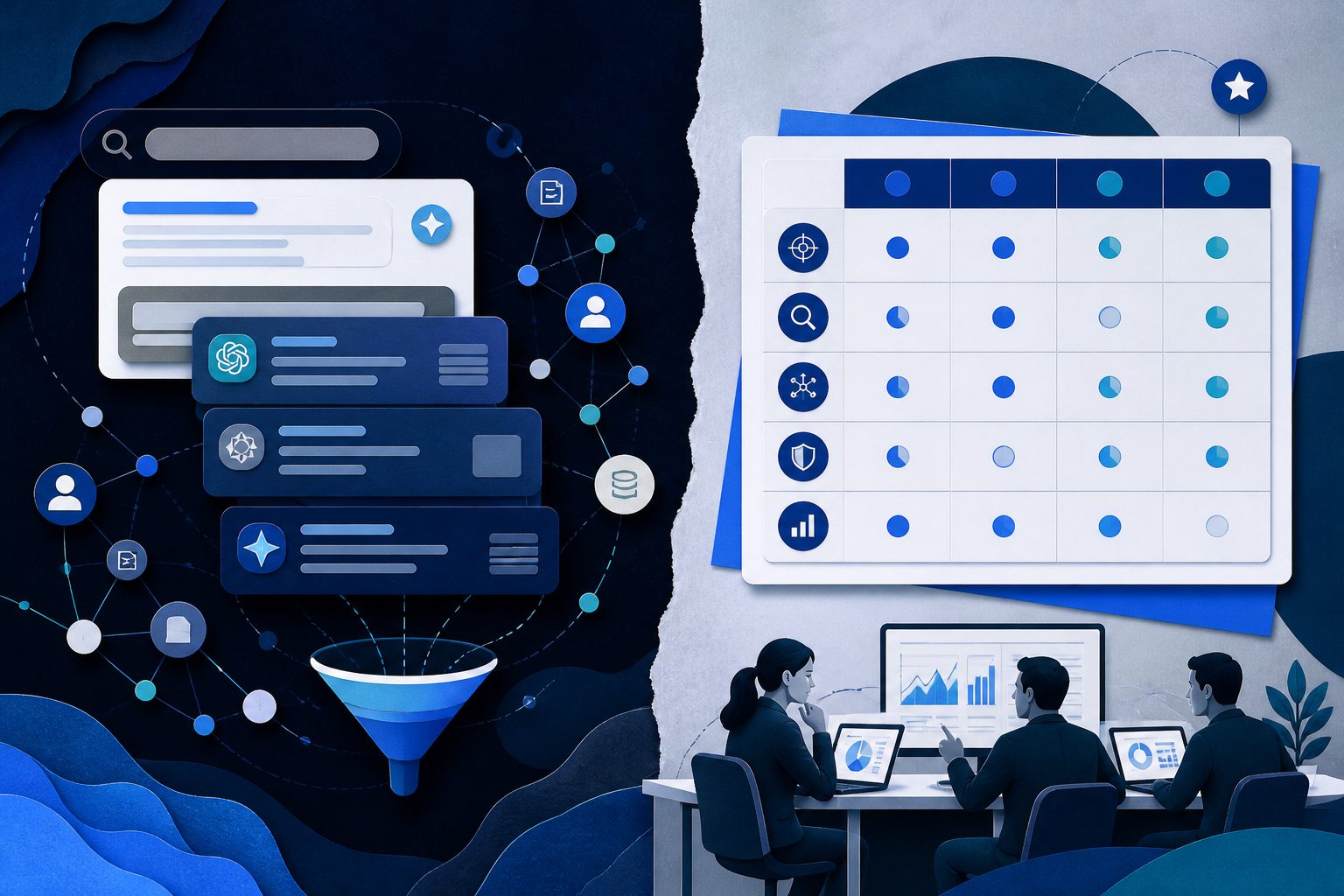
Why Measurement Must Come Before Content Production
AEO content without measurement is guesswork. AI engines do not always cite the same sources as Google’s organic results, so an SEO-winning page may still be invisible in an AI-generated recommendation.
Recent research supports this distinction. A 2026 study comparing Google Search and generative AI systems found low domain-level overlap between Google’s top results and AI-cited domains across ranking-style queries, with GPT-4o showing particularly low overlap in that test set. The paper’s findings are available in “Navigating the Shift: A Comparative Analysis of Web Search and Generative AI Response Generation”.
The operational lesson is simple: do not assume your SEO rank equals AEO visibility.
A strong service should measure at least:
- Mention rate: How often the brand appears for target prompts.
- Recommendation rank: Whether the brand is first, middle, last, or absent.
- Citation sources: Which pages, domains, forums, reviews, or documents are used.
- Sentiment: Whether the answer frames the brand positively, neutrally, or negatively.
- Fact accuracy: Whether pricing, features, positioning, or use cases are misrepresented.
- Competitor share of voice: Which alternatives are consistently recommended.
- Engine differences: How ChatGPT, Perplexity, Gemini, Claude, and Google AI surfaces diverge.
MaxAEO supports this kind of monitoring with daily updates, competitor benchmarks, citation tracking, sentiment analysis, and prompt-level AI visibility reporting across eight AI platforms. It does not automatically publish content; it provides optimization recommendations and AI-ready materials so teams can decide what to implement.
What a High-Quality AEO Engagement Looks Like
A high-quality AEO engagement starts with prompts, evidence, and gaps—not with a fixed package of articles. The best workflow moves from diagnosis to prioritization, then to content and source improvements.
A practical engagement usually follows this sequence:
- Define commercial prompts. Convert SEO keywords, sales objections, competitor comparisons, and buyer questions into monitorable AI prompts.
- Run a baseline audit. Check brand mentions, competitor mentions, citations, sentiment, and recommendation positions.
- Cluster visibility gaps. Separate missing mentions, weak positioning, outdated facts, and missing citations.
- Identify trusted source patterns. Determine whether AI engines rely on review sites, comparison pages, documentation, directories, Reddit, blogs, or media coverage.
- Build answer-ready assets. Create concise definitions, comparison tables, use-case pages, technical documentation, and factual brand descriptions.
- Protect existing SEO. Avoid rewriting pages that already drive valuable organic traffic unless changes are clearly justified.
- Measure daily or weekly movement. Track whether prompts, engines, and citations respond after updates.
This workflow matters because AI search changes unevenly. One engine may update answers quickly; another may continue relying on older sources. AEO is therefore a monitoring discipline as much as a content discipline.
A 2026 log-based natural experiment on ChatGPT referral traffic found that raw growth can be inflated by platform-wide adoption, not only optimization work. The study reported a platform-adjusted effect estimate around 1.8–2.3x while cautioning that headline multiples can overstate causality; see the arXiv paper on AEO and ChatGPT referral traffic. Buyers should ask vendors how they distinguish true optimization impact from general AI-search growth.
How to Evaluate an AEO Provider Before Buying
Evaluate AEO providers by their methodology, not their slogans. A credible provider should show how it selects prompts, tracks engines, identifies citations, prioritizes fixes, and reports outcomes.
Ask these questions in a sales call:
- Which AI engines do you monitor, and how often?
- Do you store original AI answers for later review?
- Can you compare my brand against named competitors?
- Can you show citation sources at the domain and page level?
- Do you track sentiment and factual accuracy?
- How do you convert SEO keywords into AI-search prompts?
- What happens if different engines give conflicting answers?
- Which recommendations require content, technical, PR, documentation, or review-site work?
- How do you avoid damaging existing SEO traffic?
- What metrics will be reported after 30, 60, and 90 days?
For structured content work, providers should also understand search fundamentals. Google explains that structured data helps search systems understand page meaning in its structured data documentation. However, schema alone is not an AEO strategy. It is one signal among many.
For broader service models and ROI questions, MaxAEO’s guide to answer engine optimization services expands on how teams can combine software, agency support, and internal workflows.
When MaxAEO Fits the AEO Service Stack
MaxAEO fits teams that need a visibility system before, during, and after AEO execution. It is an AI search visibility platform for monitoring how brands are mentioned, cited, recommended, and compared across major AI engines.
MaxAEO provides:
- Monitoring across eight AI engines, including ChatGPT, Perplexity, Gemini, Claude, Copilot, Grok, Google AI Mode, and Google AI Overview.
- Daily tracking of brand mention rate, competitive ranking, and average recommendation position.
- Competitor benchmarking for mention frequency, citation sources, sentiment, and share of voice.
- Citation tracking that shows the domains, articles, and platforms AI answers rely on.
- Sentiment analysis and factual accuracy checks for AI-generated brand descriptions.
- Prompt research, dashboards, exports, and optimization recommendations.
- A free AI visibility audit that can be generated from the website.
This makes MaxAEO useful for SaaS buyers comparing AEO agencies, building an in-house GEO/AEO workflow, or validating whether content and citation work are changing AI answer behavior. Teams can start with the free diagnosis on the MaxAEO homepage before deciding whether they need ongoing monitoring or a broader AEO program.
A 30-Day Plan for Starting AEO Services
The first 30 days should produce a baseline, a prioritized opportunity map, and the first set of measurable fixes. Avoid long strategy decks that do not change what AI engines can understand or cite.
A practical month-one plan:
- Days 1–3: Build the prompt set. Include category prompts, use-case prompts, competitor prompts, integration prompts, pricing-sensitivity prompts, and “best tool for” prompts.
- Days 4–7: Run the baseline audit. Measure mentions, recommendation rank, sentiment, competitor visibility, and citations by engine.
- Days 8–12: Classify gaps. Identify whether the issue is missing entity clarity, weak third-party citations, thin comparison content, outdated documentation, or negative sentiment.
- Days 13–20: Produce answer-ready assets. Create concise definitions, comparison tables, FAQ blocks, product fact pages, and use-case pages that can be easily extracted.
- Days 21–25: Improve citation paths. Update owned pages, technical docs, directories, review profiles, and third-party source coverage where appropriate.
- Days 26–30: Re-measure and decide. Compare the new answers against the baseline and choose the next prompts to prioritize.
The best answer engine optimization services treat this as a learning loop. Every new answer becomes evidence for the next optimization sprint.
Common Mistakes When Buying AEO Services
The biggest mistake is buying AEO as a vague promise instead of a measurable operating system. If a provider cannot show the before-state, the after-state, and the source-level reasons for change, the engagement is hard to evaluate.
Watch for these red flags:
- Guaranteed AI rankings or guaranteed citations.
- Reporting based only on screenshots.
- No competitor baseline.
- No distinction between ChatGPT, Perplexity, Gemini, Claude, Copilot, and Google AI surfaces.
- Content recommendations that ignore citation sources.
- “AEO” packages that only include schema markup.
- No plan for correcting hallucinated or outdated brand facts.
- No protection for existing SEO pages that already perform.
AEO is still evolving, so no provider can control every AI answer. What a strong provider can do is build a better evidence base, improve the sources AI systems can access, and measure whether the brand’s AI visibility is moving in the right direction.
Frequently Asked Questions
What are the best answer engine optimization services for SaaS companies?
The best answer engine optimization services for SaaS companies combine AI visibility monitoring, competitor benchmarking, citation tracking, prompt research, sentiment analysis, and content optimization. SaaS teams should prioritize providers that can monitor buyer-intent prompts and show which competitors appear in AI recommendations.
Is AEO different from GEO?
AEO usually focuses on appearing in direct answers, recommendations, and AI summaries. GEO, or generative engine optimization, is often used more broadly for visibility in generative AI systems. In practice, many teams use AEO, GEO, LLM visibility, and AI search optimization to describe overlapping work.
How long does AEO take to show results?
AEO timelines vary by engine, prompt, citation source, and brand authority. Some changes can be detected quickly through monitored prompts, while broader citation and reputation shifts may take longer. A trustworthy provider should report trend lines rather than promise a fixed outcome.
Do AEO services replace SEO?
No. AEO services do not replace SEO. They extend it. Traditional SEO still matters for crawlability, helpful content, technical quality, and authority. AEO adds AI-specific measurement for mentions, citations, recommendations, sentiment, and source influence.
What should I prepare before booking an AEO demo?
Prepare your brand name, website, two or three competitors, and three to five buyer prompts your prospects might ask AI assistants. MaxAEO demos can use your own brand data to review mention rate, competitor visibility, citation sources, and potential fixes.