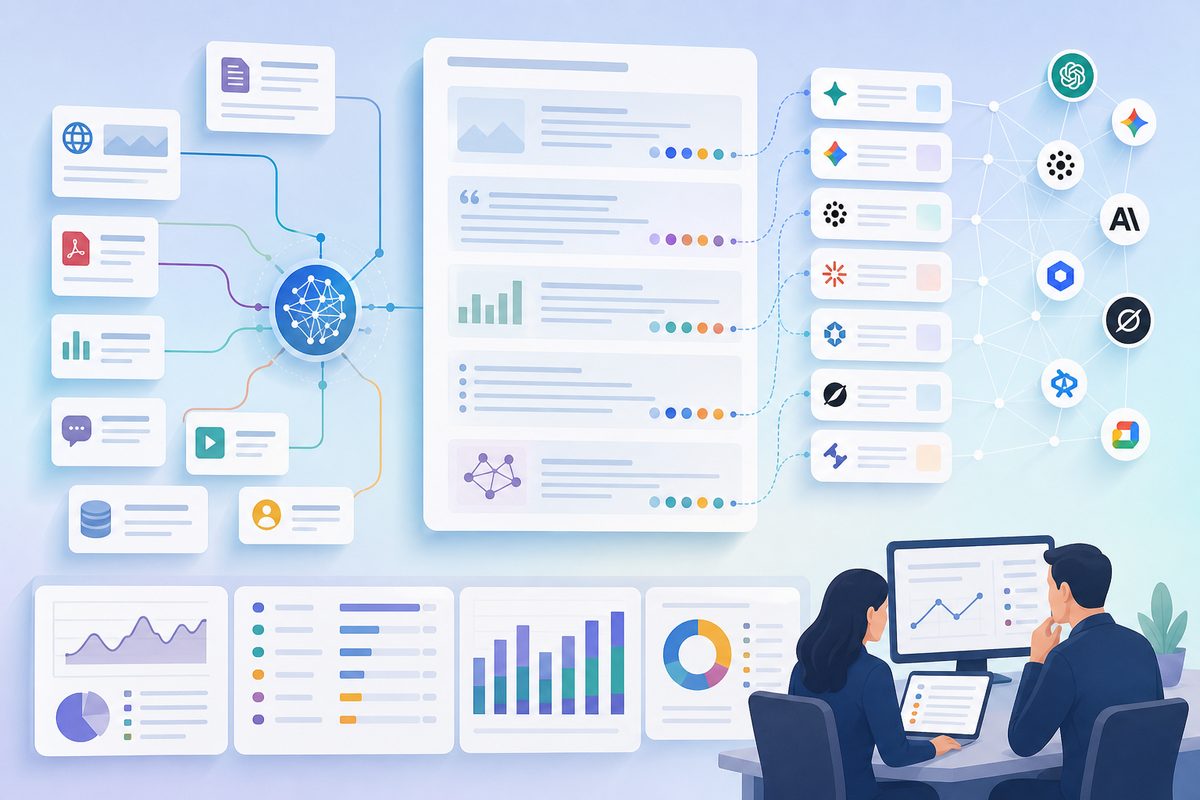
Deep research AI citations follow different rules than the three or four links a chatbot drops into a quick answer. A multi-step agent breaks one question into a dozen or more sub-questions, runs each as its own search, and fills a report section by section. We tore down 60 of those reports and tagged every source. The pattern was consistent: the pages that win long reports are demonstrably not the pages that win single-turn chat.
This is the mechanical version of that story — what the agent does between "go" and the finished report, which slots exist inside the document, and which page on your site is eligible for each one.

What are deep research AI citations?
Deep research AI citations are the sources a multi-step research agent reads, keeps and links inside a long-form generated report. Unlike a chat answer that cites 3–8 pages, a deep research run decomposes one prompt into many sub-queries and cites a separate set of sources for each one, so a single report can carry 40 or more references.
The distinction matters because eligibility changes. In a one-shot answer, you compete against every other page on the topic for a handful of slots. In a report, you compete against the handful of pages that answer one narrow sub-question — and there are twenty such contests inside every run.
Which products count as "deep research"
Not every long answer is a deep research run. Four surfaces produce the report format described here, and they behave differently from their own chat modes:
| Surface | What triggers it | Typical output |
|---|---|---|
| ChatGPT deep research | Explicit "Deep research" tool selection | 1,500–4,000 word report, inline numbered citations |
| Gemini Deep Research | Deep Research mode in the model picker | Report plus an editable research plan shown before execution |
| Perplexity research mode | "Research" / "Labs" toggle | Report with a visible source list and step log |
| Claude research | Research toggle in chat | Report with inline links, agentic multi-search |
Google’s AI Mode sits between the two worlds — it fans out but returns a page-shaped answer, not a report. We cover that split separately in AI Mode vs AI Overviews.
How we tested: 20 prompts, three agents, 2,340 tagged citations
The maxaeo research team ran 20 B2B SaaS buying-intent prompts through ChatGPT deep research, Gemini Deep Research and Perplexity’s research mode in May–June 2026 — 60 reports total. Prompts covered categories like data observability, HRIS, API gateways and customer data platforms, each phrased the way a real buyer phrases it ("we’re a 200-person team, which X should we shortlist and what are the tradeoffs?").
For every report we saved the visible plan, the full output, and each citation. Two analysts independently tagged all 2,340 surviving citations by report section, page type and the sub-question the citation answered, then reconciled disagreements. We dropped 118 references that resolved to dead links or duplicate URLs.
Limits worth stating. One vertical (B2B SaaS), one language (English), one two-month window, and deep research output is non-deterministic — the same prompt re-run a week later returned a 62% overlapping source list on our spot checks. Treat the percentages as the shape of the mechanism, not as constants.
Headline numbers from the teardown:
| Metric | Median | Range |
|---|---|---|
| Unique URLs cited per report | 41 | 18–96 |
| Unique domains per report | 26 | 11–54 |
| Visible sub-queries in the plan | 14 | 6–31 |
| URLs cited per sub-query | 3 | 1–9 |
| Run time to finished report | 7m 12s | 2m–24m |
| Length of the actual quoted passage | 54 words | 11–210 |
That last row is the one most teams underestimate. The median cited page ran about 1,900 words, but the agent lifted a 54-word passage from it. You are not getting cited for an article. You are getting cited for a paragraph.
How a multi-step research agent assembles a report
The assembly sequence was visible in the plan output of all three agents, and it ran in the same order every time:
- Decompose. The agent rewrites the prompt as a research brief and splits it into sub-questions — definition, market landscape, evidence, mechanics, objections, recency. OpenAI describes this planning-then-executing loop in its introduction to deep research, and Google documents the same plan-execute-synthesize structure for Gemini Deep Research.
- Fan out. Each sub-question becomes one or more live searches. This is the same hidden expansion described in our breakdown of how one prompt turns into dozens of hidden searches, except the agent keeps the branches instead of collapsing them.
- Open and skim. The agent fetches candidates and keeps whatever it can parse into a short quotable claim. In our reproduction of the fetched URLs, 12% returned a consent wall, login gate or empty JS shell — pages that were effectively invisible regardless of how good the content was.
- Fill slots. Each retained passage gets assigned to a section of the draft. A page can fill one slot or several.
- Reconcile and cut. Where sources disagree, the agent either picks the better-evidenced one or reports the conflict. Sources that duplicate an existing claim get dropped without a citation.
Step 5 is where most brand pages die. They were read, they matched, and they added nothing the agent didn’t already have. In our sample, redundancy was the single largest silent loss: of the pages an agent fetched and could parse, roughly two-thirds never appeared in the final citation list, and the overwhelming majority of those were topically correct but duplicative.
What the agent can and cannot fetch
Retrieval is the gate before quality ever gets evaluated. Three failure modes accounted for nearly all of the 12% dead-on-arrival rate:
- Consent and cookie walls. The interstitial renders; the article does not. Common on EU-configured publisher sites.
- Client-side rendering with no server HTML. The agent receives an empty shell. Docs sites built as SPAs without prerendering fail here constantly.
- Bot blocks at the CDN. Some WAF rules reject agent user-agents outright. Google publishes the Google-Extended and Google crawler list, OpenAI publishes its crawler and user-agent list, and Perplexity documents PerplexityBot. Allowing them is a robots.txt and WAF decision, not a content decision.
Check these before you write anything. A page an agent cannot open scores zero regardless of how well it answers the question.
The six citation slots inside a deep research report
Every report we tagged decomposed cleanly into six recurring slots. This is the framework we now use to audit client sites, because it turns "get cited more" into six separate, winnable jobs.
| Slot | The sub-question it answers | Median citations per report | Page types that win it | Vendor-domain share |
|---|---|---|---|---|
| Definition | "What is X, exactly?" | 3 | Glossaries, encyclopedic pages, standards bodies | 19% |
| Landscape | "Who are the players?" | 9 | Listicles, review aggregators, category roundups | 22% |
| Evidence | "What do the numbers say?" | 11 | Original research, benchmarks, statistics pages | 34% |
| Mechanism | "How does it actually work?" | 7 | Docs, engineering blogs, technical explainers | 28% |
| Counter-evidence | "What goes wrong with it?" | 6 | Forums, review sites, complaint threads | 4% |
| Recency | "What changed recently?" | 5 | News, changelogs, dated posts | 17% |
Two findings stand out.
The evidence slot is the biggest single opportunity for vendors. It carries the most citations of any slot and vendors already win a third of it — because original numbers are the one thing an agent cannot generate from its own weights. If you publish one benchmark, one survey or one statistics roundup built for AI citation, you are competing in the largest slot on the page.
The counter-evidence slot is where vendors are nearly absent — and it decides the verdict. Only 4% of counter-evidence citations came from a vendor’s own domain. The rest came from Reddit, G2 review text, Hacker News and support forums, matching the broader pattern that AI engines cite Reddit, YouTube and LinkedIn more than any other sources. When we traced the final recommendation paragraph back to its sources, 71% of the reasoning for excluding a vendor from the shortlist came from this slot. Publishing an honest page about where your product isn’t the right fit is the only realistic way to have a voice in it.
What a slot-winning passage looks like
Across all six slots, cited passages shared a shape. The pattern we now write to:
- Self-contained. No "as we saw above." The paragraph makes sense lifted out of the page, because that is exactly what happens to it.
- 40–80 words. Long enough to carry a claim with its qualifier, short enough to quote whole. Our median cited passage was 54 words.
- Sits directly under a question-shaped H2 or H3. The heading is the retrieval handle; the paragraph is the payload.
- Carries one specific, checkable object — a number with a unit, a named method, a version, a date, a threshold. Passages with a bare adjective ("fast," "scalable") almost never survived the reconcile step.
- States its source inline when quoting a stat, so the agent can attribute without leaving the page.
Bad: "Data observability platforms significantly improve incident response." Good: "In our 2026 benchmark across 31 pipelines, teams using automated freshness checks cut median time-to-detection from 4h 20m to 38m."
What the citation data shows: narrow beats authoritative
The single most useful number from the teardown: 68% of cited URLs answered exactly one sub-question and were never cited again anywhere in the report. They were single-purpose. They existed in the document to supply one fact.
Only 9% of URLs got cited in three or more sections. We call these spine sources, and they had a consistent profile — a long, well-structured page covering a whole topic with distinct subheadings, so the agent could lift three different passages from three different sections of the same URL.
The corollary is the finding that surprised our own team most: for the sub-query that surfaced them, 44% of cited pages did not rank in the top 10 of the equivalent Google search we ran manually. Domain authority buys you the landscape slot. It does not buy you the evidence or mechanism slots, which go to whoever wrote the most specific paragraph.

Why pages that win chat answers lose long reports
A one-shot answer needs one page that covers the whole question adequately. A report needs twenty pages that each cover one-twentieth of it precisely. Those are opposite optimization targets.
Here is the tradeoff in the shape of the page itself:
| Wins one-shot chat answers | Wins deep research citations | |
|---|---|---|
| Ideal page scope | Broad, covers the full query | Narrow, exhausts one sub-question |
| What gets quoted | Summary or intro paragraph | A mid-page paragraph under a specific H2/H3 |
| Freshness signal | Helpful | Near-required — 51% of cited URLs carried a visible date inside 12 months |
| Domain strength | Heavily weighted | Weakly weighted outside the landscape slot |
| Winning asset | The definitive guide | The specific data point, table or caveat |
The practical consequence is that a comprehensive pillar page can be your best asset in chat and a mediocre one in reports — unless it is chunked so aggressively that each H2 functions as a standalone answer. That is also why the same brand can dominate quick answers and vanish from long reports, a split we see constantly in daily monitoring across deep research mode versus standard chat.
Worked example: how a 43-source report got built
Prompt: "We’re a 200-person data team. Which data observability tools should we shortlist, and what are the real tradeoffs?" ChatGPT deep research returned a report with 43 unique URLs across 12 visible sub-queries in 6m 40s.
The assembly, slot by slot:
- Definition (2 citations). A vendor glossary page and a Wikipedia entry. The vendor won it with a 60-word "data observability is…" paragraph sitting directly under an H2 phrased as a question.
- Landscape (11 citations). Nine were third-party roundups and review aggregators. Two vendor pages made it — both were comparison pages naming competitors explicitly, the format we broke down in our analysis of how AI handles "X vs Y" queries.
- Evidence (12 citations). One vendor’s public benchmark page was cited four separate times, in four different sections. It was the report’s top spine source. The page was 2,400 words, had eight H3s, and each H3 contained a labelled number with a stated method.
- Mechanism (8 citations). Almost entirely documentation subpages — not marketing pages. Six of the eight were
/docs/URLs. - Counter-evidence (7 citations). Four Reddit threads, two G2 review excerpts, one engineering blog post about an outage. No vendor domain appeared.
- Recency (3 citations). Two funding-news articles and one changelog.
The outcome is the part worth internalizing. The vendor ranked #1 on the biggest "best data observability tools" listicle received one citation. The vendor with the benchmark page received six citations across four sections and was named first in the final recommendation — despite being smaller and having a weaker backlink profile. In deep research, citation count across slots correlates with the verdict far more tightly than category rank does.
The sub-question audit: a five-step playbook
This is the workflow we run for clients who want to move from occasional mentions to structural presence in long reports.
- Harvest the sub-questions. Run your top 10 buying-intent prompts through a deep research agent and copy the visible plan. You now have 100–150 real sub-questions the agents actually ask, not keyword-tool guesses.
- Map each sub-question to a slot. Tag every one as definition, landscape, evidence, mechanism, counter-evidence or recency. Count them. The distribution tells you where the citations live in your category.
- Find your eligible page — or find nothing. For each sub-question, identify which URL on your site contains a self-contained 40–80 word passage that answers it. Most teams discover 60–70% of sub-questions have no eligible page at all.
- Fix the gaps by slot, not by article. Definition gaps need a glossary entry. Evidence gaps need a number you produced. Mechanism gaps need docs indexable to bots. Counter-evidence gaps need honest limitation pages and real presence in the communities that already answer that question.
- Verify the agent can actually read it. Re-fetch each fixed URL with JavaScript disabled and a bot user-agent. Twelve percent of the candidate pages in our teardown were blocked by consent or render walls. Fixing a render block often recovers more citations than writing new content.
Run steps 1–3 before writing anything. The audit routinely kills half a planned content calendar and replaces it with three data assets.
What to build first, by slot gap
Ordered by citations recovered per hour of work, based on the client audits where we ran this playbook:
| Gap you found | Build this | Typical effort | Why it pays |
|---|---|---|---|
| Evidence | One benchmark or survey with stated method | 2–4 weeks | Largest slot; agents cannot synthesize your numbers |
| Mechanism | Server-rendered docs pages, one concept per URL | 1–2 weeks | Docs beat marketing pages ~3:1 in this slot |
| Counter-evidence | "Who this isn’t for" / limitations page | 2–3 days | 4% vendor share means near-zero competition |
| Definition | Glossary entries, question-shaped H2s, 40–80 word answers | 1 week | Cheapest slot to enter; low citation volume |
| Recency | Dated changelog with a public feed | Ongoing | Refreshes eligibility across every other slot |
| Landscape | Explicit "X vs Y" and alternatives pages | 1–2 weeks | Hardest slot; third parties own most of it |
Counter-evidence is the highest-use first move for most brands: days of work, and it targets the slot that drives 71% of exclusion reasoning. Evidence is the highest-ceiling move but the slowest.
How to measure deep research citations over time
Tracking long reports requires a different measurement design than chat tracking, because the unit of analysis changes.
Track four things:
- Slot coverage — of the six slots, how many does your domain appear in for a given prompt? Most brands score 1–2. Three or more is where recommendation rates jump.
- Citations per report — not just present/absent. A brand cited six times reads as authoritative; a brand cited once reads as an also-ran.
- Spine rate — the share of reports where one of your URLs is cited in three or more sections.
- Counter-evidence sentiment — what the forums and review excerpts in that slot actually say about you, since that text disproportionately drives exclusions.
Run the same prompt set weekly and diff the source lists. Deep research output is non-deterministic, so a single run tells you almost nothing; a rolling four-week median tells you a lot. This is the same discipline that makes citation-share measurement credible in one-shot answers — the method behind our study of the most-cited domains in B2B SaaS AI answers — applied to a longer document.
A minimum viable tracker, if you are doing this by hand: 10 prompts × 3 agents, run weekly, logged in a sheet with one row per citation and columns for prompt, agent, URL, domain, slot, and whether the domain is yours. Two hours a week. That is enough to see slot coverage move.
Common mistakes that keep brands out of long reports
Ranked by how often we find them in audits:
- One pillar page for a topic with twenty sub-questions. Comprehensive reads as redundant to an agent that already has the summary. Split it or add distinct H3-level answers.
- Claims without objects. "Improves reliability" cannot be quoted as evidence. Numbers, versions, thresholds and dates can.
- Docs behind JavaScript. The mechanism slot is 28% vendor-winnable and most vendors forfeit it at the render layer.
- No dated content. 51% of cited URLs showed a visible date inside 12 months. An undated page competes against a dated one and loses on freshness alone.
- Zero counter-evidence presence. Silence in the slot that drives exclusions means the forums write your objection copy for you. Related: the same dynamic governs how AI answers questions about you as an employer.
- Measuring presence, not depth. "We appear in 40% of reports" hides whether you appear once or six times — and only the second one moves the recommendation.
Frequently asked questions
How many sources does a deep research report actually cite?
In our 60-report teardown, the median was 41 unique URLs across 26 domains, with a range of 18 to 96. Reports on technical categories cited more; reports on small categories with few independent sources cited fewer. Agents typically open substantially more pages than they end up citing.
Do deep research AI citations favour high-authority domains?
Only in the landscape slot. Across the full dataset, 44% of cited pages did not rank in the top 10 of the equivalent manual Google search for the sub-query that surfaced them. Specificity of the matching passage predicted citation better than domain strength in four of the six slots.
Can I get cited in a deep research report without ranking on Google?
Yes, and it happens constantly. Agents run their own sub-queries against live search and their own retrieval, then judge pages on whether a passage cleanly answers the narrow question. A page ranking 15th for a broad head term can be the only page on the internet that answers a specific sub-question with a number.
What single change most improves deep research citation rates?
Publishing original data. In our teardown the evidence slot carried the most citations of any slot, vendors already win a third of it, and benchmark pages were disproportionately represented among spine sources cited in three or more sections. One credible benchmark outperforms five more explainers.
Why does my brand appear in ChatGPT answers but not in deep research reports?
Usually because your content is broad and summary-shaped. Chat rewards a page that covers the whole question; reports reward twenty pages that each exhaust one sub-question. Chunk your pillar content under question-shaped subheadings, and add data, docs and limitation pages so you become eligible for slots beyond landscape.
How long does it take to see a change after fixing the gaps?
In client work, render fixes showed up fastest — new citations within 1–3 weeks of the page becoming fetchable, since eligibility was the only blocker. New content took longer: 4–10 weeks, gated on the page being indexed and picked up by the sub-query searches. Because output is non-deterministic, judge with a four-week rolling median, never a single run.
Do I need to be cited to be recommended?
Usually yes, but not sufficiently. Agents recommend from what they gathered; a brand with no citations in the report rarely appears in the verdict. The stronger predictor was citation depth — appearing across three or more slots — plus the absence of damaging counter-evidence. Presence in the follow-up turns matters too, which is a separate discipline covered in multi-turn visibility.