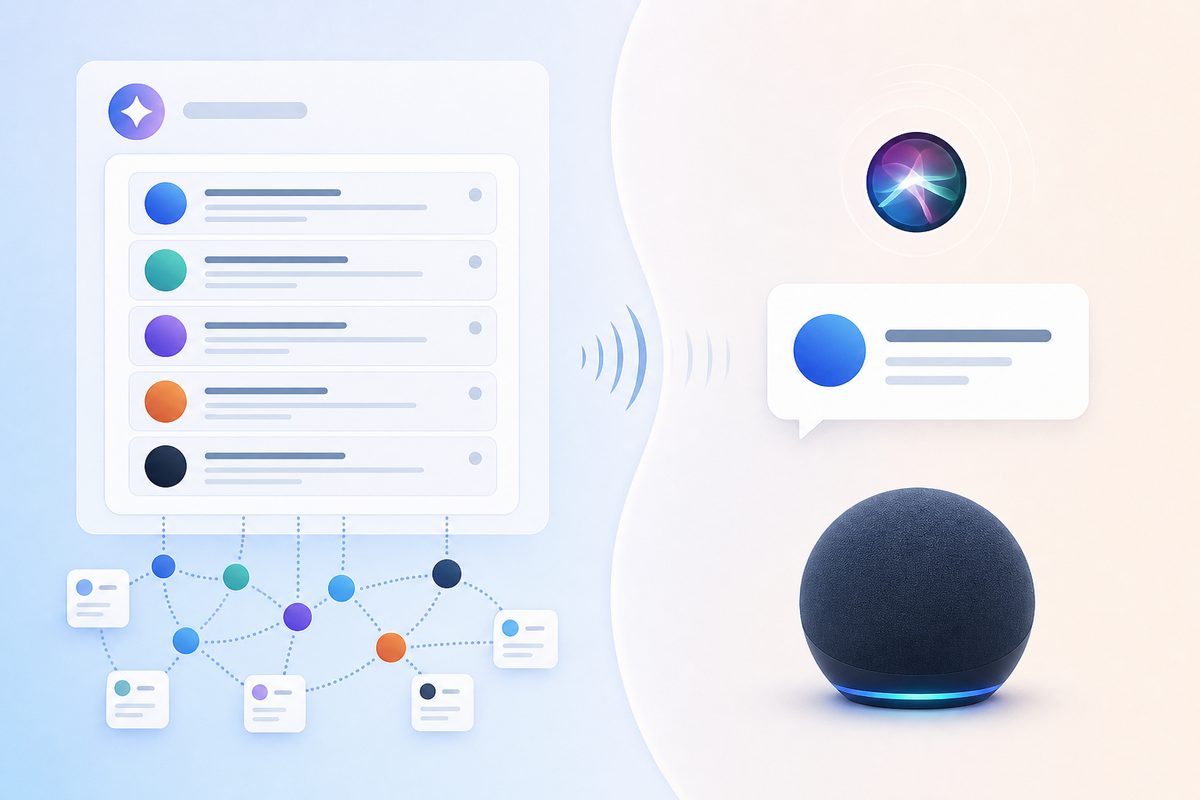
Voice assistant AI brand visibility is the hardest version of the AI search problem, because a spoken answer physically cannot read your five-item comparison table out loud. On a screen, an AI answer can name six vendors and cite eleven sources. Through a speaker, the same query returns one name — occasionally two — and everything else is silently discarded.
That difference is not cosmetic. It changes which signals are worth optimizing, how you capture an answer for monitoring at all, and what "second place" is worth. On screen, second place still earns a mention and sometimes a click. In a spoken answer, second place usually earns nothing.
This piece breaks down the word-budget math behind that collapse, how each major assistant surface chooses its one name, a repeatable audit protocol you can run without an API, and the four metrics that survive the translation from text to speech.
What is voice assistant AI brand visibility?
Voice assistant AI brand visibility is how often, how prominently, and how accurately an assistant speaks your brand name aloud when a user asks a buying, comparison, or recommendation question. It is measured on spoken output — not on rankings, not on links — because in voice there is no SERP for the user to scan.
Three things make it distinct from ordinary answer engine optimization. First, the output is ephemeral: there is no page to inspect afterward. Second, the shortlist is compressed to one or two names. Third, attribution is optional — an assistant can describe your product accurately and never say who makes it.
Those constraints mean the metrics that matter shift. Citation counts and source lists, which dominate text-based generative engine optimization, become secondary. What matters is whether you are the name spoken first.

Why a spoken answer has room for only one or two brands
The one-name dynamic is not an editorial preference. It falls out of arithmetic, and you can derive it from Google’s own guidance.
Google’s speakable structured data documentation recommends roughly 20–30 seconds of content per section — about two to three sentences — for a good audio experience. Text-to-speech reads at a conversational pace of roughly 150 words per minute. That gives a spoken answer a working budget of about 50 to 75 words.
Now price out what one usable recommendation actually costs in that budget:
| Component of a spoken recommendation | Typical word cost |
|---|---|
| Lead-in framing ("Based on recent reviews…") | 8–12 |
| Brand name + category anchor | 5–7 |
| One differentiating reason | 8–12 |
| Caveat or personalization | 6–10 |
| Next-step prompt ("Want me to order it?") | 6–10 |
| One complete recommendation | 33–51 |
A single well-formed recommendation consumes most of the budget. A second name — stripped down to "or [brand], if you want X" — costs another 13–19 words and pushes a typical answer to 46–70. A third does not fit without cutting the reasoning that makes the answer useful at all.
The same document adds a hard structural cap on the Assistant side: Google states that only up to three articles receive text-to-speech playback per query. Compare that with a text AI answer, where a ten-source citation tray costs the user nothing but a glance.
The practical conclusion: voice is winner-take-most by construction, and no amount of content optimization will widen the slot. Your goal is not to make the shortlist. It is to be the shortlist.
How each assistant surface picks its one name
Different assistants collapse the shortlist using different evidence. Knowing which pool each one draws from tells you where to spend effort.
Siri and Apple Intelligence: an answer engine bolted onto a device assistant
Apple has been rebuilding Siri around a planner-and-summarizer architecture rather than a command parser. As Search Engine Land reported on Apple’s "World Knowledge Answers" project, the system is designed around three parts — a query planner, a knowledge search layer, and a summarizer — so Siri can synthesize a web-grounded answer instead of handing the user off to Safari. Reporting across outlets has consistently pointed to Google’s Gemini models powering parts of that stack under a multi-year agreement.
For brands, the architectural detail that matters is the split. The knowledge search layer decides what evidence exists about you; the summarizer decides whether your name survives compression. You can be well-represented in the retrieval step and still be summarized out of the spoken sentence.
Practical implication: entity clarity beats page count. Consistent Organization and Product markup, an unambiguous one-line category description repeated across your owned properties, and third-party pages that describe you the same way all reduce the chance the summarizer drops you as redundant or uncertain.
The tell to watch for: if you appear in Siri’s on-screen answer card but not in the spoken sentence, that is a summarizer loss, not a retrieval loss. Fixing it means shortening and standardizing your category claim, not publishing more pages.
Alexa+: recommendation plus the ability to act
Alexa+ is the surface where a spoken recommendation converts directly. Amazon describes an assistant that can order groceries, book services, and complete multi-step tasks end to end — including a scenario where Alexa navigates the web, finds a service provider through Thumbtack, authenticates, arranges a repair, and reports back without supervision. Amazon prices it at $19.99 per month and includes it free for Prime members, which is why its distribution is measured in hundreds of millions of devices rather than early-adopter counts.
Two consequences follow. First, on Amazon-adjacent queries, catalog and marketplace signals — structured attributes, review volume, badge status, availability — outweigh anything on your own website. A product page that is perfect on your domain and thin on Amazon will lose the spoken slot to a competitor with the reverse profile.
Second, when the assistant can transact, the spoken shortlist becomes a purchase funnel with exactly one visible option. This is the same collapse that shows up in agentic and assistant-led B2B research, where the assistant does the reading and the shortlist is decided before a human sees it.
Gemini Live and Google Assistant: snippet logic in a spoken wrapper
Google’s voice surfaces inherit the most predictable behavior, because they sit closest to the classic featured-snippet pipeline: extract a concise passage, read it, optionally name the source.
The upside is that traditional snippet craft still pays — a clean 40–60 word direct answer under a question-shaped H2 is the single highest-use asset for this surface. The downside is the cap: Google’s own documentation limits text-to-speech playback to three articles per query, so there is no long tail to fall back into.
Practical test: run your target question as a text query on the same device and check whether you hold the featured snippet or AI Overview position. On Google surfaces, the spoken answer is usually downstream of what you can already see on screen — which makes this the one surface where text-side wins predict voice-side wins.
ChatGPT Voice Mode and assistant-style chat: memory changes the answer
Conversational assistants with persistent memory behave differently from a cold smart speaker. Prior conversations, stated preferences, and account context reweight the shortlist before retrieval happens. Two users asking the identical question in the same minute can hear two different single names — which is exactly why one-off spot checks are worthless and why brand mentions here need to be sampled across accounts, not observed once.
Multi-step reasoning compounds the effect: when the assistant researches before answering, the brands that survive are the ones corroborated across several independent sources, not the ones with the strongest single page. That selection dynamic is covered in detail in how deep research modes change which brands get cited.
| Surface | Primary evidence pool | What most often wins the one slot | How to capture the answer |
|---|---|---|---|
| Siri / Apple Intelligence | Web knowledge layer + on-device context | Entity clarity and consistent third-party descriptions | Screen recording; on-screen answer card |
| Alexa+ | Amazon catalog, behavioral and review signals | Structured product attributes, badge and availability status | Screen/audio recording; request history |
| Gemini Live / Assistant | Google index and snippet-eligible passages | Extractable 40–60 word direct answers | Audio recording; parallel text query |
| ChatGPT Voice Mode | Model knowledge + web retrieval + memory | Repeated, corroborated third-party positioning | Chat transcript retained after the session |
The Spoken Shortlist Audit: a repeatable protocol for measuring voice visibility
Most voice-visibility advice stops at "optimize for conversational queries." The harder problem is measurement — there is no console, no impressions report, and no API that returns what a speaker said. Here is a protocol that produces comparable numbers week over week.
- Build a fixed prompt set of 40 spoken questions. Split them evenly across four intents: category discovery ("what’s the best tool for X"), head-to-head ("is A or B better for X"), attribute-led ("what’s the cheapest X that does Y"), and problem-led ("my X keeps doing Y, what should I use").
- Freeze your variables. One device per surface, one account state, one location, one language. Log them. A change in any of these invalidates comparison with last week’s run.
- Use a clean account where possible. Personalization from your own past queries will flatter you. Where a clean account is not possible, note it as a known bias in the report.
- Record, don’t remember. Run a second device as an audio recorder, or screen-record the phone. Assistant answers vanish; your notes will drift toward what you expected to hear.
- Transcribe every answer verbatim. Include hedges and caveats. "You might consider Brand X" and "I’d go with Brand X" are different outcomes and should not be coded the same.
- Code each transcript for five fields: brands named, order named, whether your brand was named first, whether a source was attributed aloud, and whether the description of your brand was accurate.
- Ask one standard follow-up on every prompt — "any others?" — and code the second answer separately. This is where brands that lost the first slot reappear.
- Run the identical prompt as text on the same platform. The gap between the text shortlist and the spoken shortlist is the single most useful number this audit produces.
- Repeat weekly at a fixed time. Assistant behavior drifts; a single snapshot cannot tell drift from noise.
- Report movement, not absolutes. A First-Name Rate of 12% means nothing alone. Twelve percent, up from four, after a specific content and entity fix, is a defensible result.
Forty prompts across four surfaces with one follow-up each is 320 recorded answers per cycle. At roughly 45 seconds per answer — ask, listen, transcribe, code — that is about four hours of hands-on work per run. Sustainable monthly, painful weekly, which is the point where an automated AI search monitoring workflow starts paying for itself on the text side, with voice runs reserved for spot validation of what the tooling reports.

Four metrics that actually describe voice performance
Text-era metrics translate badly here. Share of voice computed over citation lists will overstate your position, because voice discards most of the list before speaking. These four are built for a one-slot surface:
- Spoken Share of Voice (SSoV) — your named mentions ÷ all brand names spoken across the prompt set. The voice-native version of ai share of voice.
- First-Name Rate — the share of answers in which you are the first brand spoken. On a one-slot surface this is the closest thing to a ranking.
- Slot Depth — the average number of distinct brands named per spoken answer. Below 1.5, the category is winner-take-most and second place is nearly worthless. Above 2.5, there is room to fight for inclusion rather than dominance.
- Follow-up Recovery — the share of answers where you appear only after "any others?" High recovery with low First-Name Rate means you are known but not preferred, which is a positioning problem, not a coverage problem.
Here is what a completed scorecard looks like. The figures below are an illustrative example showing the shape of the output, not published research — the protocol above is what produces your real numbers.
| Metric | Category discovery | Head-to-head | Attribute-led | Problem-led |
|---|---|---|---|---|
| Slot Depth | 1.2 | 2.0 | 1.4 | 1.1 |
| First-Name Rate | 10% | 25% | 15% | 5% |
| Follow-up Recovery | 35% | 20% | 30% | 40% |
| Accurate description | 80% | 90% | 70% | 60% |
Read that pattern the way you would read a funnel. Head-to-head prompts carry the highest Slot Depth because comparison questions force at least two names — which is why winning explicit "X vs Y" comparison answers is the most tractable entry point into voice: you only need to be one of two, not the only one.
Problem-led prompts show the opposite: one name, low accuracy, high recovery. That combination means the assistant knows you exist but does not connect you to the problem language customers actually use. The fix is content that names the symptom in spoken words, not the category in marketing words.
How to set a target for each metric
Absolute benchmarks do not exist for voice, so set targets from your own baseline and your category’s Slot Depth:
- Slot Depth below 1.5 — inclusion is not a goal. Target displacement of the single incumbent on your five highest-intent prompts, and expect a multi-quarter timeline.
- Slot Depth 1.5–2.5 — target First-Name Rate growth in the 5–10 point range per quarter; the second slot is winnable with corroboration work alone.
- Accurate description below 80% — fix this before chasing First-Name Rate. Being named with a wrong description spends the slot and disqualifies you in the same sentence.
Which signals move a spoken answer — and which don’t
The optimization list for voice overlaps with text generative engine optimization, but the weights are different enough to change your roadmap.
What carries more weight in voice:
- A single-sentence category claim you repeat everywhere. The summarizer needs one compressible fact about you. If your homepage, your G2 profile, and your review-site listings each describe you differently, compression drops the ambiguous entity first.
- Entity disambiguation. Organization and Product schema, consistent legal and trade names, and clear parent/child brand relationships. An assistant that is unsure whether two names are the same company will say neither.
- Third-party corroboration in plain language. Reviews, roundups and analyst mentions that describe the same benefit in similar words raise the odds that the summarizer keeps your name attached to that benefit.
- Being the answer to a problem, not a category. Problem-led prompts show the weakest brand association in most audits. Content that names the symptom in the user’s spoken words is disproportionately valuable.
What carries less weight than you’d expect:
- Long comparison tables. They win text AI answers and are unreadable aloud.
- Citation volume. A voice answer that reads three sources aloud is already unusual; the fortieth citation on your source list is invisible.
- Page-level keyword coverage. Voice queries are long and varied; entity-level association generalizes across them better than page-level targeting does.
- Speakable markup as a growth lever. Google labels the feature beta and limits it to English-language content for U.S. Google Home users. Implement it if you publish news-style content; do not build a strategy on it.
The through-line: voice rewards a compressible identity more than a comprehensive library. That is a genuinely different brief from the one most content teams are working against.
Where the voice slot is decided outside your website
The largest lever in voice sits on properties you do not own. Because the summarizer needs corroboration to justify a single name, the evidence it weighs most is the description repeated by others.
Three sources do disproportionate work:
- Review platforms and category roundups. These supply the plain-language benefit phrasing an assistant can compress. One roundup that describes you in the same words as your homepage is worth more than three that invent new framing.
- Video. Assistants that ground answers in video transcripts pull spoken-language descriptions directly, which is why getting into video-backed AI answers is unusually well-matched to voice: the source material is already conversational.
- Employer and company-reputation sources. Assistants answering "is X a good company" pull from a different pool than product queries, and a weak picture there bleeds into brand-level answers — the dynamic detailed in how AI answers employer-brand questions.
Audit these the same way you audit your own site: read the first sentence each source uses to describe you, and check whether all of them could compress into the same spoken clause. If they cannot, the summarizer has no stable fact to say aloud.
Voice versus text AI answers: what actually changes
| Dimension | Text AI answer | Spoken assistant answer |
|---|---|---|
| Brands named | 3–8 typical | 1–2 typical |
| Value of second place | Real — mention plus possible click | Near zero unless the user follows up |
| Attribution | Visible citation tray | Optional and often skipped |
| User verification | One glance at sources | Requires a spoken follow-up |
| Capture method | Scrape or API | Recording plus transcription |
| Best content shape | Structured comparison | One-sentence direct answer |
| Correction speed | Fast — fix the cited page | Slow — the entity picture must shift |
That last row is the one to plan around. When a text answer misdescribes you, the fix path usually runs through a specific citable page. When a spoken answer misdescribes you, there is often no single source to correct — the description came out of a blended entity picture. Voice-side reputation repair therefore runs on longer cycles and needs earlier detection, which is the practical case for continuous llm brand tracking rather than quarterly spot checks.
A 30-day plan to get from zero to a defensible voice report
Thirty days is enough to establish a baseline and produce one movement number — which is what a budget conversation actually requires.
Days 1–5: build the instrument. Write the 40-prompt set from real customer language: support tickets, sales call transcripts, and site search logs beat keyword tools here, because spoken queries are phrased as complaints and questions, not as keywords.
Days 6–10: run baseline and diff against text. Record all four surfaces, transcribe, and compute the four metrics. Then run the same prompts as text queries. Any prompt where you appear in text but not in voice is a compression failure, not a coverage failure — different fix.
Days 11–20: ship the compression fixes. Standardize the one-sentence category claim across owned properties. Tighten entity markup. Publish or update direct 40–60 word answers to the ten prompts with the worst First-Name Rate. Correct third-party profiles that describe you off-message.
Days 21–30: re-run and report movement. Same prompts, same devices, same time of day. Report the delta per metric per intent bucket, and flag Slot Depth separately — if Slot Depth in your category is 1.2, tell stakeholders honestly that inclusion is not a viable goal and displacement is the only path.
What thirty days will not produce: a First-Name Rate change on Siri or ChatGPT Voice Mode driven by entity work. Third-party descriptions and model knowledge update slowly. Expect Gemini-surface movement first, because it is snippet-driven, and treat the other surfaces as a two-to-three-quarter horizon.
Five mistakes that quietly ruin voice measurement
- Auditing on your own logged-in phone. Personalization from months of your own searches inflates every metric you report.
- Coding "mentioned" as a binary. "You could try Brand X" and "I’d recommend Brand X" have very different downstream effects. Code order and framing, not presence.
- Ignoring the follow-up answer. For most brands, the second answer contains more actionable signal than the first, because it reveals whether you are in the consideration set at all.
- Treating a bad description as a low priority. An assistant that names you but describes your product wrong converts worse than one that never names you — it spends the slot and disqualifies you in the same sentence.
- Reporting a single week as a trend. Assistant outputs drift on model updates you cannot see. Two data points are an anecdote; six weekly points are a trend line you can defend.
Frequently asked questions
Is voice assistant AI brand visibility measurable without an API?
Yes, but only through recording and transcription. No major assistant exposes an API that returns the spoken answer a consumer device would produce. The workable path is a fixed prompt set, recorded runs, verbatim transcripts, and consistent coding — which is why sample size and cadence matter more here than in text-based ai search monitoring.
Does optimizing for voice help or hurt text AI visibility?
It helps, with one caveat. Direct 40–60 word answers, clean entity markup, and consistent category claims improve extraction on both surfaces. The caveat is that comparison tables and long structured sections still win text answers and do nothing for voice, so keep both formats rather than replacing one with the other.
How many brands does a voice assistant typically name?
Usually one, sometimes two, rarely three. The constraint is the spoken word budget: at conversational text-to-speech speed, a 20–30 second answer is roughly 50–75 words, and one complete recommendation with a reason and a next step consumes 33–51 of them.
Should we implement speakable schema?
Only if you publish news-style content in English for a U.S. audience. Google’s documentation describes the feature as beta, limits it to English-language content for U.S. Google Home users, and notes that only up to three articles get text-to-speech playback per query. It is a small tactical addition, not a strategy.
How long does it take to change a spoken answer?
On Google’s voice surfaces, as fast as the underlying snippet changes — often weeks, because it is index-driven. On Siri, Alexa+ and ChatGPT Voice Mode, the answer depends on third-party descriptions and model knowledge, so plan in quarters, not weeks. This asymmetry is why the audit codes surfaces separately rather than averaging them.
Do smaller brands have any path into a one-slot answer?
Yes, through narrowing. A generalist claim competes with incumbents that have far more corroboration; a specific problem-led claim ("the X tool for teams that need Y") faces almost none. Slot Depth is measured per prompt, not per category — the prompts where you can be the only credible name are the ones to own first.
What does it take to get recommended by ChatGPT and other assistants in voice mode specifically?
The same entity work that wins text answers, plus compressibility. Assistants with memory reweight results per user, so consistency across many third-party descriptions matters more than any single owned page. Track it across multiple accounts and sessions — a single lucky answer is not a result.