Regional AI answer engines cite the web their own market publishes, not the web your English content plan was built for. Across 4,900 citations we logged on DeepSeek, Qwen, Naver AI Briefing, Yandex Alice and Le Chat, domestic domains supplied 54% to 94% of every sourced answer — and only 9% of those domains ever appeared in the Western engines' answers to the same questions.
This is the corpus map, engine by engine, plus what it takes to get cited in each one.
What are regional AI answer engines?
Regional AI answer engines are conversational search assistants that dominate one national or linguistic market rather than the global one. They retrieve from a domestic index, cite domestic publishers, and therefore recommend a different vendor shortlist than ChatGPT or Gemini return for an identical question.
That difference is the commercial problem. A brand can hold strong AI share of voice in English on the five engines every dashboard tracks and be entirely absent from the shortlist a Korean or Russian buyer sees — because the sources feeding those answers were never in the content plan.
Regional engine vs global engine: what actually differs
| Layer | Global engines (ChatGPT, Gemini, Perplexity) | Regional engines |
|---|---|---|
| Retrieval index | Bing, Google, or a proprietary crawl of the open web | Domestic index (Yandex, Quark) or a walled first-party corpus (Naver) |
| Preferred proof | English review sites, docs, G2-style directories | National Q&A boards, local tech media, state and trade bodies |
| Entity facts | Wikipedia, Crunchbase, LinkedIn | Baidu Baike, Naver Encyclopedia, Russian/French Wikipedia |
| Owned content | None (except Google's own properties) | Often 19–71% of citations point back at the engine's own platform |
The regional engine map: who owns which market
Five engines were in our study. They are not the only ones worth knowing about.
| Market | Engines that answer buyer questions | Retrieval-backed? |
|---|---|---|
| China | Doubao (ByteDance), DeepSeek, Qwen via Quark (Alibaba), Ernie (Baidu), Kimi (Moonshot) | Yes, except DeepSeek without search enabled |
| South Korea | Naver AI Briefing and Cue:, CLOVA X, Kakao's assistant | Yes — Naver-internal first |
| Russia and CIS | Yandex Alice with Neuro, Sber GigaChat | Yes — Yandex organic index |
| France and francophone EU | Le Chat (Mistral) | Yes — third-party search API plus licensed news |
| India | Global engines lead; Sarvam and Krutrim serve Indic-language queries | Partly |
| MENA | Global engines lead; Jais and Falcon serve Arabic-first workloads | Mostly not |
| Japan | Global engines lead, surfaced inside Yahoo! Japan and LINE | Yes, via partner indexes |
Only the first four rows justify a separate tracking budget today. The rest are model plays, not answer surfaces with their own retrieval corpus — which is the thing that changes your visibility.
Why most AI search monitoring stops at the US five
Most AI visibility tooling was built around ChatGPT, Gemini, Perplexity, Claude and Copilot, because that is where English-language demand sits.
The blind spot is scale. StatCounter's Russia data puts Yandex around 70% of search referrals. Korea is messier and worth understanding: StatCounter's Korea data shows Google ahead, while Korean domestic panel measurement (InternetTrend) has consistently put Naver above 55–60% of query share. The gap is methodology, not reality — referral-based tracking undercounts an engine like Naver that answers inside its own walled surface and never sends the click. That undercount is exactly why Naver stays missing from Western reporting stacks.
The mechanic is the same one that makes a brand win in English and vanish in another language: retrieval is local, so visibility is local.
How we mapped the corpus: methodology
Between 3 March and 26 June 2026 we ran a fixed prompt set through five regional engines and logged every cited domain.
- Engines: DeepSeek (web search on), Qwen via the Quark assistant, Naver AI Briefing plus Cue:, Yandex Alice with Neuro answers, Le Chat with web search on.
- Markets and languages: Simplified Chinese (two engines), Korean, Russian, French. All prompts written by native speakers, never translated.
- Prompts: 45 buyer-intent queries per market across project management, HR and payroll, and cybersecurity software. Three shapes: "best X for Y," "alternatives to [named vendor]," "is [vendor] any good for [use case]."
- Runs: each prompt three times on separate days, logged out, from in-market IPs where the engine allowed it.
- Volume: 135 answers per engine, 675 answers and 4,900 cited sources, hand-classified by domain ownership and hosting country.
Each citation was classed as domestic, engine-owned, or global English. Engine-owned domains are a subset of domestic. The residual few percent were third-country sources, excluded from the columns below.
The domestic corpus ratio: what five engines actually cite
Across all 675 answers, domestic sources supplied 54% to 94% of citations. The spread is the story — it tells you how much of a market's answer layer you can influence from outside that country.
| Engine | Market | Citations | Sources per answer | Domestic share | Engine-owned | Global English |
|---|---|---|---|---|---|---|
| Naver AI Briefing | Korea | 812 | 6.0 | 94% | 71% | 4% |
| Qwen / Quark | China | 1,043 | 7.7 | 89% | 22% | 8% |
| DeepSeek | China | 1,120 | 8.3 | 82% | 0% | 14% |
| Yandex Alice (Neuro) | Russia | 967 | 7.2 | 78% | 19% | 17% |
| Le Chat | France | 958 | 7.1 | 54% | 0% | 41% |
Three findings deserve their own line:
- Only 9% of the domains these five engines cited also appeared in ChatGPT, Gemini, Perplexity, Claude or Copilot answers to equivalent English prompts. The pages cited across the Western engines buy you almost nothing here.
- A brand's own English
.comwas cited in 11% of Korean answers, 6% of Chinese ones, and 34% of French ones. - Every engine cited a single dominant platform far more than any other: Zhihu on DeepSeek, Naver Blog on Naver, the Yandex organic index on Alice, French Wikipedia on Le Chat.
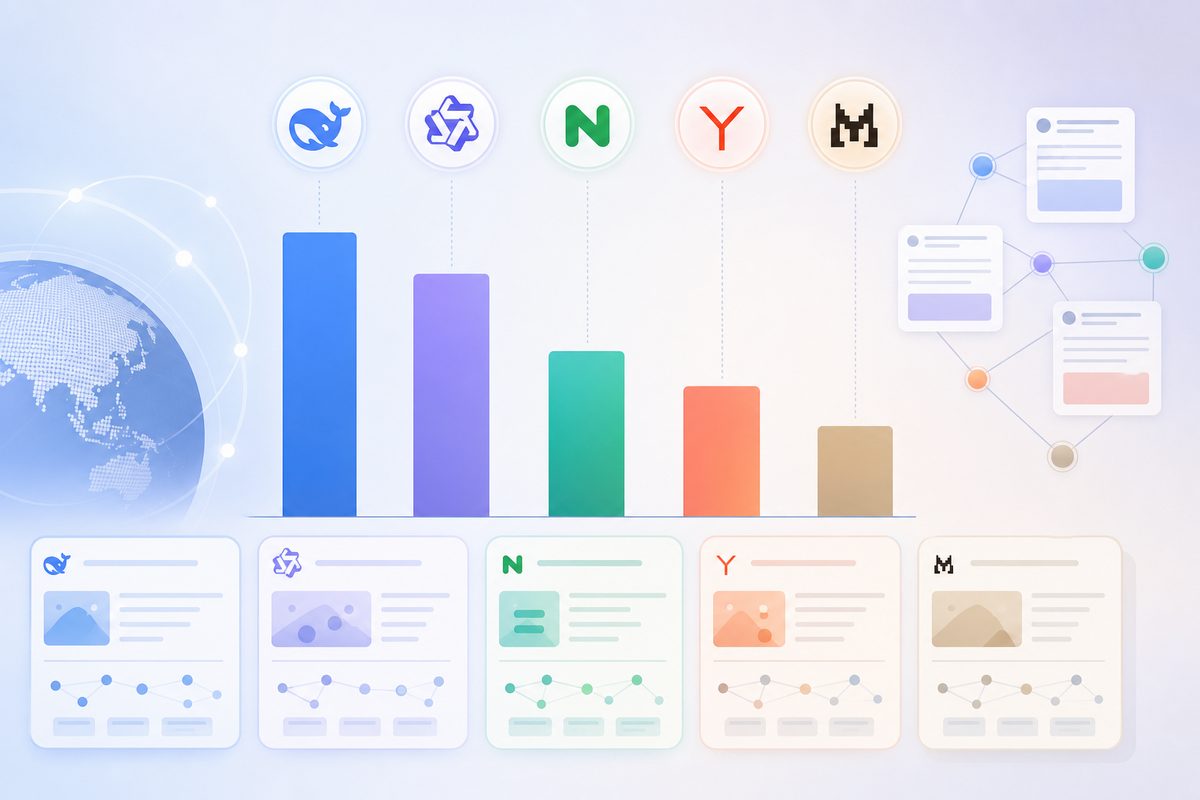
DeepSeek: the technical-authority corpus
DeepSeek is the outlier that owns no content. No encyclopedia, no blog platform, no Q&A board — so it borrows authority from whoever the Chinese web treats as expert.
Zhihu was its single most-cited domain, appearing in 41% of DeepSeek answers, usually as the source of comparative reasoning ("which tool is better for X"). WeChat public-account articles and 36Kr supplied vendor context, Baidu Baike supplied entity facts, product documentation supplied specifications. That fits China's fragmented search ecosystem, where no single index is ground truth.
The practical read: DeepSeek rewards long-form argumentative Chinese content on third-party platforms, not marketing pages. A well-argued Zhihu answer comparing the category outperformed a translated product page in all three of our categories. Reuters-reported market data places DeepSeek second among Chinese assistants behind ByteDance's Doubao — a large audience shaped by a corpus most Western brands have never published into.
Qwen and Quark: Alibaba's closed loop
Qwen behaves differently because it ships inside Alibaba's own surface. Alibaba rebuilt Quark into a flagship Qwen-powered assistant, and Quark is a search product first — it has an index, a browser, and commercial inventory behind it.
That produces the 22% engine-owned share: Quark index results, Alibaba commerce listings, Tongyi-surfaced summaries. The remaining domestic citations skew to the same platforms DeepSeek uses, but with far more weight on structured commercial pages and pricing tables.
DeepSeek is won with argument; Qwen is won with structured, indexable facts — a clean Chinese pricing page, a spec table, a category listing. Qwen quoted numeric attributes verbatim in roughly 3 of every 10 answers. On DeepSeek that almost never happened.
Naver: 94% Korean, and mostly user-generated
Naver is the most closed system of the five. AI Briefing draws overwhelmingly from inside Naver: Blog, Cafe, Knowledge-iN, SmartPlace, Naver News. Published Korean analysis puts user-generated content near 70% of AI Briefing's cited sources; our independent 71% engine-owned figure lands in the same place.
Naver also pays to keep that corpus fed, selecting roughly 3,000 creators a month across Blog, Cafe, Knowledge-iN and Premium Content under a creator fund reported at about ₩20 billion a year. An engine that subsidises its own supply is not going to start preferring your .com.
The consequence is blunt: in Korea, off-Naver content is close to invisible to the answer layer. Winning means a maintained Naver Blog, seeded Cafe discussion, accurate SmartPlace data, and Korean-language coverage in Naver News. In our sample, new Naver Blog posts began appearing in Briefing citations a median of 9 days after publishing — the fastest ingestion of any engine we tested.
Yandex Alice: Neuro, Yandex Q, and the RuNet index
Yandex sits in the middle. Neuro was launched as retrieval-first — live search results summarised by YandexGPT, with every source cited and no fixed dataset.
Our sample bears that out. Citations split between the organic Yandex index (the largest slice), Yandex Q expert answers, Russian tech media such as Habr and VC.ru, Russian Wikipedia, and marketplace listings for anything with a purchasable SKU. The 19% engine-owned share is mostly Yandex Q and Yandex services. Mediascope has reported Alice first among AI assistants in Russia by user share, so this is a mainstream audience, not a technical niche.
Because Yandex leans on its own organic index, classical Russian-language SEO still transfers to the answer layer here — more than in Korea, far more than in China. A page ranking in Yandex organic has a real chance of being quoted by Alice, which makes Russia the cheapest of the four markets to enter if you already run technical SEO.
Le Chat: an open corpus plus a licensed newswire
Le Chat is the most open corpus of the five and the only one where a global English source has a genuine shot. Mistral's documentation describes Le Chat's web search behaviour, and press reporting has traced its live results to Brave's search API rather than Google or Bing. On top sits a content partnership giving Le Chat access to AFP's archive back to 1983.
That yields the 54%/41% split: French media, French Wikipedia and government or trade-body pages on one side; English vendor sites, directories and documentation on the other.
Reach is concentrated rather than broad. SE Ranking's traffic research puts Mistral's share of AI traffic in France near 0.85% against roughly 0.24% across Europe, with France supplying about 41% of Le Chat's desktop visits — concentrated in the public-sector and enterprise buyers French B2B vendors actually sell to.
The three-layer pattern every regional engine repeats
Strip the platform names away and the same structure appears in every market. This is the framework to carry into any new one:
- An anchor corpus the engine cannot ignore — Naver Blog and Knowledge-iN, Zhihu, Yandex Q, the AFP wire. Every regional engine has one platform that supplies its opinions.
- A facts layer for entity truth — Baidu Baike, Russian and French Wikipedia, Naver Encyclopedia. Your company description, founding date and category label get fixed here, right or wrong.
- A commerce or directory layer that decides which vendors are eligible for a shortlist at all.
Miss the anchor corpus and nobody argues for you. Miss the facts layer and you get described wrong. Miss the directory layer and you never enter the candidate set. The same three layers govern which index powers each AI engine in English — the owners just change per country.
The transliteration blind spot
One finding cut across markets: in 38% of Korean and Russian answers, tracked brands appeared under a transliterated name that never string-matched the Latin-script brand. Monitoring that searches only the .com spelling reports zero mentions while the brand is being actively recommended. Local-script names and transliterations belong in the tracking config, not in the translation backlog.
Which regional engines should you actually track?
Track the engine that owns the market you sell into, and skip the rest. Adding five engines to a reporting stack you can't act on is worse than adding none.
| If you sell into | Track first | Because |
|---|---|---|
| China (enterprise / technical) | DeepSeek | Highest weight on argumentative third-party content; no owned corpus locking you out |
| China (commercial / consumer-adjacent) | Qwen via Quark | Owns index plus commerce surface; structured facts get quoted |
| South Korea | Naver AI Briefing | 94% domestic, 71% Naver-owned; nothing outside reaches the buyer |
| Russia and CIS | Yandex Alice | Organic Yandex rankings still convert into citations |
| France and francophone EU | Le Chat | Institutional adoption; English sources remain eligible |
If none of those markets are on your revenue plan, spend the effort on the engines already shaping English shortlists — including the ones B2B brands routinely forget to track: Copilot, Grok and Google AI Mode.
Entry requirements before you commit budget
Publishing into these corpora has legal and operational prerequisites that vary sharply by market.
| Market | Local entity needed? | Practical blockers |
|---|---|---|
| China | Not for Zhihu or WeChat content; yes for marketplace listings and ICP-registered hosting | Verified accounts, phone verification, slower crawl of non-ICP domains |
| South Korea | Not for Naver Blog; yes for SmartPlace | Cafe communities enforce anti-promotion rules; seeded posts get removed |
| Russia | Not required to be indexed | Sanctions and payment compliance — clear ad spend and vendor contracts with counsel first |
| France | No | None beyond writing genuinely French content |
A 30-day plan to earn citations in a regional engine
Pick one market. Run it end to end before adding a second.
- Days 1–3 — build the prompt set. 30–45 buyer-intent prompts in the local language with a native speaker. Include your brand in both Latin and local script.
- Days 4–7 — baseline. Run every prompt three times on separate days. Log mention rate, list position, sentiment, and every cited domain. That is your starting AI share of voice for the market.
- Days 8–10 — rank the corpus. Sort cited domains by frequency. The top 10 are your target list, not your keyword list.
- Days 11–14 — fix the facts layer. Correct the market's encyclopedia entry and top directories. Wrong founding dates and stale category labels propagate into answers faster than anything else.
- Days 15–24 — publish into the anchor corpus. One substantive local-language asset per week on the platform the engine actually quotes: Zhihu, Naver Blog, Habr, or the relevant French trade publication. Written locally, not machine-translated.
- Days 25–30 — re-run the identical prompt set. Compare mention rate and citation mix against the baseline. Report the delta, not the absolute number.
Thirty days moved mention rate on Yandex and Le Chat in our sample. Naver and the Chinese engines were slower — first measurable movement landed in weeks 6–9, because the corpus has to be re-crawled and re-ranked before the answer layer changes. Budget the calendar accordingly.
Limits of this study
The sample covers three B2B software categories and four languages. Consumer categories with heavy marketplace inventory almost certainly skew further toward commerce domains, especially on Qwen and Yandex.
Logged-out testing removes personalisation, which understates the variance a real user with account history sees — the same effect that makes logged-in profiles change which brands surface on Western engines.
And regional engines ship changes without release notes. Naver altered its AI Briefing source mix twice inside our window, so these figures are an average across that drift, not a snapshot.
We publish it anyway, because the alternative is planning market entry on the assumption that ChatGPT's citation behaviour generalises. The 9% overlap says it does not.
Frequently asked questions
Do regional AI answer engines matter if I only sell in English-speaking markets?
Mostly no. If revenue is US, UK and ANZ, the five Western engines cover your buyers. The exception is procurement research inside multinationals, where evaluators often research in their first language even when they buy in English.
Which regional engine has the largest user base?
By market: Doubao leads China on assistant users with DeepSeek second, Naver dominates Korean search-style questions, and Mediascope has put Alice first among Russian assistants. Le Chat is the smallest of the five by reach and the most concentrated by buyer type.
Can I get cited in DeepSeek or Qwen without a Chinese entity?
Partly. Simplified Chinese content on Zhihu and WeChat needs no local business licence, and both engines cited foreign vendors in our run. But ICP-registered domains loaded faster and were crawled more reliably, and the marketplace listings Qwen leans on generally do require a local entity.
Why does Naver cite so little from outside Naver?
Because Naver owns the supply. It funds and generates enormous volumes of first-party content across Blog, Cafe and Knowledge-iN, and AI Briefing retrieves from that pool first. An external site competes against hundreds of millions of in-ecosystem documents the engine already trusts.
Does classic multilingual SEO help with regional AI answer engines?
On Yandex, strongly — organic rank converts into Alice citations. On Le Chat, moderately. On Naver and the Chinese engines, barely: hreflang and translated pages do not get you into the corpora those engines actually quote.
Is Le Chat worth tracking outside France?
Only if you sell to European public sector or French-speaking enterprise. Its usage share elsewhere in Europe is a fraction of its French share, so for most brands it is a secondary line item.
How often should I re-measure?
Monthly. Regional engines change retrieval behaviour more abruptly than the Western five and publish no changelog, so a quarterly cadence will miss the shift that caused the drop.