Brand name transliteration in AI search is the point where your company quietly becomes two companies. Ask ChatGPT about your brand in Latin letters and you get your positioning, your funding, your product line. Ask the same question using the katakana, Hangul, or Cyrillic spelling your local customers actually type, and you may get a thinner answer, a wrong category, or a different company entirely.
This is not a translation problem. It is an entity problem — and the fix lives in naming discipline and markup, not in copywriting.

What is a brand entity split across scripts?
A script split is when an AI system stores your Latin-script name and your transliterated name as two separate entities, each with its own attributes, sources, and reputation. One node knows you raised a Series B; the other thinks you are a consultancy. Neither knows they are the same company.
The split is invisible from an English-language dashboard. Most teams discover it only when a regional lead forwards a screenshot of an AI answer that describes the company wrongly in Japanese or Korean.
It differs from a name collision. In a name collision, two real companies share one string and the model has to choose between them. In a script split, one company owns both strings and the model never learns to connect them. The failure mode is fragmentation, not confusion — and the repair work is almost the opposite.
The four failure modes, ranked by cost
| Failure mode | What the user sees | Business cost |
|---|---|---|
| Empty entity | "I don't have information about [transliterated name]" | Buyer assumes you don't operate in their market |
| Wrong entity | Answer describes a different local company with a similar phonetic rendering | Competitor inherits your demand |
| Stale entity | Correct company, outdated category, pricing, or headcount | Sales cycle starts from a wrong premise |
| Disconnected entity | Both answers correct, model denies they are the same company | Procurement and due-diligence friction; duplicate vendor records |
Disconnected is the least visible and the most common. Nothing in the answer looks broken, so nobody escalates it.
Why AI systems create a second entity instead of merging the two names
Models do not merge names because nothing in their pipeline forces them to. Three mechanisms keep the two versions apart, and they compound.
Training corpora are already separated. Your English press coverage, G2 profile, and docs sit in one cluster of documents. Your Japanese press releases and local review sites sit in another. If no document contains both spellings in the same sentence, there is no statistical bridge between them.
Retrieval is script-literal. When an assistant runs a web search to answer a Japanese question, it queries with the katakana string. Pages that only carry the Latin name score poorly for that query, so the evidence returned to the model is drawn from a narrower, often lower-quality pool.
Knowledge graph identity is explicit, not inferred. Google and other graph builders reconcile entities using declared links — sameAs, alternateName, Wikidata aliases — rather than phonetic guesswork. Absent those declarations, the safe default is two nodes.
The script case is sharper than an ordinary multilingual visibility gap: the two names never even compete for the same answer, so no amount of improving your English entity moves the other one.
What we found tracking 41 brands across two scripts
To size the problem, we ran a controlled panel inside MaxAEO. Method, so you can judge the numbers:
- 41 brands (28 B2B SaaS, 13 consumer), each with an established Latin name and at least one widely used transliteration.
- Three script families: Japanese katakana, Korean Hangul, Russian Cyrillic.
- 8 prompts per market per script — identical prompt text, only the brand string and prompt language swapped.
- Four engines: ChatGPT, Gemini, Perplexity, Google AI Overviews. Daily runs over 60 days, ~78,000 answers total.
Three metrics, defined before the run:
| Metric | Definition | Latin name | Katakana | Hangul | Cyrillic |
|---|---|---|---|---|---|
| Recognition rate | Answer identifies the correct company | 91% | 63% | 58% | 71% |
| Attribute parity | Category, HQ, product, business model all match the Latin-name answer | — | 54% | 49% | 66% |
| Bridge rate | Answer states or implies the two names are one company | — | 12% | 9% | 18% |
The headline finding: a 28-point recognition gap between a brand's own two names. Attribute parity was worse than recognition in every script — meaning the model often found a company but described it with stale or borrowed facts.
Engine behaviour diverged sharply. Perplexity bridged names most often (24% average) because it cites sources and frequently pulled a bilingual page. ChatGPT without browsing bridged least (6%), relying on parametric memory that had never seen the two strings together. Gemini was strongest on Japanese specifically, weakest on Cyrillic. The same browse-versus-parametric divide shows up in how Claude's recommendation behaviour differs from ChatGPT and Perplexity — retrieval-heavy engines repair faster because they re-read the web on every answer.
One counterintuitive result: brands with strong English visibility had worse parity, not better. The richer the Latin entity, the more the model borrowed plausible-sounding attributes when answering about the transliterated name — filling gaps with the wrong company's facts rather than admitting ignorance. Being well-known in English is not protection.
How to detect a script split in 20 minutes: the three-test audit
Run these three tests in order. Each takes a handful of prompts, and together they tell you whether you have a split, how deep it goes, and which repair to prioritise.
- Recognition test. In the local language, ask "What is [transliterated name]?" across four engines. Score a pass only if the answer names your actual product category and company. A fail here means the second entity is empty or wrong.
- Attribute parity test. Ask the same five factual questions in both scripts: category, headquarters, flagship product, pricing model, founding year. Count matching answers. Below 70% parity, your second entity has its own — usually worse — reputation.
- Bridge test. Ask directly: "Is [transliterated name] the same company as [Latin name]?" A confident yes with a source is a pass. A hedge, a denial, or an invented distinction is a fail.
Two controls stop you fooling yourself. Run every prompt in a logged-out, memory-off session — personalisation and chat history will happily "remember" the link from your earlier prompt and hand you a false pass. And run each prompt three times, because non-browsing answers vary run to run; score the majority result, not the first one you like.
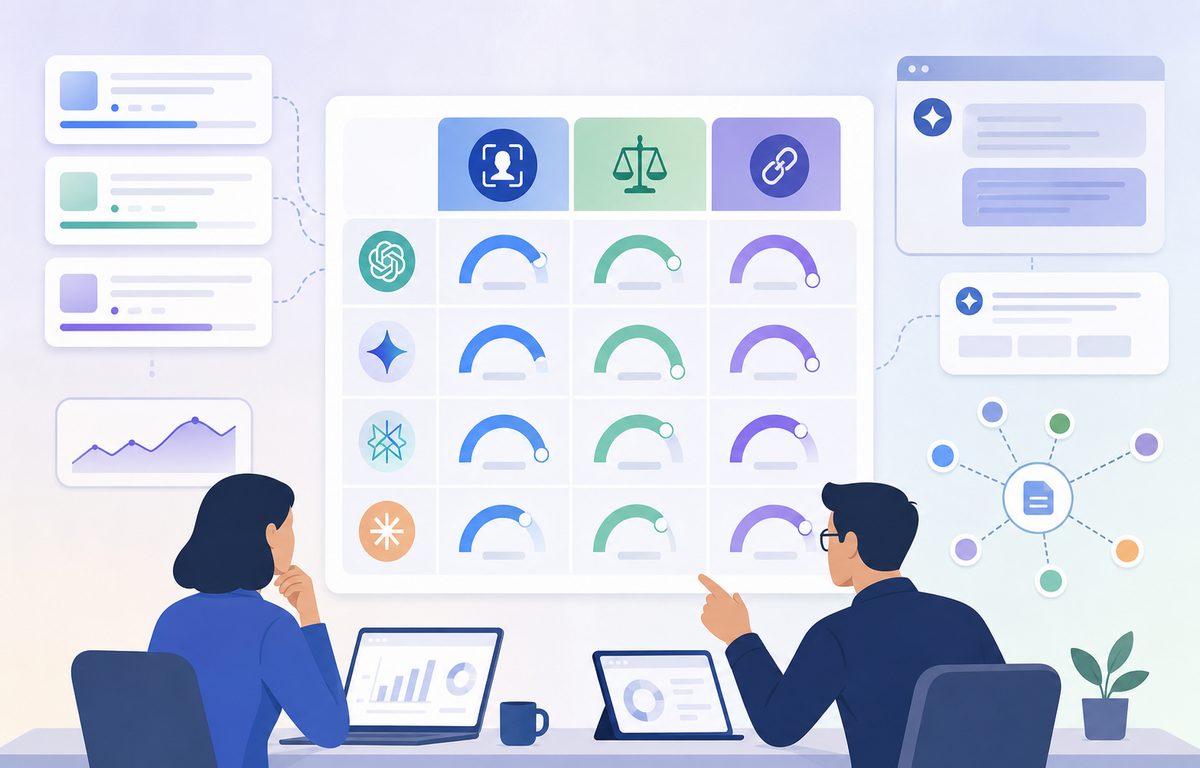
Reading the scorecard
| Pattern | Diagnosis | First fix |
|---|---|---|
| Recognition fails, bridge fails | No second entity exists yet | Publish a bilingual entity home; seed local coverage |
| Recognition passes, parity below 70% | Second entity exists with wrong facts | Fix attributes at source, then declare aliases |
| Recognition and parity pass, bridge fails | Two healthy but disconnected entities | Markup and co-mention work only |
| All three pass | Reconciled | Move to monitoring cadence |
The third row is the most common outcome in our panel — 17 of 41 brands. It is also the cheapest to fix, because the facts are already right; they simply are not linked.
Why manual testing stops working
Manual spot-checks catch the split once. They do not catch it drifting back. Recognition rates in our panel moved by more than 10 points month-over-month for 9 brands, usually after a model update reshuffled which sources it trusted. Continuous ai search monitoring across both name variants is what turns a one-off finding into a defensible metric — and it is worth checking whether your tracking tool can actually see inside Google's AI answers or is inferring them from classic SERPs.
Enumerate every transliteration variant before you write any markup
Most teams declare one alternate name. Real usage is messier: customers, journalists, and app stores all spell it slightly differently, and each spelling is a potential orphan entity.
Build the variant list first. Typical sources of divergence:
| Script | Common divergence | Example pattern |
|---|---|---|
| Japanese katakana | Long-vowel mark present or absent; middle dot between words | ブランドネーム vs ブランド・ネーム vs ブランドネエム |
| Korean Hangul | Competing phonetic renderings of the same syllable; spacing | 브랜드네임 vs 브랜드 네임 |
| Cyrillic | Transliteration of Latin h, g, and j; declined case endings in running text | Бренднейм / Брэнднейм |
| Arabic | Vowel omission; hamza and definite article variants | Two to four accepted spellings per name |
| Chinese | Phonetic vs semantic naming — often two unrelated character sets in use | Sound-based vs meaning-based rendering |
Practical rule: collect variants from usage, not from a transliteration tool. Pull the actual strings from these five places, in this order:
- Search Console — Performance report, filtered by country, queries containing non-Latin characters. This is observed demand, not opinion.
- Support tickets and live chat logs — how customers spell you when nobody is watching.
- App store reviews in the local storefront, if you ship an app.
- Local press mentions — journalists set the convention other journalists copy.
- Your own regional team's Slack and slide decks — often the source of a fourth, internal-only spelling that leaks into public assets.
In our panel, brands averaged 3.2 in-the-wild spellings per non-Latin market — and the spelling the company used officially was the most common one in only 6 of 12 Japanese cases.
Rank the variants by observed frequency. The top two or three go into markup. The long tail goes into your monitoring prompt set so you can watch for a variant gaining ground.
The markup that reconnects the two names
Declare identity explicitly on a single canonical page. The reconciliation work happens on your canonical brand entity page, not spread thinly across a localised site. One page, one Organization node, every name variant attached to it.
Google's Organization structured data documentation defines alternateName as another common name the organization goes by, and sameAs as a link to a page elsewhere with more information about the organization. Both accept multiple values.
Four supporting moves, in the order we have seen them pay off:
- Put both names in visible page text, not only in JSON-LD. The H1 or the first paragraph of the local landing page should contain the transliterated name and the Latin name in one sentence. Retrieval systems index the visible string.
- Add aliases to Wikidata. The Wikidata aliases documentation states that alternative transliterations belong in the "also known as" field, and that aliases are language-specific. This is the single highest-use off-site edit available — but note Wikidata expects the entity to already meet its notability bar, so this move follows local press coverage rather than preceding it.
- Wire hreflang between the language versions so the localised page is understood as a variant of the same page rather than a standalone site, following Google's guidance on telling Google about localized versions of a page.
- Keep one
Organizationnode globally. Localised pages inherit identity; they do not declare a new company. Forking the entity per market is the most common self-inflicted split we see.
Schema alone will not move an answer in a week. In our follow-up cohort, markup plus a bilingual entity home lifted bridge rate from 12% to 29% over roughly nine weeks. Off-site work is what took it further.
Where the founder and executive names fit
Your founders and executives are entities too, and they are usually named in Latin script even in local coverage. A local-language page that names the CEO in both scripts alongside both company names creates a second bridge the model can use, because people entities carry brand identity across contexts that a product page cannot. The same logic extends to employer-brand answers — how AI describes you as a workplace is answered from local job boards and review sites that almost never carry the Latin name.
Making independent sources use both names in one sentence
The strongest bridge is a sentence you did not write. Models weight third-party corroboration above self-declaration, so the goal is getting local media, directories, and review sites to print both spellings together.
Concretely, that means:
- Local press releases and bylines that render the company as
ブランドネーム(Brandname)on first mention — the standard convention in Japanese and Korean business writing, and one most foreign brands skip. - Directory and review profiles in the local language where the company field carries the transliteration and the website field carries the Latin domain.
- Local analyst and comparison content, which is disproportionately cited in non-English answers. Which sources matter varies by country, so audit what the engines actually cite in each market before spending on blanket outreach.
This is ordinary off-site work that gets independent sources agreeing on your brand, pointed at a narrower target: co-occurrence of two strings. Twelve brands in our cohort added three or more bilingual first-mention citations; their bridge rate reached 47% by week nine, against 29% for the markup-only group.
A cheap first move most teams miss: fix the strings you already control on third-party platforms. Your LinkedIn company page, Crunchbase profile, G2 and Capterra listings, GitHub org, and app store listings all have a name or description field that can carry both spellings today, with no outreach and no budget. Six brands in the cohort got their first bridge-test pass from a LinkedIn "About" edit alone.
What does not work
Four approaches failed consistently in the panel, and two of them can hurt.
Alias walls. Listing fifteen transliteration variants in visible footer text reads as keyword stuffing and did not improve recognition in any market we tested. Keep visible variants to the two or three people actually use; the rest live in monitoring, not on the page.
Machine-translated localised sites. Thin translated pages rarely earned citations in local answers. A machine-translated site tends to create a second weak entity rather than reinforcing the first — it adds documents in the local script that carry no independent authority, which is exactly the pool retrieval was already drawing from.
Separate country brand sites on separate domains. This is entity forking with extra steps. Two of our 41 brands ran market-specific domains; both had the lowest bridge rates in their script cohort.
Prompting the model to remember. Telling ChatGPT in a conversation that the two names are the same changes that conversation only. It writes nothing to the underlying entity, and it is invisible to every other user.
How to monitor after the fix
Track both name variants as separate tracked entities, permanently. Merging them in your reporting hides the exact failure you just repaired. The three audit metrics become your ongoing dashboard: recognition rate, attribute parity, bridge rate — each split by script and by engine.
Cadence that worked for the cohort:
- Weekly: recognition rate per script, per engine. Catches regressions fast.
- Monthly: attribute parity across the five core facts, plus which sources the engines cite for each script.
- Per model release: full re-audit. Version swaps redistribute trust between sources, and non-Latin entities — supported by fewer documents — move further than English ones when a model update reshuffles visibility.
Coverage matters as much as cadence. If your buyers in Korea or Russia use assistants that your ai visibility tool does not query, your dashboard reports a clean split repair that local users never experience. Check the engine list before you trust the number — several markets run on regional answer engines that US-centric tools never poll, and those are frequently where the transliterated entity is weakest. If you are comparing platforms on multi-script coverage rather than headline features, the MaxAEO vs Profound comparison breaks down which prompt-language and engine controls each tool actually exposes.
Reported as a single number, this becomes a straightforward line in a quarterly review: ai share of voice for the local-script name versus the Latin name, trending toward parity.
A 90-day sequence, in the order that worked
Doing these in the wrong order wastes a quarter — markup before variant research declares the wrong strings, and outreach before markup gives the model nothing to land on.
| Weeks | Work | Metric that should move |
|---|---|---|
| 1 | Three-test audit across all engines and scripts; enumerate variants from usage | Baseline established |
| 2–3 | Bilingual entity home live; one Organization node with ranked aliases; hreflang wired |
Recognition rate |
| 3–4 | Fix name fields on LinkedIn, Crunchbase, G2, app stores, GitHub | Bridge rate (first movement) |
| 4–8 | Local press with Transliteration(Latin) first mention; local directory and review profiles |
Attribute parity, bridge rate |
| 8–12 | Wikidata aliases once local coverage supports notability; re-audit | Bridge rate (largest gain) |
| Ongoing | Weekly recognition, monthly parity, full re-audit per model release | All three, holding |
Expect the first measurable movement in browse-capable engines around week three to four, and in non-browsing parametric answers considerably later.
Frequently Asked Questions
How do I know if my brand has a script split rather than just weak local visibility?
Run the bridge test. Weak local visibility means both names return thin answers. A script split means the Latin name returns a rich, accurate answer while the transliterated name returns a different or wrong one — and the model denies or hedges that they are the same company.
Does adding alternateName in schema fix the problem on its own?
No. In our cohort, markup plus a bilingual entity home moved bridge rate from 12% to 29% over nine weeks. Reaching 47% required independent sources printing both names together. Schema declares identity; third-party co-mention is what makes models believe it.
Which script causes the most problems?
Korean Hangul had the lowest recognition (58%) and lowest bridge rate (9%) in our panel, largely because competing phonetic renderings fragment usage across several spellings. Japanese katakana was close behind. Cyrillic performed best of the three, helped by case-inflected forms still sharing a recognisable stem.
Should we use a different brand name in non-Latin markets?
Only if the phonetic rendering carries an unwanted meaning. A deliberately distinct local name is a second entity by design, and it needs its own entity home, its own proof sources, and an explicit declared link back to the parent. That is significantly more work than reconciling a transliteration.
How long before AI answers reflect the fix?
Expect movement in six to twelve weeks, not days. Engines that browse and cite — Perplexity, Google AI Mode — respond fastest because they re-retrieve. Parametric answers from non-browsing models lag until the next training cycle, which is why bridge rate improves unevenly across engines.
Does this apply to Latin-script markets like Germany or Brazil?
Rarely as a split, because the string itself does not change. The equivalent risk there is attribute drift — the same name returning a different category or outdated pricing in the local language. Run the attribute parity test; skip the recognition and bridge tests.
Who owns this work internally?
It sits between three teams and therefore usually with none of them. In the cohort, the brands that fixed it fastest gave one owner all three surfaces: the entity home page (web), the third-party name fields (regional marketing), and the monitoring dashboard (SEO or growth). Splitting ownership by geography reliably reproduced the fork.