Most advice on how to get cited by Microsoft Copilot stops at one sentence: rank in Bing. That is half the answer, and for B2B brands it is the less consequential half. Copilot is the only major answer engine wired into a company's own document graph, which means the page competing with your website is often a PDF sitting in your prospect's SharePoint.
This guide covers both retrieval paths, backed by five months of our own citation tracking. You will get the Bing-side mechanics, the Microsoft 365 mechanics almost nobody writes about, and a six-step audit you can run this week.
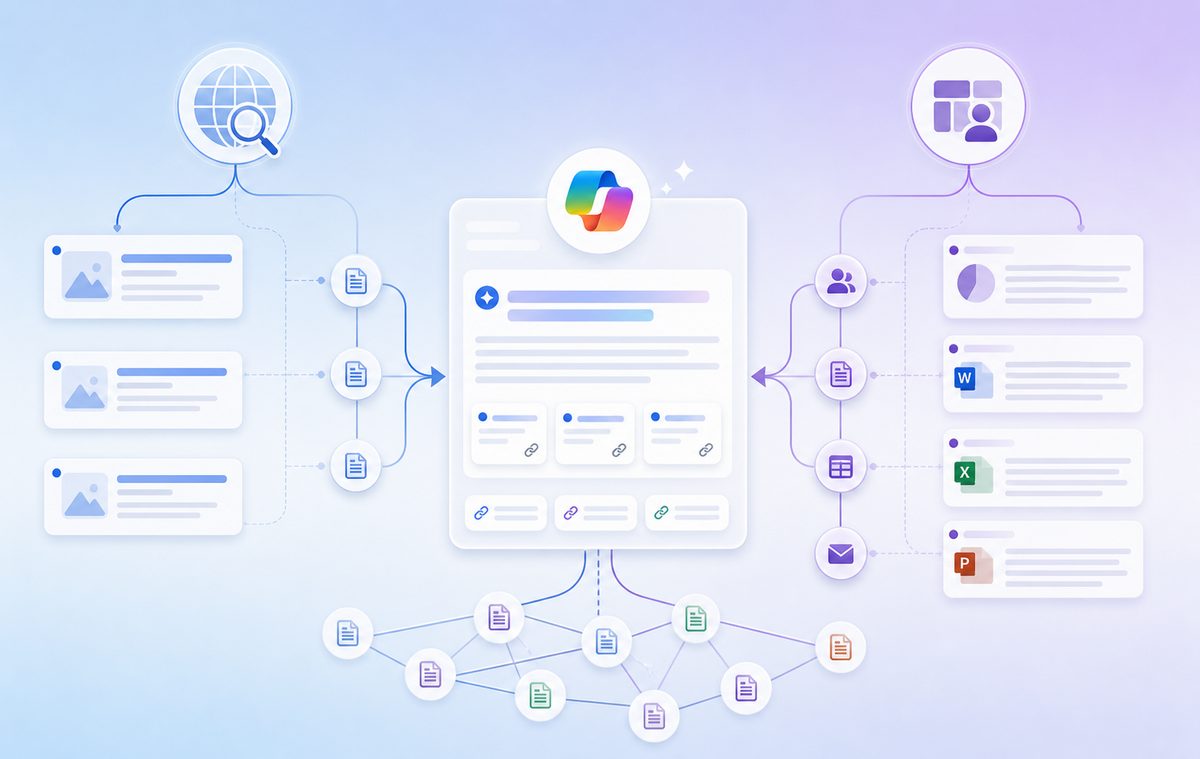
How does Microsoft Copilot choose which sources to cite?
Copilot cites sources from two separate retrieval systems. Web grounding pulls from the Bing index: Copilot rewrites your prompt into a search query, sends it to the Bing service, and cites the pages it uses. Work grounding pulls from Microsoft Graph — the emails, files, chats and meetings the signed-in user already has permission to see.
Both paths can fire in the same answer. Microsoft's architecture documentation describes the flow plainly: the prompt is preprocessed through grounding, the grounded prompt goes to the model, and the response returns with citations attached.
The practical consequence is that your Copilot visibility has two independent failure modes. You can be invisible because Bing has not indexed you well. Or you can be invisible because a buyer's tenant is full of someone else's collateral. Fixing one does nothing for the other.
Path 1: Bing web grounding
There is no separate "CopilotBot." Bing Chat and Copilot answers are built from content Bingbot has already crawled and indexed, which is why Bing's crawler documentation is the correct reference point rather than any AI-specific user agent list.
That single fact reframes the work. Copilot optimization is not a new discipline bolted onto SEO — it is Bing technical SEO plus passage-level structure, aimed at an engine that shows far fewer sources than a search results page.
Path 2: Microsoft Graph and the semantic index
Inside Microsoft 365, Copilot reads tenant content through the semantic index for Microsoft 365 Copilot, which builds a vector-based representation of a user's permitted content so retrieval matches meaning, not just keywords.
Access is scoped to the individual user, always. But scoped does not mean small: a single account manager's mailbox may hold every vendor deck, quote and RFP response their company has received this year.
Which Copilot surface is your buyer actually using?
"Copilot" is a brand covering at least four retrieval behaviours. Treating them as one product is the most common reason teams misread their own tracking data.
| Surface | Where it lives | What it grounds on | What you can influence |
|---|---|---|---|
| Consumer Copilot | copilot.microsoft.com, mobile apps | Bing index | Bing rank, page structure |
| Copilot Search | bing.com | Bing index, blended with classic results | Bing rank, snippet-ready passages |
| Copilot on Windows and Edge | Taskbar, Copilot app, Edge sidebar | Bing index plus local and page context | Bing rank; page context if the user is on your site |
| Microsoft 365 Copilot | Word, Outlook, Teams, Copilot Chat | Microsoft Graph, plus Bing when web search is on | Tenant presence first, Bing second |
Microsoft positioned Copilot Search in Bing as a deliberate blend of traditional and generative search, stating that it inline-links whole sentences and passages within responses and was built "with publishers and content owners in mind."
That design choice matters commercially. Copilot Search attaches a source to the sentence, not just to a footnote, so being the cited passage carries more click-through weight here than in engines that bundle sources at the end.
What our Copilot citation data actually shows
Between 1 February and 30 June 2026, MaxAEO ran 4,120 buyer-intent prompts daily against eight AI engines and logged every cited URL. This section uses the Copilot slice: 38,412 Copilot answers covering 612 B2B software and technology brands across 27 categories.
We ran a second, smaller study inside a licensed Microsoft 365 tenant. The same 180 prompts were executed three ways — consumer Copilot, Copilot Search in Bing, and Microsoft 365 Copilot Chat with work grounding enabled — to see how one question resolves on work-grounded versus web-grounded surfaces.
| Metric (Feb–Jun 2026) | Copilot | ChatGPT search | Perplexity |
|---|---|---|---|
| Median unique domains cited per answer | 3.4 | 5.1 | 6.8 |
| Cited URLs also in that engine's top-10 organic | 71% (Bing) | 34% (Google) | 46% (Google) |
| Share of all citations held by top 100 domains | 58% | 41% | 33% |
Three numbers do most of the explaining. Copilot cites roughly a third fewer domains per answer than ChatGPT, so the shortlist is shorter and the cost of missing it is higher. Its citations track classic Bing ranking far more tightly than any other engine we monitor tracks Google. And its citation base is more concentrated, which rewards incumbents and punishes brands with thin third-party coverage.
Five further findings from the same dataset:
- 88% of Copilot-cited URLs ranked in Bing's top 20 for at least one related query. Only 12% came from outside it.
- Median time since last substantive update on a cited page was 74 days. Pages untouched for twelve months or more were 2.3× less likely to be cited.
- Vendor-owned domains took 22% of citations on category-level prompts — but 61% of those landed on documentation, help-centre or pricing paths, not the marketing homepage.
- 63% of quoted passages came from the first 25% of body text. Front-loading is not a stylistic preference; it is where the extractor looks.
- 17% of tracked brands had at least one commercially important page indexed in Google but absent from Bing. Most had no idea.
We also ran a small controlled test on discovery speed. Forty newly published pages submitted through IndexNow first appeared in a Copilot answer a median of 9 days after publication. A matched control set of forty pages left to normal sitemap discovery took 31 days. Same site, same templates, same publishing window.
Concentration cuts both ways. The domains that dominate Copilot's citation base are not the ones that dominate ChatGPT's — our study of the most-cited domains in B2B SaaS AI answers found the overlap between engines is far smaller than most content plans assume.
Why Bing rank is still the single biggest lever
If you fix one thing, fix Bing coverage. Our data shows 88% of Copilot citations come from pages already ranking in Bing's top 20, which makes classic Bing SEO the highest-use input available — and the one most B2B teams have never audited because their reporting is Google-only.
The gap is usually mechanical rather than editorial. Sites block or throttle Bingbot in ways they never did to Googlebot. JavaScript-rendered content that Google handles gracefully arrives empty in Bing's index. Sitemaps get submitted to Search Console and forgotten in Bing Webmaster Tools.
How to find your Bing index gap
- Run
site:yourdomain.comin Bing and compare the count to the same query in Google. A gap over 20% signals a crawl or indexing problem, not a content problem. - Verify the domain in Bing Webmaster Tools and check the URL Inspection result for your ten highest-intent pages — pricing, comparison, integration, documentation.
- Confirm
robots.txtallows Bingbot explicitly, and check that nonoarchiveornocachedirective is sitting on pages you want quoted. - Submit your sitemap in Bing Webmaster Tools, then enable IndexNow so updates are pushed rather than waited on.
- Load your key pages with JavaScript disabled. If the answer disappears, so does your citation.
Step five catches more problems than the other four combined in the audits we run.
Which page-level signals get quoted in Copilot answers
Copilot quotes passages, not pages. A page can rank in Bing and still never be cited because no 40-to-60-word block inside it answers the question cleanly on its own.
The patterns that correlated with citation in our dataset:
- A direct answer in the opening 60 words, phrased as a definition or a decision, not as a preamble about why the topic matters.
- Descriptive H2s written as questions or definitions. "What does SOC 2 Type II cover?" gets extracted. "Our approach to compliance" does not.
- Self-contained sections. Each block should make sense if it is the only thing a reader sees, because that is often exactly what happens.
- Specific, checkable numbers with a named source nearby. Vague authority claims give the model nothing to quote.
- Tables for comparisons and parameters, ordered lists for procedures. Both survive extraction better than prose.
- Honest freshness. Update the content and the date together; updating only the date is a pattern engines increasingly discount.
None of this is exotic. It is the same passage discipline that wins a spot in Google AI Overviews, applied to an engine that shows three sources instead of eight.
The Microsoft 365 blind spot: when Copilot cites a file instead of your site
Here is the finding that separates Copilot from every other engine. In our 180-prompt tenant study, 34% of Microsoft 365 Copilot answers cited at least one internal file alongside or instead of a public web page — a SharePoint document, an emailed attachment, a Teams message.
In 19% of those cases, the internal file was competitor collateral: a pricing sheet, an RFP response, or an evaluation deck someone had received months earlier and forgotten. The buyer asked "which vendor should we shortlist for X?" and Copilot answered partly from a rival's own marketing PDF, because that document was in the tenant and yours was not.
With work grounding switched off, answers converged with Copilot Search in Bing 82% of the time by cited domain. The divergence is entirely a work-grounding effect.
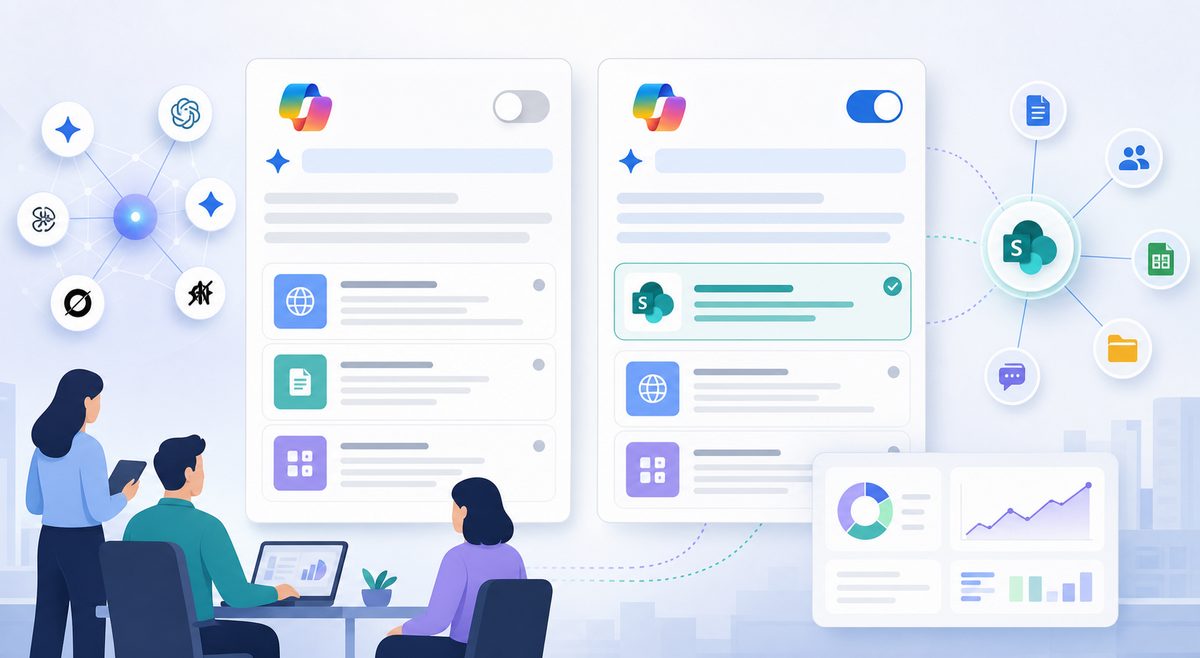
Microsoft's documentation on web search in Microsoft 365 Copilot confirms the mechanics: web search fires only when web information would improve the response, admins can disable it per user or group, and generated queries reach Bing with tenant identifiers stripped. Some of your buyers have web grounding turned off entirely. For them, tenant presence is your only presence.
How to earn a place in the tenant
You cannot index into someone else's Graph. You can make sure the artefacts that land there are yours.
- Ship durable documents, not disposable ones. A well-titled, text-layer PDF with clear headings and a dated version number gets retrieved. A slide export of a webinar does not.
- Name files the way people search.
acme-vs-competitor-migration-checklist-2026.pdfbeatsFinal_v3_deck.pdfin a semantic index that reads titles. - Put the answer in the document body, not in an image of a table. Scanned or image-only PDFs are effectively invisible.
- Get listed where IT already looks. An AppSource or Azure Marketplace listing and a Microsoft Learn integration reference are both public-web assets that Microsoft surfaces heavily to Microsoft-centric buyers.
- Consider a connector. Microsoft 365 Copilot connectors let a customer index your product's content into their Graph. If you sell software with a knowledge base, a published connector puts your documentation inside the retrieval set of every tenant that installs it.
That last point is the closest thing to a structural moat in AI visibility today, and almost no B2B marketing team has it on the roadmap.
A six-step Copilot citation audit
Run this in order. It takes about a day for a mid-sized site.
- Baseline. Pick 40 to 60 real buyer prompts for your category and run them in Copilot Search. Record whether you are mentioned, whether you are cited, and which domains own the citations.
- Check the Bing gap. Verify Bing Webmaster Tools, compare indexed counts against Google, and inspect your ten highest-intent URLs.
- Open the AI Performance report. Bing's AI Performance report in Bing Webmaster Tools shows total citations in AI answers, average unique pages cited per day, page-level citation counts and a sample of grounding queries. Note the documented limits: the grounding query data is sampled, and citation counts say nothing about placement within an answer.
- Fix extraction. Rewrite the opening 60 words of your top 20 pages to answer directly. Convert comparison prose into tables. Split any section longer than 200 words.
- Fix discovery. Enable IndexNow, resubmit the sitemap, remove stray
noarchivedirectives on pages you want quoted. - Audit the third-party layer. Copilot's citation base is concentrated, so the fastest route into a narrow shortlist is usually a page you do not own — a review site, a standards body, an analyst listing, or a news article. Earned press is the slowest of these to acquire and the most durable once you have it; the mechanics are in our journalist-outreach playbook for AI citations.
Re-run step one after three weeks. Copilot citation sets move more slowly than ChatGPT's, so give changes time before judging them.
What gets you excluded from Copilot answers
Three failure modes account for most of the "we rank in Bing but never get cited" cases we diagnose. Each one is a page-level setting, not a content quality problem.
noarchiveon templated pages. Many CMS themes ship it on paginated or filtered views. Bing treats it as a signal that indexed content should not be reused, which removes the passage from AI answers while leaving the page in the index.- Content behind a form or interstitial. If the substance loads only after an email gate or a cookie wall, the crawler sees the wrapper. The page ranks on its title and gets quoted for nothing.
- Answers that only exist inside a JavaScript component. Accordions, tabbed spec sheets and React-rendered comparison tables are the three most common offenders. Google renders them; Bing frequently does not.
The diagnostic is the same in every case: fetch the URL with a plain HTTP request and read the raw HTML. If the sentence you want quoted is not in that response, no amount of ranking will surface it.
How Copilot citations differ from other engines
Copilot is narrower, more Bing-dependent and more enterprise-shaped than its peers. Where ChatGPT will happily cite a Reddit thread and Perplexity spreads across seven domains, Copilot tends to return three or four established sources and stop.
That has two implications for planning. First, a Copilot-shaped content strategy is documentation-heavy: docs, integration pages, comparison pages and standards-adjacent content outperform thought leadership. Second, gains are stickier — the same domains kept their Copilot positions week over week far more consistently than they held ChatGPT positions across our tracking window.
The contrast is sharpest against engines with a different retrieval base. ChatGPT blends a proprietary crawl with its own index rather than leaning on one search partner, which is why the same page can be cited constantly in one and never in the other — a difference we broke down in how ChatGPT chooses and quotes sources. If Copilot is not yet on your tracking list, it usually sits alongside the other engines covered in the AI engines B2B brands forget to track.
Worked example: 4% to 31% Copilot presence in eleven weeks
A 70-person data-integration vendor we track (anonymised at their request) appeared in 4% of 140 category prompts in Copilot at baseline, against 23% in ChatGPT. Same content, same brand, radically different result.
The diagnosis took an hour. Their robots.txt allowed Googlebot by name and fell through to a restrictive default for everything else, so Bing had indexed 310 URLs against Google's 1,840. Their documentation subdomain — the exact content type Copilot favours — was almost entirely missing from Bing.
The fixes, in the order they shipped:
- Week 1: corrected
robots.txt, verified Bing Webmaster Tools, submitted both sitemaps, enabled IndexNow. - Week 3: rewrote the opening paragraph of 22 documentation and comparison pages to answer in the first 50 words.
- Week 5: converted three long feature narratives into specification tables.
- Week 7: published a connector listing and updated their AppSource entry.
By week 11, Copilot presence reached 31% of the same 140 prompts, with 68% of new citations landing on the documentation subdomain. Bing indexed URLs rose to 1,610.
One honest caveat: this was not a controlled experiment. Four changes shipped in sequence, and the robots.txt fix almost certainly did most of the work. Isolating which change earned which citation would require staggered rollouts and a holdout set. We report the sequence because it is what happened, not because it isolates a cause.
How to measure Copilot visibility without guessing
Bing Webmaster Tools tells you when you were cited. It does not tell you what the answer said about you, whether a competitor was recommended over you, or how the answer shifts across follow-up questions.
That gap matters because buyers rarely stop at one prompt. They ask a category question, then a comparison question, then a pricing question — and brands that survive the first turn often vanish by the third.
A workable measurement stack has three layers:
- Citation counts from Bing Webmaster Tools AI Performance, for URL-level trend data.
- Prompt-level tracking across a fixed set of buyer questions, run daily, capturing mention, citation, sentiment and competitive position.
- Surface separation. Track Copilot Search separately from consumer Copilot, and never blend Copilot with ChatGPT in one "AI visibility" number — our data shows the two disagree on cited domains more often than they agree.
Frequently asked questions
Does Microsoft Copilot use a separate AI crawler I need to allow?
No. There is no distinct Copilot crawler. Copilot answers are grounded on content already in the Bing index, gathered by Bingbot, so allowing Bingbot in robots.txt is the requirement. Page-level noarchive and nocache directives control how indexed content may be reused in AI answers and model training, separately from whether the page can be crawled at all.
Can I get my content into Microsoft 365 Copilot without a customer installing anything?
Only indirectly. Microsoft Graph indexes what a tenant already holds, so your route in is through documents that land there naturally — proposals, datasheets, technical guides your champion downloads and shares. A published Copilot connector is the direct route, but it requires the customer's admin to enable it.
How long does it take to see Copilot citations after fixing Bing indexing?
In our IndexNow test, newly published pages first appeared in Copilot answers a median of 9 days after publication when pushed via IndexNow, versus 31 days without. For existing pages that were blocked or poorly indexed, expect three to six weeks before citation patterns stabilise.
Is Copilot traffic worth the effort if its market share is smaller than ChatGPT's?
For B2B, usually yes. Copilot's distribution sits inside Windows, Edge and Microsoft 365, which is precisely where enterprise buyers already work. Our tracking shows Copilot cites fewer domains per answer than ChatGPT or Perplexity, so the shortlist is shorter — harder to enter, and more valuable once you are on it.
Should I write different content for Copilot than for ChatGPT?
Not different content, different emphasis. Copilot rewards documentation, comparison tables and specification detail more than narrative thought leadership, and it is far more sensitive to Bing indexing health. The passage-level discipline — answer first, self-contained sections, checkable numbers — serves every engine.
Do Copilot citations pass any SEO value to my site?
Not as links in the ranking sense. Copilot citations are rendered as inline source references, and their value is referral traffic plus presence in the answer a buyer reads before they ever run a search. Treat them as a distribution channel, not a link-building tactic.
We block Bingbot for scraping reasons. Is there any other way in?
Not on the web-grounding side — blocking Bingbot removes you from the retrieval set entirely, because Copilot has no separate crawl. Your remaining routes are third-party pages Bing does index and the Microsoft 365 tenant path through documents and connectors. If the block was set for AI-training reasons specifically, nocache and noarchive are the narrower instruments; blocking the crawler outright is the blunt one.