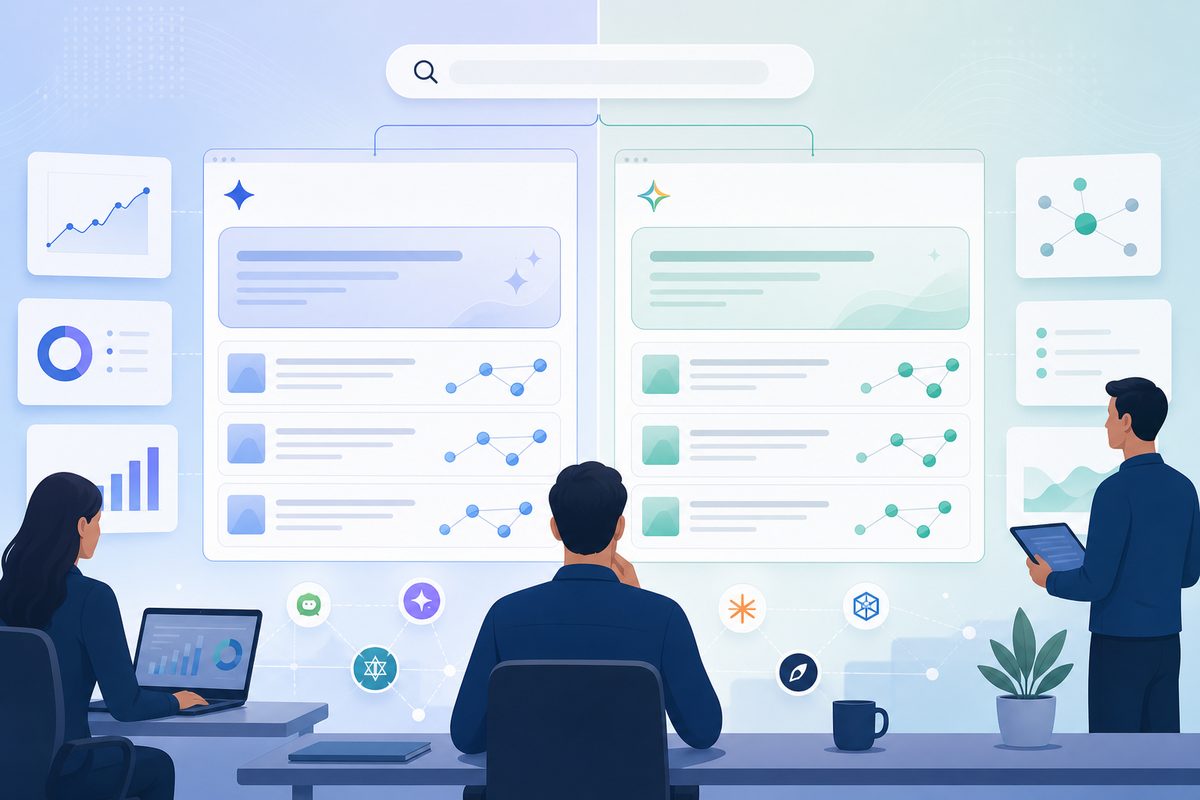
Google AI Mode visibility is decided by a different retrieval pipeline than the one that fills AI Overviews — and on identical prompts, the two surfaces mostly cite different pages. Across a 13-week panel of 1,180 B2B prompts we ran through both surfaces on the same day, only 11.4% of cited URLs matched. Brand names overlapped more than three times as often as URLs did.
That gap is the entire strategy. AI Mode is not a longer AI Overview. Teams that optimize once and assume both surfaces follow are usually winning one and losing the other without knowing which.
What is Google AI Mode visibility?
Google AI Mode visibility is how often, and how favorably, a brand's pages and name appear inside Google's conversational AI Mode tab — as a cited link, an in-text citation, or a named option in a shortlist. It is measured by prompt coverage and citation share across a panel of buyer questions, not by keyword rank position.
The distinction matters because AI Mode has no ranking positions to occupy. A single prompt triggers a fan-out of hidden sub-queries, each pulling its own candidate documents, and the model assembles one answer from whatever survived. You are not competing for slot #3. You are competing to be one of the roughly 12 sources the system leans on — a figure consistent with the 10,000-keyword AI Mode study from SE Ranking, which recorded an average of 12.6 links per AI Mode response.
The three levels of AI Mode visibility, and which one to report
Most teams conflate these, then argue about numbers that measure different things:
| Level | What it means | Stability | Use it for |
|---|---|---|---|
| Brand mention | Your name appears in the answer text | Highest (49.6% same-day persistence in our panel) | Executive reporting, share of voice |
| Citation | Any page on your domain is linked | Medium (21.4% at domain level) | Content strategy, gap analysis |
| Cited URL | One specific page is linked | Lowest (12.8%) | Diagnostics only — never a KPI |
Report the brand layer. Diagnose with the URL layer. A dashboard built on cited URLs will show a 40% "drop" that is pure churn.
Why AI Mode is a separate retrieval surface, not a bigger AI Overview
The strongest public evidence for treating these as two surfaces comes from scale studies. Ahrefs compared 730,000 response pairs and found that AI Mode and AI Overviews cite overlapping URLs only 13.7% of the time while reaching 86% semantic similarity. SE Ranking's independent run put URL overlap at 10.7% and domain overlap at 16%.
Read those numbers together and the picture is unusual: the surfaces agree on what to say and disagree on where they read it. Ahrefs' Despina Gavoyannis summarized it plainly — nine times out of ten the two features agreed on the substance, they just said it differently and cited different sources.
Our own panel landed between the two published studies, which is what you would expect from a narrower, B2B-heavy prompt set. The practical consequence: an AI Overviews win tells you almost nothing about your Google AI Mode visibility, and a monitoring setup that samples only one surface will report a number that is directionally wrong for the other.
Three mechanical differences explain the divergence:
- Trigger. AI Overviews fire inside a classic SERP for a subset of queries. AI Mode is a separate tab the user deliberately enters, usually with a longer, more conversational, more commercially-loaded prompt.
- Retrieval budget. AI Overviews resolve a query with a handful of documents. AI Mode fans out into many sub-queries and pulls candidates for each, so a page can enter through a side door the head query would never have opened.
- Session state. AI Mode supports follow-up turns that carry context forward. A brand named in turn one keeps competing in turn three; a page cited once may never be re-fetched.
What a 13-week parallel-prompt panel actually showed
Published studies compare the two surfaces at population scale. We wanted the view a single brand gets: same prompt, same day, both surfaces, tracked long enough to separate signal from churn.
Methodology
- Panel: 1,180 informational and commercial-investigation prompts across 46 B2B SaaS and tech categories (observability, CRM, HRIS, payments, security, developer tooling and others).
- Execution: every prompt run against Google AI Mode and Google AI Overviews within the same 30-minute window, from a matched US desktop location profile.
- Cadence: weekly, for 13 consecutive weeks between late April and mid-July 2026.
- Volume: 30,680 prompt-surface responses, yielding roughly 264,000 citation instances.
- Volatility sub-test: 300 prompts re-run three times inside a single day on each surface.
- Limits worth stating: US-only, desktop-only, no personalization or search history, no follow-up turns, and no click-level data. This measures retrieval behavior, not revenue.
Finding 1: source sets diverge, brand sets converge
URL agreement and brand agreement are not the same measurement.
| Compared on the same prompt, same day | AI Mode ↔ AI Overviews overlap |
|---|---|
| Exact cited URLs | 11.4% |
| Cited domains | 19.6% |
| Brands named anywhere in the answer | 38.2% |
| Top-3 named brands | 44.7% |
Brand-level agreement ran 3.3× higher than URL-level agreement. The two systems keep arriving at the same shortlist of companies through different documents. That reframes the goal: you are not trying to get one page cited twice, you are trying to make your brand reachable through enough independent documents that either retrieval path finds a way to you.
Finding 2: AI Mode names more brands, which opens slots for challengers
AI Mode answers in our panel named 5.1 brands on average, versus 2.2 in AI Overviews. On commercial prompts, AI Mode produced a shortlist of four or more named vendors 61% of the time; AI Overviews did so on 19%.
Ahrefs measured the same directional effect at population scale — 3.3 entity mentions per AI Mode answer against 1.3 for AI Overviews. Longer answers mean more slots, and more slots mean the category leader no longer absorbs the whole response. In our panel, brands ranked 6th–15th by organic traffic in their category appeared in AI Mode shortlists 2.6× more often than in AI Overviews for the same prompts.
That is the most encouraging number here for challenger brands, and it is invisible if you only watch AI Overviews.
Finding 3: winning page types split along a depth line
Citation shares by page type diverged sharply between surfaces.
| Page type | Share of AI Mode citations | Share of AI Overviews citations |
|---|---|---|
| Comparison and "best X" listicles | 31.2% | 22.4% |
| Product docs and technical references | 17.6% | 6.1% |
| Community threads (Reddit, Stack Overflow, Q&A) | 13.9% | 5.8% |
| How-to and tutorial blog posts | 11.3% | 19.7% |
| Definition and glossary pages | 8.4% | 21.6% |
| Vendor homepages and product pages | 9.1% | 10.3% |
| Video pages | 2.9% | 9.4% |
| News and press | 5.6% | 4.7% |
The pattern is consistent with public research rather than contradicting it: Ahrefs found AI Overviews strongly favor YouTube while AI Mode leans on encyclopedic and community sources such as Wikipedia and Quora, the latter cited 3.5× more often in AI Mode.
Two practical readings. First, documentation earns almost three times more of AI Mode's citations than of AI Overviews' — a surface where engineering-owned content is a marketing asset, which is why treating developer docs as a citation source pays differently here. Second, thin definition pages that perform in AI Overviews rarely carry over. That does not make glossary pages worthless — it changes their job. A definition page still wins AI Overviews and still needs to survive AI Mode, which means the 40-word definition has to be followed by the sub-questions a buyer asks next, a structure covered in how definition and glossary pages win "what is" answers.
Sampling 400 pages cited in AI Mode but not in AI Overviews, those pages answered a median of 2.4× more distinct sub-questions than pages cited only in AI Overviews. Depth, not word count — the losing pages were often longer.
Finding 4: AI Mode churns roughly 2.7× faster
Re-running 300 prompts three times in one day exposed how unstable a single snapshot is.
| Persisted across all three same-day runs | AI Mode | AI Overviews |
|---|---|---|
| Identical URLs | 12.8% | 34.6% |
| Identical domains | 21.4% | 47.9% |
| Identical brands named | 49.6% | 63.1% |
SE Ranking's three-parse test found only 9.2% of AI Mode URLs matched across all three runs, so this instability is not a quirk of our panel.
The operational lesson is specific: the brand layer is roughly four times more stable than the URL layer, so brands are the reportable metric and URLs are the diagnostic. Any AI search monitoring setup that reports a one-off URL citation as a win will manufacture wins and losses that do not exist. Weekly repeated sampling across the same fixed prompt panel is the minimum for a defensible trend line.
Finding 5: the answer's language matters as much as the link
We coded the sentence surrounding each brand mention in 2,400 AI Mode commercial answers. 31% of brand mentions were qualified rather than neutral — "better suited to smaller teams", "priced above alternatives", "steeper learning curve". Those qualifiers came overwhelmingly from third-party review platforms and community threads, not vendor pages.
This is why raw mention counts mislead. A brand named third with an unflattering clause loses the click to a brand named fifth with a clean one. Track the modifier, not just the mention.
How query fan-out decides which pages survive
AI Mode does not search for your query. It decomposes it. Google's Search engineering leadership has described the technique as fanning out every sub-question implied by a complex query, firing them in parallel, and synthesizing one response — the mechanism Google detailed in its AI Mode update from Google I/O.
That changes what a "relevant page" means. A prompt like "best observability platform for a Kubernetes-heavy startup" silently becomes a dozen searches: pricing tiers, Kubernetes integration, log retention limits, alerting, competitor comparisons, migration effort. A page that answers only the head question competes for one of those twelve retrievals. A page that resolves eight of them competes for eight.
This is why depth beats volume for Google AI Mode visibility. Ten shallow posts each catch one sub-query; one thorough document catches many, and the model prefers a source it can lean on repeatedly. The mechanics of which sub-queries get generated, and how to reverse-engineer them for your category, are covered in our breakdown of how one prompt becomes dozens of hidden searches.
How to earn Google AI Mode visibility: a seven-step playbook
Work these in order. Steps 1–2 determine whether the rest matters.
- Build a prompt panel, not a keyword list. Collect 80–200 real buyer questions from sales calls, support tickets and demo requests. These are what people type into a conversational tab; head keywords are not.
- Map the fan-out for your top 20 prompts. Write out every sub-question each prompt implies, then audit which of your pages answer each one. The unanswered sub-questions are your content backlog.
- Consolidate before you publish. Merge thin adjacent posts into one document that resolves 8–15 sub-questions. In our panel, that shape got cited; the scattered version did not.
- Make each passage self-contained. Aim for 130–170 word blocks that answer a specific question without needing the paragraph above. Retrieval pulls passages, not pages.
- Add the comparison table. Specs, pricing tiers, limits, supported integrations. Comparison and listicle formats took 31.2% of AI Mode citations in our panel, and Search Engine Land's coverage of format-level citation research found listicles lead across AI surfaces generally.
- Earn the third-party pages AI Mode already reads. 41.3% of brand-relevant AI Mode citations in our panel sat on domains the brand did not own, versus 26.8% in AI Overviews. Category roundups, review platforms and technical community threads carry disproportionate weight. Sequence by what AI Mode cites most in your category: roundups first, then the two or three community threads that already rank for your head prompts, then review platforms.
- Re-measure weekly against the same panel. Given 12.8% same-day URL persistence, anything less frequent is noise.
There is no markup step in that list, and that is deliberate. Google's documentation on how content appears in AI features states there are no additional requirements to appear in AI Overviews or AI Mode and no special optimizations necessary — pages need to be indexed and snippet-eligible. Schema still earns rich results and clarifies entities; it is not a lever for AI Mode citations.
What does not move Google AI Mode visibility
Worth stating explicitly, because these absorb budget:
- Adding schema to existing pages. Google's own docs rule it out as a requirement. Zero observed lift in our panel from pages that added Article or FAQPage markup mid-window.
- Publishing more posts on the same subtopic. Fan-out rewards one document resolving many sub-questions, not five resolving one each.
- Keyword density in the head term. AI Mode retrieves passages semantically; repeating "Google AI Mode visibility" does not make a passage more retrievable.
- llms.txt. No evidence Google reads it for AI Mode retrieval. It costs nothing, but it is not a strategy.
How to measure Google AI Mode visibility when Search Console shows only part of it
Measurement got meaningfully better in 2026, but not enough to stop external tracking.
Google shipped a generative AI performance report in Search Console in June 2026. According to the Search Console Help documentation for the report, it shows how often links to your site appeared in generative AI features on Google Search, broken down by pages, countries, dates and devices, and it is rolling out to a subset of site owners.
What it gives you and what it withholds:
- Gives: impression counts for generative AI features, page-level and country-level breakdowns, a real first-party signal that you are being surfaced at all.
- Withholds: AI Overviews and AI Mode are reported together rather than split, and the report carries no query data and no click breakdown.
So the report can tell you that something surfaced you. It cannot tell you which surface, for which prompt, alongside which competitors, or in what tone. Those four are the questions marketing leaders actually get asked in a budget review.
Building a baseline without rank data
Closing that gap means running your own prompt panel against the live surface and recording the full response — the citations, the named brands, the ordering, and the descriptive language. Minimum viable setup:
- Fix the panel. 80–200 prompts, unchanged for at least eight weeks. Changing prompts mid-window destroys the trend line.
- Run weekly, same weekday, same locale. Volatility is high enough that day-of-week and location drift will masquerade as movement.
- Record four fields per response: brand named (yes/no), position in the shortlist, cited domains, and the modifier language around your name.
- Report the eight-week rolling average, never a single week. With 12.8% URL persistence, week-over-week deltas are mostly noise.
Whether you need continuous tracking or a one-off snapshot depends on the decision you are making — the trade-off is laid out in free AI visibility reports versus ongoing monitoring, and the tools that actually parse inside AI Mode responses (rather than inferring from the classic SERP) are compared in this review of AI Overviews and AI Mode tracking tools.

Worked example: a 40-person observability vendor, nine weeks
One panel participant agreed to let us publish anonymized figures. A 40-person observability SaaS with roughly 11,000 monthly organic sessions tracked 90 category prompts.
Week 0 baseline: named in AI Mode on 4 of 90 prompts (4.4%) and in AI Overviews on 7 of 90 (7.8%). Their own domain was cited twice, both times the homepage.
What they changed over nine weeks:
- Rebuilt a scattered set of five comparison posts into one document answering 14 sub-questions, with a specification table covering retention limits, ingest pricing and Kubernetes support.
- Made six documentation pages self-contained — each opening with a direct definition, then the procedure — and linked them from the comparison hub.
- Earned inclusion in three third-party category roundups, and had an engineer answer 11 relevant community threads with substantive, non-promotional replies.
Week 9 result: AI Mode 23 of 90 prompts (25.6%), AI Overviews 12 of 90 (13.3%). AI Mode grew 5.8× versus 1.7× for AI Overviews.
The mechanism behind the split is the useful part: 14 of the 23 AI Mode appearances came from third-party pages, not their own site. Their documentation picked up 5 more. The rebuilt comparison hub accounted for 4.
Timing was uneven in a way worth planning around. The documentation gains showed up first — weeks 3 to 4, roughly two weeks after Google recrawled those pages. The comparison hub took until week 6. Third-party roundups were slowest, weeks 6 to 9, because they had to be published, then crawled, then chosen. Budget nine weeks before judging a third-party push, three for owned pages.
Two honest caveats. Organic sessions rose only 6% in the same window, so this was a visibility gain, not yet a traffic gain. And nine weeks with several simultaneous changes cannot isolate which action caused which citation — a staged rollout, changing one lever per three-week block, is the only way to attribute cleanly.
Where AI Mode fits among the engines your buyers actually use
Google AI Mode is one surface. Our panel prompts run through other engines returned meaningfully different shortlists, and B2B buying committees rarely use only one. Copilot inherits the Bing index, Perplexity weights recency harder, and ChatGPT's browsing behavior differs again — the engines most B2B teams under-track are mapped in this breakdown of Copilot, Grok, and Google AI Mode.
Two adjacent surfaces feed off the same content and are worth tracking on the same panel:
- Voice assistants, which typically read one source aloud rather than listing five — a winner-take-all variant of the same retrieval problem, covered in voice assistant AEO.
- Employer-brand queries, where AI answers about your company draw from Glassdoor, Reddit and news rather than your careers page.
The practical move: run the same fixed panel across Google AI Mode, ChatGPT, Gemini, Perplexity and Copilot, and report per-engine. A single blended "AI visibility" score hides the engine where you are losing.
Five mistakes that cap AI Mode visibility
- Reading one snapshot as a trend. With 12.8% same-day URL persistence, a single check is a coin flip dressed as data.
- Optimizing only owned pages. Over 40% of AI Mode citations for tracked brands lived on domains those brands did not control.
- Assuming AI Overviews wins transfer. URL overlap sits between 10% and 14% across every study run so far, including ours.
- Chasing schema as a citation lever. Google states no special markup is required; the effort belongs in subtopic coverage instead.
- Reporting citations without brand context. Being cited while three competitors are described more favorably in the same answer is not a win, and answer engine optimization work should be scored on share of voice and sentiment, not raw mention counts.
Frequently asked questions
Is Google AI Mode visibility the same as appearing in AI Overviews?
No. Across our 13-week panel, only 11.4% of cited URLs matched between the two surfaces on identical prompts, closely tracking Ahrefs' 13.7% and SE Ranking's 10.7%. Brand-level agreement is higher at 38.2%, but treat them as two scoreboards and monitor each separately.
Does schema markup improve Google AI Mode visibility?
Not directly. Google's documentation states there are no additional requirements or special optimizations needed to appear in AI Overviews or AI Mode beyond being indexed and snippet-eligible. Structured data remains worthwhile for rich results and entity clarity; it is not the lever for AI Mode citations.
Can I see AI Mode traffic in Google Search Console?
Partly. The generative AI performance report launched in June 2026 shows impressions from generative AI features broken down by page, country, device and date. It does not separate AI Mode from AI Overviews, and it carries no query or click breakdown, so it confirms you were surfaced without telling you where or for what.
Does blocking Google-Extended remove my site from AI Mode?
No. Google-Extended governs Gemini app and model-training uses, not AI features inside Search. AI Overviews and AI Mode draw on standard Google Search indexing, and the controls that apply there are the usual preview directives — nosnippet, data-nosnippet, max-snippet and noindex.
How often should I track AI Mode visibility?
Weekly, against a fixed prompt panel. Same-day volatility testing showed only 12.8% of AI Mode URLs persisted across three runs in one day, versus 34.6% for AI Overviews, so monthly checks cannot distinguish a real shift from ordinary churn. Report an eight-week rolling average rather than week-over-week deltas.
How long does it take to see AI Mode visibility improve?
In our nine-week worked example, owned documentation pages showed movement two to four weeks after recrawl, a consolidated comparison hub took about six weeks, and third-party roundups took six to nine. Plan a full quarter before judging an AI Mode program, and expect visibility to move well before traffic does.
Do I need a large site or high domain authority to appear in AI Mode?
No, and this is the structural opening. AI Mode named 5.1 brands per answer in our panel versus 2.2 for AI Overviews, and brands ranked 6th–15th by organic traffic in their category appeared 2.6× more often in AI Mode shortlists than in AI Overviews. More named slots per answer means challengers get in on subtopic depth rather than domain size.
Which pages should I fix first for AI Mode?
Product documentation and comparison content, in that order. Docs took 17.6% of AI Mode citations against 6.1% in AI Overviews — the widest gap of any page type — and comparison/listicle formats took 31.2%. Thin definition pages and video are the weakest AI Mode investments relative to their AI Overviews performance.