Do you need a Wikipedia page for AI search visibility? No — but that flat answer hides the part that actually matters. A Wikipedia page is the single strongest entity signal for one major AI engine, close to irrelevant for two others, and realistically out of reach for most brands that want one. So the useful question isn't "should I get a Wikipedia page." It's "which engine am I fighting for, can I even qualify, and what carries the same weight if I can't?"
This piece answers all three with observed citation data, Wikipedia's own published rules, and a decision framework you can apply this week. If you already learned that ranking #1 on Google no longer guarantees you appear in AI answers, you'll recognize the pattern: the old authority signals and the new ones only partly overlap.
The short answer: no, but it depends on the engine
You do not need a Wikipedia page to get recommended by AI. You need to be a well-described, well-corroborated entity — and Wikipedia is one shortcut to that, not the only one. The catch is that its value is wildly uneven across platforms.
For ChatGPT, a Wikipedia page is arguably the highest-use single asset you can own. For Perplexity and Google AI Overviews, it barely registers against Reddit threads, reviews, and forum discussion. So "do you need a Wikipedia page for AI search" collapses into a sharper question: which AI surface do your buyers actually use? Answer that first, because it changes the entire recommendation. A marketing lead optimizing for ChatGPT shortlists and one optimizing for Perplexity research should make opposite bets.
What a Wikipedia page actually does for AI visibility
A Wikipedia page influences AI answers through three separate mechanisms — training weight, live retrieval, and entity grounding — and most brands only think about one of them.
First, training weight. Large models are pre-trained on scraped text, and Wikipedia is deliberately over-sampled in that mix. In OpenAI's documented GPT-3 training recipe, Wikipedia was just 3% of the training data by weight, yet the model passed over it roughly 3.4 times during training versus 0.44 passes over the far larger Common Crawl web data — the builders trusted it more, so the model saw it more.
Second, live retrieval. When ChatGPT or Perplexity browses the web to answer a question, Wikipedia is a frequently fetched, easily parsed source: clean structure, stable URLs, no paywall. The model applies the same passage-selection logic to your Wikipedia entry as to any other page it pulls.
Third, entity grounding. A page gives the model a canonical, structured fact sheet — founded, headquartered, category, key people — that reduces hallucination when it describes you.
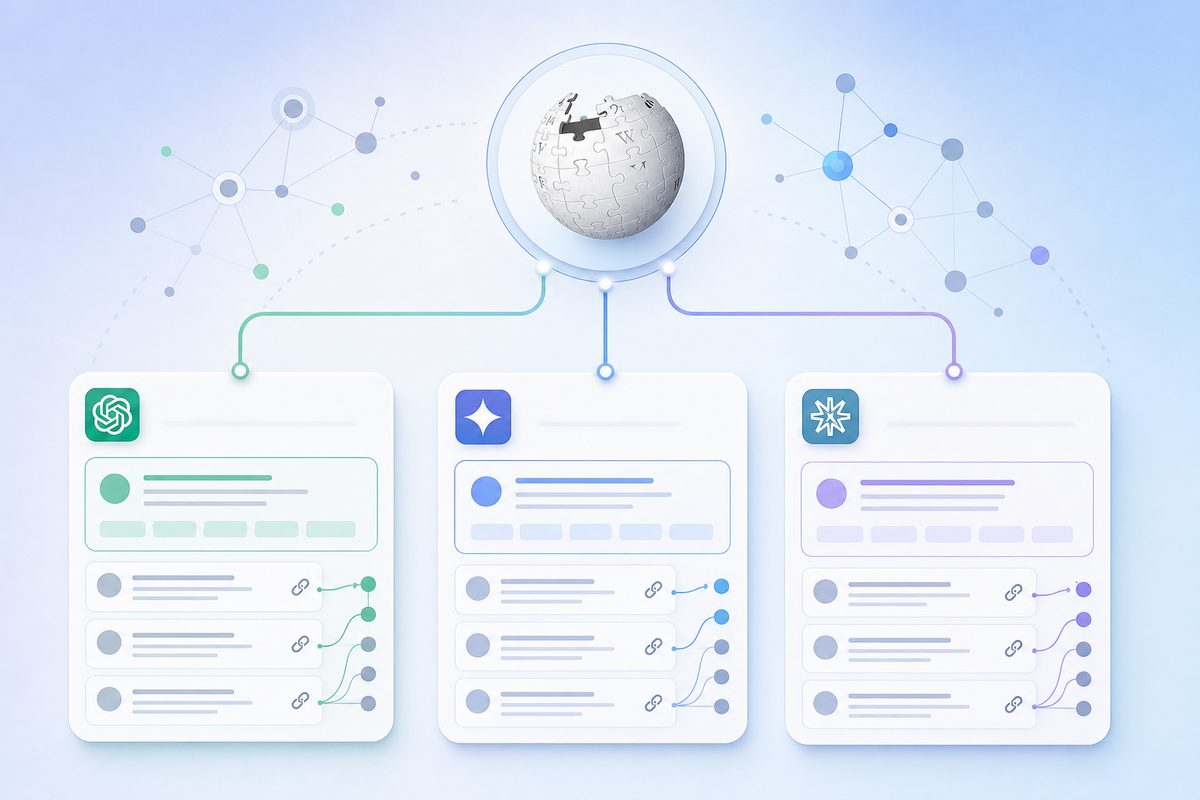
How much does Wikipedia really drive AI citations?
Wikipedia dominates ChatGPT's sourcing and almost nothing else. That's the finding most "you need a Wikipedia page" articles skip, and it's the one that should drive your decision.
Profound analyzed roughly 680 million AI citations between August 2024 and June 2025. The split across engines isn't subtle:
| AI engine | Wikipedia's share of all citations | Wikipedia's share of the engine's top 10 sources | Source that actually leads |
|---|---|---|---|
| ChatGPT | 7.8% | 47.9% | Wikipedia |
| Google AI Overviews | 0.6% | 5.7% | Reddit (2.2%) |
| Perplexity | Not in top 10 | — | Reddit (6.6%) |
Read the middle column carefully. Among ChatGPT's ten most-cited domains, nearly half of the volume is Wikipedia alone. For Google AI Overviews it's under 6%, and for Perplexity, Wikipedia doesn't crack the top ten — Reddit, YouTube, and Gartner do. (Figures from Profound's AI platform citation analysis.)
The practical translation: a Wikipedia page for AI search is a ChatGPT-and-Copilot play, not a universal one. This engine-by-engine split is exactly the logic behind how AI search engines decide which brands to cite.
The notability reality most brands hit
Here's the wall: even when a Wikipedia page would help, most B2B SaaS companies and startups cannot qualify for one — and paying someone to force it usually backfires. Wikipedia's rule for companies, WP:NCORP, is stricter than founders expect.
To justify an article, your company needs significant coverage in multiple reliable, independent, secondary sources. Each word is load-bearing, and NCORP disqualifies most of what a growth team is proud of:
- Not independent: anything you wrote, sponsored, or influenced — press releases, contributed articles, founder interviews, customer quotes.
- Not secondary: funding announcements, product-launch write-ups, and other routine coverage rehashing your own materials ("churnalism").
- Not significant: brief mentions, "top 100" list inclusions, directory entries, and local-only coverage.
- Used with great care: trade-publication features, where NCORP sets an explicit presumption against using them unless independence is obvious.
A single strong source is "almost never sufficient," and multiple pieces from the same outlet count as one. Most early-stage tech brands, audited honestly, have promotional coverage — not the independent analysis NCORP demands. Articles created anyway are routinely nominated for deletion, and contested corporate pages frequently fail to survive it. If your case rests on a TechCrunch funding note and your own blog, you almost certainly don't qualify yet — and that's a strategy input, not a defeat.
When a Wikipedia page is worth pursuing: a decision framework
Pursue a Wikipedia page only when both conditions are true: your buyers live on ChatGPT or Copilot, and you can meet NCORP with earned coverage you already have. If either is false, your effort is better spent elsewhere. Use this matrix:
| Your priority AI engine | Can you meet WP:NCORP now? | Verdict |
|---|---|---|
| ChatGPT / Copilot | Yes | Pursue it. Highest-ROI single entity move available. |
| ChatGPT / Copilot | Not yet | Build independent coverage first; claim Wikidata now. |
| Perplexity | Either | Skip Wikipedia. Win Reddit, reviews, docs, and comparison content. |
| Google AI Overviews | Either | Skip Wikipedia. Reinforce classic search plus forum/review signals. |
The framework does two useful things. It stops the wasted quarters teams spend chasing a page they can't get on an engine that wouldn't reward it. And it reframes notability as a milestone you build toward, not a gate you either pass or fail today. The independent coverage that eventually qualifies you for Wikipedia is the same coverage that earns third-party citations across the sources AI already pulls from — so the work is never wasted, even before the page exists.
What to do if you can't get a Wikipedia page (yet)
If Wikipedia is out of reach, replicate its three functions — canonical facts, corroboration, and description — with assets you fully control. In rough priority order:
- Claim your Wikidata entry. Wikidata's bar is far lower than Wikipedia's, it's machine-readable, and knowledge graphs and models query it directly for entity facts. It's the fastest way to hand AI a structured "who is this brand" answer.
- Reinforce your own facts with schema. Organization markup helps models resolve you as an entity — within clear limits on what Organization schema can and can't clarify for AI search.
- Get into the databases AI trusts. Category directories, review platforms, and structured datasets punch above their weight, because models pull entity facts and social proof straight from them.
- Publish original data. A proprietary benchmark or survey gets cited rather than just crawled — the mechanic behind original statistics as a citation magnet for small brands.
Notice the through-line: none of these require anyone's permission, and every one also earns the independent mentions that inch you toward NCORP. That's the answer engine optimization loop — build corroborated, quotable, structured facts, and both Wikipedia and the models come around.
How to know if a Wikipedia page actually moved the needle
Whether a Wikipedia page changed your AI visibility is a measurable question, not an article of faith — and skipping the measurement is how teams waste six-figure PR budgets on a page nobody can prove worked. This is where ongoing AI visibility monitoring earns its place: track your brand's share of voice and mention rate across ChatGPT, Perplexity, Copilot, and AI Overviews before the page goes live, then watch the same prompts after.
Consider an illustrative pair. Two B2B SaaS competitors in one category both start invisible when a buyer asks ChatGPT for "the best tools for X." Brand A spends four months earning a Wikipedia page. Brand B skips it and instead ships a Wikidata entry, six independent reviews, and one original benchmark report. Modeled against how the engines cite, Brand A's ChatGPT mention rate climbs meaningfully while its Perplexity presence barely moves; Brand B gains across all three engines through a different door. Without tracking, neither team could tell which spend paid off — or that Brand A's Wikipedia win did nothing for the Perplexity buyers it also cared about.
That's the discipline: attribute the lift to the asset. A page that raises ChatGPT share of voice by a measured margin is a win you can defend in a budget meeting. A page you assume helped is a line item you'll cut next year.
Frequently asked questions
Does ChatGPT read my Wikipedia page live or from training?
Both, depending on the mode. When ChatGPT answers from memory, it draws on the pre-trained weights where Wikipedia was heavily over-sampled. When it browses to answer a current question, it can fetch your live Wikipedia page and quote it directly. This is why a page can influence answers even for models whose training cutoff predates it — the retrieval path doesn't wait for the next training run.
Can I just write my own Wikipedia page?
You can, but you usually shouldn't, and it rarely survives. Wikipedia treats subject-written articles as a conflict of interest, and pages built on self-published or promotional sources are routinely flagged and deleted under NCORP. Self-promotion and paid placements explicitly don't count toward notability. The durable route is earning independent coverage first, then letting a neutral editor create the page from those sources.
Wikipedia or Wikidata — which should I do first?
Wikidata, almost always. Its notability bar is far lower, it's structured for machine reading, and it establishes canonical facts models can resolve immediately. Treat Wikidata as the entry point and Wikipedia as the milestone you reach once earned media clears the NCORP threshold.
How long until a Wikipedia page shows up in AI answers?
Days for retrieval-based answers; potentially a full training cycle for memory-based ones. Browsing-enabled engines can surface a new page almost immediately. Baked-in training knowledge lags until the model is retrained. Track both, because the same page can appear in ChatGPT's browsing answers long before it changes what the model "knows" unprompted.
Does a Wikipedia page help with Google AI Overviews?
Barely. In the citation data, Wikipedia accounts for roughly 0.6% of AI Overviews citations and under 6% of its top-10 sources, dwarfed by Reddit and YouTube. If AI Overviews is your priority surface, reinforce classic Google ranking and forum/review presence rather than chasing a Wikipedia page.