AI visibility benchmarks tell you whether your brand shows up in AI answers as often as it should. Across MaxAEO's aggregate tracking, the median brand earns a mention in roughly 31% of relevant, non-branded AI answers — but that single number hides enormous spread. A 31% mention rate is excellent for a healthcare brand and mediocre for a publisher.
Most benchmark articles hand you a formula and tell you to "set your own baseline." That advice is true and useless on day one, because a baseline only tells you whether you moved — not whether the number is good. This guide gives you the missing half: real cross-industry, cross-engine, and cross-prompt-type bands so you can judge where you actually stand.
What are AI visibility benchmarks?
AI visibility benchmarks are reference ranges for how often a typical brand gets mentioned, cited, or recommended in AI-generated answers — broken out by industry, engine, and query type. They convert a raw percentage into a verdict: bottom quartile, median, or category leader.
A benchmark is not the same as a metric. Your mention rate is your number; the benchmark is the distribution it sits inside. Without the distribution, a 40% mention rate could mean you're winning or losing badly — it depends entirely on whether your strongest competitor sits at 25% or 70%.
How these benchmarks were measured
These benchmarks draw on MaxAEO's aggregate AI search monitoring: a fixed panel of category prompts run daily against eight engines — ChatGPT, Gemini, Perplexity, Claude, Copilot, Grok, Google AI Mode, and AI Overviews — aggregated across hundreds of tracked brands spanning the industries below, over a rolling 90-day window into mid-2026.
Three methodology choices shape every number that follows:
- Non-branded by default. Unless noted, rates measure category and comparison prompts (e.g., "best AI visibility tool"), not searches that already contain your brand name. Branded prompts inflate every figure.
- Mention, not just citation. A "mention" means the brand name appears in the answer. A "citation" means a link to your domain appears. They benchmark differently, and we separate them.
- Daily sampling, not one snapshot. A single query is noise. Each rate is averaged over repeated daily runs, because AI answers change far more than people expect.
Treat the figures as directional bands, not fixed constants — they shift as engines update and as more brands optimize. For the full sampling logic, see MaxAEO's AI search monitoring methodology, and for the exact arithmetic behind the headline metric, see how the AI mention rate is calculated.
The cross-industry baseline: what an average mention rate looks like
Blended across all tracked industries, the median non-branded mention rate is about 31%, the top quartile clears 58%, and the top decile — the brands AI treats as the default answer — sits at 74% or higher. The bottom quartile languishes under 12%, effectively invisible.
| Percentile band | Non-branded mention rate | What it means |
|---|---|---|
| Bottom quartile | under 12% | Largely invisible; AI rarely surfaces you |
| Median (50th) | ~31% | Appears in about 1 in 3 relevant answers |
| Top quartile (75th) | ~58% | Consistently in the consideration set |
| Top decile (90th) | 74%+ | The name AI reaches for first |
The key takeaway: the gap between median and top-decile is wider than the gap between zero and median. Getting to "average" is mostly about being crawlable and entity-clear. Getting to category leadership is a different, harder game built on citations and reputation across the open web.
Citations benchmark lower than mentions
A citation — an actual link to your domain — is rarer than a mention, so its benchmark sits far lower. Across tracked brands the median non-branded citation rate is roughly 12%, about a third of the 31% mention rate. The reason is mechanical: engines name brands from memory, but only cite pages they can fetch and trust. If your goal is referral traffic, benchmark citations; if it's influence over the recommendation itself, benchmark mentions.
AI visibility benchmarks by industry
Industry is the single biggest predictor of what "good" looks like, because each vertical has different content norms, different regulatory friction, and a different bar for what AI engines will assert without a source.
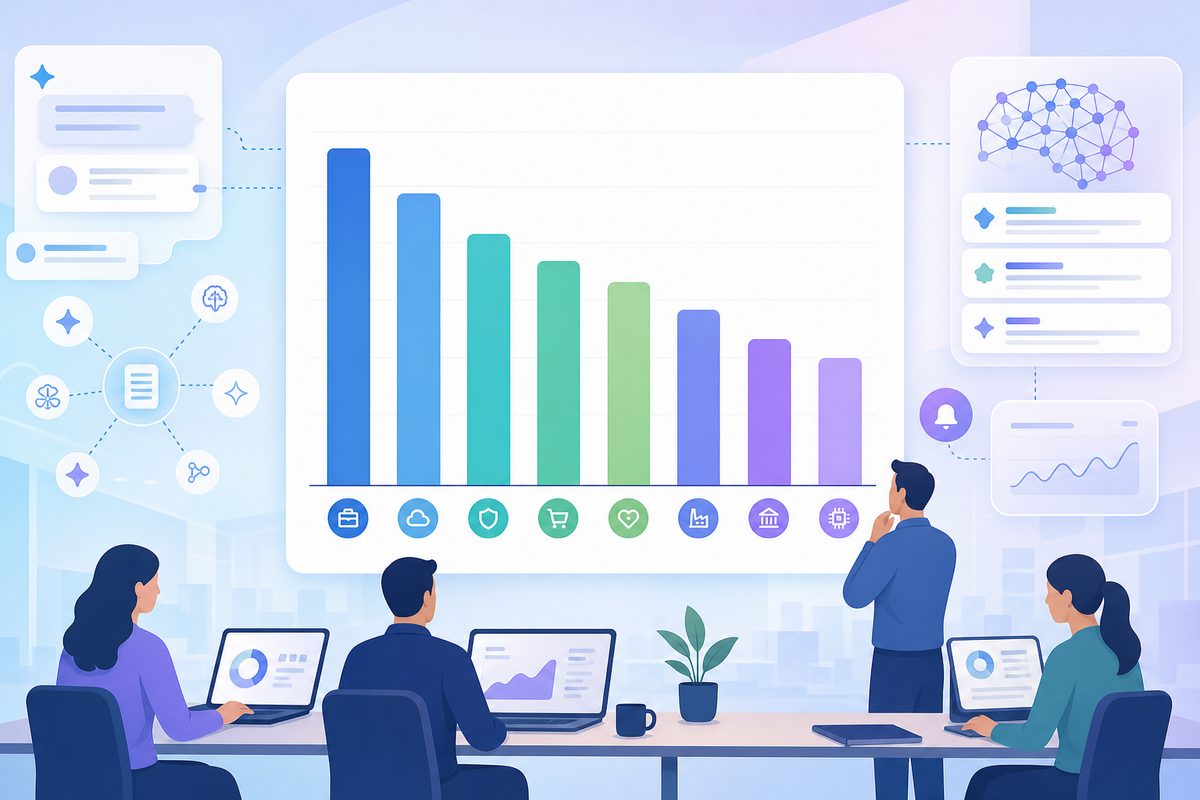
| Industry | Median mention rate | Top quartile | Why it lands here |
|---|---|---|---|
| Media & publishing | 45% | 72% | High crawlability; heavily cited as sources |
| B2B SaaS | 38% | 61% | Docs, pricing, and comparison pages pay off |
| Cybersecurity & dev tools | 36% | 60% | Deep technical content; strong G2/Reddit presence |
| DTC & e-commerce | 34% | 66% | Product schema and shopping surfaces lift the ceiling |
| Education & EdTech | 33% | 59% | Content depth is the strongest single predictor |
| Local & home services | 28% | 55% | Wins on reviews and clean local entities |
| Professional / B2B services | 24% | 52% | Thin structured data — the biggest upside gap |
| Fintech & finance | 22% | 44% | Regulatory caution caps what AI will claim |
| Healthcare | 19% | 41% | YMYL gating; mentions depend on cited authority |
Two patterns deserve attention. Regulated verticals (finance, healthcare) carry a structural ceiling — AI engines hedge on money and health, so even a strong brand sees lower raw numbers and should benchmark against its own vertical, never the blended average. And professional services show the largest median-to-leader spread relative to effort, because most firms publish case studies but skip the structured data and earned mentions that AI engines actually parse.
Why benchmarks differ by AI engine
The same brand can appear in 50% of ChatGPT answers and 15% of Perplexity answers for the identical question. Benchmarking against a single engine, or against a blended average, hides the engine where you're quietly losing.
| Engine | Median mention rate | What moves the number |
|---|---|---|
| ChatGPT | 34% | Largest surface; rewards established entities and training-data presence |
| Google AI Overviews | 29% | Tracks classic SERP authority closely |
| Gemini | 27% | Leans on Google's index and entity graph |
| Google AI Mode | 26% | Conversational Google surface; blends SERP authority with live retrieval |
| Perplexity | 24% | Live crawl; fresh content and clean citations win |
| Microsoft Copilot | 22% | Bing-index driven; favors indexed, structured pages |
| Claude | 20% | Conservative; cites cautiously and favors well-established sources |
| Grok | 19% | Social signals and recency weigh heavier |
The divergence is not random noise — it reflects how each engine sources answers. In MaxAEO's cross-engine tracking, the overlap between which domains ChatGPT and Perplexity cite is low — often fewer than 1 in 5 cited sources are shared. So an answer-engine-optimization win on one platform frequently does not transfer to the others, which is exactly why a single blended score hides the engine where you're losing.
Practical rule: benchmark per engine, then prioritize the one your buyers actually use. A B2B SaaS team should weight ChatGPT and Google AI Overviews; a research-heavy audience skews toward Perplexity.
Branded vs non-branded: two completely different benchmarks
Branded prompts and category prompts are not the same test, and mixing them produces a flattering, meaningless average. If someone types your name, you should almost always appear. The hard, valuable benchmark is whether you show up when they don't know you yet.
| Prompt type | Median mention rate | "Good" looks like |
|---|---|---|
| Branded ("MaxAEO pricing", "is MaxAEO any good") | 64% | 80%+ |
| Category ("best AI visibility tool") | 26% | 40%+ |
| Comparison ("X vs Y", "alternatives to X") | 18% | 35%+ |
Comparison prompts are the toughest benchmark and the highest-intent one — they're shortlist queries. A brand that wins category prompts but vanishes from comparison and "alternatives" prompts has a recommendation problem, not an awareness problem — and the fix is comparison-ready content the engine can safely quote, not more brand awareness.
This split is also why AI share of voice matters more than raw mention rate at the top of the market. Mention rate asks "do I exist?" Share of voice asks "when my category comes up, what fraction of the named brands is me versus competitors?" Above roughly 50% mention rate, share of voice becomes the metric that actually separates leaders.
Benchmarks move: how much your number swings week to week
A mention rate measured once is unreliable — the same prompt can return different brands on consecutive days. In MaxAEO tracking, a brand sitting near the category median commonly sees its weekly mention rate swing by ±8 to ±15 percentage points purely from model-side variability, before any optimization.
This has two consequences for how you use any benchmark:
- Never benchmark off a single day. A 22% reading on Tuesday and 37% on Friday are the same underlying brand. Average over at least a week of daily runs.
- Small movements aren't wins. If normal volatility is ±12 points, a jump from 30% to 36% is inside the noise band, not proof your last content push worked.
Volatility is highest for brands near the median and lowest at the extremes — category leaders are stable because the model is confident, invisible brands because they're consistently absent. Practically: only trust a change that holds across two consecutive weekly averages.
How to read your own mention rate against these benchmarks
Don't compare your number to the blended 31% average. Compare it to the top quartile of your specific industry, on your buyers' primary engine, for non-branded prompts. That's the only comparison that tells you whether you're competitive.
Use this four-step read:
- Locate your row. Find your industry's median and top-quartile in the table above. That's your floor and your real target.
- Pick your engine. Weight the engine your audience uses, not the average. Subtract or add based on the engine table.
- Isolate non-branded. Strip out branded prompts. If your tool can't separate them, your benchmark is inflated.
- Place yourself in a band. Below your industry median = visibility problem. Between median and top quartile = competitive but not winning. Above top quartile = defend and grow share of voice.
A worked example: a B2B SaaS brand at 33% non-branded mention rate on ChatGPT looks fine against the 31% blended average — but its real benchmark is the SaaS median of 38% and top quartile of 61%. So 33% is below median for its category. The blended average flattered it into complacency; the industry band revealed a gap.
What separates top-quartile brands
Across verticals, the brands sitting above the top-quartile line share a consistent profile — and almost none of it is paid placement. The drivers, in rough order of impact:
- Clear, machine-readable entity facts. Top-quartile brands describe themselves consistently across their site, structured data, and the open web, so engines can state who they are without guessing. Inconsistent self-description is the most common reason a known brand still gets skipped.
- Earned mentions off their own domain. Presence on Reddit, G2, Wikipedia, and YouTube feeds the sources AI engines trust most. Owned content alone rarely clears the top quartile — earned third-party mentions are what move you from median to leader.
- Comparison-ready content. Pages that directly answer "X vs Y" and "best tool for Z" give engines something safe to quote on high-intent prompts.
- Crawlable infrastructure. If ChatGPT, Perplexity, and Google can't fetch your pages, none of the above counts — a surprisingly common silent failure.
Notably, comprehensive structured data correlates with materially higher visibility regardless of industry. It's the cheapest lever most brands haven't pulled, because it makes your facts quotable without forcing the model to infer.
How to close the gap
If you're below your industry benchmark, work the levers in dependency order — infrastructure first, because everything downstream depends on it:
- Confirm AI crawlers can read your site. Verify access for GPTBot, PerplexityBot, and Google's crawlers before producing anything else.
- Fix your entity facts. Make your name, category, and core claims identical across your site, schema, and major profiles.
- Add and clean structured data. Organization, Product, and FAQ schema where relevant — give engines parseable facts.
- Earn third-party mentions. Prioritize the sources your tracking shows competitors getting cited from.
- Publish comparison and shortlist content. Target the exact non-branded and comparison prompts where you're absent.
- Re-measure on a weekly average. Confirm movement clears the volatility band before declaring a win.
For a fuller walkthrough, MaxAEO's guide on how to get discovered in AI search sequences these moves with examples, and AI search monitoring ROI connects mention-rate gains to pipeline so you can defend the budget.
Frequently asked questions
What is a good AI visibility score in 2026?
A good score is one that clears your industry's top quartile on your buyers' primary engine for non-branded prompts. In blended terms that's roughly 58%+, but the honest answer is industry-specific: ~44% is top-quartile in finance, while publishing demands 72%. Benchmark against your vertical, never the global average.
What is the average brand mention rate in AI search?
The median non-branded mention rate across tracked brands is about 31% — the typical brand appears in roughly one in three relevant AI answers. Branded prompts run far higher (median ~64%) and comparison prompts far lower (median ~18%), so always specify which prompt type a benchmark refers to.
Why is my mention rate different in ChatGPT vs Perplexity?
Because each engine sources answers differently. ChatGPT leans on established entities and training data; Perplexity crawls live and rewards fresh, well-cited pages. In our cross-engine tracking the two share fewer than 1 in 5 cited domains, so a win on one platform often doesn't transfer. Track and optimize per engine.
How often should I re-check my benchmark?
Average your mention rate over at least a week of daily runs, and re-benchmark monthly. AI answers swing ±8 to ±15 points week to week from model variability alone, so a single reading — or a small jump inside that band — isn't reliable signal. Monthly cadence catches real trend, not noise.
Mention rate or share of voice — which benchmark matters more?
Below ~50% mention rate, fix mention rate first — you can't win a race you're not in. Above that, AI share of voice becomes the deciding metric, because it measures how much of the named consideration set is you versus competitors. Leaders are separated by share of voice, not raw presence.