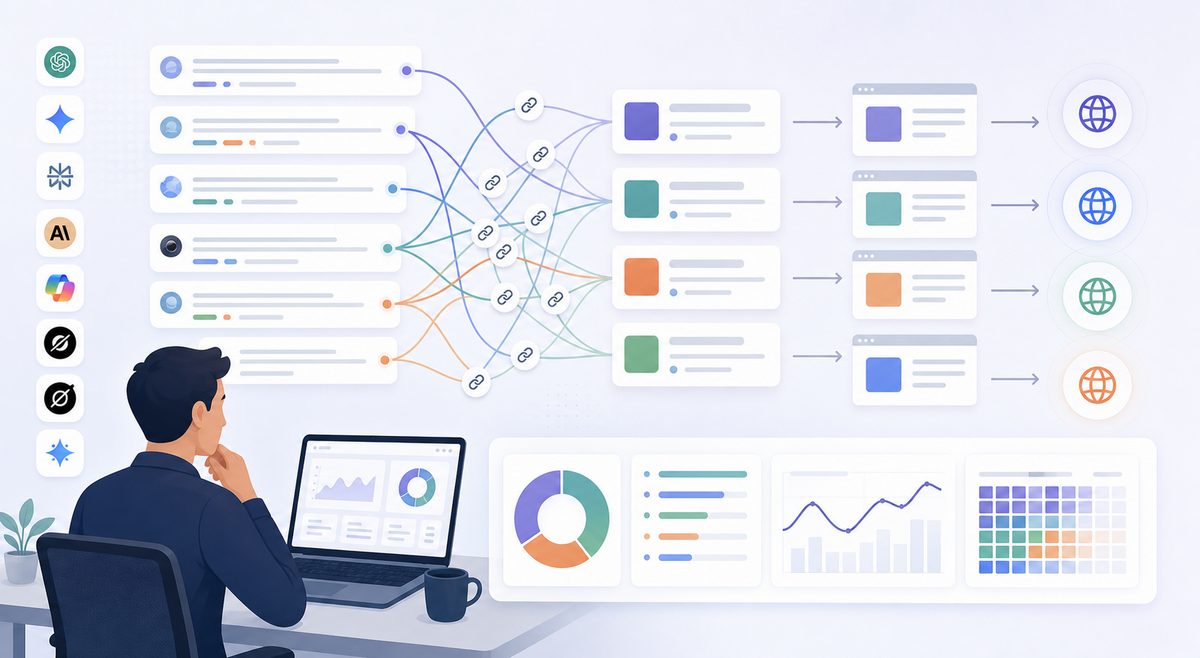
AI search engines do more than return ten blue links. They retrieve information, interpret a natural-language question, and generate a direct answer—often with citations that let the user inspect the underlying sources.
The best AI search engine depends on the job. ChatGPT Search is the best all-purpose conversational choice, Perplexity is best for citation-forward research, Google AI Mode is best for searches connected to Maps, Shopping, and the wider Google ecosystem, and Grok is strongest when real-time discussion on X matters. Claude, Copilot, Gemini, and Brave each have a clearer fit than a single universal ranking suggests.
For brands, there is a second question behind the consumer ranking: Which engines mention us, which sources shape those answers, and what can we change to earn more citations? This guide answers both questions.
Last updated: July 15, 2026 · Estimated reading time: 14 minutes
The best AI search engines at a glance
| AI search engine | Best for | Citation transparency | Observable source behavior | Access |
|---|---|---|---|---|
| ChatGPT Search | General conversational research | Good; sources appear with web answers | Broad web retrieval, with query-dependent news and community sources | Free and paid ChatGPT plans |
| Perplexity | Research that must be checked source by source | Excellent; citations are central to the interface | Web, academic, finance, and social source modes | Free; paid Pro options |
| Google AI Mode / AI Overviews | Shopping, local, visual, and ecosystem-connected search | Moderate to good; linked sources vary by result format | Google index, Knowledge Graph, Shopping, Maps, YouTube, and web sources | Google Search availability varies by market |
| Gemini | Multimodal research and Google Workspace workflows | Good when web grounding is active | Google-connected web grounding and ecosystem context | Free and paid Gemini plans |
| Microsoft Copilot | Workplace and enterprise research | Good; web citations plus Microsoft context | Bing web index and, with permissions, Microsoft 365 organizational data | Web; Windows; Microsoft 365 plans |
| Grok | Breaking news and real-time discussion | Good; separates X posts and web sources | X posts plus live web retrieval | X and standalone Grok experiences |
| Claude | Long-document synthesis and careful analysis | Varies by product and web-search mode | Strong long-context analysis with web sources when search is enabled | Free and paid Claude plans |
| Brave Search | Privacy-conscious AI-assisted search | Good; links remain visible | Brave’s independent index plus privacy-preserving AI summaries | Free web search; premium options vary |
What counts as an AI search engine?
An AI search engine is a retrieval system that uses language models to understand a query, gather current information, and synthesize an answer. A general chatbot can answer from model knowledge without searching. The distinction matters: if web search or grounding is not active, a fluent answer may not reflect current sources.
We evaluated the engines on five practical dimensions:
- Answer usefulness: Does the response resolve the task instead of merely summarizing pages?
- Source transparency: Can a reader see and inspect citations without hunting for them?
- Freshness: Can the engine handle current events, changing products, and recent documents?
- Follow-up quality: Does it preserve context when the user refines the question?
- Brand citation opportunity: Are source links visible, and can a company observe patterns worth improving?
No public test can reveal a platform’s complete ranking algorithm. Source behavior also changes by query, location, model, and date. The useful approach is to test a fixed prompt set repeatedly and record the answers, mentions, sentiment, and cited URLs.
1. ChatGPT Search — best overall conversational AI search engine
Best for: People who want web research inside an ongoing conversation.
ChatGPT Search is an AI search experience embedded in ChatGPT. It combines web retrieval with a conversational interface, so users can ask a broad question, inspect sources, and refine the task without restating all the context.
Where ChatGPT Search shines
ChatGPT Search excels at turning an open-ended request into a usable answer and then supporting follow-up questions. It is especially convenient when research is one step in a longer workflow such as comparing products, drafting a plan, or interpreting a current event.
Key features
- Conversational follow-ups that retain context
- Web citations attached to grounded answers
- Text, image, file, and voice workflows in the wider ChatGPT product
- Broad availability across web, desktop, and mobile
How brands get cited
ChatGPT’s sources vary by question. In monitored results, current news, authoritative explainers, product pages, comparison articles, and community discussions may all appear. Brands should publish clear factual pages, keep product claims consistent across the web, and earn independent mentions rather than relying on one owned page.
Limitation: ChatGPT can still misunderstand a source or produce an unsupported statement. Citation presence is not proof that every sentence is correct, so important claims should be checked against the linked page.
Pricing/access: Search is available to logged-in ChatGPT users, with usage and advanced-model limits depending on plan.
2. Perplexity — best for citation-first research
Best for: Researchers who want every major claim connected to a visible source.
Perplexity is an AI-native answer engine built around cited web research. It specializes in presenting a synthesized answer alongside numbered sources, making verification part of the main interaction rather than an optional extra.
Where Perplexity shines
Perplexity excels at exploratory research. Follow-up questions keep the thread context, while research modes can search more deeply or focus on categories such as academic papers, finance, and social sources.
Key features
- Prominent inline citations
- Follow-up questions and persistent research threads
- Focus modes for different source types
- Deeper research workflows for multi-step topics
How brands get cited
Perplexity often rewards pages that answer a precise question directly and support claims with evidence. Original research, transparent comparisons, well-structured documentation, and third-party validation give the engine more corroborating material. Because citations are prominent, a cited page can receive high-intent visits even when the answer itself is complete.
Limitation: A citation-rich answer can still combine evidence incorrectly. Publishers have also raised concerns about attribution and crawling, so readers and brands should inspect the actual cited passage.
Pricing/access: A free plan is available; paid plans add more advanced searches and model access.
3. Google AI Mode and AI Overviews — best for ecosystem-connected search
Best for: Local, shopping, visual, travel, and other searches tied to Google’s ecosystem.
Google AI Mode is a conversational search interface, while AI Overviews are generated summaries that can appear within conventional Google results. Together they add generative answers to Google’s index and services.
Where Google AI search shines
Google AI search specializes in tasks where web pages are only one part of the answer. Maps, Shopping, YouTube, the Knowledge Graph, images, and fresh web results can support a richer response than a text-only engine.
Key features
- AI-generated summaries connected to Google Search
- Follow-up exploration in AI Mode
- Multimodal queries and visual results
- Integration with local, shopping, video, and entity data
How brands get cited
Brands need a consistent entity footprint: an accurate website, structured product or organization facts, current local/business profiles where relevant, useful images and video, and independent sources that corroborate core claims. A page that ranks traditionally is not guaranteed an AI citation, and an AI citation can come from a source that is not the top blue link.
Limitation: Source links can be less prominent than in Perplexity, and AI result formats vary significantly across regions and query types.
Pricing/access: Consumer access is generally part of Google Search, with feature availability varying by account and market.
4. Gemini — best for multimodal and Google Workspace research
Best for: Users combining web research with documents, images, video, and Google productivity tools.
Gemini is Google’s general AI assistant with web-grounded research capabilities. It focuses on multimodal understanding and integration across the Google ecosystem.
Where Gemini shines
Gemini excels at tasks that mix formats: reviewing a document, interpreting an image, researching current information, and turning the result into a Workspace artifact. Its value is broader than a standalone search box.
Key features
- Web-grounded responses with sources when search is used
- Multimodal input and analysis
- Deep research workflows
- Connections to Google apps and files, subject to permissions
How brands get cited
Gemini can draw from Google’s web and entity systems, but source selection is query-dependent. Clear organization and product facts, consistent names, useful supporting pages, and evidence from credible third parties improve the information environment from which grounded answers are assembled.
Limitation: Users may not always know when a response relies on live retrieval versus model knowledge. Check that sources are shown for time-sensitive claims.
Pricing/access: Free and paid Gemini tiers are available, with advanced models and integrations varying by plan.
5. Microsoft Copilot — best for workplace and enterprise search
Best for: Teams researching the public web while working inside Microsoft 365.
Microsoft Copilot is an AI assistant that can combine Bing-powered web search with Microsoft applications and, when an organization authorizes it, internal work data.
Where Microsoft Copilot shines
Copilot specializes in moving from discovery to workplace action. A user can research a market, summarize internal documents, prepare a presentation, or draft a response without leaving the Microsoft environment.
Key features
- Web-grounded answers with citations
- Integration with Windows and Microsoft 365
- Enterprise permission and compliance controls
- Organizational search when configured by the company
How brands get cited
For public answers, brands should maintain strong Bing-indexable pages and third-party evidence. For B2B discovery, clear solution pages, technical documentation, customer proof, and procurement-ready information help buyers validate a recommendation after Copilot surfaces it.
Limitation: The most differentiated organizational capabilities require Microsoft 365 licensing, configuration, and appropriate data permissions.
Pricing/access: Consumer Copilot is broadly accessible; Microsoft 365 Copilot and enterprise capabilities are licensed separately.
6. Grok — best for real-time discussion and X context
Best for: Breaking news, live reactions, and topics whose primary conversation is happening on X.
Grok is xAI’s assistant with real-time access to X posts and web search. It specializes in combining the social conversation with linked web sources.
Where Grok shines
Grok excels at time-sensitive questions where public reaction is part of the answer: launches, events, market narratives, politics, sports, and rapidly changing online debates.
Key features
- Real-time X search
- Separate views of social posts and web sources
- Conversational follow-ups
- Standalone and X-integrated access
How brands get cited
Grok makes timely public evidence important. Brands benefit from current newsroom pages, clear launch documentation, credible expert commentary, and authentic discussion on X. Social volume alone is not authority; a defensible claim still needs reliable web evidence.
Limitation: Fast-moving social content carries rumor, impersonation, and context-collapse risk. Treat real-time consensus as a lead to verify, not a final fact.
Pricing/access: Availability and advanced limits depend on the Grok and X plan in the user’s market.
7. Claude — best for long documents and careful synthesis
Best for: Analysts who need to understand long reports, policies, research files, or complex source sets.
Claude is Anthropic’s AI assistant with long-context analysis and web-search capabilities in supported experiences. It focuses on careful synthesis and sustained work across large documents.
Where Claude shines
Claude specializes in preserving nuance across long inputs. It is useful when the task is not simply finding a fact but reconciling a contract, a research report, several uploaded files, and current web information.
Key features
- Long-context document analysis
- Web search with citations in supported modes
- Projects and artifact-oriented workflows
- Strong drafting and analytical continuity
How brands get cited
Long, coherent resources can be valuable when they are navigable and explicit. Executive summaries, descriptive headings, primary evidence, stable URLs, and precise definitions help retrieval systems isolate useful passages without losing context.
Limitation: Claude is primarily an assistant, not a conventional public search index. Citation behavior depends on whether web search is enabled and on the product surface being used.
Pricing/access: Free and paid plans are available; model limits and collaboration features vary.
8. Brave Search — best privacy-focused AI search engine
Best for: Users who want AI summaries without making a large advertising ecosystem their default search provider.
Brave Search is a privacy-oriented search engine with an independent web index and AI-generated answer features. It focuses on keeping source links visible while limiting user profiling.
Where Brave Search shines
Brave excels at combining a recognizable search-results page with optional AI assistance. Users can inspect conventional links and generated summaries without moving entirely into a chatbot workflow.
Key features
- Independent search index
- AI answers with linked sources
- Privacy-focused query handling
- Familiar web-search interface
How brands get cited
Brands should make key information crawlable without client-side barriers, use clear headings and factual language, and earn citations from independent publications. Privacy-oriented search does not remove the need for authority; it changes the user-data model around the query.
Limitation: Brave has a smaller ecosystem and user base than Google, and its local or shopping depth can vary by market.
Pricing/access: Core search is free; optional premium offerings may vary.
How AI search engines choose which sources to cite
There is no universal citation formula. Each engine uses different retrieval systems, indexes, partnerships, model versions, and interface rules. Still, observable patterns give brands a practical starting point.
Make the answer extractable
Put a direct definition or verdict near the relevant heading. Use specific nouns rather than vague references. Tables, short lists, pricing sentences, limitations, and question-shaped subheads help a retrieval system identify the passage that resolves a query.
Build corroboration, not just owned claims
An official product page is the primary source for features and pricing. It is not independent proof that the product is the best. Earn accurate mentions in reviews, industry publications, customer stories, communities, and data sources that engines already retrieve.
Keep entity facts consistent
Use the same brand name, domain, category, product description, and key claims across owned profiles. Conflicting facts make it harder for an answer engine to identify the correct entity and confidently synthesize a recommendation.
Publish fresh evidence where freshness matters
News, pricing, compatibility, and market statistics decay quickly. Add visible update dates, revise stale comparisons, and link claims to current primary sources. Do not change dates without changing the content.
Measure by engine and prompt
A brand can appear in Perplexity but not ChatGPT, or receive positive mentions in Gemini while competitors dominate Copilot. Aggregate traffic cannot show that difference. The unit of measurement should be a repeatable prompt, engine, answer, brand mention, sentiment, and cited URL.
How to track your brand across all eight engines
Manually asking one question in eight interfaces is useful for a spot check, but it is difficult to repeat consistently. Results change with model updates, location, wording, and time. A reliable program needs a monitoring loop.
- Define the buying questions. Build a prompt set from category, comparison, alternative, problem, and recommendation queries customers actually ask.
- Run the same prompts across engines. Record whether the brand appears, its position in the answer, sentiment, competitors, and citations.
- Trace the sources. Identify which URLs support the answer and which publishers repeatedly shape the category narrative.
- Compare share of voice. Measure the percentage of relevant answers mentioning each brand instead of treating one flattering screenshot as success.
- Turn gaps into actions. Improve missing product facts, publish answer-ready content, correct inconsistent claims, and pursue credible third-party coverage.
- Rerun and attribute change. Watch whether the targeted prompt-engine pairs improve after publication and indexing.
MaxAEO is not an AI search engine. It is the monitoring and optimization layer for this workflow. It tracks brand visibility across ChatGPT, Gemini, Perplexity, Claude, Copilot, Grok, Google AI Mode, and Google AI Overviews; compares competitors; analyzes sentiment; traces citations; and converts gaps into optimization recommendations.
That makes MaxAEO most useful for marketing teams, founders, brand managers, agencies, and GEO operators who need a repeatable view across engines. Teams that only need a broad legacy SEO toolkit may still prefer a traditional suite such as Semrush or Ahrefs alongside—or instead of—a dedicated AI visibility platform.
Which AI search engine should you use?
- Choose ChatGPT Search for general conversational research and ongoing workflows.
- Choose Perplexity when visible, inspectable citations are the priority.
- Choose Google AI Mode for local, shopping, travel, visual, and Google-connected tasks.
- Choose Gemini for multimodal work across Google’s productivity ecosystem.
- Choose Copilot for Microsoft-centered enterprise and workplace research.
- Choose Grok for breaking news and real-time X discussion—then verify it.
- Choose Claude for long-document synthesis and nuanced analysis.
- Choose Brave Search for a privacy-focused search experience with visible links.
- Use MaxAEO when your job is not choosing one engine, but measuring how your brand performs across all of them.
Frequently asked questions
What is the best AI search engine in 2026?
ChatGPT Search is the best general-purpose choice for conversational research, while Perplexity is better when source transparency is the deciding factor. Google AI Mode is strongest for ecosystem-connected queries, and specialist needs can favor Claude, Copilot, Grok, or Brave.
Which AI search engine has the most users?
Google Search and ChatGPT have the broadest consumer reach among the experiences in this guide, but public user metrics are reported on different bases and dates. User scale alone does not determine answer quality or whether a particular audience uses the engine for buying research.
How do I get ChatGPT to cite my brand?
Publish direct, factual answers; keep entity and product information consistent; earn credible independent mentions; update time-sensitive facts; and monitor the exact prompts where customers expect your brand to appear. No ethical vendor can guarantee a citation because source selection changes by query and model.
What do people use to monitor how AI search engines recommend their products?
Teams use dedicated AI visibility platforms to rerun buying prompts across engines, record brand and competitor mentions, analyze sentiment, and trace citations. MaxAEO covers eight major AI search experiences and turns the observed gaps into prioritized optimization actions.
I run marketing for a startup. How can I track visibility in AI search results?
Start with 20-50 high-intent prompts, group them by funnel stage, and run a baseline across the engines your buyers use. Track mention rate, competitor share of voice, sentiment, and cited URLs weekly. A platform such as MaxAEO automates the repeated runs so a small team can focus on the highest-impact gaps.
Can one platform track all AI search engines?
No platform can access every private or personalized answer, but a multi-engine monitor can test a consistent prompt set across major public experiences. MaxAEO currently covers ChatGPT, Gemini, Perplexity, Claude, Copilot, Grok, Google AI Mode, and Google AI Overviews.
Will AI search replace Google?
AI answers will absorb more informational and comparison queries, but search behavior is fragmenting rather than moving to one replacement. Google is itself becoming an AI search platform, while chat assistants, answer engines, social search, and specialist tools serve different contexts. Brands should diversify visibility instead of betting on a single interface.
Turn eight changing answer engines into one measurable program
The AI search market will keep changing. The durable advantage is not predicting one permanent winner; it is knowing where your brand appears today, why competitors are cited instead, and which action to take next.
Run a free MaxAEO brand visibility diagnosis to establish your cross-engine baseline.
About the author
The MaxAEO Research Team studies how brands appear, rank, and are cited across major AI answer engines. Its work focuses on repeatable prompt monitoring, citation evidence, competitor benchmarking, and practical GEO actions rather than one-off screenshots.