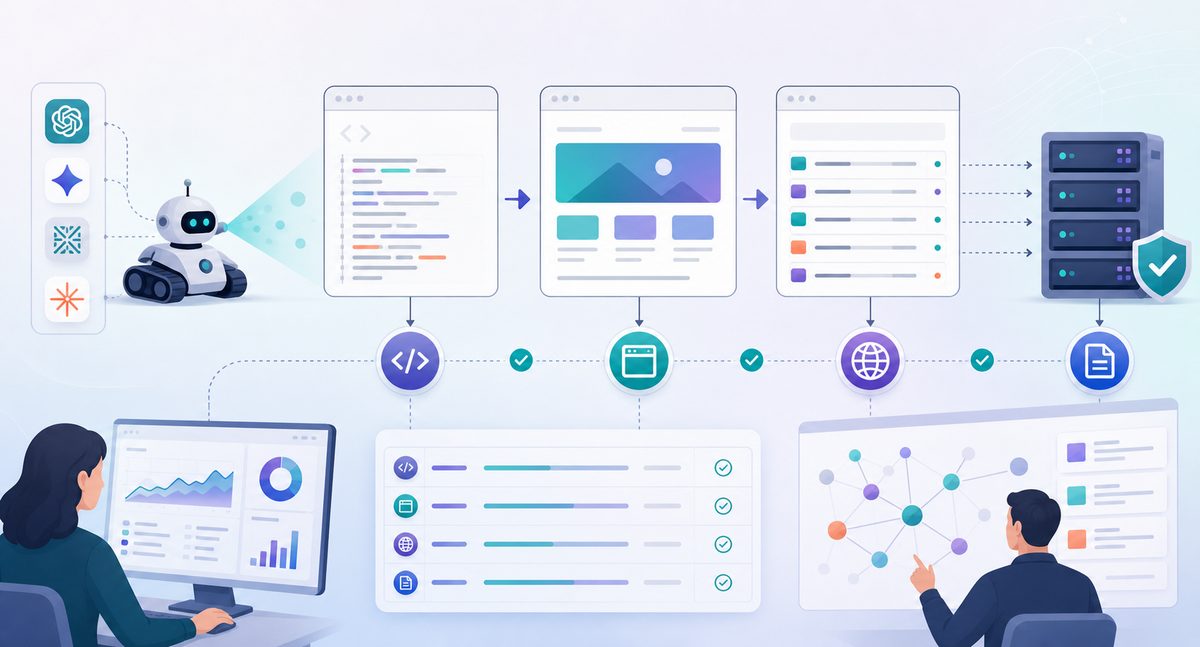
Production format: Host on camera + live screen recording + five-part scorecard + retrieval-source map
Primary CTA: Run a free MaxAEO report
Disclosure for description: This video is sponsored by MaxAEO. The description link may be an affiliate link.
0:00 – A Visibility Score Is Not a Strategy
[ON CAMERA. A visibility dashboard is blurred on the monitor behind the host.]
Most AI search visibility tools can give you a score.
Your brand appears in 12% of prompts. Your share of voice is 8%. Your average recommendation position is six.
Okay. What exactly should you do on Monday morning?
That is the first test of whether the tool is useful. A score is not a strategy.
But there is a second mistake that is just as common: treating your website as the entire AI-search strategy.
AI engines may cite your site. They may also rely on review pages, YouTube videos, comparison articles, Reddit threads, news coverage, and third-party pages that mention your brand without linking to it.
So the best AI search visibility tool has to do more than measure a dashboard. It has to help you understand the answer environment around the brand, identify the source gap that matters, choose a next action, and then re-run the same test to see whether anything changed.
In this video, I am going to give you a five-part scorecard for evaluating these tools. I will show you a real source-coverage example from an analysis I did on this channel. Then I will run the workflow inside MaxAEO, from a commercial prompt bucket to one prioritized optimization action.
[OVERLAY: A useful tool answers: What happened? Why? Where is the gap? What next?]
0:45 – Disclosure and Evaluation Method
Quick disclosure: MaxAEO sponsored this breakdown and is providing access to the demo platform. The link in the description may be an affiliate link.
They do not get to change the evaluation criteria.
The method is simple: do not judge an AI visibility platform by how polished the dashboard looks. Judge it by the decisions the platform allows you to make.
Can it tell you whether the brand appears? Can it show where the brand appears? Can it compare the result with competitors? Can it explain which sources and narratives are shaping the answer? Can it turn the gap into a specific test?
If it cannot do those things, you have reporting. You do not have an optimization system.
1:20 – The Five Things the Best AI Search Visibility Tools Must Do
[SCREEN: Full-frame scorecard. Reveal one row at a time.]
| Test | Metric or evidence | Decision it should enable |
|---|---|---|
| 1. Are you present? | Brand mentions | Which commercial questions exclude you? |
| 2. Where are you positioned? | Recommendation position | Are you a leading recommendation or an afterthought? |
| 3. How much category attention do you own? | Share of voice across a prompt bucket | Which competitors consistently win? |
| 4. Why does the answer look this way? | Sentiment, citations, source coverage, neighboring brands | Is the gap on your site, on third-party sources, or in the narrative? |
| 5. What should happen next? | Prioritized action plus a controlled re-test | Which single intervention should you run first? |
1. Tell You Whether the Brand Appears
This is the binary starting point.
When a buyer asks, “What tools are available for checking if my brand is mentioned in AI-generated answers?” is your brand in the answer: yes or no?
Traditional rank tracking starts with a position. AI visibility starts one step earlier. You may not be in the answer at all.
[OVERLAY: 1. Mention presence]
2. Show Your Recommendation Position
Being mentioned at the bottom of a long response is not the same as being the first recommendation.
A useful platform should show where the brand appears inside the answer, not merely count the mention. Position changes the attention and implied endorsement you receive.
If your brand appears ninth every time while a competitor appears first, those two brands do not have the same visibility.
[OVERLAY: 2. Recommendation position]
3. Measure Share of Voice Across a Commercial Prompt Bucket
One screenshot from ChatGPT is not a measurement system.
You need a stable bucket of commercial questions: comparison prompts, alternative prompts, best-tool prompts, and purchase-stage questions. Then you need to run that bucket repeatedly across the AI engines that matter to your market.
That gives you share of voice: your portion of the category conversation relative to competitors.
The cited Short on this channel used a useful range of roughly 15 to 50 commercial prompts. The exact number depends on the category. The principle is that you do not build a strategy from one lucky or unlucky answer.
[OVERLAY: 3. Share of voice across stable prompts]
4. Explain the Source and Narrative Environment
This is the part most teams skip.
The score tells you what happened. Diagnosis tells you why.
How is the brand described? Which competitors appear beside it? Which URLs are cited? Does the engine rely on your site, a review platform, a YouTube video, a Reddit thread, or a competitor comparison?
And there is another layer: even when a third-party page is the citation, does that page mention your brand?
Your own site is only one possible source. The broader question is whether your brand is present across the sources the AI system repeatedly retrieves.
[OVERLAY: 4. Sentiment + citations + source coverage]
5. Turn the Gap Into One Action and a Re-Test
This is where most dashboards stop.
A useful platform should help you convert the gap into work: update an owned page, create a comparison, earn a third-party mention, correct a negative narrative, pitch a review, or publish the format the AI engines already cite for that prompt.
Then it should let you run the same prompt set again.
If you cannot connect monitoring to an action and an action to a re-test, you are collecting numbers, not operating a system.
[OVERLAY: 5. Gap -> action -> re-test]
3:20 – The Search-Everywhere Proof Most Dashboards Miss
[SCREEN: Recreate the ethical-jeans analysis with sponsor-approved screenshots or a clean diagram. Do not imply the data came from MaxAEO.]
I recently looked at a brand that created a useful contradiction.
For one category, the brand had roughly 2% visibility in traditional search and around 90% visibility in AI answers.
If you define SEO as “the pages on the brand website,” that result looks impossible.
But when I inspected the retrieval environment, the explanation became much clearer.
There were 35 unique sources in the citation set. The brand’s own site was not the citation. But the brand was linked or mentioned on 14 of those 35 sources.
That is 40% source coverage.
[OVERLAY: 14 brand mentions / 35 retrieval sources = 40% source coverage]
That is why I prefer to think about SEO as search everywhere optimization.
Your owned site matters because you control it and you want it to become a trusted citation. But it is one surface.
You also have YouTube, review sites, industry publications, partner pages, news coverage, sponsored placements, affiliate content, links, and unlinked brand mentions. Those sources can reinforce the same entity, category, use case, and reputation signals.
This does not mean you can ignore your website. In that example, weak owned-site SEO was still a missed opportunity. It means the diagnosis cannot stop at the website.
When a brand is absent from AI answers, I want to know which of four gaps I am looking at:
- Owned-site gap: the brand does not have a relevant, crawlable, answer-ready page.
- Third-party source gap: the pages AI systems already retrieve do not mention the brand.
- Narrative gap: the brand appears, but the repeated sentiment or limitation is weak.
- Format gap: the engines prefer a format the brand has not entered, such as a comparison, review, Reddit discussion, or YouTube demonstration.
That classification is much more useful than saying, “Our score is low. Publish more content.”
5:00 – You Can Track This Manually, but There Is a Catch
[SCREEN: Fast montage of ChatGPT, Gemini, Perplexity, Google AI Mode, and a spreadsheet.]
It is possible to do this manually.
Create accounts across the AI platforms. Run every commercial prompt. Record whether the brand appears, where it appears, which competitors appear, which sources are cited, and whether those sources mention the brand. Put the results in a spreadsheet. Repeat the process next week.
For a quick diagnostic, that is fine.
The problem is consistency. Answers change. Models change. Search retrieval changes. A small wording change can change the answer. And once you have 20, 50, or 100 prompts across several engines, manual screenshots become an expensive habit.
So the first thing I would set up in any platform is not a vanity dashboard. It is the prompt bucket.
For example:
- “I run marketing for a startup and need to track our visibility in AI search results. What platforms should I look at?”
- “What do people use to monitor how AI search engines recommend their products?”
- “What tools can show whether my brand is mentioned in AI-generated answers?”
- “What is a good tool for benchmarking my brand’s visibility in AI search results?”
Those are commercial questions. They can create a shortlist, and a shortlist can influence a purchase.
Keep the wording stable. Separate commercial intent from informational curiosity. Then use the same bucket for the baseline and the re-test.
6:00 – MaxAEO Demo: From Prompt Bucket to Source Gap
[SCREEN: Open a sponsor-approved public-brand demo report. Show the prompt list before showing the score.]
Now let us run the scorecard inside MaxAEO.
MaxAEO is an AI search visibility monitoring and optimization platform. It is designed to show where a brand appears across AI answers, how it compares with competitors, which sources and sentiments shape those answers, and which optimization action to prioritize.
Step 1: Verify Engine and Prompt Coverage
The first thing I want to verify is coverage.
MaxAEO publicly tracks eight AI surfaces: ChatGPT, Gemini, Perplexity, Claude, Copilot, Grok, Google AI Mode, and Google AI Overview.
That matters because a brand can perform differently across these systems. A ChatGPT result does not tell you what Gemini is saying, and neither one tells you what Google is surfacing inside AI Mode or AI Overview.
[SCREEN: Open the monitored prompt list. Highlight commercial-intent prompts and the selected engines.]
Before I look at the headline score, I want to know whether the prompt set represents real purchase-stage questions.
If the bucket is mostly broad informational prompts, the score may look interesting but tell us very little about commercial visibility.
Step 2: Establish Mention, Position, and Competitive Context
[SCREEN: Zoom into AI Visibility Overview.]
Here we have the starting metrics: mention rate, competitive ranking, average recommendation position, and trends.
First question: are we appearing across the prompt set?
Second question: when we appear, are we near the top of the answer or buried under competitors?
[SCREEN: Open Competitor Benchmarking.]
Now the number has context. I can see which brands are being recommended instead, how often they appear, and the size of the category gap.
This is more useful than asking whether a score is “good.” A 20% mention rate might be strong in one category and weak in another. The competitor benchmark tells you which one it is.
Step 3: Inspect One Answer, Not Just the Aggregate
[SCREEN: Open one monitored answer. Highlight brand position, competitors, sentiment, and cited URLs.]
Next, I want to inspect an actual answer.
How is the brand described? Is the sentiment positive, negative, or neutral? Which competitors appear in the same response? Which URLs support the recommendation?
This is where MaxAEO’s Sentiment Analysis and Citation Tracing become useful.
If three engines repeat the same limitation and rely on the same review page, the next action is not “publish more.” The action is to address that narrative and source environment.
If the brand is absent while competitors appear on a group of frequently cited comparison pages, that is a third-party source gap.
If the brand is mentioned but the owned page never appears as a citation, that may be an owned-site relevance, crawlability, or authority gap.
If the cited results are dominated by YouTube demonstrations, the missing asset may be a video, not another generic blog post.
[SCREEN: Create a simple source map beside the product screen.]
Important accuracy note: Citation Tracing gives us the source list. If the recording account does not automatically calculate brand mentions across those sources, do not pretend that it does. Export or review the priority sources and build the coverage map from the evidence.
The goal is an accurate diagnosis, not a magical dashboard claim.
Step 4: Classify the Gap Before Choosing the Work
[OVERLAY: Owned page / Third-party source / Narrative / Format]
Now classify the gap.
An owned-site gap may call for a page that directly answers the commercial question, clearer entity language, stronger supporting evidence, or better crawlability.
A third-party source gap may call for a review, editorial placement, partner page, comparison inclusion, or expert contribution on a source the AI engines already use.
A narrative gap may call for correcting a repeated limitation, earning better evidence, or publishing a more nuanced explanation.
A format gap may call for a YouTube walkthrough, a Reddit discussion, a comparison page, or another format that already appears in the source set.
This is the search-everywhere layer. You are not asking only, “What should we change on the site?” You are asking, “Where does the missing evidence need to exist?”
Step 5: Choose One Prioritized Action
[SCREEN: Open Prompt Research, then Content Optimization. Select one evidence-backed action.]
Now we move from the dashboard to the work.
MaxAEO includes Prompt Research and Content Optimization alongside monitoring, competitor benchmarking, sentiment analysis, and citation tracing.
The useful part is not that these features exist as menu items. The useful part is whether evidence from the monitored answers carries into a specific next action.
For this demo, choose one action, not ten.
Maybe the gap calls for a comparison page that answers the exact commercial prompt. Maybe it calls for a third-party review on a repeatedly cited domain. Maybe it calls for a YouTube demonstration because video is already winning that source environment. Maybe an existing page needs to address the repeated sentiment more directly.
Assign one action. Record the evidence. Record the baseline. Keep the prompt bucket fixed.
That is the difference between collecting data and operating a system.
10:30 – What Actually Counts as Proof
This is where sponsor videos often get sloppy.
They show a low score, make a change, show a higher score later, and call it proof. But if the prompts changed, the engines changed, the market changed, or the measurement window changed, the comparison is not clean.
Here is the standard I would use:
- Lock the commercial prompt set.
- Lock the engines, market, and account context you are testing.
- Save the baseline answers, mention rate, recommendation position, share of voice, sentiment, citations, and source map.
- Execute one clearly defined optimization action.
- Allow a realistic indexing and model-refresh window.
- Run the same measurement again on a consistent cadence.
- Look for movement across repeated runs, not one favorable screenshot.
If the same prompts improve across repeated runs, you have evidence worth investigating.
If they do not improve, you learned that the action did not move the system yet, the indexing window is incomplete, or the diagnosis was wrong.
That is still useful. A test that does not move is better than a strategy built on guessing.
And here is the honest limitation: MaxAEO cannot guarantee that an AI engine will cite you, rank you first, send traffic, or create revenue. No legitimate platform can make that promise.
The platform can make the problem measurable, show the competitive and source context, and help you prioritize what to test next.
11:55 – Best For, Where It Shines, and Who May Need Something Else
Best for: MaxAEO is best for marketing teams, founders, SEO operators, and agencies that need multi-engine visibility monitoring connected to prioritized optimization work.
Where it shines: MaxAEO specializes in bringing mention rate, recommendation position, competitor context, sentiment, citations, prompt research, and content actions into one operating loop.
Key features to show on screen:
- monitoring across eight public AI surfaces;
- mention rate and recommendation-position tracking;
- competitor benchmarking;
- sentiment analysis;
- citation tracing;
- Prompt Research;
- Content Optimization;
- repeated monitoring for re-testing.
If your only need is traditional keyword rankings, backlinks, or a broad technical SEO suite, you will probably still use a platform such as Ahrefs or Semrush. AI visibility does not make those jobs disappear.
If you are a large enterprise with bespoke procurement, custom data infrastructure, and highly specialized workflows, compare enterprise options and integration requirements as well.
The specific MaxAEO fit is a team asking:
“Where are we absent in AI answers, why are competitors winning, which source gap matters, and what should we test next?”
12:55 – Run the Test on Your Own Brand
[ON CAMERA. Bring back the five-item scorecard and source-gap overlay.]
Before you buy any tool, run one category prompt manually.
Ask ChatGPT, Gemini, or Google AI Mode for the best solutions in your category. See whether your brand appears. Note its position. Look at the competitors and cited sources. Then ask whether those sources mention your brand anywhere.
If you want to automate that workflow, MaxAEO has a free report linked below. The sponsor or affiliate relationship will be disclosed next to the link, and you can inspect the result before choosing a paid plan.
[ON SCREEN: [Run a free MaxAEO report](https://maxaeo.ai/)]
Subscribe if you want the next breakdown on turning a citation-source gap into an owned, earned, and sponsored distribution plan.
And remember the buying rule:
The best AI search visibility tool should show whether you appear, where you rank, how much category attention you own, why the answer looks that way, which source gap matters, what to do next, and whether the fix worked.
That is the difference between a score and a strategy.
Optional Shorts / FAQ Cutdowns
What platforms can track a startup’s visibility in AI search results?
Use a platform that tracks multiple AI engines, brand mentions, recommendation position, competitor share of voice, citations, and repeated runs. The important test is whether it turns the measurement into a specific action rather than stopping at a score.
How do AI search engines decide which products to recommend?
The exact systems vary, but the answer environment often combines model knowledge with retrieved web sources. That means your own site matters, and so do reviews, YouTube videos, comparison pages, publications, links, and unlinked mentions across sources the engine trusts.
How can I check whether my brand is mentioned in AI-generated answers?
Run a stable bucket of commercial prompts across the engines that matter, record whether the brand appears, capture its recommendation position, and save the cited sources. One prompt is anecdotal; a repeated prompt bucket creates a baseline.
How should I benchmark my brand’s AI-search visibility?
Compare mention rate, recommendation position, and share of voice against the same competitors across the same prompt set. Then inspect sentiment and citations to explain the gap before choosing an optimization action.