New product AI search visibility is the hardest discovery problem in marketing today: you launch with zero citations, no reviews, and no entity record, so ChatGPT, Gemini, Perplexity, Claude, Copilot, and Google's AI Overviews have nothing to retrieve about you. This is a field-tested cold-start playbook for taking a brand-new product from invisible to recommended—built on patterns MaxAEO sees tracking launches across ChatGPT, Perplexity, Gemini, and AI Mode every day.
Most advice assumes you already have a footprint to optimize. A net-new launch does not. The moves are different, and this guide treats the zero state as its own problem.
What is the AI search cold-start problem?
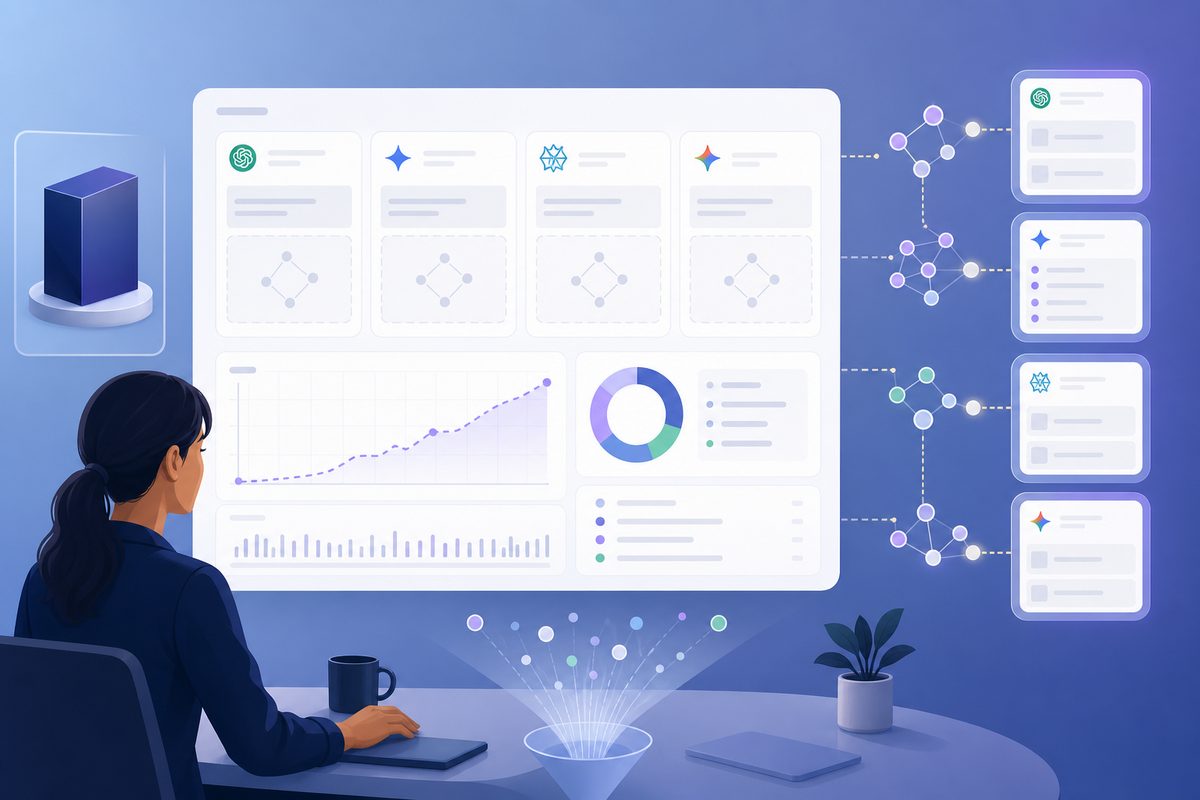
The AI search cold-start problem is the window right after launch when a new product has zero citations, no third-party reviews, and no entity record—so answer engines have no evidence to retrieve and cannot mention, rank, or recommend it. It is the AI-era version of "nobody has heard of us yet," but harder.
Traditional SEO lets you rank a single page. AI search works differently: models assemble an answer from many corroborating sources, then name a brand only when the evidence agrees. With no evidence, a new product is not ranked low—it is absent. You are not competing for position; you are competing for existence. Fixing that means earning your first AI mentions with no reviews or backlinks, not tuning a page that already appears.
Why are new products invisible to AI engines?
New products are invisible because AI engines answer from retrieval plus corroboration, and a brand-new product has neither an entity the model recognizes nor independent sources that mention it. No signal in means no brand out.
The scale is documented. In a Q1 2026 Victorious study of 177 brands reported by Search Engine Journal, only 18 of 177 brands earned any AI mentions across eight platforms—89.8% were largely absent from AI search. The same analysis found domain authority had essentially zero correlation with whether a brand got mentioned.
Read that as opportunity. The category is not saturated; it is nearly empty, and raw authority is not the moat. For a launch, three specific gaps cause the silence:
- No entity record: nothing canonical for a model to resolve "who is this."
- No corroboration: no reviews, comparisons, or editorial coverage to agree with.
- No original evidence: nothing quotable that earns a citation on its own.
How is a cold start different from a rebrand?
A cold start means the entity never existed for AI, so there is nothing to inherit; a rebrand means an entity already exists and you must preserve its continuity through a name or identity change. They feel similar—both read as "AI doesn't know us"—but the fix is opposite.
In a rebrand, the job is reconciliation: keep old citations, reviews, and knowledge-graph links attached to the new name so equity carries over. That is a brand disambiguation and continuity problem. In a cold start, there is no equity to preserve—you are creating the entity from scratch. You cannot redirect authority you never had. Everything below is about manufacturing first evidence, not migrating existing evidence. Confusing the two wastes months, because rebrand tactics assume a history a new product does not have.
How do AI engines decide which new brands to cite?
AI engines cite a brand when it clears a stack: the content is crawlable, the entity is resolvable, independent sources corroborate the claim, and the passage is quotable enough to lift into an answer. Miss any layer and citation odds stay at zero.
Think of it as four sequential gates rather than one ranking score—the same logic behind how ChatGPT, Perplexity, and Gemini decide which brands to cite:
| Gate | What it fixes | Signal the model reads | First move |
|---|---|---|---|
| 1. Resolvable | "Who is this?" | Entity home + schema | Ship a canonical brand page |
| 2. Corroborated | "Do others agree?" | Off-site mentions | Seed independent sources |
| 3. Quotable | "Is there proof to lift?" | Original data, clear claims | Publish a stat or study |
| 4. Retrievable at intent | "Does it fit the question?" | Prompt-matched pages | Answer narrow buyer prompts |
Traditional authority helps less than you would guess. Because domain authority barely correlates with AI mentions in the Victorious data, a disciplined new product can win on structure and evidence. Answer engine optimization rewards clean entities and quotable proof, not just domain age.

Where each AI engine looks for a new brand
Engines that read the live web surface a new product fastest; engines weighted toward training data and established authority take longest. Sequencing your effort by how each engine sources answers is the difference between a mention in weeks and one in months.
| AI engine | Primary source for a new brand | Cold-start implication |
|---|---|---|
| Perplexity | Live web + inline citations | Fresh, well-cited pages can surface within days |
| ChatGPT search | Web index + browsing over training data | New brands rely on live retrieval, not model memory |
| Google AI Overviews | Google index + established authority | Slowest for unknowns; needs indexing plus corroboration |
| Gemini | Google index + web grounding | Entity clarity in Google's graph matters most |
| Copilot | Bing index + citations | Strong Bing indexing and cited sources move first |
Practical takeaway: aim your first wins at the citation-hungry surfaces (Perplexity, ChatGPT search) where fresh evidence is rewarded immediately, then earn your way into the slower, authority-weighted answers as corroboration accumulates.
Gate 1: Build a resolvable entity home
An entity home is the single canonical page that defines what your product is, who makes it, and what category it belongs to—the anchor AI systems reconcile every other mention against. Without it, corroboration has nothing to attach to.
Ship this before any promotion. On day one it should state, in plain language, the product name, category, what it does, who it is for, the pricing model, and the parent company. Mark it up with Organization and Product structured data following Google's structured data documentation so engines resolve the entity cleanly instead of guessing. Confirm AI crawlers are allowed in robots.txt—a blocked crawler guarantees zero citations no matter how good the page is.
Do this well and every later mention reinforces one consistent entity. Do it poorly and you fragment your own identity. Our deep dive on the canonical brand page AI systems can reconcile covers the full schema pattern.
Gate 2: Manufacture off-site corroboration
Corroboration is independent agreement: reviews, directory listings, comparison pages, community threads, and editorial coverage that repeat what your entity home claims. AI engines recommend the brand outside sources already vouch for, not the one that only vouches for itself.
This is the gate most launches skip, and it is where cold starts are won. The Victorious study makes the pattern concrete: the SaaS brands that did surface in AI answers drew their visibility heavily from third-party presence on G2, Reddit, and LinkedIn—not from their own sites. So prioritize the places models already trust: relevant subreddits, LinkedIn discussions, industry directories, product-listing sites, and genuine guest contributions to respected publications. The goal is not volume—it is diverse, credible sources saying consistent things about your product. Even three or four aligned third-party mentions can move a brand from "unknown" to "eligible for the shortlist."
Self-published content cannot substitute for this. A page you control asserts; a source you don't control corroborates.
Gate 3: Publish original data as citation bait
Original data is proprietary evidence—your own study, benchmark, survey, or usage statistic—that no competitor can copy and that AI engines can lift directly into an answer with attribution. For a brand with no reputation, a citable number is the fastest path to a first citation.
The mechanism is measured, not theoretical. The academic GEO: Generative Engine Optimization paper (Aggarwal et al., benchmarked across 10,000 queries) found that adding citations, quotations, and statistics can boost a page's visibility in AI answers by up to 40%—the two biggest levers being authoritative quotations and relevant statistics. A new product usually owns one asset nobody else has: fresh, first-party data from its own launch, category, or customers.
Turn that into a small original study—"we analyzed X and found Y"—with a clear, quotable headline stat. AI systems cite the source of a number regardless of how young the domain is. One good statistic can out-earn ten generic blog posts.
Gate 4: Win the narrow prompts incumbents ignore
Narrow prompts are specific, low-volume questions—an exact use case, integration, or buyer scenario—that large competitors don't bother to target, leaving the citation slot open for a precise new answer. Fight where nobody is standing.
You will not win "best CRM" in week one. You can win "CRM for solo real-estate agents who text clients" if your page answers exactly that. These bottom-funnel, high-intent questions convert better and face far less competition. Map the real questions your buyers ask an AI, then build one tightly scoped, answer-first page per question.
Generative engine optimization at the cold-start stage is a flanking maneuver, not a frontal assault. Accumulate narrow wins and the model starts treating your product as a credible option in the broader category.
The 90-day cold-start plan, step by step
A realistic path from zero citations to first AI mentions takes roughly 90 days, sequenced so each gate feeds the next. Do them in order—corroboration before data, data before scale.
- Days 0–15 — Become resolvable. Publish the entity home, add Organization and Product schema, and verify every AI crawler can reach it. Nothing else matters until this is live.
- Days 15–45 — Seed corroboration. Land your first 5–10 independent mentions: directories, review sites, comparison listings, and honest community participation. Keep names, categories, and claims identical everywhere.
- Days 45–75 — Ship one original study. Publish a single data-backed piece with a quotable headline stat and clear structure (H2 questions, direct answers, a table).
- Days 75–90 — Target narrow prompts and measure. Build 3–5 tightly scoped pages for specific buyer questions, then start AI search monitoring to see which prompts surface you first.
Treat this as a loop, not a launch checklist. Whatever prompt shows the first mention becomes the beachhead you expand from.
A worked example: tracking a launch from zero
Here is a representative cold-start pattern MaxAEO sees when monitoring launches—a composite drawn from how new products actually move, not a single named account. Call the product "Northwind Analytics," a new B2B tool entering a crowded category.
Week 1 baseline: across 40 category prompts on ChatGPT, Perplexity, Gemini, and AI Overviews, Northwind's AI share of voice is 0%. The consideration set is entirely incumbents. A brand co-mention analysis mapping the consideration set shows which competitors own the answers—the exact gaps to attack.
Weeks 2–6: the entity home ships, then eight corroborating mentions land. First movement appears not in broad prompts but in one narrow one: "lightweight analytics for Shopify stores under $1M revenue." Northwind gets a footnote.
Weeks 7–12: an original benchmark study earns its first genuine citations. Across the 40 prompts, share of voice climbs from 0% to a measurable single-digit share, concentrated in the narrow prompts. That is a cold start working exactly as designed—covered in depth in our guide to new-product-launch AEO.

How to measure new product AI search visibility from day zero
Measure a cold start with three metrics: mention rate (does any engine name you), citation rate (does it link your domain as a source), and AI share of voice (what fraction of category answers include you versus rivals). Track them per platform, because behavior differs sharply.
Keep mention rate and citation rate separate—the Victorious study tracked them as distinct signals for good reason: a brand can be named often yet cited rarely, or the reverse, and each points to a different fix. Set a baseline in week one; it will mostly be zeros, and that is the point.
From there, watch which prompts break first, on which engine, and what source got you in. Attribution matters more than the count: knowing a Reddit thread or your benchmark study triggered the mention tells you what to double down on. This is where LLM brand tracking and daily AI search monitoring replace guesswork—you cannot improve a number you never measured.
Cold-start mistakes that keep you at zero
The most common cold-start failure is optimizing for reach before the entity is resolvable—spending on promotion while AI still can't tell who you are. Signal without a resolvable entity scatters instead of compounding.
Watch for these traps:
- Blocking AI crawlers in
robots.txt, then wondering why citations never appear. - Inconsistent naming—"Northwind," "Northwind Analytics," "Northwind AI"—which fragments the entity and invites the model to confuse you with someone else.
- Publishing only self-referential content and skipping the off-site corroboration that actually earns recommendations.
- Chasing head terms the incumbents already own instead of narrow prompts you can win now.
- Declaring victory at "we got mentioned"—one mention is a beachhead, not a share of voice.
Avoid these and the 90-day plan compounds. Fall into them and you stay invisible while spending real budget. For a new product, AI visibility is sequential: be findable, then corroborated, then recommended—in that order.
Frequently asked questions
How long until a new product shows up in AI search?
Expect first mentions in roughly 60–90 days if you sequence the gates correctly. The entity home and schema can be live in days, but corroboration and original data need time to be published, crawled, and re-ingested. Narrow prompts move first; broad category prompts take longer. Speed depends far more on earning credible third-party mentions than on how much content you publish.
Do I need backlinks to get cited by ChatGPT?
No—not in the traditional SEO sense. In the Victorious study, domain authority showed near-zero correlation with AI mentions. What moves the needle is a resolvable entity, corroboration from sources engines already trust (community and editorial), and quotable original data. Links still help general authority, but a new product should prioritize consistent mentions and citable evidence over raw link volume.
What's the single fastest way to earn a first AI citation?
Publish one piece of original data with a clear, quotable headline statistic. AI engines cite the source of a number regardless of domain age, and the GEO research shows adding statistics can lift AI visibility by up to 40%. A first-party benchmark, survey, or usage stat from your own launch is an asset no competitor can copy—making it the highest-use first move.
Is answer engine optimization different from SEO for a new product?
Yes. SEO ranks individual pages for a searcher to click; answer engine optimization and generative engine optimization earn a mention inside an AI-generated answer built from many corroborating sources. For a cold start, that shifts the work from on-page tuning toward entity clarity, off-site corroboration, and quotable evidence—so the model has something to assemble an answer around.
How do I know if AI is confusing my new product with another brand?
Run the same category prompts across ChatGPT, Perplexity, Gemini, and AI Overviews and read what each says about you. If engines attribute the wrong category, founder, or features—or blend you with a similarly named company—you have a disambiguation problem. Tighten your entity home, use one consistent name everywhere, and monitor mentions so drift gets caught before it hardens into the model's default answer.