AI Overviews zero-click is the new default on Google: the AI answer sits at the top of the page, and most searchers never click through. In a July 2025 study, Pew Research Center found that users clicked a result in just 8% of searches that showed an AI summary, versus 15% without one—and only 1% clicked a link inside the summary itself. For marketers, that looks like a loss. It doesn't have to be. This is an offense-first playbook for winning attention, citations, and pipeline even when Google answers first and the click never comes.
What "AI Overviews zero-click" actually means
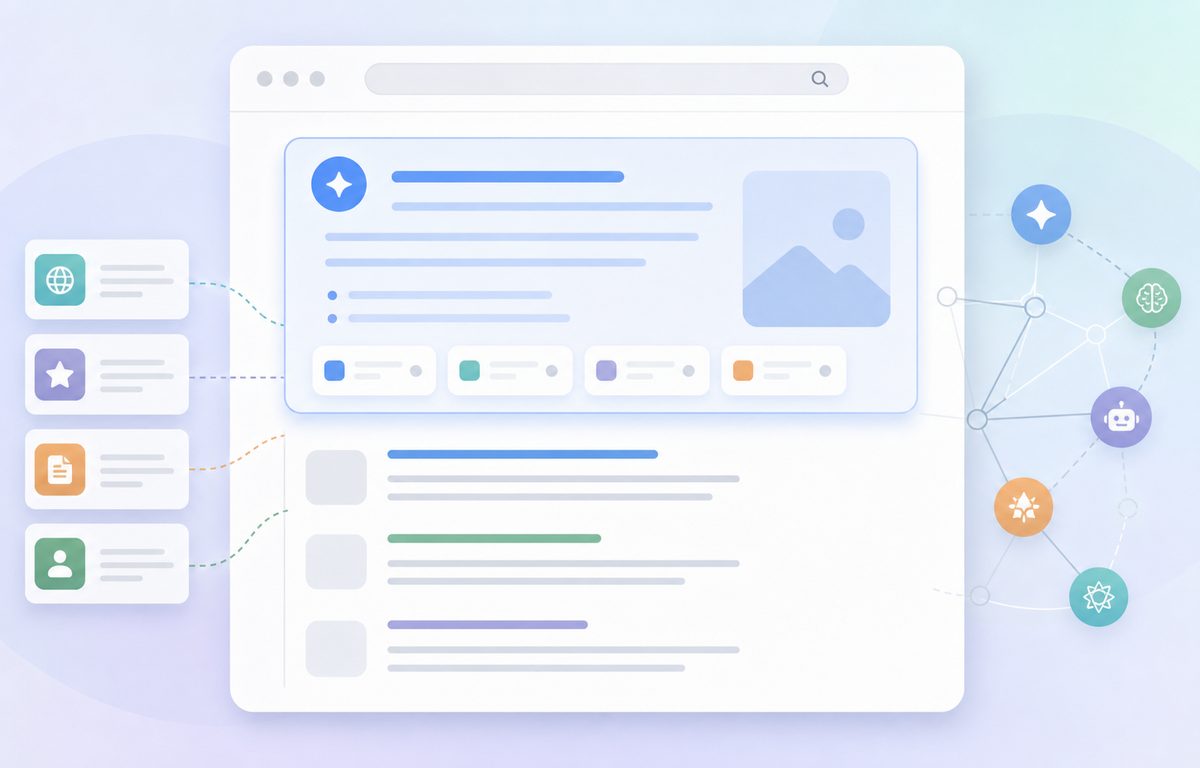
AI Overviews zero-click search is when Google's AI-generated answer resolves a query at the top of the results page, so the user gets what they need without clicking any website. The brand still "wins" when it is the cited source or named inside that answer.
Two forces stack here. Zero-click search is the older trend—featured snippets, knowledge panels, and instant answers that end the query on the SERP. AI Overviews are the accelerant: a generative summary that pulls from multiple pages, paraphrases them, and rarely rewards a single blue link. Google's AI Mode pushes this further, using a query fan-out technique—one query becomes many sub-queries answered together in a single conversational block.
The result is a search page where ranking #1 no longer guarantees traffic. The new question is not "how do I rank?" but "how do I get quoted—and what do I do when the click disappears anyway?"
Why the old zero-click playbook fails against AI Overviews
The featured-snippet playbook—win position zero, capture the click that spills over—breaks under AI Overviews because the overview absorbs the click instead of leaking it. A snippet showed one answer from one page and often teased the reader into clicking for more. An AI Overview synthesizes several sources, answers completely, and cites them as small, easy-to-ignore links.
The click math confirms it. Ahrefs' analysis of roughly 300,000 keywords found that the presence of an AI Overview correlated with a 34.5% lower click-through rate for the top-ranking page. Pew's data showed users end the browsing session entirely 26% of the time on pages with an AI summary, versus 16% without.
So the tactics that won position zero and featured snippets still matter—but only as inputs to a bigger goal: being the source the AI trusts, quotes, and recommends. That shift is the core of answer engine optimization (AEO) and generative engine optimization (GEO): you optimize to be the cited answer, not merely the highest link.
The 3C framework: Concede, Contest, Convert
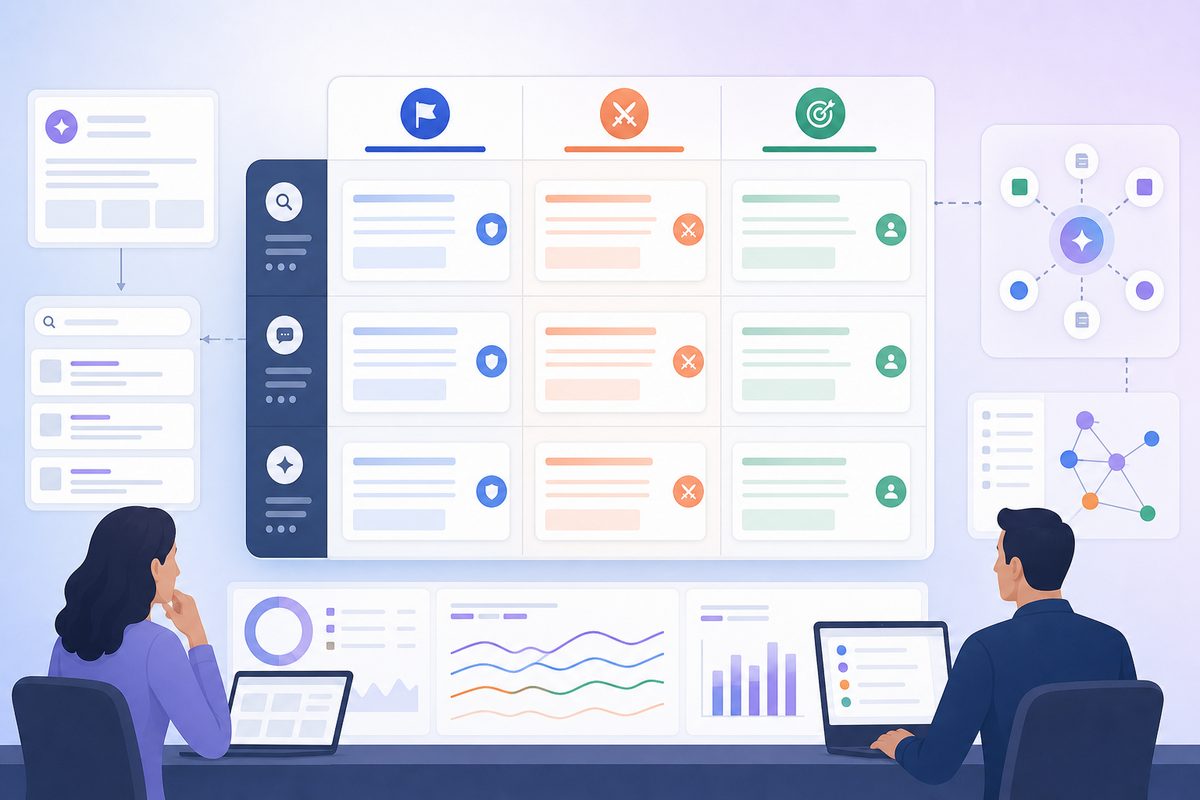
Not every query deserves the same response. Fighting for a click on a definitional search is a waste; conceding a high-intent buyer query is malpractice. The 3C framework triages your prompts by zero-click likelihood so you spend effort where it changes revenue. It's the operating model we use when reading tracking data across the B2B accounts we monitor.
| Query type | Zero-click likelihood | Play | What "winning" means |
|---|---|---|---|
| Definitional ("what is X") | Very high (70%+) | Concede the click, contest the citation | You are the named source inside the overview |
| Comparison ("best X," "alternatives to X") | High | Contest | Your brand lands on the AI-generated shortlist |
| Brand-adjacent ("how does X work," "X reviews") | Medium | Convert | The overview steers a warm user to your page |
| Deep transactional ("pricing, integrations, migration") | Lower | Convert | You win the click and the deal |
Concede: give up the click, keep the credit
For pure definitional and "what is" queries, the click is mostly gone and chasing it is a losing trade. Concede the visit and compete instead to be the source the overview cites. A citation on a high-volume definitional prompt seeds brand recognition that pays off later, when the same reader runs a bottom-funnel search and already knows your name.
Contest: fight for the shortlist
"Best," "top," and "alternatives to competitor" prompts generate AI shortlists—the two-to-five brands the model names. Contest every buyer-relevant shortlist, because inclusion is a qualified impression even without a click. Getting listed depends heavily on what independent sources say, which is why off-site evidence matters more here than on-page copy. (More on that below.)
Convert: turn the answer into a click and a demo
For brand-adjacent and transactional prompts, the overview often can't answer completely—pricing, security, migration steps, and integrations need your page. Convert these by making your page the obvious next step the overview points to. Detailed, structured, up-to-date pages on the specifics AI can't paraphrase are where clicks—and pipeline—still flow. And when buyers do click an AI citation, both engine and position swing the click-through rate, so the citations that convert are worth engineering for.
How to get quoted inside an AI Overview
To win a spot in an AI Overview, give Google a clean, verifiable passage to lift and enough independent corroboration to trust it. Retrieval-based answers reward clarity and consensus, not keyword density. Four moves do most of the work:
- Lead every section with a 40–60 word answer. Put a complete, standalone statement in the first 100 words of the page and at the top of each H2. Models extract self-contained passages; buried answers don't get quoted.
- Structure for extraction. Use descriptive, question-shaped headings, short paragraphs, comparison tables, and step lists. A table answers "compare X vs Y" cleanly; a numbered list answers "how do I."
- Build off-site agreement. AI systems recommend the brand that independent sources already describe the same way—reviews, analyst pages, community threads, and third-party comparisons. If ten neutral sources describe you consistently, you become the safe answer.
- Cover the fan-out. Google's AI Mode breaks one question into many sub-questions. Map the sub-questions around your core prompts and answer each on the page so you can be cited across the whole fan-out, not just the headline query.
These same plays raise brand mentions in ChatGPT, Perplexity, and Gemini too—the mechanics of getting recommended by ChatGPT and getting quoted by Google's AI overlap almost entirely. But the offense starts on Google, where the volume is.
What a "win" looks like when nobody clicks
When the click disappears, a win becomes measurable in four downstream signals instead of one session. Traffic dashboards miss all of them, which is why so many teams conclude—wrongly—that they're simply losing.
- Citation share. How often you are the named source across your buyer prompts. Rising citation share means Google is teaching more buyers your name for free.
- Shortlist presence. Whether you appear on the AI-generated shortlist for "best" and "alternatives" queries. This is your AI Share of Voice against named competitors.
- Branded search lift. A reader who sees your name in an overview often searches your brand days later. That branded spike is a real, trackable echo of a zero-click impression.
- Dark conversions. Buyers who used AI, never clicked a citation, and arrived later via direct or branded traffic. These are the buyers who used AI but never clicked a citation—invisible to last-click attribution.
Google frames the trade optimistically, claiming clicks from AI Overview pages are "higher quality." That may be true for the visits that survive—but it quietly concedes that the number of visits falls. The healthier response is to stop grading yourself only on clicks and start grading on citations, shortlist presence, and branded lift. This is where an AI search monitoring and LLM brand tracking discipline replaces a rankings-only scorecard.
Measure it: separate AIO loss from ranking drops
Before you act, prove where the loss came from—an AI Overview eating clicks is a different problem than falling out of the rankings, and they demand opposite fixes. Google Search Console makes this harder than it should: per Google Search Central's documentation on AI features, impressions and clicks from AI Overviews and AI Mode are folded into the normal "Web" search type with no separate breakout.
Here's a practical way to isolate the AI Overview effect:
- Segment by query pattern. Pull GSC data for informational, definitional, and "how/what/why" queries—the ones most likely to trigger an overview—and compare their click trend against transactional queries.
- Watch the impressions–clicks gap. Stable or rising impressions with falling CTR at the same average position is the fingerprint of an AI Overview absorbing the click, not a ranking drop.
- Cross-reference an AI-answer tracker. Because GSC can't see inside the overview, pair it with a tool that records whether an overview fired and whether you were cited. This is the difference between guessing and knowing.
For the full method, see our measurement playbook for separating AIO click loss from ranking drops. The point: don't rewrite a page that's ranking fine and losing clicks purely to an overview—work to get into that overview instead.
Worked example: a B2B SaaS account over one quarter
Across a composite of B2B SaaS accounts we monitor, playing offense on AI Overviews turned a raw click loss into a net pipeline gain within one quarter. We tracked 40 buyer-intent prompts daily for 90 days—definitional, comparison, and brand-adjacent—and logged whether an overview fired, whether the brand was cited, and where it sat on the shortlist. The numbers below are representative, anonymized, and directional, not a controlled study.
| Signal | Start | End of quarter |
|---|---|---|
| AI Overview citation rate (40 prompts) | 6% | 34% |
| AI Share of Voice vs 3 named competitors | 2nd | 1st |
| Organic clicks (overview-heavy queries) | baseline | −22% |
| Branded search volume | baseline | +18% |
| Self-reported "found us via AI" on signups | 3% | 11% |
The click loss was real and did not reverse—−22% on overview-heavy queries. But citation rate rose from 6% to 34%, branded search climbed 18%, and self-reported AI-sourced signups more than tripled. The team stopped defending a traffic number it couldn't win and started defending a citation-and-pipeline number it could. That reframe—not a traffic recovery—is the win available under AI Overviews zero-click conditions.
A 30-day operating cadence
Run AI Overview offense as a monthly loop, not a one-time project, because Google's answers and your competitors' citations change weekly. A tight cadence keeps the work honest and the reporting defensible.
- Days 1–3 — Inventory. List the 30–50 buyer prompts that decide deals. Record which fire an overview and whether you're cited today.
- Days 4–7 — Triage with 3C. Tag each prompt Concede, Contest, or Convert. Kill effort on low-value definitional clicks.
- Days 8–18 — Rework passages. Add 40–60 word answer blocks, tables, and step lists to Contest and Convert pages. Fill fan-out sub-questions.
- Days 19–24 — Seed off-site agreement. Refresh third-party comparisons, reviews, and analyst mentions so independent sources describe you consistently.
- Days 25–30 — Measure and report. Compare citation rate, share of voice, and branded lift against last month. Report the deltas, not just traffic.
Then repeat. The teams that hold this rhythm compound their citation share while competitors keep staring at a falling clicks chart.
Frequently asked questions
What is AI Overviews zero-click search?
AI Overviews zero-click search is a Google result where the AI-generated summary answers the query on the page, so the searcher never clicks a website. You still benefit when your brand is the cited source or named in the answer, which turns a lost click into a free branded impression and a potential shortlist spot.
Do AI Overviews actually reduce website traffic?
Yes, for overview-heavy queries. Pew found clicks fell to 8% with an AI summary versus 15% without, and Ahrefs measured a 34.5% lower CTR for the top page when an overview appeared. The nuance: transactional and brand-specific queries lose far less, because the overview can't fully answer them—so segment before you panic.
How do I get my brand cited in an AI Overview?
Lead pages and sections with a 40–60 word standalone answer, structure content with question-shaped headings and tables, and build consistent third-party mentions so independent sources agree on how they describe you. Retrieval favors clear, corroborated passages—not keyword-stuffed copy. These are the same signals that earn AI citations across ChatGPT and Perplexity.
Can I measure AI Overviews impact in Google Search Console?
Only indirectly. Google folds AI Overview and AI Mode data into the standard "Web" search type, so there's no native breakout. Diagnose it by watching for stable impressions with falling CTR on informational queries, then confirm with a dedicated AI-answer tracker that sees whether an overview fired and whether you were cited.
Is zero-click search bad for B2B specifically?
Less than it looks. B2B buyers run long research journeys, and being on the AI shortlist early shapes the final vendor list even without a click. Track AI Share of Voice and branded-search lift as leading indicators, and treat dark, AI-influenced conversions as pipeline you'd otherwise miss.
Winning under AI Overviews zero-click search isn't about clawing back every click Google took—it's about being the answer Google gives. Concede what you can't win, contest every shortlist, convert the queries that still click, and measure citations instead of only sessions. Track it monthly, and the falling-traffic chart stops being your scoreboard.