A ChatGPT wrong product category result usually means the prompt, conversation context, or public evidence points toward an adjacent market. Test the answer in fresh chats, compare search and non-search responses, map recurring sources, align owned and third-party descriptions, then rerun the same prompts to verify improvement.
This is more than a wording problem. Category classification determines which competitors ChatGPT recommends, which capabilities buyers expect, and whether your product qualifies for a shortlist.
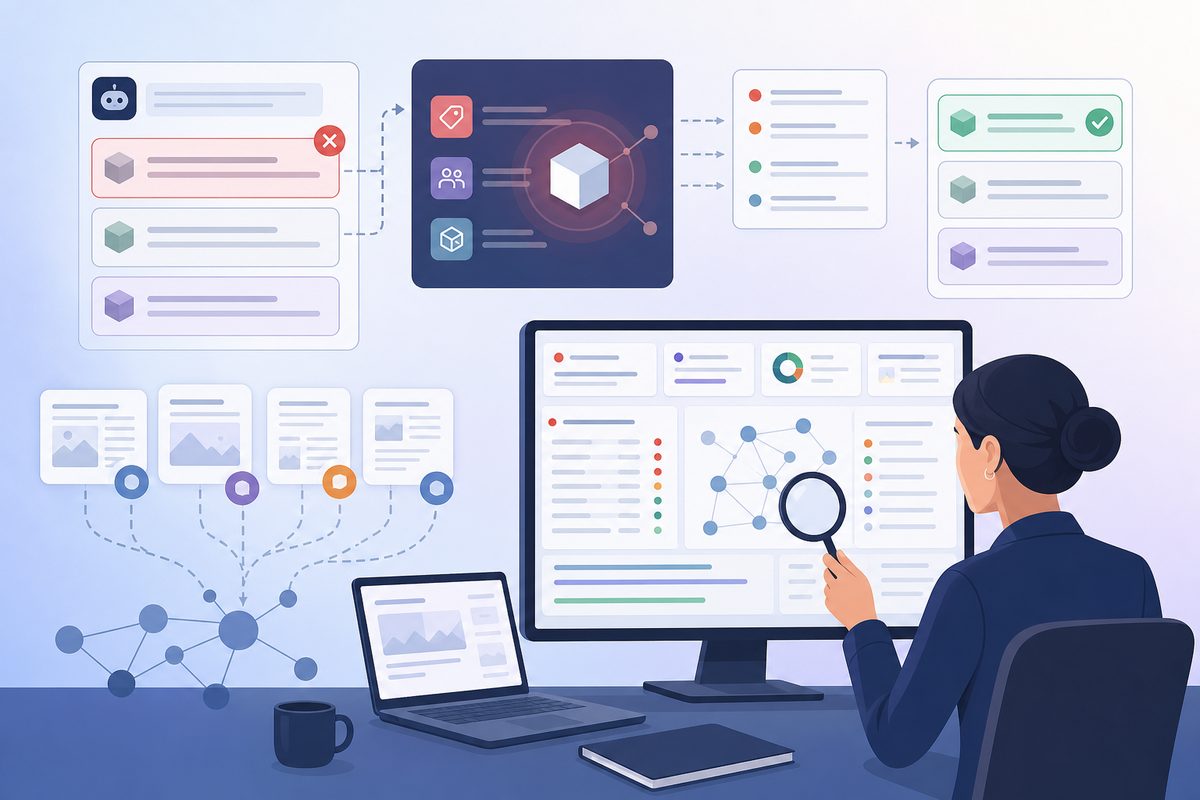
How to fix a wrong product category in ChatGPT
Use this seven-step process:
- Define one canonical category and list acceptable secondary categories.
- Reproduce the error in fresh chats without earlier conversation context.
- Test multiple prompt intents, including classification, comparison, use-case, and recommendation prompts.
- Separate searched answers from non-search answers because their evidence paths differ.
- Record recurring categories, competitors, citations, and descriptions.
- Correct the most influential conflicting evidence, starting with sources you control.
- Rerun the unchanged prompts and compare category accuracy before and after the corrections.
You can correct one conversation by giving ChatGPT explicit context. Persistent correction across users and future answers requires clearer, more consistent public evidence.
What does “ChatGPT wrong product category” mean?
A wrong product category occurs when ChatGPT places a product in a market that changes how buyers would evaluate it. Calling an AI search visibility platform an SEO rank tracker, for example, creates the wrong competitor set, expected features, and purchase criteria—even if the description contains some accurate details.
Not every variation is an error. Products often serve several use cases or participate in adjacent markets. Define the classification policy before reviewing outputs:
| Classification | Example | How to score it |
|---|---|---|
| Correct primary category | “AI search visibility platform” | Correct |
| Approved secondary category | “Generative engine optimization platform” | Correct if deliberately supported |
| Adjacent but misleading category | “SEO rank tracker” | Category drift |
| Feature mistaken for category | “ChatGPT mention tracker” | Category drift |
| Unrelated category | “Social listening platform” | Severe category drift |
| No category assigned | Features are listed without identifying the market | Unclassified |
The key test is commercial meaning: Would the category send a buyer toward the right alternatives, requirements, and budget? If not, the answer is materially wrong even when it sounds plausible.
Is the error limited to one conversation or visible more broadly?
Before changing your website, determine the scope of the problem.
| What you observe | Most likely explanation | Next test |
|---|---|---|
| Wrong only after a long conversation | Earlier context is steering the answer | Repeat in a fresh or Temporary Chat |
| Wrong in fresh chats using one prompt | The prompt may be ambiguous | Test controlled paraphrases |
| Wrong across prompt types and fresh chats | Persistent category drift is likely | Audit owned and third-party evidence |
| Wrong only when web search is used | Current web sources may be driving the answer | Inspect cited pages and source recurrence |
| Wrong only without web search | The classification may reflect model knowledge or unresolved entity associations | Strengthen current public evidence and monitor |
| Wrong in one country or language | Localized sources or translations may conflict | Compare regional pages and local listings |
| Another company with the same name appears | Entity disambiguation is weak | Add company, product, domain, and audience context |
This first split prevents a common overreaction: treating one context-dependent response as proof that ChatGPT categorizes the brand incorrectly for everyone.
Why does ChatGPT put products in the wrong category?
A ChatGPT category answer can be influenced by the current prompt, preceding conversation, model knowledge, and—when search is used—retrieved web pages. There is no single public category field that universally controls ordinary brand recommendations.
1. Inconsistent language on owned pages
The homepage may call the product a “customer intelligence platform” while documentation calls it a “survey tool” and the About page says “experience management software.” ChatGPT then has several defensible labels but no clear hierarchy.
Inventory the category nouns used in:
- Homepage title, H1, and opening copy
- Product and platform pages
- About and company profiles
- Documentation overviews
- Comparison and alternatives pages
- Press kits, PDFs, webinars, and old landing pages
- Organization and product structured data
The problem is usually not natural variation. It is unresolved hierarchy: pages do not distinguish the primary category from use cases, features, and adjacent markets.
2. Stale third-party descriptions
Review sites, partner directories, app marketplaces, company databases, and syndicated press releases may preserve an earlier positioning statement. This is common after a rebrand, acquisition, or move upmarket.
A stale page becomes more important when it:
- Ranks for the brand name
- Is cited repeatedly in searched answers
- Uses an explicit category label
- Groups the product with outdated competitors
- Is duplicated across several domains
3. Prompt ambiguity
“What kind of tool is Acme?” provides little buyer, product, or use-case context. ChatGPT may choose the category most strongly associated with a feature mentioned in the conversation.
Compare these prompts:
- “What product category does AcmeCloud compete in?”
- “What kind of software is AcmeCloud?”
- “What is AcmeCloud used for by enterprise security teams?”
- “Is AcmeCloud a SIEM, a CSPM platform, or something else?”
- “Which products should a buyer compare with AcmeCloud?”
If only the security-team prompt produces “SIEM,” the answer may reflect an overlapping job rather than persistent category drift.
4. Features are more prominent than the category
A product page may devote most of its copy to dashboards, alerts, integrations, or reporting while mentioning the market category once in a title tag. Models can then mistake the most repeated feature for the product class.
A category needs supporting explanation:
- What the product is
- Who buys it
- What core job it performs
- Which established market it belongs to
- How it differs from adjacent categories
- Which products are valid comparisons
5. Competitor associations point to another market
Comparison pages and listicles can define a product by its neighbors. If a workflow automation platform is repeatedly compared with project-management software, that competitive set may reinforce the wrong classification.
This can also happen on the company’s own site. Publishing broad “alternative to” pages for loosely related products may increase traffic while weakening category clarity.
6. A namesake or product-suite collision exists
ChatGPT may merge:
- Two companies with the same or similar names
- A parent company and an individual product
- A legacy product and its replacement
- A feature name and the platform containing it
- Regional versions with different positioning
Use the full entity in diagnostic prompts: brand name, product name, official domain, audience, and company location where relevant.
7. The company recently changed categories
A repositioning creates a temporary evidence split. Current commercial pages may use the new category while reviews, interviews, documentation, and backlinks still use the old one.
The solution is not to delete every historical reference. Mark the transition clearly, update controlled profiles, and publish enough current evidence to explain what changed.
8. The evidence is insufficient
When reliable pages describe features but avoid a market label, ChatGPT may infer the nearest familiar category. An invented category name can make the problem worse if buyers and independent sources do not recognize it.
The product category naming framework for AI search explains how to choose a category that is distinctive without becoming unintelligible.
How do you reproduce the category error reliably?
One screenshot is not a diagnostic. Use a fixed test set that can be repeated after evidence changes.
Start with a clean test environment
For every observation:
- Open a new conversation.
- Do not correct or educate ChatGPT before asking the test prompt.
- Record the exact prompt.
- Record the model and account state.
- Note whether custom instructions or Memory could affect the response.
- Record whether web search was used.
- Save the response, citations, screenshot, date, language, and location.
Do not combine searched and non-search answers into one metric. When ChatGPT uses search, OpenAI says responses include inline citations and a Sources panel. Those links provide investigation leads, but they do not reveal every influence behind the answer. See the official ChatGPT search documentation.
Use four prompt families
A practical starting set contains 24 prompts: six prompts from each family, run three times. This produces 72 observations. It is an operational baseline, not a statistically universal sample size; expand it when answers remain highly variable.
Direct classification
- “What product category is [brand] in?”
- “What kind of software is [brand]?”
- “How would you classify [brand]?”
- “What market does [brand] compete in?”
Job-to-be-done
- “What tools help [audience] accomplish [job]?”
- “Is [brand] suitable for [specific workflow]?”
- “What is [brand] mainly used for?”
- “Which team normally buys [brand]?”
Comparison
- “What are the main alternatives to [brand]?”
- “How does [brand] compare with [known direct competitor]?”
- “Is [brand] closer to [correct category] or [adjacent category]?”
- “Which vendors compete directly with [brand]?”
Recommendation and shortlist
- “Recommend three [category] products for [buyer and constraints].”
- “Should [brand] be shortlisted for [use case]?”
- “What products should I evaluate alongside [brand]?”
- “Which [category] platforms fit [company profile]?”
Prompt families matter because category accuracy may be high on direct questions but poor when buyers ask for recommendations.
Use controlled paraphrases, but avoid filling the test set with near-duplicates that create false confidence. The prompt deduplication methodology for AI visibility shows how to separate meaningful intent variants from cosmetic wording changes.
What should the category audit record?
Capture enough detail to explain the output, not just whether the brand appeared.
| Field | What to record | Why it matters |
|---|---|---|
| Assigned category | Exact noun phrase used | Reveals recurring labels |
| Outcome | Correct, approved secondary, adjacent, feature-level, unrelated, or unclassified | Enables consistent scoring |
| Answer rationale | Sentence explaining what the product does | Shows which attributes drive classification |
| Competitors | Every company mentioned | Exposes the inferred market |
| Recommendation position | Rank or shortlist position | Measures commercial visibility |
| Search state | Searched, not searched, or unclear | Separates evidence paths |
| Citations | Exact URLs and domains | Identifies recurring retrievable sources |
| Prompt context | Family, wording, language, and buyer | Explains prompt-driven variation |
| Environment | Model, date, account state, and location | Makes retesting comparable |
| Evidence | Full response and screenshot | Preserves an auditable record |
A brand mention is not automatically positive. Ten mentions in the wrong category can make an unqualified share-of-voice metric look healthy while sending buyers to the wrong market.
How do you trace the evidence behind the wrong category?
Build an evidence map for every recurring wrong label. Search for the exact phrase, close variants, and the competitor names that appear beside it.
Audit sources in this order
- Cited pages in wrong answers
- Owned pages ranking for the brand
- Claimed directory and marketplace profiles
- Review and comparison pages
- Partner and integration listings
- Press coverage and syndicated announcements
- Documentation, PDFs, and archived campaign pages
Classify every occurrence:
| Evidence cluster | Diagnostic question |
|---|---|
| Owned commercial pages | Do they state one primary category near the top? |
| Technical content | Does feature language imply a different market? |
| Controlled external profiles | Is old positioning still live? |
| Independent coverage | Which category and competitors frame the brand? |
| Search citations | Which URLs recur when the wrong category appears? |
| Uncited answers | Does the same error persist without visible retrieval? |
A cited page is associated evidence, not proof of causation. It may support only one sentence, and other influences are not visible. Look for recurrence across independent runs.
An AI source gap analysis is useful when competitors have clear category explainers, reviews, and comparisons while your intended category appears only in self-promotional copy.
The MaxAEO Category Drift Diagnostic
The MaxAEO Category Drift Diagnostic turns inconsistent answers into four measurable questions:
- How often is the classification wrong?
- Which prompt intents produce the error?
- Which sources and competitors recur with it?
- Which evidence can the team realistically correct?
Define the accepted categories and scoring rules before reviewing the results.
Category Accuracy Rate
Accepted category observations ÷ total eligible observations × 100
“Accepted” can include a primary category and deliberately supported secondary categories. Unclassified responses remain in the denominator because they do not establish the intended market.
Calculate the rate by prompt family, model, language, region, and search state. A single blended percentage can conceal a commercially important failure.
Weighted Category Drift Index
Assign an outcome severity:
| Outcome | Severity |
|---|---|
| Correct or approved secondary category | 0 |
| No category assigned | 0.25 |
| Adjacent but misleading category | 0.50 |
| Feature mistaken for category | 0.75 |
| Unrelated category | 1.00 |
Then assign an intent weight:
| Prompt intent | Weight |
|---|---|
| Direct informational classification | 1 |
| Job-to-be-done or comparison | 2 |
| Recommendation or shortlist | 3 |
Calculate:
Σ(outcome severity × intent weight)
÷
Σ(maximum severity × intent weight)
× 100
Lower is better. The index gives more weight to errors that can redirect buyers during evaluation. It is a prioritization measure, not a probability or industry benchmark.
Source Association Ratio
Wrong-category rate when a source appears
÷
Wrong-category rate when it does not appear
A ratio above 1 identifies an association worth investigating. It does not demonstrate that the source caused the answer.
Do not calculate the ratio from tiny groups or when either denominator is zero. Report the underlying counts beside the ratio so readers can judge the evidence.
Competitor Set Alignment
Direct or approved competitor mentions
÷
all competitor mentions
× 100
A correct category label with an unrelated competitor set is only a partial recovery. Buyers may still receive the wrong alternatives and evaluation criteria.
Worked example: diagnosing category drift
RelayDesk is a hypothetical workflow-automation product used here solely to demonstrate the calculation.
Across 72 ChatGPT observations:
| Classification | Observations | Share |
|---|---|---|
| Workflow automation | 27 | 37.5% |
| Project management | 31 | 43.1% |
| Integration platform | 9 | 12.5% |
| No category assigned | 5 | 6.9% |
If “workflow automation” is the only accepted category, the Category Accuracy Rate is 37.5%. The explicit wrong-category rate is 55.6%: 40 of 72 observations used project management or integration platform. The remaining 6.9% were unclassified.
The problem was concentrated in commercial prompts:
- Project-management classification appeared in 67% of shortlist runs.
- It appeared in 28% of direct-classification runs.
- The same outdated directory appeared disproportionately in wrong searched answers.
The source groups were:
| Evidence observed | Wrong answers | Total answers | Wrong-category rate |
|---|---|---|---|
| Outdated directory cited | 14 | 18 | 77.8% |
| Current owned page cited | 3 | 15 | 20.0% |
| No visible citation | 23 | 39 | 59.0% |
The directory’s Source Association Ratio versus uncited answers is:
77.8% ÷ 59.0% = 1.32
That supports investigating the directory. It does not prove causation.
The evidence inventory then finds:
- The homepage title says “project management automation.”
- The product H1 says “workflow automation.”
- An old partner profile says “project management platform.”
- Most current documentation describes workflows without naming the category.
The working hypothesis is now testable: contradictory owned and controlled third-party evidence is reinforcing the project-management label.
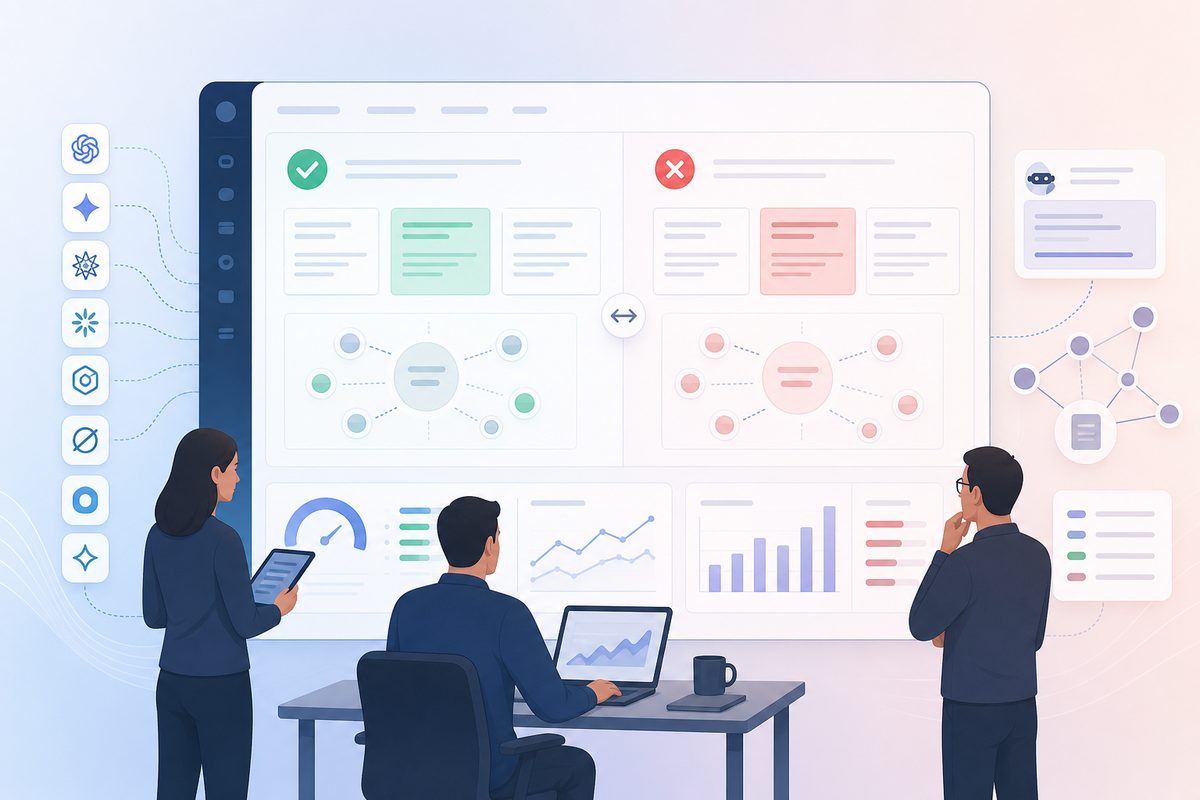
How should category corrections be prioritized?
Do not fix sources in the order stakeholders discover them. Score each evidence cluster:
Observed recurrence (%) × commercial impact (1–3) × controllability (1–3)
For the RelayDesk example:
- An editable directory appears in 25% of observations.
- It occurs mainly in shortlist prompts, so impact is 3.
- The company controls the profile, so controllability is 3.
25 × 3 × 3 = 225
A two-year-old news article appearing in 4% of observations, with medium impact and no editorial control, scores:
4 × 2 × 1 = 8
The score prioritizes work; it does not establish causality. Correct one cluster at a time when practical, preserve control prompts, and log every update date.
How do you write a canonical category statement?
A canonical statement identifies the product, audience, core job, and category boundary in language buyers already understand.
Use this pattern:
[Brand] is a [primary category] for [audience] that [core job]. Unlike [adjacent category], it [defining boundary].
For MaxAEO:
MaxAEO is an AI search visibility platform for marketing, SEO, brand, and agency teams. It monitors how major answer engines mention, rank, cite, and describe brands; unlike a conventional rank tracker, it measures visibility inside generated answers.
The boundary is essential. Features explain what the product does; boundaries explain why it belongs in one category rather than another.
Use the same primary category noun across high-authority pages and controlled profiles. Supporting language can vary naturally. Consistency does not require repeating an exact sentence everywhere.
Which owned pages should you correct first?
Prioritize pages that are authoritative, indexable, and likely to be retrieved:
- Homepage
- Primary product or platform page
- About page
- Documentation overview
- High-ranking comparison pages
- Frequently cited resources
- Press kit and company boilerplate
- Important PDFs and webinar pages
For each page:
- State the category near the top.
- Identify the primary audience.
- Explain the core job.
- Distinguish the product from adjacent categories.
- Name representative direct competitors only when useful to buyers.
- Keep titles, H1s, introductory copy, and structured data aligned.
- Link to a definitive category explanation.
- Remove or update obsolete category claims.
Do not eliminate legitimate use-case language. Clarify the hierarchy:
Primary category → buyer use cases → capabilities → individual features
How should third-party descriptions be corrected?
Start with sources that recur in wrong answers and sources the company can update directly:
- Claimed review profiles
- App and partner marketplaces
- Company databases
- Agency or reseller pages
- Integration listings
- Syndicated company descriptions
- Old press boilerplate
Provide a correction package containing:
- Current canonical category
- One-sentence boundary from the adjacent market
- Supporting product URL
- Exact outdated wording
- Suggested factual replacement
- Date the positioning changed
- Contact information for verification
Independent writers do not have to reproduce marketing language verbatim. The objective is accurate market classification, not editorial control.
If an influential page cannot be changed, publish stronger current evidence and correct every source you do control. For outdated descriptions and obsolete capabilities, use the process for correcting stale product facts in AI answers.
Can structured data fix a wrong category?
No. Structured data can reinforce a visible, consistent category, but it cannot override contradictory copy, ambiguous positioning, or stronger third-party evidence.
Use the most accurate applicable Schema.org type, such as SoftwareApplication, Product, or Organization. Properties such as applicationCategory should describe information users can verify on the page.
Google’s structured data policies require markup to represent visible page content. Treat schema as a consistency layer, not a hidden category-control field.
Check that:
- Category copy appears in rendered HTML.
- Canonical category pages are indexable.
- Titles and headings agree with visible positioning.
- Internal links point to the definitive explanation.
- Old duplicate pages do not compete with current messaging.
- Structured data validates and matches the page.
- Product and company entities are not conflated.
Why must competitor associations be corrected too?
Category and competitor errors reinforce each other. If ChatGPT labels a product correctly but compares it with unrelated tools, buyers still receive the wrong alternatives, features, and purchase criteria.
Label every competitor mentioned:
- Direct budget rival
- Approved adjacent-category competitor
- Feature neighbor
- Substitute workflow
- Irrelevant association
Then compare ChatGPT’s inferred competitive set with the companies used in sales, product marketing, and win-loss analysis.
Review your own comparison content as well. A broad set of “alternative to” pages can create associations the product team never intended. The guide to defending alternatives-to-your-brand prompts explains how to address incorrect recommendation sets without relying on unsupported superiority claims.
What should you avoid doing?
Do not optimize around one screenshot
A single response may reflect conversation context or ordinary output variation. Confirm recurrence first.
Do not repeat the category phrase everywhere
Mechanical repetition can damage readability without resolving the product’s boundary. Explain the category with buyers, jobs, capabilities, and comparisons.
Do not treat citations as a complete causal trace
A cited URL is an investigation lead. It does not expose model training data, hidden retrieval, or every source influencing the answer.
Do not change prompts during the retest
If the wording changes after the correction, you cannot tell whether the evidence improved or the test became easier.
Do not count every adjacent category as wrong
Define legitimate secondary categories before scoring. Otherwise, the audit may punish valid product breadth.
Do not invent supporting data
Use recorded responses, visible citations, controlled page inventories, and clearly labeled examples. Unsupported claims weaken both the correction and the credibility of the content explaining it.
Do not expect feedback on one answer to create a universal update
A thumbs-down report or in-conversation correction may address that interaction. It does not guarantee that future users, models, or searched answers will adopt the category.
How do you verify that the correction worked?
Rerun the exact baseline after meaningful evidence changes. Because crawling, retrieval, and model updates follow different schedules, there is no reliable universal recovery time.
A practical measurement cadence is:
- Weekly for six weeks after a major correction
- Monthly thereafter for stable categories
- Immediately after a rebrand, acquisition, major product launch, or category change
Compare:
- Category Accuracy Rate
- Weighted Category Drift Index
- Accuracy by prompt family
- Searched versus non-search answers
- Competitor Set Alignment
- Recurring wrong-category phrases
- Citation domains and URLs
- Regional and language variation
- Time between evidence updates and observed movement
Keep the original prompts, full responses, screenshots, and update log. A recovery is incomplete if direct classification improves but comparison and shortlist prompts remain wrong.
Also check for displacement. Removing one incorrect category may reveal another adjacent classification that was previously less visible.
A practical 30-day correction plan
Days 1–3: Establish the baseline
- Define accepted and rejected categories.
- Create the fixed prompt set.
- Run fresh-chat tests.
- Separate searched and non-search results.
- Record categories, competitors, and citations.
Days 4–7: Map the evidence
- Inventory category language across owned pages.
- Review cited sources and branded search results.
- Find outdated profiles and partner descriptions.
- Check product-versus-company entity confusion.
- Score evidence clusters by recurrence, impact, and controllability.
Days 8–14: Correct high-priority sources
- Align the homepage, product page, About page, and documentation.
- Publish a clear category-and-boundaries explanation.
- Update controlled listings and company boilerplate.
- Correct structured data where it conflicts with visible content.
- Preserve a dated change log.
Days 15–30: Retest and investigate
- Rerun the unchanged prompt set weekly.
- Compare target prompts with unaffected control prompts.
- Check whether cited sources and competitor sets changed.
- Investigate remaining errors by prompt family.
- Avoid declaring success from one favorable answer.
This schedule organizes the work; it does not promise that ChatGPT will refresh within 30 days.
How should category accuracy become an operating metric?
Category accuracy should sit beside brand mentions, citations, recommendation rank, and AI share of voice. Visibility without correct positioning can expose the brand to more buyers while directing them toward the wrong market.
A repeatable monitoring loop should:
- Track realistic buyer prompts.
- Detect changes in category language.
- Segment answers by model, intent, market, and language.
- Capture citations and competitor co-mentions.
- Alert teams when a misleading category exceeds an internal threshold.
- Connect evidence changes to later answer movement.
- Preserve a history of responses and screenshots.
MaxAEO monitors how brands are mentioned, cited, ranked, and described across major answer engines. That makes it possible to distinguish “the brand appeared” from the more important outcome: the brand appeared in the right category and competitive context.
Frequently asked questions
Can you directly tell ChatGPT that its product category is wrong?
You can correct the current conversation by providing accurate context and can report an unsatisfactory response through the available feedback controls. That does not guarantee a durable change across other users, prompts, models, or searched answers. Persistent improvement requires consistent public evidence and repeated measurement.
Why is the category correct in one ChatGPT conversation but wrong in another?
The conversations may use different context, models, search states, account settings, or prompt wording. Answers can also vary between runs. Test the exact prompt in fresh chats under recorded conditions before concluding that the brand has a persistent category problem.
Does a cited page prove which source caused the wrong category?
No. A citation shows that the page was surfaced with the answer, not that it independently caused the classification. Measure whether the source recurs in wrong answers, inspect the claim it supports, and compare results after correcting the evidence while preserving control prompts.
How long does a category correction take to appear?
There is no dependable universal timeline. Results depend on crawling, retrieval, model updates, search mode, and the amount of conflicting evidence. Rerun a fixed baseline weekly after major changes and record when each correction becomes observable.
What if the product legitimately belongs to several categories?
Define one primary category and document approved secondary categories. Multi-category participation is not inherently a problem. The issue is uncontrolled substitution, where an adjacent category changes the buyer, competitor set, or evaluation criteria in important prompts.
Can a new category name improve AI positioning?
It can, but an unfamiliar name needs a clear definition, an established buyer problem, boundaries from adjacent markets, and consistent third-party usage. Repeating a phrase that customers and independent sources do not recognize may cause ChatGPT to treat it as a tagline rather than a category.
Can schema markup change ChatGPT’s product category?
Schema can reinforce visible product information, but it cannot guarantee a ChatGPT classification or override contradictory evidence. Use accurate structured data that matches the page, then focus on clear positioning, indexable category evidence, and consistent external profiles.
How often should a ChatGPT wrong product category audit run?
Run a complete audit after a rebrand, acquisition, major positioning change, or category launch. For ongoing monitoring, track high-value classification, comparison, and shortlist prompts weekly or daily, then reopen the source audit whenever category drift exceeds your internal threshold.