Entity home SEO is the practice of designating one durable, indexable page as the clearest first-party record of an organization. The page defines the company’s names, relationships, products, people, locations, identifiers, and official profiles in visible copy, then mirrors verified facts in structured data.
The goal is not to force Google or an AI model to accept a company’s claims. It is to make the correct entity easier to identify, distinguish from namesakes, and reconcile with other sources.

A useful entity home does more than add Organization schema to an About page. It answers three questions for every important fact:
- Which entity does this fact describe?
- When is the fact valid?
- What evidence supports it?
This guide explains how to choose the page, resolve conflicting claims, structure the content, implement the technical signals, and measure whether search and AI systems describe the brand accurately.
What is entity home SEO?
Entity home SEO makes one URL the most complete and maintainable first-party explanation of a company’s identity. It connects the public brand to the correct legal organization, products, owners, founders, locations, identifiers, and official profiles.
An entity home is an SEO industry concept, not a special Google page type. Google documents Organization structured data and URL canonicalization, but it does not provide an “entity home” designation that a site owner can apply.
The page typically serves four audiences:
- Prospects checking whether they found the right company.
- Search engines resolving names and relationships.
- AI systems retrieving attributable brand facts.
- Journalists, analysts, partners, and directories verifying information.
The entity home is one component of a wider entity SEO strategy for AI search. Its specific job is to provide a stable identity record.
A reliable mental model is:
The entity home states the company’s version of the facts. Relevant independent evidence determines how confidently external systems can corroborate those facts.
Why does a company need a canonical identity page?
A company needs an entity home when its identity is distributed across pages that describe different names, products, locations, people, or points in time. Without a stable reference, readers and machines must infer how those fragments relate.
A typical B2B company may be represented by all of these sources:
| Source | Information it may contain | Common ambiguity |
|---|---|---|
| Homepage | Current positioning and flagship product | Legal entity may be omitted |
| About page | History, founders, and mission | Ownership or leadership may be outdated |
| Product documentation | Product and vendor names | Product may be mistaken for the company |
| Terms and privacy pages | Legal name and registered address | Legal identity may not match the public brand |
| Category, headquarters, and staff count | Fields may be approximate or stale | |
| Press releases | Funding, acquisitions, and appointments | Each announcement reflects one date |
| Review platforms | Product category and vendor | Vendor and product names may be conflated |
| Business directories | Address, industry, and founding year | Data may be copied from another directory |
| News coverage | Ownership and market context | Correct at publication, not necessarily current |
The entity home provides the missing connective language:
- “Brand A is operated by Company B.”
- “Company B develops Product C.”
- “Company B has been owned by Group D since June 2025.”
- “The London address is the registered office; the company’s headquarters is in Manchester.”
- “Person E served as CEO until January 2026.”
These statements reduce ambiguity because they identify the subject, relationship, and—when necessary—the effective date.
Is an entity home the same as a homepage, About page, or canonical tag?
No. “Entity home” describes a page’s function, while homepage and About page describe common page formats. An HTML canonical tag solves URL duplication; it does not establish the identity of a real-world organization.
| Asset | Primary purpose | Can it be the entity home? |
|---|---|---|
| Homepage | Explain value and drive conversion | Yes, if it clearly identifies the organization |
| About or company page | Explain identity, history, and structure | Usually the strongest option |
| Pressroom | Publish announcements and media assets | Supporting evidence, but often fragmented |
| Contact page | Publish communication and address details | Supporting page, not a complete identity record |
| Legal page | Identify the contracting or data-controlling entity | Useful evidence, but too narrow on its own |
| Organization schema | Express visible facts in machine-readable form | Reinforcement, not a replacement for the page |
rel="canonical" |
Select a preferred URL among duplicates | No; it addresses URL canonicalization |
Google’s canonicalization guidance concerns duplicate or substantially similar URLs. A self-referencing canonical is useful on an entity-home page, but it does not make that URL an authority on the company.
The homepage can perform both sales and identity functions when its opening copy clearly names the organization. A dedicated /about or /company page is usually better when homepage messaging changes frequently.
Which URL should be the entity home?
Choose the most durable indexable URL that can answer “Which organization is this?” without requiring the reader to infer the answer from product or campaign copy. For most companies, that is /about, /company, or /who-we-are.
Evaluate candidate pages against six criteria:
- Identity: Does the page state the public and legal names?
- Scope: Does it distinguish the company from its products and brands?
- Relationships: Can it explain ownership, founders, subsidiaries, and acquisitions?
- Stability: Will the URL survive campaigns and redesigns?
- Discoverability: Is it linked from the homepage or sitewide navigation?
- Governance: Is a specific team responsible for reviewing its facts?
A lightweight homepage that changes every quarter is a poor entity home even if it attracts the most links. A stable company page is usually easier to maintain without diluting conversion copy.
When should separate entities have separate pages?
Create a distinct canonical page when an entity is independently searched for and needs facts that cannot be explained clearly on the company page.
| Entity | Separate page is usually justified when… |
|---|---|
| Parent company | It owns multiple businesses or has its own public identity |
| Subsidiary | It operates under a distinct name, market, or legal structure |
| Product brand | People search for it independently of the vendor |
| Founder or executive | The person has a meaningful public or professional profile |
| Location | The office has unique staff, services, contact details, or local relevance |
| Former brand | Search demand and historical references remain after a rebrand |
Connect the pages with explicit relationship statements. Do not rely on navigation proximity, logos, or shared design to communicate ownership.
What facts belong on an entity-home page?
Publish the smallest set of verified facts needed to identify the company and explain its important relationships. Include current facts, label historical facts clearly, and exclude unsupported superlatives, volatile metrics, and promotional claims that do not help with identification.
A complete fact inventory normally covers these areas:
| Fact family | Useful fields | Required clarification |
|---|---|---|
| Names | Public name, legal name, aliases, former names | Current, legal, trading, or historical |
| Category | Specific description of the business | What the company does in plain language |
| Ownership | Parent, subsidiary, or independent status | Effective date and affected entity |
| Products and brands | Principal products and trading brands | Develops, owns, operates, or distributes |
| People | Founders and current key leaders | Current and former roles |
| Locations | Headquarters, registered office, staffed offices | Do not treat every address as headquarters |
| History | Founding, rebrand, merger, or acquisition dates | Separate announcement date from effective date |
| Official profiles | Social, developer, app-store, and directory profiles | Each profile must represent the same entity |
| Identifiers | Relevant corporate or industry identifiers | Jurisdiction and entity to which each applies |
| Verification route | Press or corporate contact | A monitored way to request corrections |
Every published sentence should pass this test:
Can the company identify the subject, explain why the statement is current, and show evidence appropriate to that fact?
Do not publish a field merely because Schema.org supports it. An empty or uncertain field is better omitted than completed with a directory value no one has verified.
Use an Entity Reconciliation Contract before writing
The Entity Reconciliation Contract is a claim-level governance framework for preventing outdated or mis-scoped facts from entering the page or its schema. It is an internal editorial record, not a protocol used by Google.
Maintain one row per material claim:
| Field | Purpose | Example |
|---|---|---|
| Claim ID | Gives the fact a stable reference | ORG-OWN-004 |
| Subject | Identifies the entity being described | Northstar Grid, Inc. |
| Relationship | States what connects the subject and value | subsidiary of |
| Value | Records the fact or related entity | Heliotrope Group plc |
| Scope or qualifier | Prevents overgeneralization | Wholly owned subsidiary |
| Validity | Records when the fact became or stopped being true | From May 2024 |
| Evidence | Links to the strongest available support | Filing and acquisition announcement |
| Status | Controls publication | Current, historical, provisional, or disputed |
| Owner | Assigns responsibility | Legal operations |
| Last reviewed | Exposes staleness | July 14, 2026 |
The public sentence can then be generated from a reconciled record:
Northstar Grid, Inc. has been a wholly owned subsidiary of Heliotrope Group plc since May 2024.
This is more dependable than recording “Heliotrope” in an unqualified parent-company field.
A brand source of truth can hold the full contract, internal notes, evidence, and review history. The entity home should publish only the reader-relevant result.
Prioritize reconciliation debt
Not every discrepancy deserves equal attention. Score each unresolved claim with this MaxAEO prioritization model:
Reconciliation priority = business impact × ambiguity × source divergence
Score each factor from 1 to 3:
- Business impact: How harmful would an incorrect answer be?
- Ambiguity: How easily could the fact describe another entity or interpretation?
- Source divergence: How many materially different current values appear?
An incorrect parent company might score 3 × 3 × 2 = 18. A formatting difference in a social handle might score 1 × 1 × 1 = 1.
Fix the highest scores first. This prevents teams from polishing low-risk profile fields while ownership, product attribution, or name-collision problems remain unresolved.
Which sources should support entity facts?
Use evidence that is appropriate to the claim, current for the relevant date, and as close as possible to the accountable source. There is no universal source hierarchy: a corporate registry may establish a legal name, while product documentation may be better evidence of which company operates a service.
| Claim | Strong evidence routes |
|---|---|
| Legal name | Current corporate record, terms, privacy notice, or official filing |
| Public brand | Company page, product interface, trademark record, and current coverage |
| Ownership | Current filing, parent-company record, and dated transaction announcement |
| Product relationship | Product documentation, terms, company page, and app-store publisher record |
| Executive role | Current leadership page and dated appointment announcement |
| Headquarters | Company contact page and current corporate record, with location type specified |
| Former name | Rebrand announcement, archived record, redirect, and current continuity statement |
| Founding date | Contemporaneous company record or reliable independent reporting |
| Official profile | Reciprocal link or account controlled by the organization |
Treat directories as discovery leads, not automatic proof. Several directories can repeat one incorrect value because they copied the same original source.
Also distinguish first-party authority from independent corroboration. The company is normally the best source for its current product documentation and official profiles. Independent reporting or records are more persuasive for claims such as market status, reputation, or transaction context.
How to build an entity home step by step
Build the page by resolving evidence before writing prose. The process is: inventory claims, define entities, log contradictions, settle high-priority facts, write an answer-first identity block, connect evidence, implement schema, and assign ongoing ownership.
1. Inventory every existing identity claim
Collect exact values from:
- Homepage and About pages.
- Contact, legal, privacy, and terms pages.
- Product pages and documentation.
- Press releases and investor materials.
- Social and developer profiles.
- App stores, review platforms, and major directories.
- Relevant corporate records.
- Current reputable news coverage.
- Existing structured data.
Record the source URL, observed value, source date, and review date. Preserve contradictions during collection instead of silently choosing the most convenient value.
“San Francisco,” “Bay Area,” and “Delaware corporation” could all be accurate, but they may refer to an office, regional identity, and place of incorporation. The inventory must retain those distinctions.
2. Model organizations, brands, products, and people separately
Create a separate row for each independently meaningful entity. Then express relationships with verbs:
- “Company A develops Product B.”
- “Brand C is a trading name of Company A.”
- “Company A has been a subsidiary of Group D since May 2025.”
- “Person E co-founded Company A.”
- “Person E served as CEO until January 2026.”
A list of adjacent names is not a relationship model. The verb establishes what the connection means.
3. Investigate name collisions
Search the brand name with qualifiers including:
- Category.
- Product.
- Founder.
- Parent company.
- Headquarters country.
- “Official site.”
- Common abbreviations and former names.
Record any namesake that could plausibly be confused with the organization. Then place compact disambiguators near the beginning of the entity home: category, principal product, country, and official domain.
Do not create unnecessary comparison copy about the other organization. If confusion already appears in search or AI answers, use the entity disambiguation playbook for brand-name collisions to identify which conflicting attributes and external records need attention.
4. Write a 40–60-word identity block
The opening should be understandable when quoted without the rest of the page.
Use this pattern:
[Public name] is a [specific category] company that [principal activity]. Its legal name is [legal name], and it [develops/owns/operates] [principal product or brand]. The company is headquartered in [verified location] and has been [ownership status] since [effective date].
Omit unsupported fields. Do not fill gaps with estimates simply because competitors publish equivalent details.
A weak opening says:
We are a global leader transforming the future through innovation.
A useful opening says:
Acme Signal is a network-monitoring software company operated by Acme Signal, Inc. The company develops the Acme Pulse platform and is headquartered in Denver, Colorado.
The second version establishes identity, activity, product relationship, legal entity, and location without promotional claims.
5. Organize the remaining page by reconciliation job
After the opening, use short sections for:
- Products and brands.
- Ownership and corporate structure.
- Founders and current leadership.
- Headquarters and other locations.
- Former names and company history.
- Official profiles and identifiers.
- Press or verification contact.
- Last-reviewed date.
Do not publish empty sections. If a fact is unresolved, keep it in the internal discrepancy log until it can be supported.
6. Link claims to the best supporting page
A relationship should lead to the page most capable of explaining it:
- Product claim → product page or documentation.
- Acquisition → dated transaction announcement or filing.
- Executive appointment → dated newsroom announcement.
- Former name → rebrand announcement.
- Location → contact or location page.
- Corporate identifier → relevant official record when public and appropriate.
Avoid a large undifferentiated reference list. Place links beside the claims they support so readers can verify the context.
7. Make the page crawlable and canonical
The entity home should:
- Return a
200status. - Be indexable and not blocked by
robots.txt. - Use a self-referencing canonical when it is the preferred version.
- Appear in the XML sitemap.
- Be linked from the homepage, footer, or primary About navigation.
- Render its essential identity copy in crawlable HTML.
- Redirect retired duplicate company pages where appropriate.
- Use consistent hreflang annotations when equivalent language versions exist.
Follow Google Search Essentials for baseline crawlability and indexability requirements.
Avoid multiple unsynchronized About pages across country folders, legacy subdomains, investor sites, and campaign domains. When separate pages must remain, define their scope and link to the primary corporate record.
8. Add Organization schema after approving the copy
Google says Organization structured data can help it understand administrative details and disambiguate an organization. Its Organization structured data documentation recommends placing the markup on the homepage or a single page describing the organization rather than repeating it unnecessarily across every URL.
Implementation rules:
- Use
namefor the recognized organization name. - Add
legalNameonly when it describes the correct legal entity. - Use
alternateNamefor genuine aliases, not keyword variations. - Use absolute URLs for
urlandlogo. - Use
sameAsonly for pages representing the same organization. - Assign a stable organization
@id, such ashttps://example.com/#organization. - Reuse that
@idconsistently when other site markup references the organization. - Keep Person, Product, and LocalBusiness facts on the correct entities.
- Remove or qualify values that are no longer current.
- Ensure every material marked-up fact agrees with visible page copy.
Google’s structured data policies require markup to represent the page accurately. Valid syntax does not make an unsupported fact true, and structured data does not guarantee a particular search feature.
A minimal implementation may look like this:
Add properties only when the values are verified and visible or clearly supported by the page. Validate the final markup with the Schema.org validator and the relevant Google testing tools.
9. Assign ownership and update triggers
A page without governance accumulates reconciliation debt. Assign one accountable team and define event-based updates for:
- Rebrands.
- Mergers and acquisitions.
- Parent-company changes.
- Executive appointments and departures.
- Headquarters or office changes.
- Product launches and retirements.
- Domain migrations.
- New or retired official profiles.
Review stable facts at least quarterly. The review should compare visible copy, structured data, legal pages, major profiles, and high-impact third-party records.
For identity changes, preserve the effective date and relevant history instead of silently overwriting the old state.
Entity-home page template
A strong entity home can be concise when each section has a defined purpose. Use the following structure as a publication template, not as a requirement to fill every possible field.
Identity summary
[Public name] is a [specific category] company that [principal activity]. Its legal name is [legal name, if relevant]. It [develops/owns/operates] [principal products or brands] and is headquartered in [verified location].
Products and brands
For each principal product or brand, state:
- Its current name.
- Whether the organization develops, owns, operates, or distributes it.
- The official product URL.
- Former names when needed for continuity.
Ownership and corporate structure
State:
- Whether the organization is independent, a parent, or a subsidiary.
- The full name of the related organization.
- The relationship type.
- The effective date of material changes.
- Relevant subsidiaries when readers need the distinction.
Leadership and founders
Include current key roles and clearly label former roles. Link to canonical person pages only when those pages contain useful, verified information.
Locations
Distinguish among:
- Headquarters: principal operational base.
- Registered office: legal address recorded for the organization.
- Office: staffed business location.
- Service area: market served, not necessarily a physical location.
- Remote workforce: working model, not an address.
History
Document only material identity events:
- Founding or launch.
- Former names.
- Rebrands.
- Mergers and acquisitions.
- Parent-company changes.
- Major product-brand transitions.
Official profiles and identifiers
List profiles controlled by the organization and identifiers that help distinguish it. Do not include personal executive accounts as company sameAs references.
Verification and freshness
Provide a monitored corporate or press contact and show when the page was last reviewed.
Worked example: resolving four conflicting claims
A reconciled entity home replaces loose labels with explicit, dated relationships. The following fictional example shows the method without presenting invented facts as a real case study.
Assume four sources contain these claims:
| Existing claim | Reconciliation problem |
|---|---|
| “Northstar” | The short name matches unrelated companies |
| “Relay Cloud” listed as the company | The product is confused with its developer |
| Austin and Toronto both called headquarters | The location types are unclear |
| “Part of Heliotrope” | The ownership relationship has no scope or date |
The internal contract resolves the claims as follows:
| Subject | Relationship | Value | Qualifier |
|---|---|---|---|
| Northstar Grid | public brand of | Northstar Grid, Inc. | Current |
| Northstar Grid, Inc. | develops | Relay Cloud | Current product |
| Northstar Grid, Inc. | subsidiary of | Heliotrope Group plc | Wholly owned since May 2024 |
| Northstar Grid, Inc. | headquartered in | Austin, Texas | Principal operational base |
| Northstar Grid, Inc. | maintains an office in | Toronto, Ontario | Not headquarters |
The entity-home opening can now say:
Northstar Grid is the public brand of Northstar Grid, Inc., a B2B software company that develops Relay Cloud. Northstar Grid, Inc. has been a wholly owned subsidiary of Heliotrope Group plc since May 2024. The company is headquartered in Austin, Texas, and maintains an office in Toronto, Ontario.
This 46-word block resolves brand-to-company, company-to-product, subsidiary-to-parent, and headquarters-to-office relationships. It deliberately omits market leadership, customer count, founding year, and geographic coverage because those facts were not established in the scenario.
Completeness does not mean filling every possible field. It means resolving the relationships most likely to cause misidentification.
How should rebrands, acquisitions, and multiple locations be handled?
Treat identity changes as dated relationships. Do not overwrite history in a way that breaks the connection between former names, domains, owners, products, and the current organization.
| Scenario | What the entity home should state | Common mistake |
|---|---|---|
| Rebrand | Former name, current name, and effective date | Removing every reference to the former name |
| Acquisition | Acquired entity, buyer, relationship, and effective date | Assuming the announcement immediately changed every legal or product name |
| Merger | Predecessor entities and resulting organization | Treating one predecessor as the only continuation |
| Product rename | Former and current product names plus vendor | Presenting the renamed product as a new company |
| Headquarters move | Former and current location with effective date when useful | Leaving conflicting current addresses across profiles |
| Multiple offices | Precise label for each location | Calling every staffed office a headquarters |
| Regional subsidiary | Legal entity, region, parent, and scope | Using the global parent and local subsidiary interchangeably |
Redirect retired entity-home URLs when appropriate, but keep enough visible continuity on the destination page to explain the transition.
Create location pages only when they contain unique local information. Near-duplicate city pages do not clarify the entity and may introduce conflicting addresses, phone numbers, or service claims.
How can you test whether search and AI systems understand the brand?
Use a fixed, evidence-based prompt set instead of testing only flattering brand queries. Save the complete answer, citations, platform, prompt wording, language, location, account state, and test date so later results remain comparable.
The MaxAEO Entity Reconciliation Test uses 12 prompts across four categories:
| Category | Example checks | Prompts |
|---|---|---|
| Identity | Official name, legal name, category | 3 |
| Relationships | Parent company, founder, product ownership | 3 |
| Place and time | Headquarters, former name, effective dates | 3 |
| Disambiguation | Namesake distinction, official site, official profiles | 3 |
Score each answer:
- 2 points: Correct, unambiguous, and assigned to the right entity.
- 1 point: Broadly correct but incomplete, hedged, or missing a material qualifier.
- 0 points: Incorrect, contradictory, outdated, or attributed to the wrong entity.
The maximum is 24 points per platform and test run.
Because generated answers can vary, repeat important prompts under the same observable conditions. Do not combine different models, countries, languages, or account states into one unlabeled average.
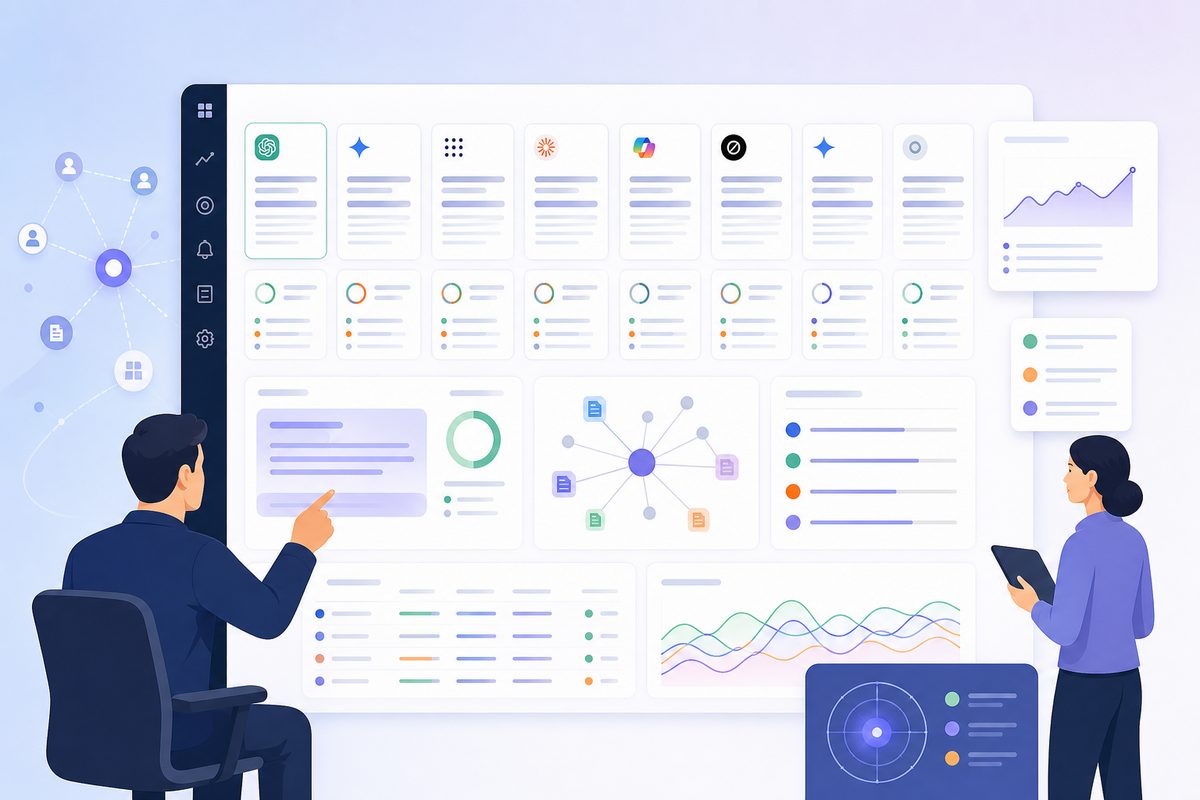
Test platforms separately. Google AI Overviews, Google AI Mode, ChatGPT, Gemini, Claude, Perplexity, Copilot, and other systems may retrieve different sources or update on different schedules.
When selecting software for this workflow, compare whether it preserves prompt-level answers and citations—not merely a single visibility score. This review of Google AI Overviews and AI Mode tracking tools explains the evidence needed for meaningful monitoring.
Which metrics show that entity home SEO is working?
Measure fact accuracy, relationship clarity, and source attribution rather than relying only on visits to the entity-home page. A searcher may consume a correct fact in an answer without clicking the source.
Use these metrics:
- Fact accuracy rate: Points earned divided by the maximum possible score.
- Entity confusion rate: Tests that merge the organization with a namesake or related entity.
- Relationship completeness: Correct parent, product, founder, and location relationships.
- Citation coverage: Answers citing the entity home or an appropriate supporting page.
- Source quality: Proportion of citations from current, accountable sources.
- Description consistency: Frequency of the approved category and differentiators.
- Correction latency: Time between publishing a verified change and observing corrected answers.
- Platform variance: Difference between the highest- and lowest-scoring systems.
- Reconciliation debt: Number and priority of unresolved cross-source discrepancies.
Keep the underlying prompt, answer, citation, screenshot, and date for every score. Without that evidence, a visibility percentage cannot explain what changed or why.
Do not infer causation from one before-and-after test. Recrawling, external coverage, retrieval changes, model updates, personalization, and prompt wording may all affect the result.
Common entity home SEO mistakes
The most damaging mistakes are contradictory facts, unclear entity scope, and unsupported specificity. Additional copy or schema cannot compensate for confusing the company with its products, people, parent, or historical identity.
Avoid these patterns:
- Turning the page into a second homepage filled with slogans and calls to action.
- Publishing a legal name without explaining its relationship to the public brand.
- Marking up facts that are absent from or contradicted by visible copy.
- Adding executive profiles to the organization’s
sameAs. - Using
sameAsfor unrelated directory search results. - Calling every office a headquarters.
- Treating an acquisition announcement as proof of the current legal structure.
- Removing a former name without preserving rebrand continuity.
- Copying founding dates, employee counts, or addresses from unverified directories.
- Describing a parent, subsidiary, product, and brand as interchangeable.
- Creating multiple company pages with overlapping scope and conflicting facts.
- Using
alternateNamefor keyword variants the company has never used. - Publishing “global leader,” “best,” or “most trusted” as identity facts without evidence.
- Creating Wikipedia or Wikidata records merely to manufacture authority.
Entity SEO organizes evidence; it does not manufacture it. A short, precise record is more useful than an impressive-looking page built on circular citations.
Frequently asked questions
Can the homepage be the entity home?
Yes. A homepage can serve as the entity home when it clearly names the organization, explains what it does, identifies important products and relationships, and remains stable enough to act as a reference. A dedicated About or company page is often better when the homepage prioritizes campaigns or frequently changing conversion copy.
Does an entity home guarantee a Knowledge Panel, ranking, or AI citation?
No. An entity home provides clearer first-party evidence, but it does not guarantee a Knowledge Panel, organic ranking, citation, or recommendation. Search and AI systems decide what to crawl, retrieve, corroborate, and display using their own systems and other available sources.
Is Organization schema enough without a company page?
No. Organization schema should mirror accurate, visible information. It cannot replace readable explanations of ownership, product relationships, former names, or location types. Valid schema syntax also cannot make an unsupported claim credible.
Should sameAs link to every page that mentions the company?
No. Use sameAs for authoritative URLs that identify the same organization, such as controlled official profiles or strong entity records. Do not use it for ordinary articles, customer pages, executive profiles, keyword searches, or a different organization with a similar name.
Does a company need Wikipedia or Wikidata for entity SEO?
No. A company can establish a clear entity home without either platform. Wikipedia and Wikidata have their own eligibility, sourcing, and conflict-of-interest requirements. They should not be created solely as SEO assets or populated with unsupported first-party claims.
Should every founder and product have a separate entity home?
Only when the person or product is independently searched for and has enough useful, verified information to justify a dedicated page. Connect separate pages with explicit relationships such as “founded by,” “developed by,” or “owned by.”
How many entity homes should a company have?
Use one primary page per independently meaningful entity and language-market version. Do not create several competing company pages with the same scope. Parent companies, subsidiaries, product brands, people, and physical locations may each need separate pages when their identities are distinct.
How often should an entity home be updated?
Update it whenever a material identity fact changes. Review it at least quarterly to catch stale profiles, broken evidence links, schema discrepancies, and changes introduced elsewhere on the site.
How long does it take search or AI answers to reflect a correction?
There is no reliable universal timeframe. Discovery, crawling, indexing, retrieval, external corroboration, and model update schedules differ by platform. Record the publication date and monitor the same prompts over time instead of promising a fixed correction window.
Build a record with low ambiguity per fact
The best entity home is not the longest corporate biography. It is the page with the lowest ambiguity per fact. Every name has a scope, every relationship has a verb, every material change has a date, and every machine-readable value agrees with visible copy.
Treat entity home SEO as a maintained reconciliation system:
- Select one durable identity page.
- Inventory claims across first- and third-party sources.
- Separate organizations, products, brands, people, and locations.
- Resolve high-impact contradictions.
- Publish concise, evidence-backed relationship statements.
- Mirror verified facts in Organization schema.
- Review the record after every material change.
- Monitor how search and AI systems describe the brand.
The entity home establishes the intended facts. Consistent supporting sources and repeated testing reveal where external understanding still diverges.