Author: maxaeo
A rebrand can reduce AI search visibility when Google, ChatGPT, Gemini, Perplexity, and other answer systems interpret the old and new names as separate companies. Even when organic rankings survive, AI answers may recommend the former brand, attach outdated facts to the new name, or list both names as competitors.
The practical solution is to create a consistent, crawlable, externally corroborated trail connecting the old name to the new one. Establish that trail before launch, synchronize the main identity signals on launch day, and measure both branded accuracy and unbranded recommendation retention for at least 90 days.
There is no universal switch that updates every model. You can, however, make the correct identity substantially easier to retrieve, reconcile, and cite.
What does entity continuity mean during a rebrand?
Entity continuity during a rebrand is the documented, crawlable connection showing that an organization changed its public name without becoming a different company. It links the former and current names to the same history, products, people, legal context, domains, and external profiles so search and answer systems can reconcile both identities.
A complete continuity trail preserves four relationships:
| Relationship | What the evidence must establish |
|---|---|
| Former name → current name | The business was renamed rather than closed or replaced by an unrelated company |
| Current name → company history | Founding date, leadership, products, customers, and milestones belong to the continuing organization |
| Products → current brand | Existing products and services are now correctly attributed to the new name |
| External references → one entity | Profiles using either name describe the same organization and point to its current official properties |
The evidence must be visible in page copy as well as technical markup. A schema change cannot compensate for an About page that implies a new company was founded on the rebrand date.
First determine what actually changed
A public name change, domain migration, acquisition, and product repositioning require different identity relationships. Do not publish “OldName is now NewName” until legal, brand, and communications teams agree that the statement is accurate.
| Rebrand scenario | Relationship to communicate | Main AI search risk |
|---|---|---|
| Public brand rename only | Same company, new public name | Old and new names treated as competitors |
| Legal-name change only | Public brand may be unchanged; legal entity name changed | Contracts and corporate records appear inconsistent |
| Brand and domain change | Same company and history, new name and canonical website | Lost citations, broken redirects, and fragmented authority |
| Company and product rename | Map each former product and company name separately | Product history becomes attached to the wrong parent brand |
| Acquisition or merger | State whether the acquired entity remains, is absorbed, or becomes a product | Buyer, parent, and acquired company conflated |
| Repositioning with a rename | Same organization, but its category or target market also changed | New name inherits neither the old category nor the intended new one |
If the website domain also changes, use a dedicated site migration and AI citation continuity plan. If ownership changes, document predecessor, successor, and parent relationships using an acquisition AEO framework rather than presenting the transaction as a simple rename.
How is an AI search rebrand different from a traditional SEO migration?
Traditional SEO and AI search depend on overlapping evidence, but they expose different failure symptoms. A technically successful migration can preserve rankings while generated answers continue using the former identity.
| Area | Traditional search symptom | AI answer symptom | Measurement |
|---|---|---|---|
| URL transfer | Old pages drop or incorrect pages rank | Answers cite obsolete or irrelevant URLs | Redirect validation, indexation, cited-URL tracking |
| Brand identity | Branded results show mixed names | Old and new names are treated as separate companies | Transition accuracy and collision rate |
| Category relevance | Non-branded rankings decline | Brand disappears from generated shortlists | Recommendation retention and AI share of voice |
| Factual continuity | Snippets show outdated text | Answers combine current branding with old products or ownership | Attribute-level description accuracy |
| Evidence freshness | Search results retain old titles | Model knowledge or retrieved sources lag behind the launch | Source audit plus repeated answer testing |
Organic rankings, cited sources, and generated answers should therefore be monitored separately. A correct answer to “What is NewName?” does not prove that NewName appears when a buyer asks for the best provider in its category.
Why do AI answers lag behind a company name change?
A rebrand initially adds new evidence without removing or updating all the old evidence. Answer systems may encounter the new website alongside years of press coverage, directories, marketplace profiles, customer pages, reviews, documents, and model knowledge using the former name.
Common failure states include:
- The old name is presented as the current company.
- The old and new names appear in the same competitor list.
- The rename is recognized, but the description, ownership, or products are outdated.
- The new name is confused with a similarly named organization.
- The answer is correct, but its citation leads to an obsolete or unrelated page.
- The new name disappears from unbranded category recommendations.
- The answer changes when the prompt, market, language, or account state changes.
When the new name overlaps with another active organization, add stable differentiators such as industry, headquarters, founders, products, legal name, and official domains. Use a brand-name collision and entity disambiguation process to separate genuine name ambiguity from ordinary rebrand lag.
Build a pre-launch AI visibility baseline
Record the old brand’s search and answer visibility four to six weeks before launch whenever possible. Without a baseline, teams cannot distinguish rebrand damage from normal response variability.
For every observation, save:
- Exact prompt or search query
- Engine or search surface
- Date and time
- Country and language
- Logged-in or anonymous state
- Full answer text
- Cited URLs
- Brand position in any list
- Named competitors
- Whether the company description is accurate
- Screenshot or archived result
- Reviewer and review status
Use five prompt groups
- Former-name identity: “What is OldName?” and “Who owns OldName?”
- Current-name identity: Prepare equivalent NewName prompts for the first post-launch wave.
- Transition: “Did OldName change its name?” and “What is OldName called now?”
- Category discovery: “Which platforms solve [specific buyer problem]?”
- Comparison and validation: “OldName alternatives,” “Is OldName suitable for [use case]?” and “OldName vs [competitor].”
Branded prompts detect identity problems. Unbranded prompts show whether the company retained its category associations and recommendation share.
Do not rewrite the fixed prompt set after launch. Add new prompts in a separate exploratory group so the baseline remains comparable.
Create a canonical rebrand identity page
Publish one permanent, indexable page that states the old name, new name, effective date, and what did or did not change. This page should become the authoritative destination for customers, partners, journalists, search systems, and answer engines verifying the transition.
A useful title and heading pattern is:
- Title: OldName Is Now NewName: Official Company Rebrand
- H1: OldName Is Now NewName
- Opening statement: “OldName changed its public name to NewName on [date]. It is the same company and continues to provide [products or services].”
Change the wording if the legal entity, ownership, products, or customer relationships also changed. Accuracy is more important than using a convenient template.
Include a minimum identity packet
The page should answer:
- What were the exact former and current names?
- On what date did the new name take effect?
- Did the legal entity name change?
- Did ownership or leadership change?
- Did products, services, pricing, contracts, or customer accounts change?
- What is the current official domain?
- Which former domains remain controlled by the company?
- Which social, support, billing, privacy, and security pages are official?
- How should old products or documents now be attributed?
- Where can journalists and partners download approved brand assets?
Keep the page live after the launch banner disappears. Link it from the About page, newsroom, footer, relevant product documentation, and legacy URLs that still receive traffic.
Preserve historical evidence without making the old name dominant
Retain former-name references where they explain history or help users complete a task, but label the current name unambiguously. Erasing the previous name can remove the evidence needed to connect old citations, products, executives, and customer documents to the new brand.
Keep transition context in:
- The canonical rebrand page
- The About-page timeline
- Newsroom and press-release archives
- Executive and author biographies
- Product documentation containing legacy terminology
- Customer notices about accounts, contracts, billing, security, or support
- Historical case studies and event materials
- High-traffic pages that still rank for the former name
Do not add both names to every title or heading. Use the former name only where it helps a reader understand the transition.
For archived articles, preserve the original publication date. Add a visible update note when the current brand name is necessary for accuracy rather than silently rewriting history.
Implement the technical transfer
Technical continuity requires relevant one-to-one redirects, updated canonical signals, crawlable identity content, and continued control of former domains. Visual similarity between the old and new sites is not an identity signal.
Use this implementation order:
- Create a complete URL map. Send each changed URL to its closest current equivalent.
- Use server-side permanent redirects. Google treats
301and308redirects as canonicalization signals in its redirect guidance. - Remove redirect chains and loops. Each legacy URL should reach its final destination in one hop where possible.
- Update canonical tags. New pages should normally self-canonicalize to their current URLs.
- Replace old internal links. Do not rely on redirects for navigation, hreflang, structured data, images, or XML sitemaps.
- Publish new XML sitemaps. Include canonical, indexable URLs only.
- Verify crawlability and indexability. The rebrand page, About page, and main product pages must be accessible without authentication or blocked rendering.
- Retain the old domain, DNS, TLS certificate, and redirect infrastructure.
- Annotate the launch in analytics and search reporting.
- Monitor server logs and indexing tools for unresolved old URLs.
Google’s site-move documentation recommends retaining redirects for at least one year. Keep high-value redirects longer when old URLs continue attracting links, visits, or AI citations.
Avoid redirecting every old page to the homepage. Page-level destinations preserve context and give a cited legacy URL a useful current endpoint.
Update Organization structured data without creating a second company
Use one current Organization entity and identify the former brand as an alternate name. Do not publish separate old-name and new-name Organization nodes unless two organizations genuinely remain.
Review these properties:
| Property | Rebrand implementation |
|---|---|
@id |
Use one consistent identifier for the current Organization node across the new site |
name |
Current public organization name |
alternateName |
Former public name and genuine recognized variants |
legalName |
Current legal entity name, if publicly disclosed |
url |
Canonical current website |
logo |
Current crawlable logo |
sameAs |
Current official profiles representing the same organization |
foundingDate |
Original company founding date, not the rebrand date |
founder |
Publicly documented founders |
parentOrganization |
Actual parent company, if applicable |
The visible page copy and structured data must agree. If the website says the legal entity is unchanged, the markup should not imply that a new organization was founded at launch.
Google’s Organization structured data documentation explains how organization details can help Google understand and disambiguate an entity. Structured data does not guarantee a knowledge panel, ranking, citation, or corrected AI answer.
After deployment:
- Validate the rendered markup rather than only the source template.
- Confirm that only one primary Organization node represents the company.
- Remove obsolete profile URLs from
sameAs. - Check that the new logo URL is crawlable.
- Verify that product, website, breadcrumb, and author markup reference the intended organization.
Update external identity sources by evidence value
Prioritize external sources by authority, visibility, and likelihood of influencing buyer research. Updating every social avatar while leaving major partner and marketplace pages unchanged creates a polished but contradictory identity.
| Tier | Source type | Required action | Audit weight |
|---|---|---|---|
| 1 | Corporate, legal, regulatory, security, investor, and official marketplace records | Use the legally accurate name and explain brand-name differences | 5 |
| 2 | Major partners, integrations, customers, industry directories, and executive profiles | Update name, description, URL, logo, and transition context | 3 |
| 3 | Community profiles, event pages, local listings, and minor legacy citations | Correct material errors and record unresolved references | 1 |
Create a partner update kit containing:
- Exact current and former names
- Approved transition sentence
- Effective date
- Current legal name
- Short and long company descriptions
- Current logo files
- Current canonical domain
- Page-level destination URLs
- Contact for questions or verification
Track every request with the source URL, tier, owner, submission date, current status, displayed name, destination URL, and next follow-up date.
Five synchronized authoritative sources can provide a clearer identity trail than dozens of low-quality listings copied from inconsistent databases.
Coordinate launch-day identity signals
Launch the core website, schema, profile, and announcement changes within one controlled release window. Spreading foundational updates over several weeks creates a period in which the new name lacks corroboration.
Use this sequence:
- Publish the canonical rebrand page and updated About content.
- Activate and test the URL redirects.
- Update navigation, internal links, canonicals, hreflang, sitemaps, metadata, and structured data.
- Publish the official announcement using the approved old-to-new statement.
- Update Tier 1 profiles and distribute the partner kit.
- Submit new sitemaps through relevant webmaster tools.
- Test the homepage, transition page, About page, and priority product pages as a crawler and as a user.
- Run direct identity and transition prompts across monitored answer surfaces.
- Log incorrect answers, cited sources, and screenshots.
- Escalate errors involving ownership, security, billing, contracts, or customer access.
- Annotate the date in SEO, analytics, PR, support, and AI visibility reports.
Do not treat launch-day answers as a verdict. Different systems retrieve, crawl, index, or regenerate information at different rates.
Test AI answers with a controlled prompt matrix
Use the same prompts, environments, and scoring rules before and after the rebrand. Repeated runs help reveal answer variability, but they do not eliminate it.
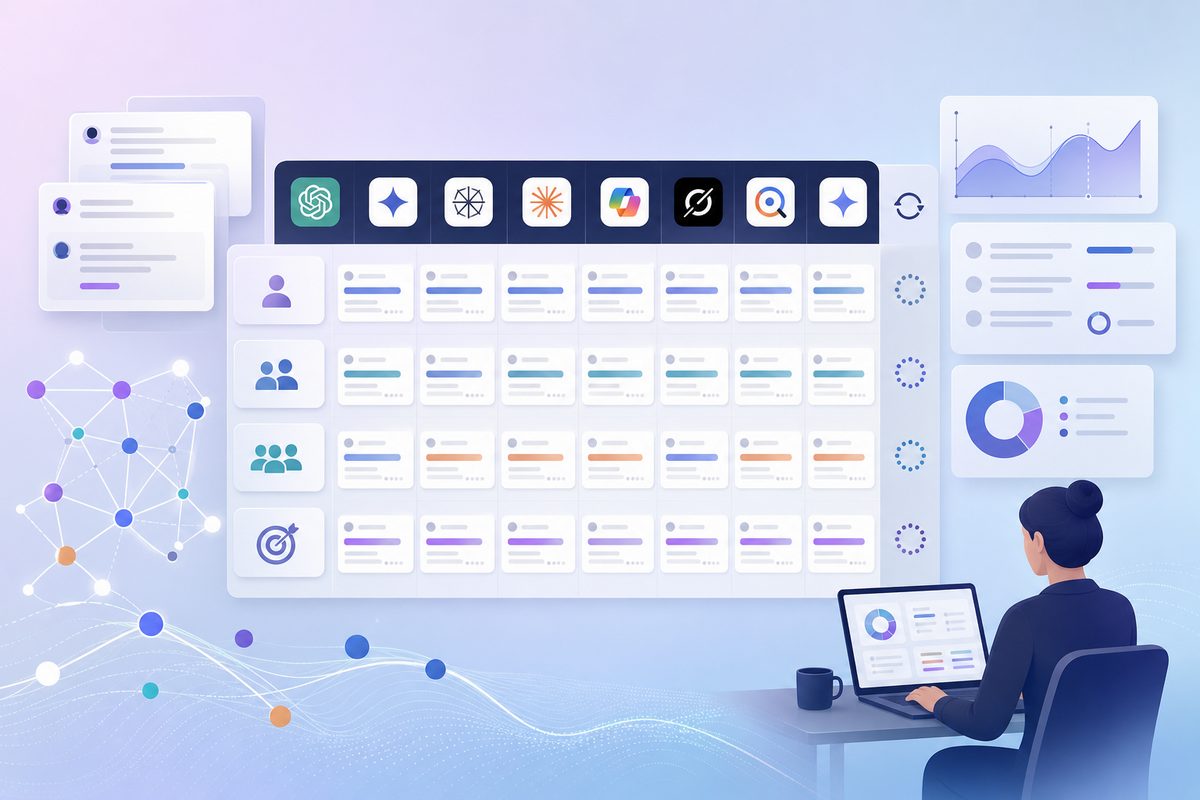
A comprehensive measurement wave can use 24 prompts:
- Six identity and transition prompts
- Six category-discovery prompts
- Six comparison or alternative prompts
- Six reputation, proof, or suitability prompts
Run each prompt three times on eight relevant surfaces, where available:
- ChatGPT
- Gemini
- Perplexity
- Claude
- Microsoft Copilot
- Grok
- Google AI Mode
- Eligible Google AI Overview queries
This design creates 576 scheduled observations per wave: 24 prompts × 3 runs × 8 surfaces. It is a reproducible measurement design, not an industry benchmark.
A smaller team can begin with 12 prompts, two runs, and four priority surfaces for 96 observations per wave. Preserve the same core sample from one wave to the next.
Fix or record:
- Prompt wording
- Locale and language
- Device type where relevant
- Logged-in or anonymous state
- Conversation history
- Search personalization settings
- Engine or model label
- Test date and time
Record “no AI Overview shown” as a separate result. It is not the same as an answer that omits the brand.
Small wording changes can alter which companies an answer names. The prompt wording sensitivity methodology explains why fixed prompts and exploratory variants should be reported separately.
Calculate an Entity Continuity Score
The Entity Continuity Score is a 100-point diagnostic model for testing whether the old and new names resolve to one coherent organization. It is a maxaeo planning framework, not a disclosed Google or LLM ranking factor.
| Layer | Points | Scoring evidence |
|---|---|---|
| Canonical identity | 25 | Permanent transition page, exact effective date, consistent About and product copy, verified official domains |
| Technical transfer | 20 | Relevant redirects, one-hop resolution, updated canonicals and internal links, clean sitemaps, crawlable destinations |
| Structured identity | 15 | One Organization node, current name, former alternateName, correct URL, current profiles, visible-copy parity |
| External corroboration | 20 | Weighted agreement across audited Tier 1, Tier 2, and Tier 3 sources |
| Answer continuity | 20 | Transition accuracy, recommendation retention, and collision-free answers |
Score external corroboration consistently
Give every audited external source its tier weight:
- Tier 1 source: 5 points of weight
- Tier 2 source: 3 points of weight
- Tier 3 source: 1 point of weight
Then calculate:
External corroboration score = 20 × agreeing source weight ÷ total audited source weight
A source “agrees” only when its displayed name, description, company URL, and ownership context are materially correct. A profile with the new logo but the old URL does not fully agree.
Score answer continuity
Convert each percentage to a decimal and calculate:
Answer continuity = (10 × transition accuracy) + (6 × recommendation retention, capped at 100%) + (4 × collision-free rate)
For example, suppose a hypothetical post-launch wave produces:
- 80.6% transition accuracy
- 64.3% recommendation retention
- 95.8% collision-free responses
The answer-continuity layer scores:
(10 × 0.806) + (6 × 0.643) + (4 × 0.958) = 15.75 out of 20
These figures illustrate the calculation. They are not customer results or market benchmarks.
Use the total score for prioritization:
- 90–100: Strong continuity; monitor long-tail prompts and remaining citations.
- 75–89: Mostly coherent; correct concentrated source or engine gaps.
- 50–74: Fragmented identity; prioritize authoritative contradictions.
- Below 50: High confusion risk; manage the rebrand as an active incident.
Never let the total conceal a critical error. Incorrect ownership, security, billing, or contractual information requires immediate action regardless of the score.

Measure visibility transfer with separate metrics
Use distinct metrics for identity, category discovery, citations, and confusion. A single AI visibility score cannot explain why the new brand is missing or inaccurate.
| Metric | Formula | What it diagnoses |
|---|---|---|
| New-name identity accuracy | Correct new-name descriptions ÷ direct new-name responses | Whether the current brand is understood |
| Old-to-new transition accuracy | Responses correctly connecting both names ÷ transition responses | Whether legacy searches reach the new identity |
| Legacy-only answer rate | Responses presenting only the old name as current ÷ returned responses | Failure to recognize the rename |
| Entity collision rate | Responses mixing the company with another entity ÷ returned responses | Name ambiguity or contradictory evidence |
| Recommendation retention | Post-launch unbranded recommendations ÷ baseline unbranded recommendations | Transfer of category relevance |
| Citation carryover | Relevant baseline citations still valid or correctly redirected ÷ relevant baseline citations | Preservation of source continuity |
| Description accuracy | Responses with correct category, products, ownership, and status ÷ assessed responses | Attribute-level factual quality |
| New-name AI share of voice | New-name mentions ÷ all tracked brand mentions in the prompt set | Competitive visibility under the new identity |
Report the numerator and denominator beside every percentage. “Accuracy improved to 80%” is much less useful than “58 of 72 transition responses were correct.”
Count a legacy citation as carried over only when it remains useful or resolves directly to a relevant current page. A redirect to an unrelated homepage should not pass.
Diagnose incorrect answers with a contradiction ledger
Trace each wrong answer to the evidence most likely to sustain it. Repeatedly editing the homepage will not fix an error originating from an authoritative partner profile or unmapped legacy URL.
Create one ledger entry for every material problem:
- Prompt and engine
- Incorrect claim
- Exact answer text
- Cited or likely supporting URL
- Source tier
- Current source wording
- Correct fact and verification source
- Responsible owner
- Corrective action
- Retest date
- Resolution status
Use this remediation map:
| Observed problem | Inspect first | Corrective action |
|---|---|---|
| Old name presented as current | Rebrand page, former homepage, Tier 1 profiles | Make the current identity dominant while preserving a clear rename statement |
| Old and new names listed as competitors | Organization nodes, directories, category pages | Consolidate entity signals and state explicitly that both names refer to one company |
| New name confused with another business | About page, leadership facts, official profiles, domains | Add stable differentiators and correct ambiguous citations |
| Correct name with an outdated product description | Product pages, marketplace listings, cited reviews | Update authoritative product facts and strengthen relevant destinations |
| Brand absent from category recommendations | Baseline prompts, category content, independent evidence | Re-establish the company’s category and use-case relevance under the new name |
| Correct answer with irrelevant citations | Redirect map, canonical tags, cited source content | Redirect to the closest equivalent page and update referring sources |
| Correct answer only when logged in | Test context, memory, prior conversations | Separate personalized and anonymous results in reporting |
| New brand treated as newly founded | About copy, schema, business profiles | Restore the original founding date and explain the rebrand date separately |
Prioritize errors that could change a purchase decision or affect ownership, security, pricing, contracts, billing, or account access.
Follow a 30-, 60-, and 90-day recovery plan
The first 90 days should progress from technical validation to external correction, category recovery, and ongoing governance. Use evidence-based exit criteria rather than promising that every answer engine will update by a fixed date.
| Period | Primary work | Exit criteria |
|---|---|---|
| Days 0–14 | Validate redirects, canonicals, schema, sitemaps, transition page, Tier 1 profiles, and direct identity answers | No critical technical failure; official sources use the correct identity |
| Days 15–30 | Correct high-authority contradictions, review cited URLs, retest identity prompts, and resolve customer-impacting errors | Critical factual errors have been corrected or assigned to named owners |
| Days 31–60 | Update partner and marketplace pages, compare recommendation retention, and strengthen category evidence | Direct-name accuracy is stable; major external contradictions are declining |
| Days 61–90 | Expand long-tail prompts, assess citation carryover, refresh proof content, and formalize reporting | Remaining issues have documented severity, owners, actions, and retest dates |
| After day 90 | Monitor new prompts, new citations, competitors, sentiment, and product changes | Rebrand monitoring is incorporated into normal brand and search operations |
Do not remove the transition page after 90 days. Former-name searches, old documents, backlinks, press coverage, and model knowledge can persist for years.
Report business outcomes, not screenshot volume
A useful rebrand dashboard shows whether buyers can still discover, recognize, and verify the company. Screenshots provide evidence, but they are not a performance metric.
Report weekly during the initial transition:
- Entity Continuity Score and layer-level movement
- Direct identity accuracy by engine
- Transition accuracy
- Legacy-only and entity collision rates
- Unbranded AI share of voice
- Recommendation retention by buyer use case
- Description accuracy by factual attribute
- Citation carryover and newly cited sources
- Branded organic impressions, clicks, and ranking changes
- Referral traffic from answer and search surfaces
- Open issues by severity, owner, and source tier
- External profiles corrected during the period
Separate actions from outcomes:
- Action: Ten partner pages were updated.
- Outcome: Old-to-new transition accuracy increased from 62.5% to 80.6%.
- Business signal: Demo requests using the former brand name declined while new-name assisted conversions increased.
Segment results by engine. An aggregate score can hide a serious failure on one buyer-relevant surface.
A defensible monitoring system should retain raw answers, citations, prompts, context settings, timestamps, screenshots, and reviewer decisions. See the practical workflow for tracking brand mentions in ChatGPT and other AI answers.
Rebranding mistakes that create persistent AI confusion
The most damaging mistakes remove historical evidence, divide one company into duplicate entities, or validate only the new branded query.
Avoid:
- Deleting former-name content without a durable transition page
- Redirecting every legacy URL to the homepage
- Letting old-domain registration or TLS expire while links still exist
- Using the rebrand date as the founding date
- Publishing separate Organization entities for the old and new brands
- Updating social profiles while ignoring corporate, partner, and marketplace sources
- Changing the company name, product names, domain, and positioning without an explicit relationship map
- Replacing historical article dates with the rebrand date
- Treating one correct ChatGPT answer as proof of cross-engine continuity
- Comparing logged-in post-launch results with anonymous baseline results
- Rewriting the prompt set and losing before-and-after comparability
- Counting an absent AI Overview as a negative brand mention
- Publishing unsupported claims solely to influence generated answers
- Ending monitoring when direct branded prompts become accurate
Good answer engine optimization does not manufacture identity evidence. It makes accurate, corroborated facts easier to discover, reconcile, and cite.
Frequently asked questions
How long does it take AI search engines to recognize a rebrand?
There is no dependable universal timeline. Recognition varies with crawling, retrieval, model knowledge, source consistency, engine, prompt wording, location, and account context. Test weekly against a pre-launch baseline and report results by engine instead of promising a fixed recovery date.
Will a rebrand hurt Google rankings?
It can, especially when URLs, domains, page content, or category positioning change at the same time. Relevant permanent redirects, updated canonicals, preserved content relationships, and continued control of the old domain reduce migration risk. AI answer accuracy should still be measured separately from organic rankings.
Should the old company name remain on the website?
Yes, where it explains the transition or helps users verify historical information. Keep it on the canonical rebrand page, About-page timeline, relevant documentation, and selected archives. The new name should remain dominant, and every retained reference should make the relationship clear.
Can Organization schema alone preserve rebrand AI search visibility?
No. Schema can clarify the current name, alternate name, legal name, website, and official profiles, but it cannot override contradictory external sources or guarantee a generated answer. It works best when it matches visible copy, redirects, profiles, and authoritative citations.
Should a company monitor only brand mentions in ChatGPT?
No. Monitor the answer surfaces your buyers use and include identity, transition, category, comparison, reputation, and suitability prompts. Unbranded prompts are essential because buyers may discover the company without entering either brand name.
Does a rebrand require a completely new prompt library?
No. Preserve the fixed baseline prompts needed for comparison, then add NewName and transition variants. Removing the former-name prompts hides whether customers using the legacy brand can still find the correct company.
Can a company directly update an AI model’s memory?
Generally, there is no single request that updates every model or answer surface. Correct the authoritative sources, maintain redirects, use provider feedback tools where appropriate, and track whether retrieved answers improve. Do not assume that correcting one response changes the underlying model globally.
What if the brand name, domain, products, and positioning all change together?
Create a relationship map covering company, legal entity, domains, products, founders, ownership, and categories before publishing. Explain each relationship explicitly and monitor identity transfer separately from category-association transfer. Otherwise, teams may fix the rename while missing a loss of unbranded discovery.
Final rebrand AI search visibility checklist
A successful rebrand preserves the company’s history, discoverability, citations, and category relevance while making the current name unmistakable.
Before closing the transition project, confirm that:
- A permanent page explains the former and current names.
- The effective date and legal-entity status are accurate.
- About, product, support, privacy, billing, and security pages agree.
- Every changed high-value URL has a relevant direct redirect.
- Canonicals, internal links, hreflang, and sitemaps use current URLs.
- The former domain remains controlled and serves valid redirects.
- One Organization entity uses the current name and appropriate alternate name.
- The founding date reflects the company’s history, not the rebrand launch.
- Priority external profiles and partner pages use the correct identity.
- Historical content retains useful former-name context.
- A fixed pre-launch prompt baseline is preserved.
- Direct, transition, category, comparison, and reputation prompts are monitored.
- Logged-in, anonymous, market, and language contexts are recorded.
- Wrong answers are connected to evidence, owners, corrective actions, and retests.
- Identity accuracy, recommendation retention, citations, and collisions are reported separately.
- Monitoring continues after direct branded prompts begin returning the correct name.
The goal is not to erase the old brand from the web. It is to leave a coherent evidence trail showing that the organization continued, the name changed, and the new identity should inherit the former brand’s legitimate history, authority, and category relevance.