By maxaeo · Updated July 14, 2026
An AI visibility prompt library is a governed, version-controlled set of real buyer questions used to test whether answer engines mention, recommend, cite, and accurately describe a brand. Each prompt has a business purpose, metadata, owner, weight, lifecycle status, and preserved run history so results remain comparable over time.
A list of generated questions helps with discovery. A maintained library becomes a measurement system: it defines what the business monitors, how tests are run, which outcomes count, and when prompts should change.
This guide provides:
- A minimum viable prompt-record schema
- A copyable library of 60 prompt templates
- A seven-gate prompt acceptance test
- Rules for variants, weights, baselines, and version control
- Metric formulas with explicit denominators
- A worked monitoring example
- Weekly, monthly, quarterly, and event-driven governance
What Is the Difference Between a Prompt List and a Prompt Library?
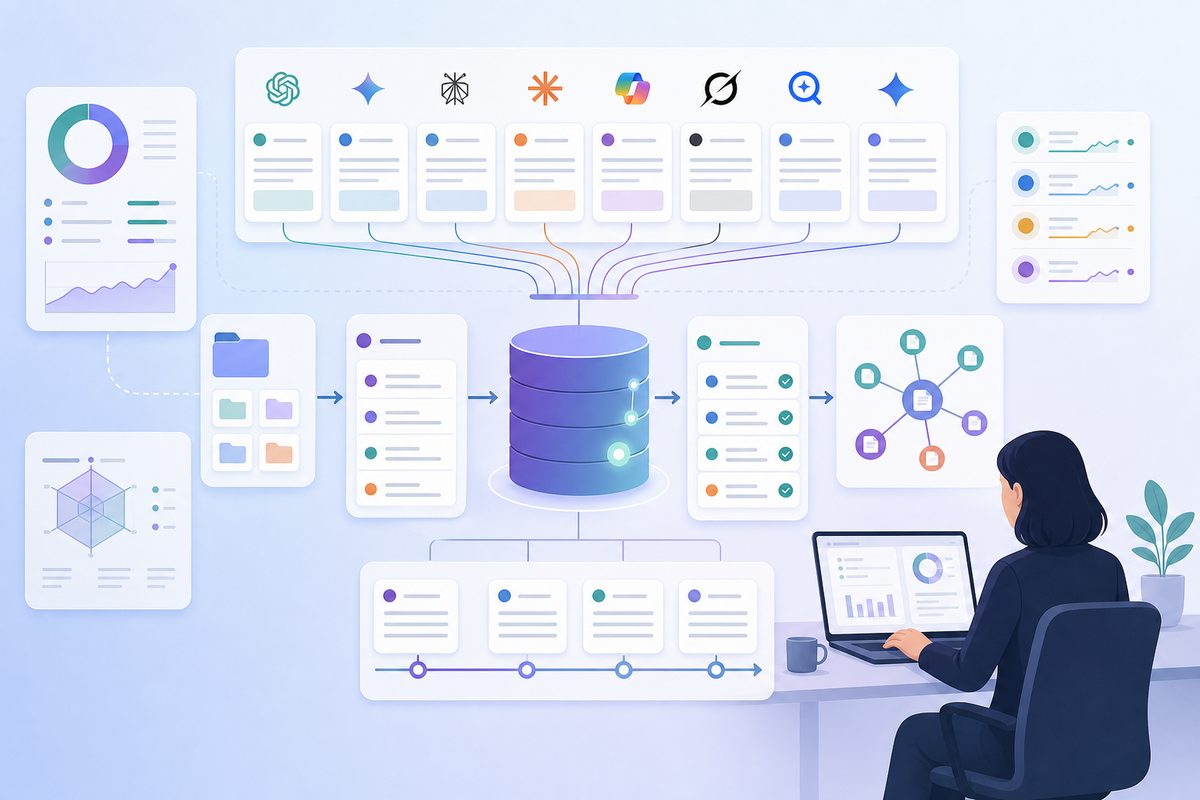
A prompt list stores questions. A prompt library governs questions as measurement assets. It preserves exact wording, business context, test settings, raw answers, ownership, and version history so teams can compare results without confusing methodological changes with genuine visibility changes.
| Prompt list | AI visibility prompt library |
|---|---|
| Captures ideas | Defines a measurable portfolio |
| Often created once | Reviewed on a declared cadence |
| Stores prompt text | Stores wording, metadata, ownership, and history |
| Treats every row equally | Weights prompt families by business importance |
| Replaces old wording | Versions material wording changes |
| Counts mentions | Separates mentions, recommendations, citations, and accuracy |
| Grows without limits | Uses admission, deduplication, and retirement rules |
| May discard outputs | Preserves raw answers and cited evidence |
The critical principle is that the prompt is part of the measurement instrument. If the wording, model, market, or session context changes, the result may change even when the brand’s market position has not.
Why Do One-Time Prompt Lists Produce Misleading Results?
One-time lists break down because they overrepresent easy questions, accumulate duplicate variants, and lose the context needed to explain changes. The result is often more data but less confidence.
The most common failure modes are:
- Coverage bias: Informational prompts dominate while commercial comparisons, shortlists, objections, and factual-risk questions receive little coverage.
- Paraphrase inflation: Ten versions of one question give a narrow use case ten times the influence of a single-prompt topic.
- Historical discontinuity: A prompt is edited in place, but the reporting chart treats the new wording as the same measurement series.
- Configuration drift: A different model, geography, login state, or browsing setting creates an apparent visibility change.
- Invalid denominators: Failed runs are counted as brand absences, or citation rates include surfaces that do not expose citations.
- Metric collapse: Mentions, recommendations, positive descriptions, and citations are combined into one score even though they answer different questions.
- Missing accountability: No owner is responsible for reviewing obsolete products, competitors, claims, or buyer language.
Wording deserves explicit control. “What are the best platforms?”, “Which platforms should I shortlist?”, and “Which platform is most reliable?” may express a related need but elicit different answer sets. Controlled variants can reveal that sensitivity; uncontrolled variants distort the portfolio. See the analysis of how prompt wording changes AI answers.
What Should an AI Visibility Prompt Library Contain?
A durable library has four connected layers: a portfolio map, prompt register, run matrix, and evidence log. Keeping them separate prevents a wording change or model update from overwriting historical evidence.
1. Portfolio map
The portfolio map defines the market the library is intended to represent. Use rows for topics or use cases and columns for dimensions such as buyer stage, persona, market, or prompt type.
It should answer:
- Are the highest-value use cases represented?
- Are both branded and non-branded discovery covered?
- Can the library distinguish education from commercial recommendation?
- Are important objections and factual risks included?
- Does one audience, region, or prompt family dominate the sample?
- Which required portfolio cells have no active prompt?
A simple coverage metric is:
Coverage rate = weighted required cells with at least one accepted prompt ÷ all weighted required cells
Weighting the cells prevents ten low-value informational topics from making the library appear complete while one revenue-critical shortlist topic remains uncovered.
2. Prompt register
Each prompt needs a permanent ID and enough metadata to make the result interpretable.
| Field | What to record |
|---|---|
| Prompt ID | Stable identifier, such as SEC-SHORT-011 |
| Exact wording | The text submitted to the answer engine |
| Prompt family | The underlying buyer need shared by controlled variants |
| Version | Current semantic version of the wording |
| Persona | Practitioner, manager, executive, procurement, or evaluator |
| Journey stage | Awareness, consideration, evaluation, decision, or post-purchase |
| Intent | Learn, discover, compare, shortlist, validate, troubleshoot, or purchase |
| Topic and use case | The problem or capability being measured |
| Brand mode | Non-branded, branded, competitor-led, or category-plus-brand |
| Market | Geography, language, and relevant regulatory context |
| Expected answer shape | Explanation, list, comparison, recommendation, or factual answer |
| Scoring target | Mention, recommendation, rank, citation, accuracy, or positioning |
| Family weight | Commercial or strategic importance of the underlying need |
| Risk level | Consequence of an inaccurate or hostile answer |
| Owner | Person accountable for continued relevance |
| Status | Draft, experimental, active, frozen, or retired |
| Inclusion rationale | The decision this prompt helps the business make |
| Review trigger | Event or date that requires reassessment |
| Added and reviewed dates | Lifecycle audit trail |
A minimum viable spreadsheet can begin with this header:
prompt_id,prompt_family,version,exact_wording,persona,journey_stage,intent,topic,brand_mode,market,answer_shape,scoring_target,family_weight,risk,owner,status,inclusion_rationale,review_trigger
3. Run matrix
The run matrix defines how prompts are tested. Store these settings with every run:
- Answer engine and product surface
- Model or model family, when visible
- Run timestamp and timezone
- Country, region, and language
- Logged-in or logged-out state
- Personalization state, when controllable
- Web-search or browsing availability
- Fresh session or multi-turn conversation
- Number of repeated runs
- Device or interface, if it changes the product experience
- Collection method and extractor version
Do not silently pool ChatGPT, Google AI Mode, AI Overviews, Gemini, Perplexity, Claude, and Microsoft Copilot. A combined executive score can be useful, but model- and surface-level results must remain available underneath it.
4. Evidence log
For every valid response, preserve:
- Full answer text
- Brand presence and surrounding description
- Recommendation status and position, when the answer is ordered
- Named competitors
- Cited URLs and the claims they support
- Factual claims evaluated
- Error, refusal, or incomplete-run reason
- Capture date and run configuration
- Screenshot or response archive for material findings
- Reviewer notes and corrective action
A binary mention field cannot show whether the answer recommended the brand, criticized it, confused it with another company, or repeated an obsolete product claim. The evidence log turns LLM brand tracking into an auditable reputation and discovery program.
60 AI Visibility Prompts You Can Copy
The following templates cover discovery, education, commercial evaluation, reputation, proof, implementation, and entity accuracy. Replace the bracketed variables with language a real buyer would use.
Use:
[brand]for the monitored company[competitor]for a named alternative[category]for the product or service category[audience]for the buyer or user[use case]for the problem being solved[constraint]for a technical, financial, or operational requirement[region]for the target market
These 60 questions form a candidate pool, not a mandatory permanent portfolio. Select prompts supported by buyer evidence, then group intentional variants into families. For additional brand-oriented examples, use the 60-prompt framework for AI brand monitoring.
Non-branded category discovery
- What are the leading
[category]platforms for[audience]? - Which tools help
[audience]solve[use case]? - What software should a company evaluate when it needs to
[use case]? - Which
[category]providers serve organizations in[region]? - What types of products can solve
[use case], and when should each be used? - Which companies are known for
[category]capabilities?
Problem education and category formation
- What is the most effective way for
[audience]to address[use case]? - What causes
[problem], and which tools can help prevent it? - When does a company need a dedicated
[category]platform? - What capabilities are essential for solving
[use case]? - What is the difference between
[category]and[adjacent category]? - What should buyers understand before evaluating
[category]vendors?
High-intent shortlists
- What are the best
[category]platforms for[audience]? - Which
[category]tools should a[company type]shortlist? - What are the most reliable solutions for
[use case]? - Which
[category]vendors are best suited to[company size]companies? - What are the top
[category]platforms available in[region]? - Which three
[category]products would you recommend for[audience], and why?
Constraint-based recommendations
- Which
[category]tools support[required integration]? - What is the best
[category]platform for a team with[constraint]? - Which vendors can meet
[security, compliance, or data-location requirement]? - What
[category]products work well for companies using[technology stack]? - Which
[category]platforms are suitable for[regulated industry]? - What is the best option for
[use case]with a budget of[budget range]?
Alternatives and comparisons
- What are the main alternatives to
[brand]? - How does
[brand]compare with[competitor]for[use case]? - Which is better for
[audience]:[brand]or[competitor]? - What are the differences between
[brand],[competitor A], and[competitor B]? - Which
[brand]alternative offers[required capability]? - When should a buyer choose
[brand]instead of[competitor]?
Branded validation
- What does
[brand]do? - Who is
[brand]designed for? - Is
[brand]a good choice for[use case]? - What are
[brand]’s main products and capabilities? - Does
[brand]support[integration, region, or compliance requirement]? - Where does
[brand]fit within the[category]market?
Objections and reputation
- What are the main limitations of
[brand]? - What do customers commonly like and dislike about
[brand]? - What should buyers verify before choosing
[brand]? - Is
[brand]trustworthy for[high-risk use case]? - Has
[brand]had any significant security, legal, or service issues? - Which types of customers may not be a good fit for
[brand]?
Evidence, authority, and trust
- What evidence supports
[brand]’s claims about[capability]? - Which
[category]vendors publish credible research about[topic]? - What case studies show that
[brand]can deliver[outcome]? - Which independent sources compare
[brand]with its competitors? - What certifications, audits, or third-party validations does
[brand]have? - Which sources should a buyer consult before selecting a
[category]provider?
Implementation and post-purchase fit
- How should a company implement
[brand]for[use case]? - How long does a typical
[category]implementation take? - What skills and resources are needed to deploy
[brand]? - How does
[brand]integrate with[technology or workflow]? - What implementation risks should teams plan for when adopting
[category]? - How should a buyer measure success after deploying
[brand]?
Entity and factual accuracy
- Who owns
[brand]? - Where is
[brand]headquartered, and which markets does it serve? - Who founded
[brand], and who currently leads the company? - Has
[brand]acquired, merged with, or been acquired by another company? - What is
[brand]’s current product name, category, and pricing approach? - Is
[brand]the same company or product as[similar entity name]?
How Do You Build an AI Visibility Prompt Library?
Build the library from business decisions and observed buyer language—not from model-generated ideas alone. The most reliable sequence is decisions, evidence, coverage design, candidate generation, acceptance testing, deduplication, weighting, and baseline collection.
Step 1: Define the decisions the data must support
Begin with three to five decisions. Examples include:
- Which use cases are losing non-branded discovery?
- Which competitors dominate commercial shortlists?
- Does the brand appear for high-intent enterprise requirements?
- Which inaccurate descriptions require correction?
- Which cited sources influence recommendations?
- Where is the brand known but not recommended?
If a prompt’s result would not change a marketing, product, sales, communications, or reputation decision, it probably does not deserve permanent monitoring.
Step 2: Gather buyer language from evidence
Prioritize sources according to their proximity to the buyer:
- Direct buyer evidence: Sales-call transcripts, discovery notes, request-for-proposal language, support tickets, implementation questions, and customer interviews.
- Behavioral evidence: Site search, product-search logs, paid-search terms, organic queries, comparison-page visits, and help-center searches.
- Market evidence: Community discussions, reviews, competitor pages, analyst terminology, conference agendas, and regulatory guidance.
- Expansion evidence: Keyword tools and language-model brainstorming used to reveal missing formulations.
Do not copy sensitive customer language into external answer engines. Convert confidential examples into generalized questions before testing.
For a broader process, see keyword research for AI search.
Step 3: Design the required coverage matrix
Define the dimensions before generating prompts. A focused B2B library might require coverage across:
| Dimension | Example values |
|---|---|
| Journey stage | Awareness, consideration, evaluation, decision |
| Prompt type | Discovery, education, shortlist, comparison, validation, reputation, entity |
| Persona | Practitioner, manager, executive, procurement, technical evaluator |
| Use case | Core problem areas tied to products or services |
| Brand mode | Non-branded, branded, competitor-led |
| Market | Country, region, language, regulatory context |
| Risk | Low, medium, high, critical |
Mark required cells and assign greater coverage weight to commercially important or high-risk areas. Do not require every possible combination; that creates a combinatorial explosion with little decision value.
Step 4: Generate candidates and account for query fan-out
Create several natural questions for each required cell. Include the explicit question and the adjacent subquestions an answer engine may use to resolve it: requirements, definitions, comparisons, evidence, risks, integrations, and regional constraints.
This matters because a broad user question can expand into multiple hidden information needs. The guide to query fan-out in AI search explains how those branches affect which sources and brands may be selected.
Candidate generation expands coverage. It does not determine which prompts become active.
Step 5: Apply the maxaeo Seven-Gate Acceptance Test
A candidate must pass the first four gates and at least six of seven overall.
| Gate | Acceptance question | Reject when |
|---|---|---|
| Business relevance | Would a change affect a real decision? | The result is interesting but unactionable |
| Buyer realism | Could the target audience plausibly ask it? | It uses internal jargon or artificial keyword syntax |
| Clear intent | Can the user’s task be classified consistently? | Reviewers disagree about what the user wants |
| Scorable answer | Can the target outcome be identified reliably? | “Success” depends on subjective interpretation |
| Incremental coverage | Does it add a use case, stage, audience, market, risk, or controlled test? | It merely restates an existing prompt |
| Repeatability | Can it run without missing documents or conversation context? | It depends on “the report above” or another unnamed input |
| Maintainability | Does it have an owner and review trigger? | No one can decide when it becomes obsolete |
Failing business relevance is an automatic rejection. A realistic, scorable prompt still has no measurement value if nobody would act on the result.
Step 6: Create prompt families
A prompt family represents one underlying buyer need. Variants belong in the same family when they preserve the user, use case, commercial stage, and expected answer shape.
Keep a variant only when it tests a documented hypothesis, such as:
- “Best” versus “recommended”
- “Platform” versus “tool”
- Technical-evaluator language versus executive language
- A local market term versus a global category term
- A budget, compliance, or integration constraint
Do not treat grammatical differences as independent demand. If a family contains three active variants, it should not automatically receive three times the portfolio weight.
Step 7: Assign family weights
Use a 1–5 weight based on stable business value:
| Weight | Meaning |
|---|---|
| 1 | Useful context with limited commercial or reputation impact |
| 2 | Relevant supporting topic |
| 3 | Material use case or audience |
| 4 | High-intent, high-revenue, or high-risk decision |
| 5 | Strategic priority or critical factual/reputation exposure |
Document the reason for every weight of 4 or 5. Never reduce a weight because the brand performs poorly.
To prevent paraphrase inflation, divide the family weight across its active variants:
Variant weight = prompt-family weight ÷ number of active variants in that family
A family with weight 5 and five wording variants therefore contributes the same maximum portfolio weight as a family with weight 5 and one prompt.
Step 8: Approve the run protocol and capture a baseline
Freeze the initial prompt wording and test configuration before collecting the baseline. Preserve raw outputs and label the first complete, quality-checked cycle as the baseline.
OpenAI’s official evaluation guidance treats evaluations as structured tests with defined criteria rather than isolated prompting. An AI visibility library applies the same discipline to brand-discovery and recommendation questions.
How Many Prompts Should You Monitor?
There is no universal target. Use the smallest active set that covers material buyer decisions without allowing duplicate families to dominate. A focused B2B company can often begin with 40–100 governed prompts, while multi-product or multi-market organizations may need separate connected libraries.
The prompt count is only one part of the workload:
Responses per cycle = active prompts × answer-engine surfaces × markets × repeated runs
For example:
60 prompts × 5 surfaces × 2 markets × 3 runs = 1,800 responses per cycle
Daily collection would produce 54,000 responses in a 30-day month. Storage, extraction, citation capture, review, and quality assurance usually matter more than the number of spreadsheet rows.
A balanced 60-prompt starting allocation could be:
| Prompt group | Count | Share |
|---|---|---|
| Non-branded discovery and education | 12 | 20% |
| Shortlists and constrained recommendations | 12 | 20% |
| Comparisons and alternatives | 8 | 13% |
| Branded validation | 6 | 10% |
| Reputation and objections | 6 | 10% |
| Evidence and trust | 6 | 10% |
| Implementation | 4 | 7% |
| Entity and factual accuracy | 6 | 10% |
| Total | 60 | 100% |
This allocation is a planning model, not an industry benchmark. Change it to reflect the company’s revenue mix, buyer journey, markets, and risk exposure.
Should Prompts Be Repeated?
Yes, if the goal includes measuring answer variability. Repeated runs reveal whether a brand is consistently present or appears only intermittently, but three runs do not make a result statistically conclusive.
Use these rules:
- Run each repetition in a fresh session unless multi-turn behavior is the object of the test.
- Keep the prompt, surface, market, language, and account state unchanged.
- Run repetitions within a declared time window.
- Store each response separately; do not keep only the most favorable answer.
- Report the numerator and denominator alongside every rate.
- Increase repetitions for high-risk or highly variable prompt families.
- Treat conversational-journey tests as a separate dataset from single-turn monitoring.
A result of “2 mentions from 3 runs” conveys more uncertainty than “40 mentions from 60 runs,” even though the first percentage is higher. Dashboards should expose that difference.
How Should AI Visibility Be Measured?
Measure distinct outcomes before combining them. A brand can be mentioned without being recommended, recommended without receiving a supporting citation, or cited while being described inaccurately.
| Metric | Definition |
|---|---|
| Mention rate | Valid responses naming the brand ÷ valid responses |
| Recommendation rate | Valid responses explicitly recommending or shortlisting the brand ÷ valid responses |
| First-recommendation rate | Ordered recommendation answers placing the brand first ÷ valid ordered answers |
| Brand-source citation rate | Cite-capable responses linking to an approved brand-controlled source ÷ valid cite-capable responses |
| Presence share of voice | Response-level brand presences ÷ response-level presences for all tracked brands |
| Claim accuracy rate | Evaluated factual claims judged correct ÷ all evaluated factual claims |
| Category alignment rate | Brand mentions using the approved category description ÷ responses mentioning the brand |
| Competitor co-mention rate | Responses naming both the brand and a tracked competitor ÷ responses mentioning the brand |
Count each brand once per response when calculating presence share of voice. Otherwise, an answer that repeats one brand name five times can distort the metric without representing five independent recommendations.
Use explicit recommendation labels
A practical scoring rubric is:
| Score | Observable outcome |
|---|---|
| 0 | Brand absent |
| 1 | Brand named but not recommended |
| 2 | Brand included in a relevant shortlist |
| 3 | Brand explicitly recommended or placed first in a meaningful ordered list |
Do not assign a first-place score when the answer says its list is unordered or presents alphabetical results.
Calculate a weighted portfolio score carefully
One possible executive metric is:
Weighted visibility = Σ(variant weight × surface weight × outcome score) ÷ maximum possible weighted score
Keep the underlying mention, recommendation, citation, accuracy, prompt-family, and surface results visible. A combined score is a navigation aid, not the evidence itself.
Fix the denominator before reporting
A run should be excluded from the visibility denominator when:
- The surface returned a technical error
- Collection failed before an answer was captured
- The response was empty or unrelated because of a system failure
- A login, location, or consent wall blocked the test
A refusal can be a valid observable outcome if the refusal was produced normally in response to the prompt. Report it separately rather than silently turning it into an absence.
Citation rates should use only surfaces and runs where citations are available. Otherwise, the metric penalizes a brand for a product-interface limitation.
How Do You Version Prompts Without Breaking Trends?
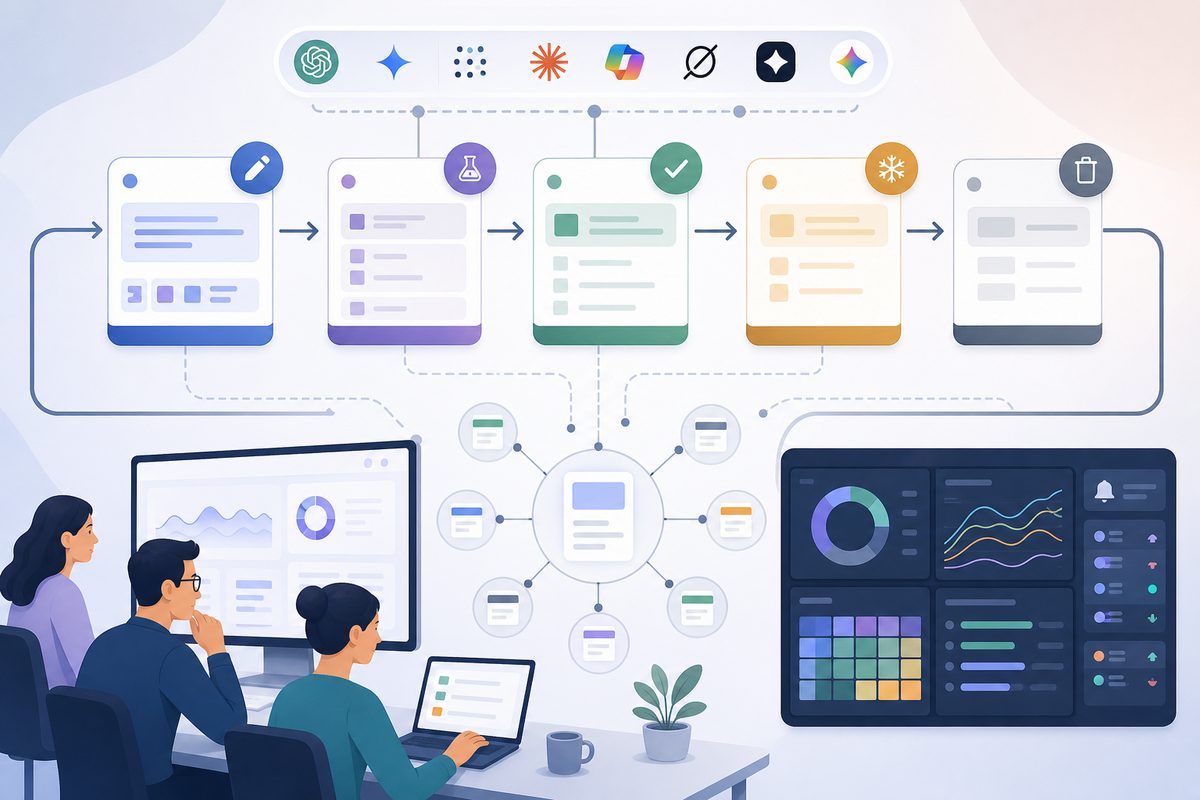
Create a new analytical version when a change alters the user, category, constraint, market, or expected answer. Preserve the old wording and results. Never overwrite a historical prompt series.
Use five lifecycle states:
| Status | Meaning |
|---|---|
| Draft | Proposed but not approved |
| Experimental | Tested for realism, incremental coverage, or wording sensitivity |
| Active | Included in recurring reporting |
| Frozen | Preserved without routine edits, often for an overlap comparison |
| Retired | No longer run; history and rationale retained |
Apply different controls to different changes:
| Change | Required action |
|---|---|
| Punctuation or obvious typo | Correct and log; series may continue |
| Equivalent formatting change | Log the change and preserve a comparison run if uncertain |
| Material wording change | Create a new prompt version |
| New persona, use case, or market | Create a successor prompt or new prompt ID |
| Model, surface, location, or session change | Create a new run-configuration version |
| Weight change | Create a new portfolio version with an effective date |
| Product or company rename | Preserve the old prompt and connect it to the successor |
For a material change, run the old and new versions in parallel for at least one measurement window. This overlap shows whether the wording itself creates a discontinuity.
A version event should contain:
- Old and new wording
- Reason for the change
- Approver
- Effective date
- Related prompt-family ID
- Reports affected
- Whether the series continues or restarts
- Link to the predecessor or successor
What Run Controls Make Results Comparable?
Comparable monitoring requires a declared protocol. Exact control is not always possible on consumer answer-engine products, but uncontrolled variables should be recorded rather than ignored.
Use fresh sessions for the primary benchmark
Fresh sessions reduce carryover from earlier messages. Keep multi-turn tests when they represent a real research journey, but store them in a separate cohort because conversation history changes the prompt context.
Separate personalized and neutral tests
If logged-out testing is available, use it as the primary neutral benchmark. Logged-in or personalized tests can reveal the customer experience, but they should not be pooled with neutral runs.
Preserve model and interface changes
A product may change its model, retrieval behavior, citation interface, or answer format. Record the visible configuration and annotate known changes. Do not assume a sudden portfolio movement was caused by the brand.
Control time and geography
Run comparison cycles in similar time windows and from declared markets. Location can change availability, sources, regulations, and recommendations. Language translations should be separate prompt versions because translation changes more than geography.
Distinguish monitoring from research
Recurring monitoring needs stable prompts. Exploratory research can use follow-ups, open-ended queries, and temporary experiments. Promote an experimental prompt only after it passes the acceptance gates.
What Tool Should Store the Library?
The correct tool depends on the complexity of the program, not the sophistication of the software.
| Setup | Best fit | Main limitation |
|---|---|---|
| Governed spreadsheet | One team, limited markets, manual review | Weak raw-response storage and concurrency controls |
| Relational database | Multiple surfaces, markets, versions, and long histories | Requires engineering and reporting work |
| AI visibility platform | Automated collection, extraction, and dashboards | May hide scoring logic or limit raw-data portability |
| Hybrid system | Platform collection plus internal evidence warehouse | More integration and governance work |
Whatever the tool, require:
- Stable prompt and family IDs
- Exportable raw responses
- Versioned run configurations
- Separate prompt, run, and evidence tables
- Documented scoring logic
- Role-based ownership
- Audit history
- Reproducible reporting queries
Automation can run prompts. It cannot decide whether the portfolio still represents buyer demand.
Who Should Own the Prompt Library?
Use one portfolio owner and distributed subject owners. Central governance protects consistency; product, sales, brand, and regional reviewers protect relevance.
| Role | Primary responsibility |
|---|---|
| Portfolio owner | Coverage, schema, quality gates, capacity, and reporting continuity |
| Prompt steward | Wording, metadata, prompt families, and lifecycle updates |
| Product or category owner | Technical accuracy and use-case relevance |
| Brand or communications owner | Positioning, reputation, and entity accuracy |
| Regional owner | Local terminology, competitors, regulations, and language |
| Analyst | Run integrity, extraction, scoring, and anomaly review |
| Executive sponsor | Strategic priorities, budget, and escalation decisions |
One person may hold several roles. The essential control is that every active prompt has one accountable owner.
The library should connect to a broader AEO program operating model. Monitoring produces value only when findings lead to source improvements, content changes, entity corrections, product messaging, digital PR, or distribution work.
What Maintenance Cadence Keeps the Library Trustworthy?
Use different cadences for collection quality, evidence review, portfolio design, and material business changes.
Weekly: validate collection
Check:
- Failed and blocked runs
- Missing or malformed citations
- Duplicate captures
- Extraction errors
- Unexpected answer-format changes
- Configuration drift
- Unreviewed critical factual claims
Monthly: review outcomes and evidence
Analyze:
- Prompt families gaining or losing mentions
- Gaps between mention and recommendation rates
- New or disappearing cited domains
- Competitor movement
- Category-description changes
- Recurring objections
- Factual errors and assigned corrections
- Results with small or unstable denominators
Quarterly: rebalance the portfolio
Review coverage by persona, use case, journey stage, market, prompt family, risk, and weight. Retire obsolete questions, promote useful experiments, and add prompts supported by new buyer evidence.
Set an active-prompt capacity. New prompts should compete for space rather than expanding the library indefinitely.
Event-driven: review after material changes
Trigger immediate review after:
- A product launch or retirement
- Repositioning or a category change
- A pricing-model change
- A merger, acquisition, or company rename
- Entry into a new market
- A significant regulatory change
- A major answer-engine product change
- A new competitor or substitute category
- Repeated factual errors or a reputation incident
- Sales evidence that buyer language has shifted
What Does a Worked 60-Prompt Library Look Like?
Consider an illustrative cybersecurity software company monitoring 60 prompts across five answer-engine surfaces with three repeated runs:
60 × 5 × 3 = 900 responses per cycle
Assume 24 prompts cover high-intent comparisons and shortlists:
24 × 5 × 3 = 360 high-intent responses
The brand appears in 126 of those responses and receives an explicit recommendation in 45:
- Mention rate: 126 ÷ 360 = 35%
- Recommendation rate: 45 ÷ 360 = 12.5%
Now assume only three selected surfaces expose citations consistently. The citation-eligible denominator is:
24 prompts × 3 cite-capable surfaces × 3 runs = 216 responses
If 27 responses cite an approved brand-controlled source:
- Brand-source citation rate: 27 ÷ 216 = 12.5%
Using 360 as the citation denominator would incorrectly report 7.5%. The revised denominator produces a more defensible metric because it excludes surfaces where a citation could not appear.
The gap between a 35% mention rate and a 12.5% recommendation rate is the actionable finding. The brand is entering consideration but often fails to cross the recommendation threshold. The next investigation should compare:
- Brands recommended instead
- Claims used to justify those recommendations
- Sources cited around those claims
- Missing proof, integrations, or category language
- Recurring objections
- Differences by prompt family and answer-engine surface
This example demonstrates the calculation method; it is not customer performance data or an industry benchmark.
Which Quality Controls Prevent Misleading Reports?
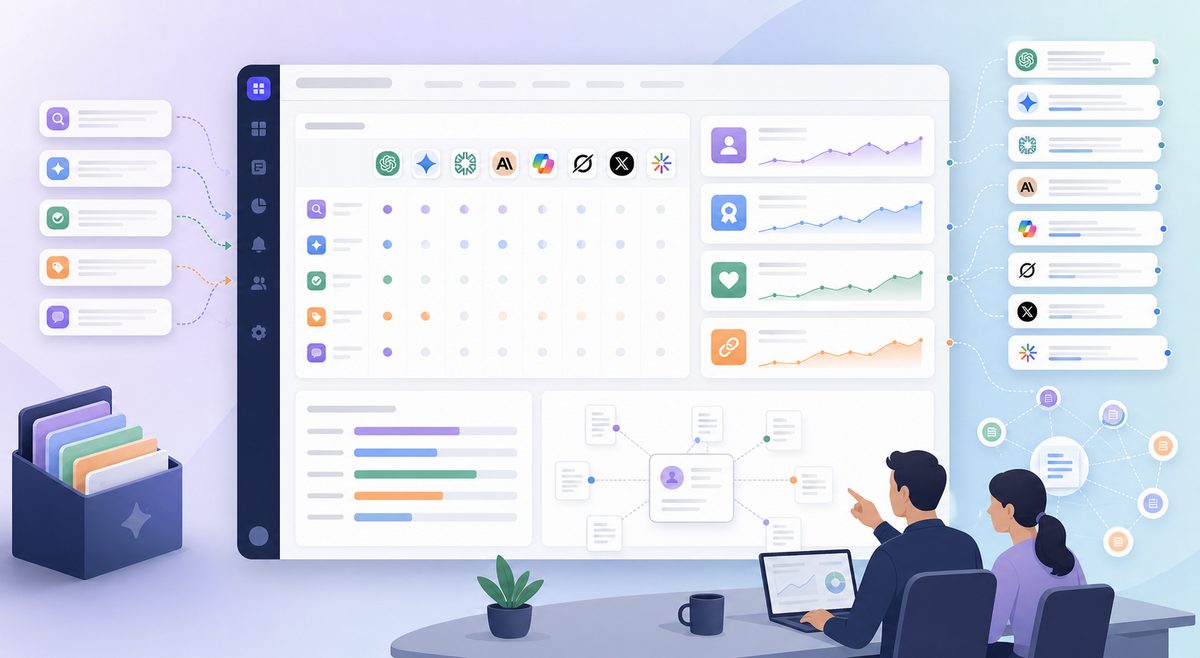
Before publishing an AI visibility report, verify that:
- Failed collections are not counted as brand absences.
- Every rate includes a numerator and denominator.
- Citation metrics include only cite-capable runs.
- Period comparisons use the same active prompt set or disclose changes.
- Added, modified, frozen, and retired prompts are listed.
- Prompt-family weights prevent paraphrase inflation.
- Model, market, language, session, and repetition settings are consistent.
- Recommendation labels follow a documented rubric.
- Raw answers support material conclusions.
- Cited URLs are stored with the claims they support.
- Factual accuracy is reviewed separately from sentiment.
- Combined scores can be decomposed by prompt family and surface.
- Weight changes use an effective date and do not rewrite prior periods.
- High-risk findings receive human review before escalation.
For agencies, keep client portfolios separate. A shared schema is efficient; shared weights are usually misleading because clients differ in revenue priorities, markets, competitors, and risk.
What Mistakes Should Teams Avoid?
Avoid these patterns:
- Generating hundreds of prompts before defining business decisions
- Tracking only questions that contain the brand name
- Treating SEO keywords as complete buyer questions
- Allowing informational prompts to crowd out commercial decisions
- Adding every paraphrase as an equally weighted prompt
- Editing wording after a poor result without creating a new version
- Running benchmark prompts inside an existing conversation
- Pooling personalized and neutral results
- Combining answer engines before checking surface-level movement
- Treating every mention as a recommendation
- Assigning rank to an unordered answer
- Reporting citation rates across surfaces that do not show citations
- Measuring a citation without checking which claim it supports
- Reporting positive sentiment without validating factual accuracy
- Deleting obsolete prompts and their historical evidence
- Leaving active prompts without an owner or review trigger
How Can You Launch the Program in 30 Days?
A 30-day launch should establish a defensible baseline rather than maximize prompt volume.
- Days 1–5: Define the business decisions, audiences, markets, surfaces, metrics, and owners.
- Days 6–10: Gather buyer-language evidence and create the required coverage matrix.
- Days 11–15: Generate candidates, assign taxonomy, form prompt families, and apply the seven gates.
- Days 16–20: Approve family weights, active capacity, scoring rules, and the run protocol.
- Days 21–25: Complete baseline runs, preserve outputs, validate extraction, and review critical claims.
- Days 26–30: Publish the first evidence-backed report, assign corrective actions, and schedule governance reviews.
The first report should disclose:
- What the library covers and excludes
- Which prompts and surfaces were active
- How prompts and variants were weighted
- Which runs failed
- Which metrics have small denominators
- Which results require further observation
- What actions were assigned and to whom
Frequently Asked Questions
Can an SEO keyword list become an AI visibility prompt library?
Yes, but not without transformation. Convert each keyword into a complete buyer question with a persona, problem, decision, market, and expected answer shape. Then group variants, apply acceptance gates, assign an owner, and preserve the exact wording used for monitoring.
How many prompts should an AI visibility library contain?
Use the smallest set that covers material buyer decisions. A focused B2B program can often start with 40–100 governed prompts. Product breadth, markets, personas, risk, answer-engine coverage, and repetition frequency matter more than a universal prompt count.
Should paraphrased prompts be tracked separately?
Track a paraphrase only when it tests a specific hypothesis about wording, persona, or regional language. Store it in the same prompt family and divide the family weight across active variants so paraphrases do not inflate the topic’s importance.
Should each prompt run in a fresh conversation?
Yes for a single-turn benchmark. Previous messages can change the answer and create a different test condition. Keep multi-turn buyer-journey experiments in a separate dataset with the entire conversation preserved.
How often should prompts be changed?
Change a prompt when the buyer, product, market, constraint, or intended decision changes. Do not rewrite prompts merely to improve results. A material wording change should create a new version and an overlap comparison with the old wording.
Can AI visibility monitoring be automated?
Collection and initial extraction can be automated, but governance cannot be fully delegated. Owners still need to validate recommendation labels, factual errors, source relevance, portfolio coverage, prompt retirement, and methodological changes.
Do AI citations matter more than brand mentions?
Neither is universally more important. Mentions indicate inclusion, recommendations indicate preference, citations reveal supporting sources, and accuracy protects trust. Report them separately and prioritize the metric tied to the business decision.
Can one library compare multiple answer engines?
Yes, if the run matrix preserves surface-level results. Use the same approved prompt portfolio where possible, but do not pool results until differences in model, citation availability, personalization, geography, and answer format are visible.
Turn Prompt Tracking Into a Defensible Measurement System
A useful AI visibility prompt library is broad enough to represent real buyer decisions, small enough to govern, and stable enough to support historical comparison. Its value comes from the controls around the questions: coverage, metadata, prompt families, weights, run settings, evidence, ownership, and version history.
Start with a governed core, preserve every material change, and report mentions, recommendations, citations, and accuracy separately. That creates a reliable path from AI search monitoring to content, product, communications, and authority-building decisions.