AI search triage is the first-response workflow for a specific problem: an answer engine changed how it names, cites, ranks, or describes your brand. The goal is not to "optimize for AI" immediately. The goal is to classify the incident, preserve evidence, find the likely source path, assign the right owner, and choose the fix most likely to change the next answer.
Most AI search failures look similar in a dashboard. A brand mention disappears. A competitor gets named first. ChatGPT cites an outdated article. Google AI Overviews repeats an old claim. Perplexity uses a review page that no longer reflects the product. These are not the same problem, and treating them the same wastes time.
What Is AI Search Triage?
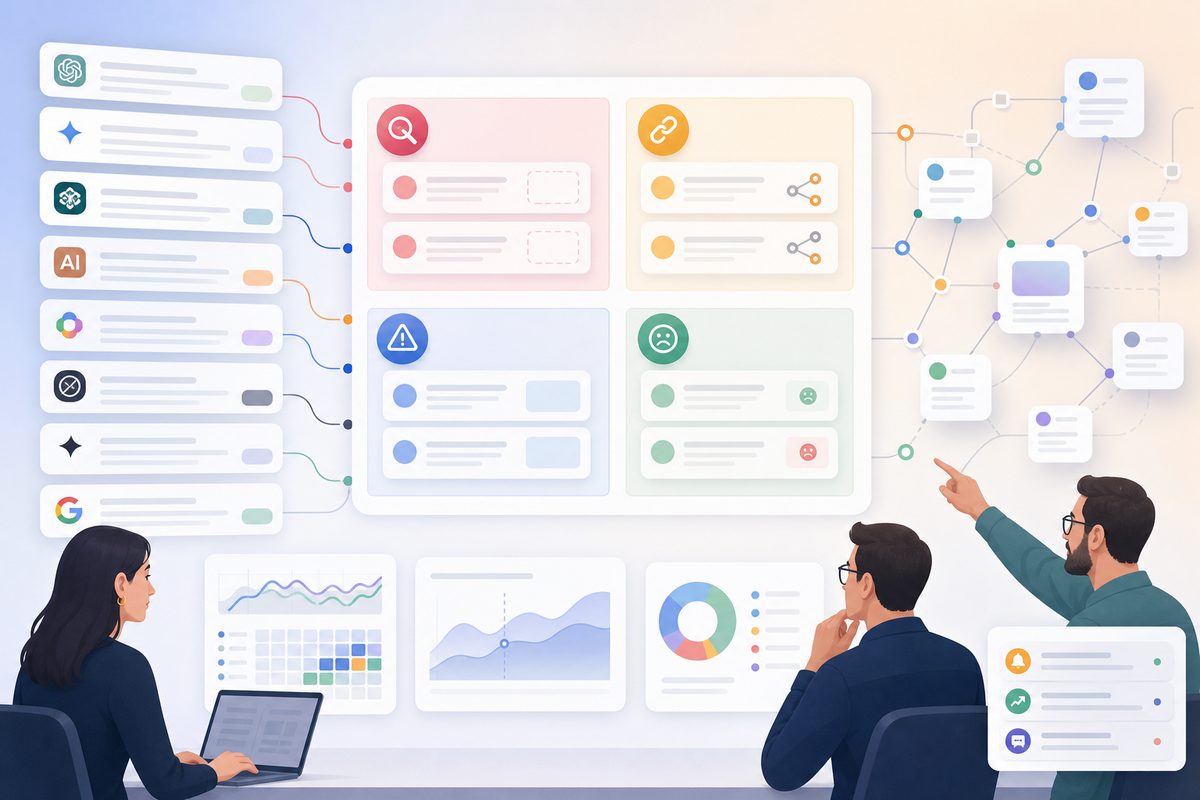
AI search triage is the process of classifying an AI answer problem before optimization begins. It separates visibility loss, citation failure, factual error, and sentiment drift, then preserves evidence, maps the likely source path, assigns an owner, scores severity, and schedules the next measurement.
Use AI search triage when a monitored answer changes in a way that could affect discovery, trust, sales conversations, analyst perception, or brand reputation. It sits between AI search monitoring and remediation: monitoring detects the change; triage decides what kind of change it is.
At its simplest, triage answers seven questions:
- What changed? Mention, position, citation, claim, tone, or competitor set.
- Where did it change? Engine, prompt, market, account state, and device if known.
- Did it repeat? Same prompt, close variants, adjacent prompts, or other engines.
- Which source path shaped it? Owned page, earned media, review site, forum, documentation, marketplace, or competitor page.
- Is the answer factually wrong? If yes, treat it as a claim issue before a visibility issue.
- How commercially sensitive is it? Informational wording, buyer shortlist, compliance claim, pricing, launch, or reputation risk.
- Who can change the evidence? SEO, content, product marketing, comms, PR, legal, support, docs, partnerships, or agency.
Why AI Search Triage Matters
AI search is less stable than classic rank tracking. A 2026 arXiv preprint, "Don't Measure Once: Measuring Visibility in AI Search", argues that AI search visibility should be measured as a distribution because answers vary across runs, prompts, and time. One screenshot can be important evidence, but it is not enough to assign a major fix.
Google's guidance for AI features and your website makes the same operational point from another angle: AI Overviews and AI Mode can use query fan-out, issuing multiple related searches across subtopics and sources. That means one buyer prompt may be shaped by category pages, documentation, reviews, partner pages, comparison content, and freshness signals at the same time.
This is why broad GEO advice is not enough. "Make content helpful, structured, and crawlable" is necessary, but it does not tell a team what to do when:
- The brand disappears from a high-intent shortlist.
- The answer cites a competitor comparison page instead of the brand's own page.
- The answer repeats an old pricing model.
- The brand is described as "best for startups" when enterprise is the target.
- The cited page is accurate, but the answer makes an unsupported leap.
AI search triage turns those cases into distinct workstreams.
The AI Search Triage Matrix
Classify the primary incident first. A single answer can contain more than one issue, but one issue should drive the first ticket.
| Incident class | Primary symptom | How to confirm | First owner | First fix |
|---|---|---|---|---|
| Lost mention | Brand disappears, drops below competitors, or loses AI share of voice | Compare repeated runs, prompt variants, engines, and prior baseline | SEO or growth | Prompt-cluster review, competitor source gap, content coverage fix |
| Bad citation | Brand is mentioned, but the cited source is weak, stale, unrelated, or competitor-controlled | Check whether the cited URL supports the answer's claim | Content SEO or digital PR | Repair preferred source, update old pages, improve claim-evidence clarity |
| Wrong claim | Answer states an incorrect fact about pricing, features, security, availability, integrations, funding, category, or customers | Compare answer against approved source of truth and cited sources | Product marketing, docs, comms, or legal | Correct public facts, remove conflicting evidence, request recrawls where possible |
| Sentiment drift | Answer is technically true but commercially damaging | Compare tone across time, engines, and competitor framing | Brand, PR, product marketing, or customer marketing | Strengthen proof, reviews, comparison pages, case studies, and third-party narratives |
A good triage ticket should include: incident class, confidence level, prompt cluster, affected engines, exact answer text, cited URLs, screenshots, baseline comparison, likely source path, commercial risk, owner, approval owner, fix type, and recheck date.
AI Search Triage vs AI Visibility Monitoring
AI visibility monitoring tracks patterns. AI search triage interprets incidents.
| Function | Main question | Output |
|---|---|---|
| AI search monitoring | "Did something change?" | Alerts, trends, prompt-level metrics |
| AI search triage | "What kind of problem is this?" | Incident class, severity, owner, next action |
| GEO remediation | "What evidence should we change?" | Page updates, source repairs, PR outreach, docs fixes |
| Governance | "Who approves sensitive changes?" | Claim rules, escalation paths, legal review triggers |
A strong prompt set for AI brand monitoring makes triage faster because each prompt already maps to a buyer journey, competitor set, geography, product line, and risk level.
The First 30 Minutes: Triage the Alert Before You Fix It
Do not rewrite a page from one answer. The first 30 minutes should preserve evidence, test recurrence, and classify the issue.
- Freeze the evidence. Save the exact prompt, platform, model if shown, date, time, market, account state, answer text, cited URLs, screenshots, and run ID.
- Compare against baseline. Check the last 7, 14, and 30 days for mention rate, first-mention position, cited domains, sentiment label, and claim changes.
- Repeat the prompt. Run the same prompt multiple times and test close variants. Treat a single answer as evidence, not a trend.
- Check adjacent prompts. If one prompt moved, it may be phrasing sensitivity. If a cluster moved, source evidence or market framing may have changed.
- Separate mention from citation. A brand can be visible but poorly cited. A source can be cited but not actually support the claim.
- Map the likely source path. Identify owned, earned, review, forum, docs, marketplace, partner, analyst, or competitor sources.
- Assign one primary class. Choose lost mention, bad citation, wrong claim, or sentiment drift.
- Score severity. Rank by commercial impact, recurrence, confidence, controllability, and urgency.
- Assign an owner and recheck date. One team owns the next action, even if several teams support it.
Common False Positives
Many AI search alerts look urgent but should not become tickets yet. Filter these before escalating.
| False positive | What it looks like | What to do |
|---|---|---|
| One-run variability | One answer excludes the brand, but repeats include it | Monitor until it repeats in the same prompt cluster |
| Prompt wording drift | "Best platform for X" changed, but "top tools for X" did not | Add prompt variants before assigning a content fix |
| Citation decoration | A page is cited but does not appear to shape the answer | Compare claim language to cited and uncited sources |
| Locale mismatch | US prompt changed, UK or APAC prompt stayed stable | Route by market and source inventory |
| Model-mode mismatch | Live-search mode differs from non-browsing mode | Tag retrieval state separately |
| AI Overview non-trigger | Google does not show an AI Overview for a query | Track as availability, not lost visibility |
Class 1: Lost Mentions
A lost mention means the brand disappeared, moved lower, or appears less often across a prompt set. It is a visibility problem first, not necessarily a reputation problem.
Start by identifying the shape of the loss:
- Breadth: one prompt, one cluster, one engine, or multiple engines.
- Position: absent entirely, named lower, or mentioned only after competitors.
- Replacement: which competitors, categories, or source types filled the space.
- Intent: informational prompt, comparison prompt, buying shortlist, local query, or category definition.
- Source shift: owned pages replaced by third-party roundups, analyst content, reviews, or competitor pages.
The highest-priority lost mentions are usually high-intent prompts with commercial language such as "best," "top," "compare," "alternatives," "for enterprise," "for regulated teams," or "for [use case]." If competitor pages are repeatedly shaping answers, use that pattern to inspect why AI search engines cite competitor pages instead of yours.
Typical fixes include:
- Build or update the exact category, use-case, or comparison page that matches the prompt.
- Add concrete decision criteria: integrations, buyer segment, deployment model, compliance, pricing context, migration path, support model, and proof.
- Strengthen internal links to the page that should represent the brand for that prompt cluster.
- Make critical facts available in crawlable HTML, not only in images, app UI, PDFs, or gated decks.
- Update third-party profiles where answer engines repeatedly retrieve market evidence.
Class 2: Bad Citations
A bad citation happens when the answer names the brand but relies on the wrong evidence. The cited source may be outdated, thin, unrelated, competitor-controlled, or unable to support the claim being made.
This is a separate issue from visibility. A buyer may trust the answer less if the citation points to a weak source. Worse, the weak source may carry old positioning, stale pricing, missing features, or competitor-friendly selection criteria.
A citation audit should record:
- Cited URL and domain
- Source type: owned, earned, review, forum, marketplace, documentation, analyst, partner, or competitor
- Claim supported by the citation
- Claim not supported by the citation
- Source freshness
- Source depth and commercial relevance
- Whether the page reflects current positioning
- Whether the answer's wording appears to come from another source
A 2026 arXiv preprint, "What Gets Cited: Competitive GEO in AI Answer Engines", tested 252,000 paired trials across six LLMs and found that topical relevance and list position were the strongest drivers of first citation, while explicit price information and recent timestamps also helped. That supports a practical rule: citation repair should focus on relevance, completeness, freshness, and extractable evidence before cosmetic formatting.
For a deeper workflow, use GEO citation tracking to map AI citations to source fixes. The practical question is not "How do we get more citations?" It is "Which source is shaping this answer, and what can we change about that source path?"
Class 3: Wrong Claims
A wrong claim is a factual error in the answer. It may involve pricing, packaging, integrations, compliance, security, features, customers, funding, availability, market category, or company status.
Wrong claims need evidence repair, not keyword stuffing. First identify whether the false claim appears in:
- An outdated owned page
- Old docs or release notes
- A pricing page cached by third parties
- Review-site metadata
- Partner listings or app marketplaces
- Analyst or directory profiles
- Forum posts and copied comparison pages
- The answer itself without a visible supporting citation
Citations do not guarantee accuracy. A 2026 arXiv preprint on Google AI Overviews studied 55,393 trending queries over 40 days and decomposed 98,020 atomic claims. It found that 11.0% of claims were unsupported by the cited pages, and that nearly 30% of cited domains did not appear in the co-displayed first-page results. See "Measuring Google AI Overviews: Activation, Source Quality, Claim Fidelity, and Publisher Impact".
For brand-critical errors, follow an AI brand reputation management workflow: capture the answer, identify the source path, correct owned facts, update public evidence, contact third-party sources where appropriate, and remeasure after the likely refresh window.
Escalate wrong claims immediately when they involve legal, regulated, financial, medical, security, privacy, investor, customer, or availability claims.
Class 4: Sentiment and Positioning Drift
Sentiment drift means the answer may be factually defensible but commercially harmful. The brand is still visible, but the framing has shifted.
Examples:
| Drift pattern | Example answer language | Likely source problem | Typical fix |
|---|---|---|---|
| Weak-fit framing | "Best for small teams" | Old customer examples or review mix | Publish segment-specific proof and enterprise examples |
| Outdated limitation | "Lacks enterprise controls" | Old reviews, stale docs, or missing release evidence | Update docs, release notes, security pages, and third-party profiles |
| Price risk | "More expensive than alternatives" | Pricing pages lack context or value proof | Add packaging clarity, ROI evidence, and comparison context |
| Trust concern | "Mixed support reviews" | Review pattern dominates public evidence | Improve review response narrative and customer proof |
| Category confusion | "A social listening tool" instead of AI search monitoring | Entity descriptions are inconsistent | Align homepage, category pages, profiles, and boilerplate |
Sentiment drift often belongs to brand, PR, product marketing, and customer marketing. SEO can surface the issue, but the fix may require stronger third-party proof, customer stories, analyst updates, review programs, comparison pages, or support-response content.
A Practical AI Search Triage Scoring Model
Use a 25-point score to decide what gets fixed first.
| Factor | 1 point | 3 points | 5 points |
|---|---|---|---|
| Commercial impact | Informational prompt | Consideration prompt | High-intent shortlist, competitor, pricing, or sales-objection prompt |
| Recurrence | One answer | Repeats in one engine | Repeats across engines, prompt variants, or markets |
| Confidence | No clear source path | Partial source path | Clear citation, repeated source pattern, or confirmed conflicting source |
| Controllability | Unowned source only | Mixed owned and third-party evidence | Owned page, docs, profile, partner page, or known source owner |
| Urgency | Low-stakes wording | Sales or positioning risk | Legal, compliance, security, reputation, launch, or executive risk |
Priority bands:
| Score | Action |
|---|---|
| 20-25 | Escalate within one business day and assign an executive-visible owner if sensitive |
| 15-19 | Assign this week with a fix owner and recheck date |
| 10-14 | Add to backlog and group with related prompt-cluster fixes |
| 5-9 | Monitor until recurrence or commercial risk increases |
Do not average away severe problems. A single wrong compliance claim in one major engine can outrank a mild mention drop across ten low-intent prompts.
Worked Example: A Recommendation Shortlist Disappears
A B2B SaaS company tracks 48 high-intent prompts across four AI engines. On Monday, its AI search monitoring dashboard flags that the brand disappeared from three "best tools for enterprise onboarding analytics" prompts in ChatGPT and Gemini, while Claude and Perplexity remain stable.
The raw alert looks like a lost mention. Triage shows a narrower pattern:
| Prompt cluster | Previous 30-day mention rate | Current mention rate | Cited source pattern | Primary class |
|---|---|---|---|---|
| Enterprise shortlist | 62% | 21% | New competitor comparison pages | Lost mention |
| Pricing comparison | 48% | 45% | Old review-site page | Bad citation |
| Security fit | 55% | 53% | Owned docs and trust page | No incident |
| Market category | 70% | 68% | Analyst and category pages | No incident |
The first fix is not a homepage rewrite. The loss is concentrated in enterprise shortlist prompts and appears tied to competitor comparison pages. The team should inspect the newly influential pages, extract their selection criteria, and compare them with owned enterprise proof.
If competitors show deployment timelines, named integrations, admin controls, security certifications, procurement support, or enterprise case studies that the brand page lacks, the fix is evidence completeness. The old review-site citation in pricing prompts deserves a second ticket, but it is lower priority because mention rate stayed stable.
Worked Example: A True Mention With a Wrong Claim
An answer says, "Brand X is not suitable for HIPAA-regulated workflows," and cites a two-year-old integration roundup. Brand X now has a public trust page, updated BAA language, and recent documentation, but those pages are not cited.
Triage classifies this as a wrong claim, not a lost mention. The incident score is high because the claim affects regulated buyers.
The fix sequence should be:
- Confirm the approved claim language with legal or compliance.
- Update owned trust, security, docs, and comparison pages so the claim is explicit and crawlable.
- Remove or correct any conflicting public wording.
- Contact the third-party roundup if it is outdated.
- Request recrawl where supported.
- Recheck the same prompt set daily until the wrong claim disappears, then weekly until stable.
How To Assign the Fix
The fastest teams separate diagnosis from ownership. The AI visibility owner classifies the incident. The work owner changes the evidence. The approval owner signs off on sensitive claims.
| Triage output | Work owner | Approval owner | Recheck cadence |
|---|---|---|---|
| Lost mention in commercial prompts | SEO or growth | Marketing lead | 3-7 days after fix, then weekly |
| Bad citation from owned content | Content SEO | Product marketing | After recrawl or next scheduled run |
| Bad citation from third-party source | PR, partnerships, or agency | Comms lead | Weekly until source changes |
| Wrong factual claim | Product marketing, docs, or support | Legal, compliance, or executive owner if sensitive | Daily until resolved |
| Sentiment drift | Brand, PR, customer marketing, or product marketing | Comms lead | Weekly and after major proof updates |
If the same issue repeats, do not keep reopening isolated tickets. Create a standing owner map for prompt clusters, source types, and claim categories.
What To Fix After Triage
The fix depends on the incident class.
| Incident class | Do first | Avoid |
|---|---|---|
| Lost mention | Fill the exact evidence gap for the affected prompt cluster | Publishing generic thought leadership |
| Bad citation | Repair the preferred source path and outdated sources | Chasing more citations without checking claim support |
| Wrong claim | Correct the source of truth and conflicting public facts | Calling it a hallucination without source analysis |
| Sentiment drift | Add proof that changes the commercial framing | Overcorrecting with unsupported marketing claims |
For lost mentions, prioritize pages that match buyer language. For bad citations, improve claim-evidence pairs. For wrong claims, reconcile every public source of truth. For sentiment drift, strengthen credible proof from customers, reviews, analysts, partners, and documentation.
Google's helpful, reliable, people-first content guidance is relevant here because it asks whether content provides original information, complete coverage, clear sourcing, and value beyond the obvious. The AI-search layer is to make that evidence easy for answer systems and human buyers to verify.
What Structured Data Can and Cannot Fix
Structured data can help search systems understand page content, but it is not a universal AI search triage fix. Google's AI feature guidance says there is no special schema required for AI Overviews or AI Mode, and that structured data should match visible page text.
Use structured data when it accurately reflects visible content, such as organization details, articles, software apps, reviews where eligible, products, FAQs where appropriate, and breadcrumbs. Do not add markup for claims that are not visible to users. If the visible evidence is weak, schema will not solve the underlying problem.
How To Prevent Repeat Incidents
AI search triage should improve the operating system, not just close a ticket. Each incident should leave behind a cleaner prompt map, source inventory, claim library, and owner model.
Build four assets:
- Prompt map. Group prompts by funnel stage, product line, buyer persona, geography, competitor set, and risk level.
- Source inventory. Track owned, earned, review, forum, documentation, marketplace, analyst, partner, and competitor sources that shape answers.
- Claim library. Maintain approved statements about pricing, features, integrations, security, compliance, customers, category, and positioning.
- Escalation rules. Define severity thresholds before a sensitive claim appears in an answer.
A weekly scorecard should connect metrics to action. Track mention rate, first-mention position, AI share of voice, citation frequency, cited domains, unsupported claims, sentiment labels, affected prompt clusters, source type, owner, status, and recheck date. For a full metric set, see AEO dashboard metrics for a weekly AI search visibility scorecard.
Frequently Asked Questions
What is AI search triage?
AI search triage is the process of diagnosing an AI answer problem before fixing it. It classifies the issue as a lost mention, bad citation, wrong claim, or sentiment drift, then assigns severity, owner, source path, and recheck date.
How often should AI search triage run?
Run triage when an alert crosses a severity threshold. High-intent prompt clusters should be reviewed weekly. Pricing, launch, compliance, funding, security, and positioning changes should be checked before and after the public update.
Is a lost AI mention always an SEO problem?
No. A lost mention can come from weak owned content, but it can also come from competitor PR, review-site changes, market-specific prompts, third-party source shifts, or model variability. The source path determines the owner.
What is the difference between a bad citation and a wrong claim?
A bad citation is an evidence or attribution problem. A wrong claim is an accuracy problem. They often overlap, but not always. An answer can cite a weak source while making a true claim, or cite a credible source while making an unsupported claim.
Can structured data fix AI answer problems?
Structured data can help systems understand visible page information, but it cannot fix weak evidence, stale sources, or unsupported claims. It should support accurate, visible content rather than replace it.
Who should own AI search triage?
One person or team should own diagnosis, usually SEO, growth, or AI visibility. The fix owner depends on the incident: SEO for lost mentions, content or PR for citations, product marketing or docs for wrong claims, and brand or comms for sentiment drift.
Which metrics belong in an AI search triage dashboard?
Track mention rate, first-mention position, AI share of voice, citation frequency, cited domains, prompt cluster, engine, market, sentiment label, claim accuracy, unsupported claims, source type, owner, severity, status, and next measurement date.
The Bottom Line
Treat AI search triage as the bridge between monitoring and action. Do not let every lost mention become an SEO rewrite, every bad citation become a PR panic, or every wrong claim become a vague complaint about AI hallucination.
Classify the incident first. Preserve the evidence. Map the source path. Score the business impact. Assign one accountable owner. Then fix the evidence that answer engines and buyers can actually verify.