AI source gap analysis is a diagnostic workflow that explains why AI answer engines recommend competitors instead of your brand. It compares lost prompts, cited URLs, and source evidence to identify missing pages, weak proof, stale facts, or third-party validation gaps, then turns each gap into a fixable source brief.
Most AI visibility work stops at tracking mentions, rankings, and citations. That is useful, but it does not answer the editorial question that matters next: what source would have made the answer engine more confident in recommending us?
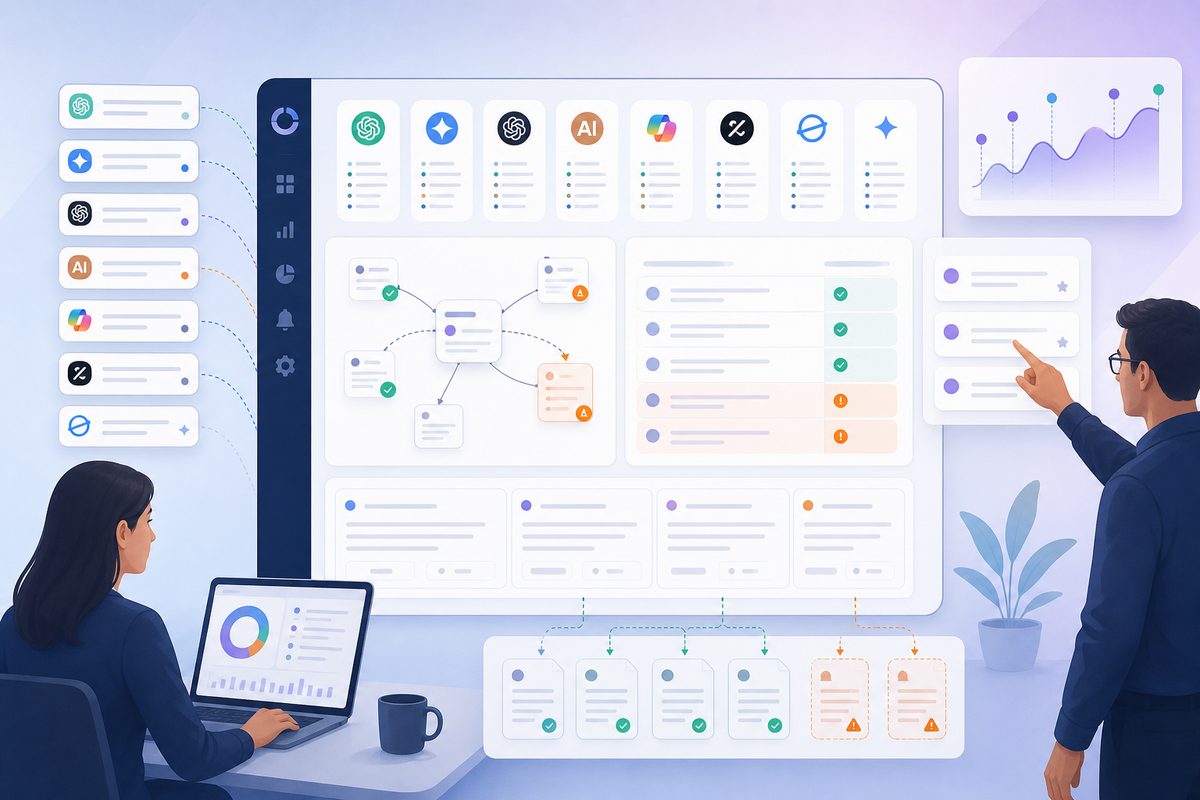
This guide shows how to run AI source gap analysis with a source gap ledger, a seven-step workflow, a scoring model, and a worked example. The goal is not to chase every unstable AI answer. The goal is to identify the missing evidence behind repeated lost recommendations in ChatGPT, Perplexity, Gemini, Claude, Copilot, Grok, Google AI Mode, and AI Overviews.
What AI Source Gap Analysis Actually Solves
AI source gap analysis solves the gap between visibility measurement and source repair.
A standard AI visibility report might say:
- Your brand appears in 18% of "best tool" prompts.
- Competitor A appears in 64%.
- Competitor A is cited from review pages, comparison pages, and category guides.
- Your own site is cited rarely.
That report still does not tell a content, PR, or product marketing team what to do. AI source gap analysis adds the missing diagnostic layer:
| Question | Output |
|---|---|
| Which prompt cluster are we losing? | "Best AI search monitoring tools for agencies" |
| Which competitors or domains are winning? | Competitor pages, review sites, category listicles |
| What evidence do those sources make easy to extract? | Agency reporting, multi-client dashboards, pricing, proof screenshots |
| What evidence is missing or weak for our brand? | No agency use-case page, no public reporting screenshots, no third-party validation |
| What source should exist next? | An agency use-case page plus review/profile cleanup |
| How will we know the gap closed? | Higher mention rate, better recommendation rank, stronger citations, more accurate wording |
The important shift is from "we need more AI citations" to "we need this specific source because this specific prompt is missing this specific proof."
AI Source Gap Analysis vs. Citation Gap and Content Gap Analysis
These workflows overlap, but they answer different questions.
| Workflow | Main question | Best use | Common blind spot |
|---|---|---|---|
| SEO content gap analysis | What topics or keywords are we missing? | Planning organic content coverage | May ignore AI citations, third-party sources, and answer wording |
| AI citation tracking | Which URLs and domains are cited in AI answers? | Monitoring visibility and source usage | Does not always explain what source should be created |
| AI citation gap analysis | Which competitor sources are cited more than ours? | Comparing citation share and source overlap | Can stop at "get more citations" without an evidence brief |
| AI source gap analysis | What missing source or proof caused the lost recommendation? | Turning AI monitoring into content, PR, and source repair actions | Requires judgment, not just automated counts |
Use AI citation tracking to collect the raw evidence. Use AI citation gap analysis to compare your citation footprint against competitors. Use AI source gap analysis to decide what to build, update, earn, or correct.
Why Source Gaps Cause Lost AI Recommendations
AI answer engines do not recommend brands from one ranking signal. They synthesize answers from retrieved pages, prior model knowledge, structured data, entity understanding, and citations. A brand can rank in classic Google results and still lose an AI shortlist if the answer engine cannot find clear, current, extractable proof for the prompt.
Google's documentation on AI features and your website says AI Overviews and AI Mode may use a "query fan-out" process, issuing multiple related searches across subtopics and data sources before generating a response. For a prompt like "best AI visibility tools for agencies," that can expand into agency reporting, multi-client dashboards, citation tracking, pricing, reviews, integrations, and category definitions.
The research direction points the same way. The original GEO: Generative Engine Optimization paper describes generative engines as systems that synthesize information from multiple sources and reports that visibility can improve when content is structured with stronger evidence and citations. A 2026 preprint, What Gets Cited: Competitive GEO in AI Answer Engines, ran 252,000 controlled RAG trials and found that topical relevance and source position were the strongest drivers of first citation selection, with price information and recency also helping.
For marketers, the practical takeaway is simple: answer engines need source confidence. If your evidence is scattered, thin, stale, blocked, or only self-asserted, the safer answer is often the competitor with clearer sources.
What Counts as a Source Gap?
A source gap is the missing or weak evidence that prevents an AI answer engine from confidently including, citing, or recommending your brand for a prompt cluster.
It is not always a missing blog post. In AI source gap analysis, a "source" can be any crawlable, verifiable page or record that supports the answer:
| Source type | What it proves | Example gap |
|---|---|---|
| Owned factual page | What the company is, who it serves, and what it offers | No clear product category page |
| Owned decision page | Why a buyer should choose it | No comparison, use-case, or pricing explainer |
| Documentation | Whether a feature, integration, or workflow exists | Integration mentioned in sales decks but not public docs |
| Methodology page | How a metric or claim is calculated | AI share of voice claims with no public method |
| Customer proof | Whether the product works in a real setting | No case study for the target segment |
| Third-party validation | Whether others confirm the claim | Weak review profile, no partner listing, no analyst mention |
| Category evidence | Whether the brand belongs in the shortlist | Competitors appear in category guides but the brand does not |
| Freshness evidence | Whether the facts are current | Old screenshots, old pricing pages, stale descriptions |
A useful source gap is specific enough to brief. "Need more authority" is too vague. "Need a crawlable agency use-case page with multi-client reporting screenshots and review-backed proof" is actionable.
The Source Gap Ledger Framework
The Source Gap Ledger is the operating table for AI source gap analysis. Each row connects a lost prompt cluster to the sources that shaped the answer, the missing evidence, the owner, and the next fix.
Create one row per prompt cluster, not per keyword. Group prompts by buyer intent and evidence need:
| Prompt cluster | Examples |
|---|---|
| Shortlist | "best AI visibility tools," "top AI search monitoring platforms" |
| Segment | "AI search monitoring for agencies," "AI visibility platform for B2B SaaS" |
| Feature | "tools that track brand mentions in ChatGPT," "AI citation tracking API" |
| Alternative | "alternatives to [competitor]," "[competitor] vs [brand]" |
| Trust | "most accurate AI citation tracking tools," "enterprise AI visibility software" |
| Problem | "brand not showing up in AI search," "wrong AI answer about my company" |
Your ledger should include these fields:
| Field | Why it matters |
|---|---|
| Prompt cluster | Prevents overreacting to one wording variation |
| Engine and market | ChatGPT, Perplexity, Gemini, AI Overviews, country, language |
| Date and run count | Keeps volatile answers from being treated as fixed rankings |
| Brand outcome | Omitted, mentioned, cited, recommended, mispositioned |
| Competitor outcome | Which brands appear and how strongly |
| Cited URLs | The visible source set where citations exist |
| Inferred sources | Pages that appear to shape the answer when citations are absent |
| Missing evidence | The exact proof the answer lacks |
| Source class | Owned factual, decision, docs, third-party, category, freshness |
| Recommended fix | Page, update, PR target, review cleanup, correction workflow |
| Owner | SEO, product marketing, docs, PR, customer marketing, web engineering |
| Priority score | Commercial value, repeatability, evidence absence, fixability |
| Close criteria | What must improve after the fix |
This turns AI search monitoring into an editorial and reputation backlog.
How to Run AI Source Gap Analysis in 7 Steps
Run AI source gap analysis by collecting repeatable buyer prompts, capturing AI answers across engines, extracting cited and influential sources, classifying the missing proof, and converting each gap into a source brief. Retest the same prompt cluster after the fix.
-
Build a buyer-intent prompt set. Use sales calls, demo objections, support tickets, G2 language, Search Console queries, competitor comparison searches, and "best tool" queries. Include shortlist, alternative, use-case, feature, pricing, integration, and problem-aware prompts.
-
Collect answers across engines and markets. Track the same prompts in ChatGPT, Perplexity, Gemini, Claude, Copilot, Grok, Google AI Mode, and AI Overviews where relevant. Store answer text, screenshots, citations, brand rank, competitor mentions, sentiment, and visible source URLs.
-
Repeat before judging. AI answers are unstable. A 2026 preprint on AI visibility measurement uncertainty argues that single-run citation visibility can be misleading because identical queries may produce different cited sources. Treat one answer as anecdotal; treat repeated prompt clusters as evidence.
-
Separate the failure type. Label whether the brand is omitted, mentioned but not recommended, recommended without citation, cited but weakly framed, or described incorrectly. Each failure points to a different source fix.
-
Extract the winning source set. List URLs cited by the answer. When citations are not exposed, inspect repeated wording, named facts, competitor pages, category pages, and search results likely used for retrieval. Mark inferred sources with lower confidence.
-
Classify the missing evidence. Ask what the winning sources make easy for the model to say. Do they prove a use case, segment fit, integration, pricing model, review strength, category membership, methodology, or recency?
-
Assign and retest the fix. Create or update the source, earn the third-party validation, or correct the stale record. Retest with the same prompt set, market, engine mix, and scoring method.
The output should be a prioritized backlog of source briefs, not a generic content calendar.
How to Score Source Gaps
Prioritize source gaps with a simple 20-point model. Start with rows scoring 15 or higher.
| Factor | 1 point | 3 points | 5 points |
|---|---|---|---|
| Commercial intent | General learning | Evaluation | Vendor shortlist or replacement |
| Repeatability | One-off answer | Repeats in one engine | Repeats across engines or dates |
| Evidence absence | Minor detail missing | Thin or stale proof | No credible source exists |
| Fixability | Requires long-term market validation | Needs cross-team work | Can be fixed with owned page or clear update |
A high score does not guarantee rankings or citations. It tells the team where a better source is most likely to remove a real blocker.
Use this rule of thumb: fix high-intent, repeated, specific gaps before broad awareness gaps. A missing integration page for a prompt that shows purchase intent is usually more valuable than another general guide about AI visibility.
How to Analyze Prompts Without Visible Citations
Not every AI answer shows citations. ChatGPT may answer without links. Gemini, AI Overviews, and Perplexity may cite different numbers of pages. Some systems cite sources that support only part of the answer.
Use confidence levels instead of pretending every source is known:
| Confidence level | Evidence | How to use it |
|---|---|---|
| High | Visible citation URL supports the answer claim | Add directly to the ledger |
| Medium | Repeated wording, facts, or named comparisons match a crawlable source | Mark as inferred and verify manually |
| Low | The answer appears to rely on model memory or uncited general knowledge | Do not over-prioritize unless the pattern repeats |
| Negative | The cited page does not support the claim or is outdated | Add to source correction or reputation repair |
This matters because citation and influence are not the same thing. A 2026 preprint on citation selection and citation absorption separates being selected as a citation from being absorbed into the answer. Its finding is useful for practitioners: some pages are cited but do little work, while structured, semantically aligned pages with extractable evidence can shape answer content more strongly.
Worked Example: From Lost Recommendation to Source Brief
The example below is an illustrative B2B SaaS source gap ledger. It shows the kind of diagnosis an editorial team should produce after AI search monitoring.
| Prompt cluster | AI answer pattern | Source pattern | Source gap | Fix |
|---|---|---|---|---|
| "Best AI search monitoring tools for agencies" | Competitor A appears in most answers; brand appears once | Agency listicles, competitor agency page, review snippets | No agency-specific page proving multi-client reporting | Publish agency use-case page with screenshots, workflows, and reporting proof |
| "Tools to track brand mentions in ChatGPT" | Brand is mentioned but not cited | Guides defining AI citation tracking and brand monitoring | Thin owned explanation of ChatGPT mention tracking | Build a focused guide with steps, limitations, and sample prompt clusters |
| "AI visibility platform for B2B SaaS" | Competitor B ranks above brand | Category pages and "best tools" pages | Weak category proof and few third-party validations | Update category source page and pitch inclusion in relevant market maps |
| "How to fix wrong AI answer about my brand" | Generic advice returned; brand omitted | Help docs, SEO blogs, reputation management pages | No source repair workflow tied to AI answers | Publish a correction workflow and link it from support, docs, and brand pages |
The source brief for the first row should not say "write an agency blog post." It should specify the evidence the page must supply:
| Brief element | Requirement |
|---|---|
| Page type | Use-case page |
| Target prompt cluster | AI search monitoring for agencies |
| Direct answer | One 40-60 word explanation of how the product helps agencies monitor client visibility in AI answers |
| Proof | Multi-client dashboard screenshots, alert examples, reporting workflow, limitations |
| Comparison support | How agency needs differ from in-house SaaS teams |
| Internal links | Link to citation tracking, recommendation sources, and competitor citation diagnosis pages |
| Third-party support | Review profile, partner directory, agency case study, credible market map |
| Close criteria | Brand appears in shortlist answers more often and is described as agency-relevant |
That is the difference between content production and source gap repair.
Which Missing Sources Usually Cost Recommendations?
The highest-use missing sources are usually decision-support assets. These are pages that make a model comfortable saying, "this brand belongs in the answer for this use case."
| Missing source | Why it matters in AI answers | Example page brief |
|---|---|---|
| Category source-of-truth page | Defines what the brand is and where it fits | "AI search visibility platform for B2B SaaS" |
| Use-case page | Connects the product to a buyer segment | "AI search monitoring for digital agencies" |
| Comparison page | Gives models structured differences | "Brand vs competitor for AI citation tracking" |
| Alternative page | Helps with replacement and migration prompts | "Alternatives to [competitor] for AI visibility tracking" |
| Integration page | Proves ecosystem fit | "Slack alerts for AI reputation management" |
| Methodology page | Makes metrics defensible | "How AI share of voice is calculated" |
| Customer proof page | Adds experience and credibility | "How a SaaS team found missing AI citations" |
| Third-party validation | Reduces self-claim risk | Review profile, partner listing, analyst mention |
| Correction workflow | Repairs wrong or stale facts | "Fix wrong AI answer about my brand" |
For competitor-specific source diagnosis, read why AI search engines cite competitor pages instead of yours. For broader source mapping, use AI recommendation sources to understand which owned and third-party records commonly shape brand mentions.
How to Tell Whether the Gap Is On-Site or Off-Site
An on-site gap exists when your own domain lacks the crawlable page, wording, or proof needed to support the recommendation. An off-site gap exists when independent sources do not validate your claim, contradict your positioning, or give competitors stronger evidence.
Use this diagnostic rule:
If the AI answer gets basic facts wrong, fix owned sources first. If it knows the facts but still recommends competitors, inspect third-party validation and category evidence.
| Symptom | Likely gap | Best owner |
|---|---|---|
| Brand omitted from the category | Category evidence gap | SEO or product marketing |
| Brand described with wrong positioning | Entity clarity gap | Brand, comms, SEO |
| Competitors cited from review sites | Third-party validation gap | Customer marketing or PR |
| AI cites old information | Freshness gap | Content ops, docs, or web |
| Competitor recommended for a feature you also have | Feature proof gap | Product marketing |
| Answer avoids recommending any vendor | Trust or specificity gap | Content, PR, analyst relations |
| Brand appears but no owned URL is cited | Owned source quality or crawlability gap | SEO and web engineering |
| Brand is cited but not recommended | Decision proof gap | Product marketing and content |
Do not use the same fix for every symptom. A blog post will not solve a review ecosystem problem. A PR mention will not fix unclear product taxonomy. A comparison page will not help if it is blocked from indexing, too vague to quote, or unsupported by third-party evidence.
If the issue is wrong or stale facts, use a repair process like fixing wrong AI answers about your brand instead of treating it as a normal content gap.
How to Build Pages AI Engines Can Cite
Build source pages around one decision question. The page should give a direct answer, prove it with extractable evidence, clarify the entity, and link to deeper support.
Google's helpful, reliable, people-first content guidance asks whether a page provides original information, comprehensive coverage, clear sourcing, and value beyond other search results. Those standards are directly relevant to AI source gap work.
Use this page pattern:
| Page element | What to include | Why it helps |
|---|---|---|
| Direct answer block | A 40-60 word definition, recommendation, or positioning statement | Gives answer engines a clean extractable passage |
| Evidence table | Features, use cases, proof points, limitations | Supports comparison and synthesis |
| Named audience | "For B2B SaaS teams," "for agencies," "for startups" | Improves prompt-source alignment |
| Specific examples | Workflows, screenshots, sample reports, implementation details | Demonstrates experience |
| Public methodology | How metrics, rankings, or claims are calculated | Makes claims more defensible |
| Freshness markers | Updated screenshots, changelog links, current dates | Reduces stale-answer risk |
| Entity clarity | Consistent company name, product names, categories, and terminology | Helps brand disambiguation |
| Internal links | Links to relevant source, tracking, and repair pages | Helps crawlers and users find supporting evidence |
| Structured data | Article, Organization, Product, or SoftwareApplication where appropriate | Reduces ambiguity for search systems |
Do not create a "GEO page" that repeats the target keyword without proof. Strong AI-citable pages are specific, current, and useful to a buyer who is comparing options.
Google also notes in its AI features documentation that there are no special schema requirements for AI Overviews or AI Mode. Structured data still matters for clarity, but it is not a shortcut. For article pages, follow Google's Article structured data guidance on headline, author, date, and representative image fields.
How to Measure Whether the Source Gap Closed
A source gap closes when the target prompt cluster shows stronger brand inclusion, more accurate wording, better recommendation rank, improved citation quality, or broader source support. Citation count alone is not enough.
Track these metrics before and after each fix:
| Metric | What it tells you |
|---|---|
| Mention rate | How often the brand appears for the prompt cluster |
| Recommendation rank | Whether the brand appears first, in the shortlist, or only as an afterthought |
| Citation rate | Whether owned or third-party sources are cited |
| Citation quality | Whether cited pages are accurate, current, authoritative, and relevant |
| Answer accuracy | Whether the brand is described correctly |
| Sentiment | Whether the answer frames the brand positively, neutrally, or with caveats |
| AI share of voice | How much visibility the brand captures against competitors |
| Source diversity | Whether visibility depends on one fragile source or several credible sources |
| Absorption | Whether the new source changes the answer wording, not just the citation list |
Use the same prompt wording, engine set, geography, language, cadence, and scoring rules. Store screenshots and source URLs. If a fix works in Perplexity but not ChatGPT, or in AI Overviews but not Gemini, record the difference instead of forcing one blended score.
A good close criterion looks like this:
| Weak close criterion | Strong close criterion |
|---|---|
| "Publish agency page" | "Agency prompt cluster improves from omitted to shortlist in at least 3 of 5 tracked engines over two consecutive runs" |
| "Get more citations" | "Owned agency page or credible third-party validation appears in cited or influential source set" |
| "Improve authority" | "Two independent sources validate agency use case and AI answers stop describing the product as only for in-house teams" |
Common Mistakes in AI Source Gap Analysis
The biggest mistake is treating source gaps as keyword gaps. AI engines need evidence, not repeated phrases.
Avoid these errors:
- Optimizing one answer. AI answers vary. Use repeated prompt clusters before assigning work.
- Publishing generic guides for every gap. Many source gaps need use-case, comparison, documentation, methodology, or validation pages.
- Ignoring off-site evidence. Review pages, partner directories, analyst reports, and credible media can shape recommendations.
- Assuming a citation is an endorsement. A cited page may provide background without supporting your brand.
- Skipping source accuracy checks. A cited page that misstates your positioning can hurt more than no citation.
- Using unsupported superlatives. "Best," "most accurate," and "leading" need proof or should be removed.
- Forgetting crawlability. If important proof is buried in JavaScript, PDFs, sales decks, images, or gated content, answer engines may miss it.
- Not assigning an owner. Source gaps cross SEO, PR, product marketing, docs, customer marketing, and web engineering.
- Measuring only citations. The real outcome is better answer inclusion, accuracy, and recommendation strength.
Frequently Asked Questions
What is AI source gap analysis?
AI source gap analysis is the process of finding the missing or weak sources that cause AI answer engines to omit, misdescribe, or under-recommend a brand. It maps lost prompt clusters to missing owned pages, stale facts, weak third-party validation, unclear category evidence, or source quality problems.
How is AI source gap analysis different from AI citation gap analysis?
AI citation gap analysis compares which sources cite or mention your brand versus competitors. AI source gap analysis goes one step further: it identifies the missing source or evidence class behind a lost recommendation and turns that diagnosis into a page, PR, documentation, or correction brief.
How many prompts do you need for a useful analysis?
Start with 25 to 50 buyer-intent prompts per product category. Include shortlist, comparison, alternative, use-case, feature, integration, pricing, and problem-aware prompts. Run them across multiple engines and repeat them over time. The goal is not maximum prompt volume; it is enough repeated evidence to separate patterns from noise.
Can AI source gap analysis work if an engine does not show citations?
Yes, but the confidence level is lower. Use visible citations where available, then compare repeated answer wording, named facts, competitor pages, search results, and known category sources. Mark inferred sources separately from observed citations so the team does not overstate certainty.
Are source gaps always fixed with new content?
No. Some gaps require updating existing pages, making documentation crawlable, correcting stale third-party profiles, improving review coverage, earning credible mentions, or clarifying product positioning. A new blog post is only one possible fix.
Does schema markup help close source gaps?
Schema markup can help search systems understand page facts, but it does not guarantee AI recommendations. Treat schema as clarity infrastructure. The stronger lever is a source that combines direct answers, specific proof, clear entity signals, current facts, and credible validation.
How often should teams rerun AI source gap analysis?
Rerun priority prompt clusters weekly or biweekly when AI visibility is tied to pipeline, launches, or reputation risk. Monthly tracking is usually enough for lower-priority clusters. Rerun immediately after major launches, rebrands, pricing changes, category shifts, or PR campaigns.
What should the final deliverable look like?
The final deliverable should be a source gap ledger with prompt clusters, observed answer patterns, cited or inferred sources, missing evidence, source class, recommended fix, owner, priority score, and close criteria. It should produce a source repair backlog, not just a dashboard.