AI search monitoring cadence is the schedule for checking how answer engines mention, recommend, rank, cite, and describe your brand across buyer prompts. It defines which prompts run daily, weekly, monthly, or quarterly, which engines are sampled, and which changes trigger action.
The short answer: weekly is the default cadence for most B2B SaaS teams. Use daily monitoring only for launches, reputation risk, fast-moving competitor battles, and high-intent shortlist prompts. Use monthly monitoring for stable, low-risk prompts. Use quarterly reviews to refresh the prompt library, not to detect active visibility changes.
A strong AI search monitoring cadence is not a reporting habit. It is a risk control system. It should help the team catch material movement early without reacting to every random answer variation.
Quick Answer: The Best AI Search Monitoring Cadence
Use different cadences for different prompt groups. A single schedule for the entire prompt library usually over-tracks low-value prompts and under-tracks the questions that influence revenue.
| Cadence | Use it for | Best audience | Main risk |
|---|---|---|---|
| Daily | Launches, PR issues, competitor campaigns, high-intent shortlist prompts, inaccurate brand descriptions | SEO owner, product marketing, comms | Expensive noise if no one acts on changes |
| Weekly | Core category, comparison, branded, and buyer-intent prompts | SEO, content, demand gen, growth | Can miss sudden changes without event overrides |
| Monthly | Low-risk education prompts, baseline trend reporting, early-stage programs | Marketing leadership, agency clients | Too slow for reputation or launch monitoring |
| Quarterly | Prompt library cleanup, engine coverage review, budget review, competitor set refresh | Channel owner, CMO, agency strategist | Not suitable for active monitoring |
The practical model is:
- Monitor the core buyer prompt set weekly.
- Move high-risk prompts to daily during temporary risk windows.
- Monitor low-risk educational prompts monthly.
- Review the whole system quarterly.
What AI Search Monitoring Cadence Actually Includes
AI search monitoring cadence covers more than how often a report is generated. It defines the repeatable measurement design behind the report.
A complete cadence includes:
- Prompt frequency: how often each buyer question is tested.
- Engine coverage: which systems are checked, such as ChatGPT, Perplexity, Gemini, Claude, Copilot, Grok, Google AI Mode, and AI Overviews.
- Sampling depth: whether a prompt is run once, repeated for validation, or sampled across multiple days.
- Evidence archive: whether answers, citations, timestamps, screenshots, and model details are stored.
- Action threshold: what level of change becomes an investigation, alert, or fix.
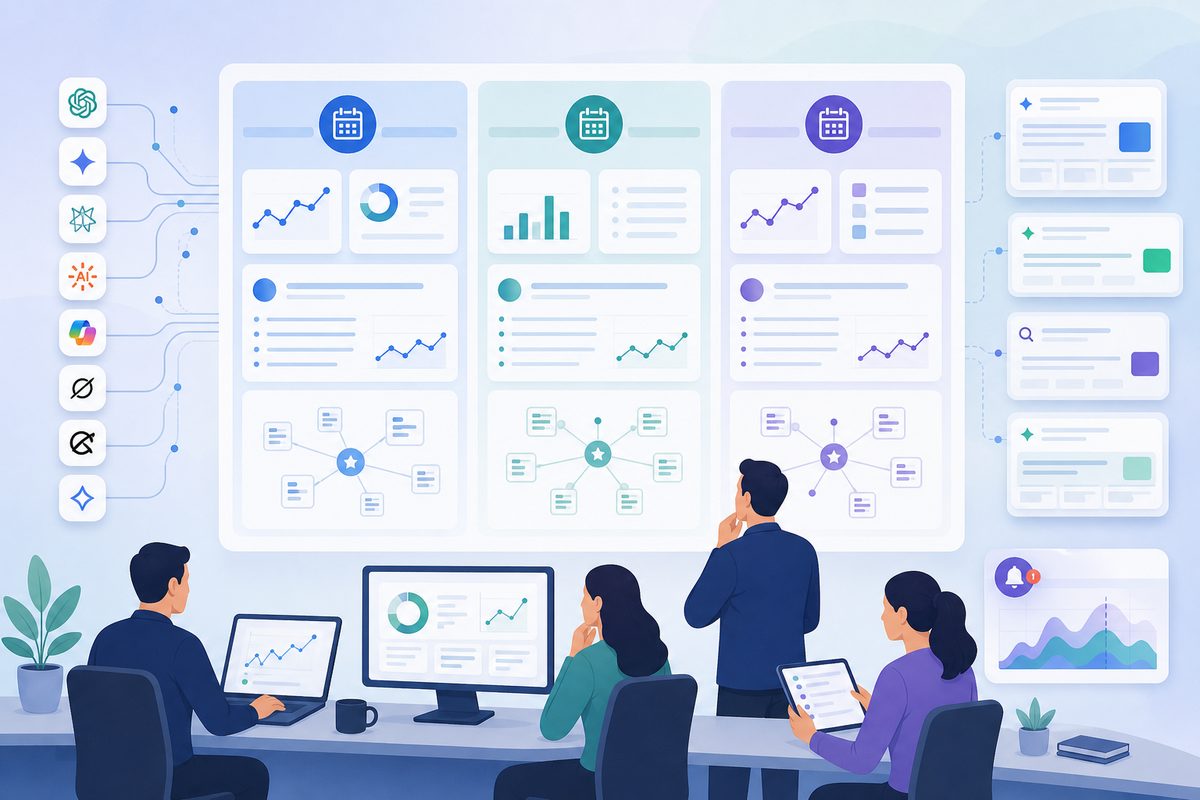
A single AI answer is a snapshot. Cadence turns snapshots into a trend line.
Why AI Search Cadence Is Different From SEO Rank Tracking
Traditional SEO rank tracking usually checks a URL’s position for a query. AI search monitoring is more complex because the answer itself can change. The same prompt may produce different brands, different citations, different ordering, and different descriptions across engines or sessions.
Google’s own documentation says AI Overviews and AI Mode may use query fan-out and can show different responses and links across those AI features. Google also states that AI feature traffic is included in overall Search Console Performance reporting, not as a full prompt-level visibility log, so teams still need their own monitoring for non-Google engines and answer-level changes. See Google’s AI features and your website guidance.
Research points in the same direction. The 2026 paper “Don’t Measure Once: Measuring Visibility in AI Search (GEO)” argues that one-off observations are unreliable because AI answers vary across runs, prompts, and time. The 2026 paper “Quantifying Uncertainty in AI Visibility” shows that citation visibility can vary enough that single-run metrics may look more precise than they are.
For marketers, the operating lesson is simple: measure often enough to detect material movement, but validate changes before calling them trends.
Use the Cadence Risk Score Before Choosing Frequency
The Cadence Risk Score is a practical framework for deciding whether a prompt group needs daily, weekly, twice-weekly, or monthly monitoring. Score each factor from 0 to 3.
| Factor | 0 points | 1 point | 2 points | 3 points |
|---|---|---|---|---|
| Revenue influence | Awareness only | Some pipeline influence | Active evaluation query | Direct shortlist or vendor-selection query |
| Market volatility | Stable category | Occasional new entrants | Frequent competitor campaigns | Category language changes week to week |
| Brand risk | Low risk | Some factual errors | Confusion with competitors | Legal, compliance, PR, or trust sensitivity |
| Campaign timing | No active push | Always-on content | Launch or PR campaign | Major launch, rebrand, funding, acquisition, or crisis |
| AI answer instability | Rarely changes | Citation changes sometimes | Brand order shifts often | Answers differ materially day to day |
| Reporting pressure | Internal learning | Manager review | Executive review | Board, investor, client, or crisis reporting |
Use the total score to assign cadence:
| Score | Recommended cadence |
|---|---|
| 0-5 | Monthly |
| 6-10 | Weekly |
| 11-14 | Twice weekly |
| 15-18 | Daily |
Add one capacity rule: do not increase cadence unless someone owns the review and the fix path. Daily monitoring without a daily reviewer creates dashboards, not decisions.
Cadence by Prompt Type
Prompt type matters because not every AI search query has the same business impact.
| Prompt group | Example | Normal cadence | Risk-window cadence |
|---|---|---|---|
| Branded | “What is [brand]?” | Weekly or monthly | Daily |
| Category shortlist | “Best AI visibility tools for B2B SaaS” | Weekly | Daily |
| Comparison | “[brand] vs [competitor]” | Weekly | Daily |
| Problem-aware | “How do I track AI citations?” | Monthly or weekly | Weekly |
| Reputation | “Is [brand] reliable?” | Weekly | Daily |
| Executive education | “What is answer engine optimization?” | Monthly | Weekly |
For prompt design, start with buyer questions that map to real decision points. A tight 40-prompt set is usually more useful than 400 loosely related prompts. If the prompt library is still being built, use a structured AI search prompts framework before deciding how often each prompt should run.
When Daily AI Search Monitoring Is Worth It
Daily monitoring is worth it when late detection can cost pipeline, reputation, or executive confidence. It is not worth it just because a tool supports daily runs.
Use daily monitoring for:
- Product launches and major feature announcements.
- Rebrands, repositioning, funding news, acquisitions, or pricing changes.
- Negative press, legal risk, compliance sensitivity, or trust-sensitive categories.
- Competitor campaigns that target your category or comparison terms.
- High-intent shortlist prompts such as “best [category] tools for [use case].”
- Prompts where AI engines frequently misdescribe the brand.
Daily monitoring should be a watchlist, not the whole prompt library. For example:
25 high-risk prompts × 5 engines × 14 launch days = 1,750 answer checks
That is already enough work before repeated sampling, citation review, screenshots, and fix assignment.
A daily monitoring workflow should capture only exceptions:
- Run the watchlist at a consistent time.
- Store answer text, citations, timestamp, engine, and model where available.
- Flag brand disappearance, competitor replacement, harmful descriptions, and new citation sources.
- Re-run material exceptions before escalating.
- Assign the fix to content, PR, product marketing, sales enablement, or web.
Daily cadence should end when the risk window ends. If the launch stabilizes after 14-21 days, move those prompts back to weekly.
Why Weekly Monitoring Is the Default
Weekly AI search monitoring is the best default for most B2B SaaS teams because it balances signal, cost, and action speed.
B2B buying decisions usually unfold over weeks. Prospects compare vendors, integrations, pricing, use cases, analyst opinions, and peer recommendations before booking demos or shortlisting tools. Weekly monitoring matches that decision rhythm better than daily noise or monthly delay.
A strong weekly workflow includes:
- Run the same core prompt set on the same weekday.
- Compare mention rate, average brand order, citation share, AI share of voice, sentiment, and recommendation language.
- Review the actual answer text for high-value prompts.
- Identify source gaps, competitor gains, and inaccurate descriptions.
- Assign fixes to content, product marketing, PR, or web.
- Send a short operating report with wins, losses, and next actions.
For KPI definitions, use an AI search metrics scorecard that separates mention rate, rank/order, citation share, sentiment, recommendation language, and source quality. Mention volume alone is too weak to guide strategy.
When Monthly Monitoring Is Enough
Monthly monitoring is enough when the prompt group is stable, low-risk, and not tied to an active campaign. It is best for baseline trend reporting and early-stage programs where the team is still learning which prompts matter.
Use monthly monitoring for:
- Low-risk informational prompts.
- Stable branded prompts with few factual errors.
- Long-tail education queries that do not influence near-term buying decisions.
- Executive trend summaries where weekly movement would be too noisy.
- Early budget validation before the program expands.
Monthly monitoring is not “set and forget.” The prompt wording, engine list, scoring method, and evidence archive still need to stay consistent. The difference is the decision horizon: monthly reports answer “Are we becoming more visible?” rather than “What changed this week?”
Do not use monthly monitoring for launch prompts, competitor battles, reputation-sensitive terms, or high-intent shortlist queries.
What Quarterly Monitoring Is For
Quarterly cadence is not a substitute for weekly or monthly measurement. Use quarterly review for governance.
A quarterly review should answer:
- Are we tracking the right prompt groups?
- Did new competitors enter the market?
- Did buyer language change?
- Which AI engines now matter for our audience?
- Which prompts no longer deserve monitoring?
- Which prompts should move from monthly to weekly or weekly to daily?
- Is the reporting burden still worth the cost?
Quarterly is also the right time to revisit prompt count. If the team has no capacity to read and act on the output, expanding from 80 prompts to 300 prompts will reduce focus. For sizing the library, use a dedicated guide on how many AI search prompts to track.
Add Event-Based Overrides to Any Cadence
Event-based overrides temporarily increase monitoring frequency when the market changes. They protect teams from the main weakness of weekly or monthly reporting: important shifts rarely wait for the calendar.
| Trigger | Temporary cadence | Duration | What to watch |
|---|---|---|---|
| Product launch | Daily | 14-21 days | Category prompts, comparison prompts, launch-message accuracy |
| Funding or acquisition news | Daily | 7-14 days | Brand description, market position, company facts |
| Rebrand or repositioning | Daily | 30 days | Old naming, new category fit, confused descriptions |
| Competitor campaign | Daily or twice weekly | Campaign window | AI shortlists, competitor citations, comparison pages |
| Major content refresh | Twice weekly | 2-4 weeks | Whether refreshed pages become cited |
| Negative press or PR issue | Daily | Until stable | Sentiment, factual errors, source changes |
| Google or model update | Twice weekly or daily | 2-4 weeks | Citation churn, answer language, brand order |
The trigger should apply only to affected prompts. Do not move the entire library to daily because ten launch prompts are volatile.
How Many Runs Should You Use Per Prompt?
For normal weekly operations, one run per prompt per engine is usually enough to maintain a directional trend, as long as the team avoids overreacting to a single answer. For high-risk prompts, add validation runs when something material changes.
Use this practical sampling rule:
| Situation | Sampling approach | How to interpret it |
|---|---|---|
| Monthly baseline | 1 run per prompt per engine | Directional trend only |
| Weekly operations | 1 run per prompt per engine | Compare over multiple weeks |
| Daily watchlist | 1 run daily, validate exceptions | Fast detection, not statistical proof |
| Material exception | 2-3 repeat runs | Confirm whether the issue repeats |
| Research-grade analysis | Multiple runs across days | Report uncertainty and avoid single-point claims |
A useful threshold: treat a change as meaningful when it repeats over time, appears across multiple engines, affects a high-value prompt, or comes with a citation/source change.
One bad answer is an investigation. A repeated bad answer on a high-intent prompt is an action item.
Make Cadence Data Comparable
Cadence only works when the inputs stay stable. If prompt wording, location, engine selection, or scoring changes every week, the trend line becomes hard to trust.
For each run, archive:
- Exact prompt wording.
- Prompt group and buyer journey stage.
- Engine and model, where visible.
- Date, time, and time zone.
- Country, language, and device context when relevant.
- Logged-in or clean-session state.
- Full answer text.
- Brand mention status.
- Brand order or relative position in recommendations.
- Citation URLs and source domains.
- Sentiment and recommendation language.
- Screenshot or export.
- Owner and next action.
This is why manual prompt logs often work well at the beginning. They force the team to read the answers and learn why the brand appears, disappears, or gets misdescribed.
Budget the Cadence Before Expanding the Library
The basic cost formula is:
prompts × engines × runs × monitoring days = answer checks
That number affects software cost, API cost, analyst review time, and reporting effort.
| Plan | Prompt count | Engines | Frequency | Approx. monthly checks |
|---|---|---|---|---|
| Starter baseline | 30 | 4 | Monthly | 120 |
| Weekly operating model | 60 | 5 | Weekly | 1,200 |
| Launch watchlist | 25 | 5 | Daily for 14 days | 1,750 |
| Agency multi-client view | 50 per client × 10 clients | 5 | Weekly | 10,000 |
The review burden is often larger than the software burden. If nobody reads changed answers, checks citations, or assigns fixes, more frequent monitoring only creates more unprocessed data.
Budget for:
- Monitoring platform or API cost.
- Analyst review time.
- Exception validation.
- Reporting.
- Content updates.
- PR or third-party source development.
- Executive or client communication.
What to Report Daily, Weekly, and Monthly
Daily, weekly, and monthly reports should not contain the same information. Each rhythm supports a different decision.
| Reporting rhythm | Audience | Include | Exclude |
|---|---|---|---|
| Daily alert | SEO owner, comms, product marketing | Drops, harmful descriptions, competitor replacements, new citations | Full trend decks |
| Weekly operating report | SEO, content, growth, demand gen | Share of voice, prompt winners and losers, source gaps, fixes shipped | Raw answer dumps |
| Monthly executive report | CMO, founder, agency client | Trend line, category position, competitor movement, business impact | Every prompt-level fluctuation |
| Quarterly strategy review | Channel owner, leadership | Prompt library changes, engine coverage, budget, ownership | Day-to-day exceptions |
A weekly report should be readable in five minutes. Include the three prompts that improved, the three that declined, the top cited sources, the most important competitor movement, and the fixes needed next. For a practical format, use an AI visibility report template instead of turning raw answer logs into a deck.
Connect Monitoring Cadence to Fix Cadence
AI search monitoring is only useful if it changes what the team fixes. When visibility drops, diagnose the cause before rewriting pages.
Common root causes include:
| Gap | What it looks like | Fix cadence |
|---|---|---|
| Source gap | AI engines cite competitors, review sites, forums, or analyst pages instead of your pages | Weekly or monthly |
| Evidence gap | Your page makes claims without proof, examples, screenshots, or comparison detail | Weekly |
| Entity gap | AI systems misunderstand what the company does, who it serves, or how it differs | Weekly |
| Freshness gap | Third-party sources show outdated pricing, integrations, positioning, or company facts | Weekly or monthly |
| Format gap | Competing pages provide definitions, steps, tables, and comparisons that your page lacks | Weekly |
| Technical eligibility gap | Pages are hard to crawl, not indexed, blocked, or inconsistent with visible structured data | Immediate |
Google’s guidance on helpful, reliable, people-first content emphasizes original information, complete coverage, clear sourcing, and substantial added value. That is also the practical standard for answer engine optimization: AI systems need clear, trustworthy evidence to cite or summarize.
For Google AI features specifically, the same Google AI features guidance says foundational SEO still applies and pages must be eligible to appear in Search with a snippet. Do not treat AI monitoring as separate from technical SEO, content quality, and entity clarity.
Recommended Operating Model
A mature AI search monitoring cadence uses monthly baselines, weekly operations, daily exceptions, and quarterly governance.
Use this operating model:
- Build a 40-80 prompt core set across branded, category, comparison, problem-aware, and reputation prompts.
- Group prompts by business risk instead of tracking every prompt the same way.
- Score each group with the Cadence Risk Score.
- Monitor the core buyer prompt set weekly.
- Monitor low-risk educational prompts monthly.
- Create a daily watchlist for launches, reputation risk, competitor campaigns, and high-intent prompts.
- Validate material exceptions before escalating.
- Report by decision level: daily alerts, weekly operating reviews, monthly executive summaries.
- Review the system quarterly for prompt quality, engine coverage, budget, and ownership.
For a broader program structure, connect the cadence to the full AEO operating model, including ownership, reporting, prompt governance, and fix workflows.
Common Mistakes to Avoid
The most common mistake is measuring more often than the team can act. A daily dashboard looks serious, but if fixes ship monthly, daily movement rarely improves performance.
Avoid these mistakes:
- Using one cadence for every prompt. High-risk comparison prompts and low-risk education prompts should not be measured the same way.
- Changing prompts too often. Trend lines become useless when the question set keeps moving.
- Tracking only branded prompts. You learn whether AI knows you, not whether buyers find you.
- Ignoring citations. Mentions without source review do not explain why the answer changed.
- Using one engine as the truth. ChatGPT, Perplexity, Gemini, Claude, Copilot, Grok, AI Mode, and AI Overviews can produce different competitive realities.
- Reporting vanity metrics. Mention volume is weaker than recommendation language, rank/order, source quality, and share of voice.
- Treating every answer change as a trend. Validate changes before escalating.
- Skipping answer archives. Without stored answers and citations, teams cannot diagnose what changed.
The best cadence is disciplined. It runs on schedule, keeps prompt sets stable, and turns meaningful exceptions into fixes.
Frequently Asked Questions
What is AI search monitoring cadence?
AI search monitoring cadence is the schedule for checking how AI answer engines mention, recommend, rank, cite, and describe your brand across a fixed prompt set. It includes prompt frequency, engine coverage, sampling depth, evidence storage, and action thresholds.
Is daily AI search monitoring always better?
No. Daily monitoring is better only for high-risk, revenue-sensitive, or time-sensitive prompts. For stable category prompts, weekly monitoring usually gives a cleaner signal with lower review cost.
What is the best default cadence for a B2B SaaS team?
Weekly is the best default for most B2B SaaS teams. It matches content operations, campaign reviews, SEO workflows, and executive reporting. Add daily monitoring only for launches, crises, competitor campaigns, and high-value shortlist prompts.
How often should agencies monitor AI visibility for clients?
Agencies should monitor core client prompt sets weekly and send monthly executive summaries. Daily monitoring should be reserved for clients in active launches, reputation-sensitive industries, or competitive categories where AI shortlists change quickly.
Should branded prompts and category prompts use the same cadence?
No. Branded prompts may need weekly or daily checks when reputation accuracy matters. Category and comparison prompts should be scored by revenue influence and volatility. Low-risk educational prompts can often be monitored monthly.
How many prompts should be monitored daily?
Only the prompts tied to immediate risk should be monitored daily. A practical daily watchlist is often 10-30 prompts across the most important engines. Keep the broader library on weekly or monthly cadence.
How do you know when to reduce cadence?
Reduce cadence when a prompt group shows stable mentions, stable citations, low revenue influence, and no active campaign pressure for at least four reporting cycles. Keep event-based overrides ready so the team can increase frequency when risk returns.
How should teams handle AI answer variability?
Treat single-run changes as investigations, not conclusions. A change becomes more meaningful when it repeats across time, appears across multiple engines, affects a high-value prompt, or comes with a citation change.