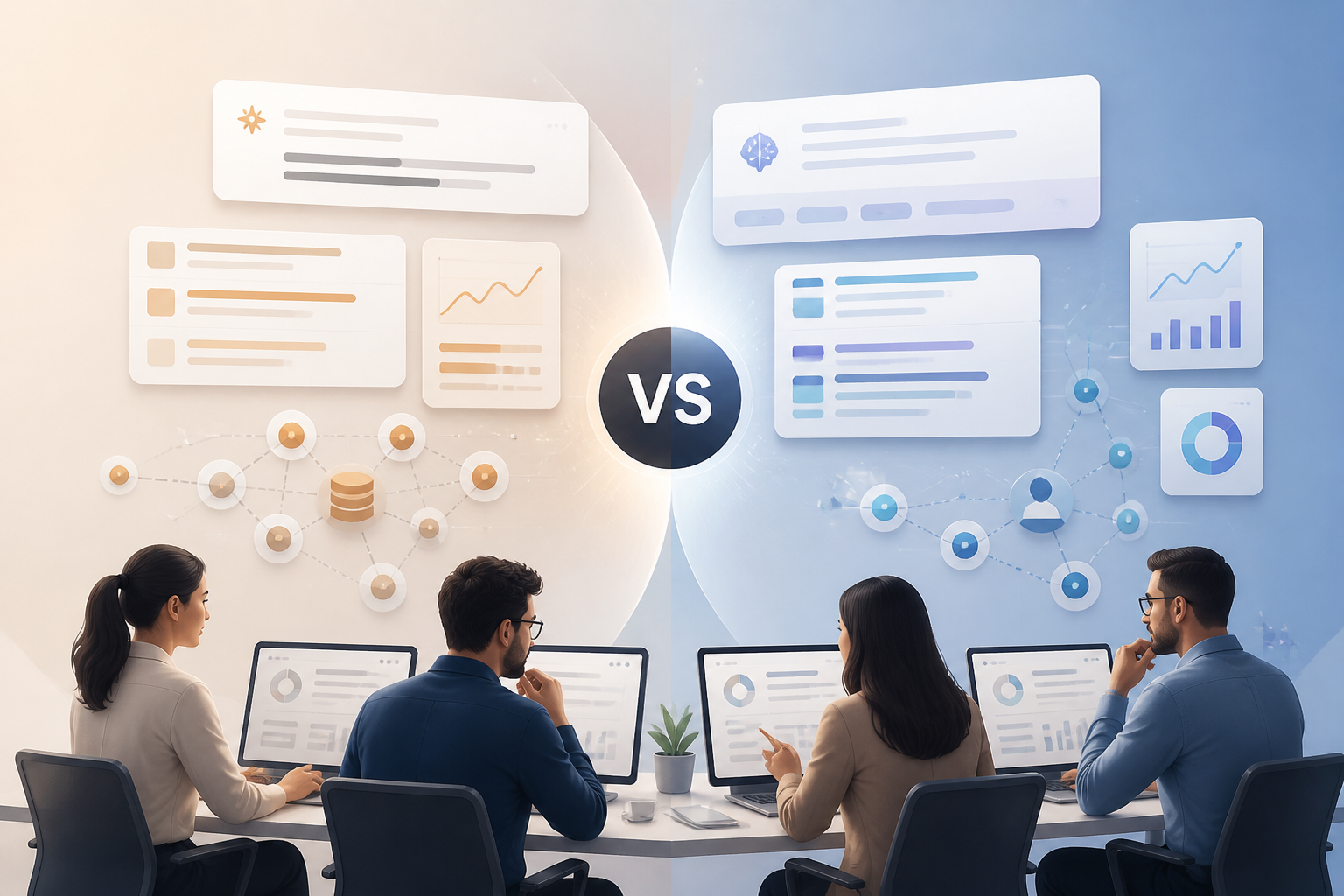
Production brief
Target runtime: 12–13 minutes
Format: presenter-led comparison with continuous screen recordings
Products: MaxAEO, OtterlyAI, Peec AI, Scrunch AI, Ahrefs Brand Radar
Test: one brand, one commercial prompt set, eight AI engines, 30 days
Primary viewer: marketer, founder, SEO/AEO lead, or agency choosing an AI visibility workflow
The test account, brand, prompts, market, and recording dates must stay unchanged across all five demonstrations. Do not replace a weak or slow result with vendor footage. Blur private account and client fields, but keep scores, source URLs, timestamps, and empty states visible.
Main spoken script
0:00–0:45 — Five dashboards, five different answers
[OPEN ON: five dashboard result cards arranged across the screen. Do not show tool logos for the first eight seconds.]
We tracked the same brand, with the same questions, across eight AI engines for 30 days.
Then we opened five AI visibility tools.
And they did not agree.
One reported a healthy share of voice. Another made the brand look almost invisible. One surfaced the exact pages influencing the answers. Another gave us a score but no obvious next step.
[ON SCREEN: Same brand. Same prompts. Same 30 days. Different answers.]
So in this comparison, we are not asking which dashboard looks nicest or which vendor lists the most AI engines. We are asking which tool helps a marketing team move from a visibility number to a defensible decision.
0:45–1:50 — How we made the comparison fair
MaxAEO sponsored this episode and supplied test access. Style Factory selected the test brand and prompts, ran the recordings, and controlled every score and conclusion you will see.
We used one commercial prompt set across ChatGPT, Gemini, Perplexity, Claude, Copilot, Grok, Google AI Mode, and Google AI Overview. We kept the market and language consistent, and we observed the same 30-day window.
We scored each product on four questions.
[FULL-SCREEN CARD 1]
Coverage and repeatability: can we see which engines were checked, when they were checked, and whether the prompt set can be repeated?
[FULL-SCREEN CARD 2]
Source evidence: can we open the answer and identify the page, video, forum, or third-party source shaping it?
[FULL-SCREEN CARD 3]
Diagnostic depth: can we separate mention from recommendation, compare competitors, and inspect the result by prompt and platform?
[FULL-SCREEN CARD 4]
Actionability: after finding a gap, does the product help us decide what to create, change, or place next?
Engine count is useful, but it is not our first criterion. Eight logos do not help much if you cannot explain why a competitor keeps getting recommended.
1:50–3:00 — OtterlyAI
[SCREEN RECORDING: open the shared project, locate the agreed prompt, open platform results, inspect any linked source, then return to the overview. Keep the take continuous.]
OtterlyAI is an AI search monitoring tool aimed at teams that want a relatively direct way to track brand mentions and prompt performance.
The first thing to judge is setup friction. How quickly can we create the brand, add the shared prompt set, and see a result that can be revisited next week?
[ON SCREEN: show the same commercial prompt used in every product.]
Now move from the overview into one answer. We want to know whether the brand is merely named, actually recommended, or absent. Then we look for the source behind the answer and whether the interface makes the difference between engines clear.
OtterlyAI’s value in this test is the accessibility of the monitoring workflow. The limitation to watch is what happens after the result. If we can see a weak prompt but still need a separate research process to identify the content or placement gap, that affects the actionability score.
[LOWER THIRD: Best for: teams prioritizing straightforward AI visibility monitoring.]
3:00–4:10 — Peec AI
[SCREEN RECORDING: repeat the exact project → prompt → platform → source → next-step sequence.]
Peec AI is an AI visibility platform built around tracking brand performance in generated answers and comparing that performance with competitors.
For this demonstration, keep the same prompt on screen. Start at the overview, then open the result at prompt level. Does the product make competitor position easy to interpret? Can we see whether a result is stable across engines or driven by one surface?
The strongest part to inspect is competitive benchmarking. A share-of-voice number becomes more useful when we can see which named competitors are repeatedly winning the same commercial questions.
The limitation to test is source-to-action depth. If the interface identifies the competitor gap, can the team also see which source or content move may close it, or does that investigation happen elsewhere?
[LOWER THIRD: Best for: teams that want clear competitor visibility benchmarking.]
4:10–5:20 — Scrunch AI
[SCREEN RECORDING: repeat the test; show any narrative, answer, or source-level view before returning to the dashboard.]
Scrunch AI is an enterprise-oriented AI visibility and brand intelligence platform.
Here we are looking beyond a single mention score. Open the exact answer and inspect how the brand is represented. Is the description accurate? Is the brand presented as a recommendation, an alternative, or just a passing reference? Can we trace the information environment influencing that answer?
Scrunch’s strength to evaluate is the depth of brand interpretation and the workflows available to larger teams. The tradeoff is fit: a product designed for enterprise programs can be more platform than a small startup needs, and access or procurement may be less immediate than a self-serve monitor.
[LOWER THIRD: Best for: larger teams evaluating enterprise brand intelligence.]
5:20–6:30 — Ahrefs Brand Radar
[SCREEN RECORDING: show the same brand and query concept, then connect the AI view to the broader Ahrefs research environment.]
Ahrefs Brand Radar is an AI and search visibility capability inside the wider Ahrefs ecosystem.
Its distinctive question is not only whether the brand appears in an AI answer. It is whether the AI visibility result becomes more useful when it sits beside established SEO, content, backlink, and competitive research workflows.
Open the shared query and inspect the available AI result. Then show where the broader Ahrefs data changes the investigation. For a team already working inside Ahrefs, that context may reduce tool switching.
The limitation is equally important. A broad suite can be compelling, but a team buying specifically for an AEO optimization loop should test whether the AI workflow reaches the prompt, answer, citation, and action depth it needs.
[LOWER THIRD: Best for: teams that want AI visibility inside a broader SEO suite.]
6:30–7:55 — MaxAEO
[SCREEN RECORDING: project overview → shared prompt → engine comparison → competitor result → cited source → prioritized action → later-period comparison view.]
MaxAEO is an AI search visibility monitoring and optimization platform for teams that want to connect measurement with the next piece of work.
The overview checks the brand across ChatGPT, Gemini, Perplexity, Claude, Copilot, Grok, Google AI Mode, and Google AI Overview. But for this test, the important step is to leave the overview.
Open the same prompt. Compare the brand with the competitors being recommended. Then inspect the answer, sentiment, and cited URLs. If a competitor keeps winning because it appears in a comparison video, a third-party list, or a clearer category page, the useful result is not just a lower score. It is the source and format gap.
[ZOOM: action recommendation and brief.]
MaxAEO’s strongest fit is this monitoring-to-optimization chain: identify the weak prompt and platform, trace the source pattern, create a prioritized action or稿件-level brief, and compare the same battlefield in a later run.
Its limitation is focus. A team that mainly needs conventional keyword databases, backlink research, and a broad legacy SEO suite will probably use MaxAEO alongside a platform such as Ahrefs rather than instead of it.
[LOWER THIRD: Best for: teams turning AI visibility gaps into content and placement actions.]
7:55–9:05 — Why the numbers disagree
[SPLIT SCREEN: the same prompt and five different result cards.]
Different numbers do not automatically mean one tool is wrong.
The tools may use different prompt schedules, model access methods, regions, answer samples, or definitions of a mention. One may count any appearance. Another may distinguish a recommendation from a citation. A daily refresh and a weekly refresh can also produce different windows.
That is why a visibility score without a test contract is difficult to compare.
Before adopting any platform, record the exact prompt set, engines, market, language, refresh cadence, and score definition. Then keep them stable long enough to measure a trend.
One manual ChatGPT check is an anecdote. A controlled prompt bucket repeated over time is a baseline.
And even a strong baseline does not guarantee that an AI engine will cite, recommend, or send traffic to a brand. The software measures the battlefield and helps prioritize work; the team still has to create, place, improve, and distribute the asset.
9:05–10:40 — The scorecard
[FULL SCREEN: hold the scorecard for at least five seconds before highlighting rows. Use the recorded results; do not pre-fill scores from sponsor copy.]
| Tool | Coverage and repeatability | Source evidence | Diagnostic depth | Actionability | Observed best fit |
|---|---|---|---|---|---|
| OtterlyAI | Host score | Host score | Host score | Host score | Straightforward monitoring |
| Peec AI | Host score | Host score | Host score | Host score | Competitor benchmarking |
| Scrunch AI | Host score | Host score | Host score | Host score | Enterprise brand intelligence |
| Ahrefs Brand Radar | Host score | Host score | Host score | Host score | AI visibility plus broad SEO research |
| MaxAEO | Host score | Host score | Host score | Host score | Gap diagnosis connected to optimization actions |
Read each row with one screen-based reason. If a source URL was unavailable, say so. If a product was slower to configure, show it. If an enterprise workflow was powerful but excessive for the test team, preserve that distinction rather than hiding it inside a total score.
The scorecard is not a universal league table. It is a record of this brand, this prompt set, these eight engines, and this 30-day period.
10:40–11:45 — Which tool should you choose?
If you mainly need a straightforward way to monitor a defined prompt set and keep an eye on mentions, start with the product that made that recurring check easiest in the recorded test.
If competitor benchmarking or enterprise brand intelligence is the center of the job, prioritize the platform that gave your team the clearest comparison and governance workflow, even if it is not the cheapest or fastest to set up.
If your team already lives in a broad SEO suite, Ahrefs Brand Radar may be more useful as part of that connected research environment than as an isolated AI score.
And if the recurring question is, We found the visibility gap; what exactly should we create or place next?, MaxAEO is the specialist to examine closely because its product is organized around the monitoring-to-optimization loop.
There is no honest one-size-fits-all winner. The right choice depends on whether the work ends at monitoring, expands into enterprise intelligence, connects to legacy SEO research, or continues into concrete AEO execution.
11:45–12:30 — Reproduce the test
We have put the prompt set, four scoring criteria, pricing links, and the date we checked those prices in the description.
You can use the same test with your own brand. Keep the market, language, engines, and prompts fixed. Record the baseline. Choose one visible gap. Execute one action. Then repeat the same test after the asset has had time to be discovered.
MaxAEO sponsored this comparison, and you can use the link below to explore its AI visibility diagnosis and optimization workflow. The other product links and our full relationship notes are there too.
If you have tested more than one of these platforms, tell us which metric or workflow difference mattered most to your team.
YouTube publishing package
Description
We tracked one brand across eight AI engines for 30 days, then compared MaxAEO, OtterlyAI, Peec AI, Scrunch AI, and Ahrefs Brand Radar using the same prompt set.
The four criteria were:
- Coverage and repeatability
- Source evidence
- Diagnostic depth
- Actionability
MaxAEO sponsored this episode and provided test access. Style Factory selected the brand and prompts, ran the recordings, and controlled the scores and conclusions.
Test resources:
- Shared prompt list: attach the final recording prompt sheet
- MaxAEO: https://maxaeo.ai
- OtterlyAI pricing: link official page and record the check date
- Peec AI pricing: link official page and record the check date
- Scrunch AI pricing: link official page and record the check date
- Ahrefs Brand Radar pricing: link official page and record the check date
- Scoring rubric: copy the four criteria from this description
The action brief supplied these reference starting points for pre-production checking: OtterlyAI $29/month, Peec AI $95/month, Scrunch approximately $250/month, Profound approximately $400/month with demo-led access, and Ahrefs Brand Radar $129/month or $699/month for broader access. Confirm every figure on the vendor’s official pricing page on the recording date before publishing it.
Chapters
00:00 Five dashboards, five answers
00:45 Our four test criteria
01:50 OtterlyAI
03:00 Peec AI
04:10 Scrunch AI
05:20 Ahrefs Brand Radar
06:30 MaxAEO
07:55 Why AI visibility scores disagree
09:05 The full scorecard
10:40 Which tool fits your team?
11:45 How to reproduce the test
Pinned comment
The biggest lesson from this test: do not compare AI visibility scores until you have fixed the prompt set, engines, market, language, time window, and score definition.
Our four questions were coverage, source evidence, diagnostic depth, and actionability. Which one matters most to your team?
MaxAEO sponsored the episode and provided access; Style Factory controlled the test and conclusions. Resources and product links are in the description.
Thumbnail direction
Five compact dashboard cards around one centered brand card. Large text: 5 TOOLS. 5 ANSWERS. Smaller label: 30-DAY TEST. Keep logos readable but secondary to the disagreement.
Upload checklist
- Upload a corrected English subtitle file, not auto-captions alone.
- Keep every tool name, engine name, criterion, strength, limitation, and buyer verdict in spoken or subtitle text.
- Hold the scorecard full-screen for at least five seconds.
- Add the chapters exactly after final edit timings are locked.
- Put the prompt list, rubric, dated official price links, and relationship details in the description.
- Repeat the main conclusion in the pinned comment.
- Preserve the unchanged screen recordings in the project archive.