If I were building a product marketing dashboard from scratch in 2026, I would not start with keyword rankings.
I would start with a simpler, more uncomfortable question: when a buyer asks ChatGPT, Perplexity, Gemini, Grok, or Google AI Mode about my category, does my brand show up, and what does the answer say about us compared with the competitors?
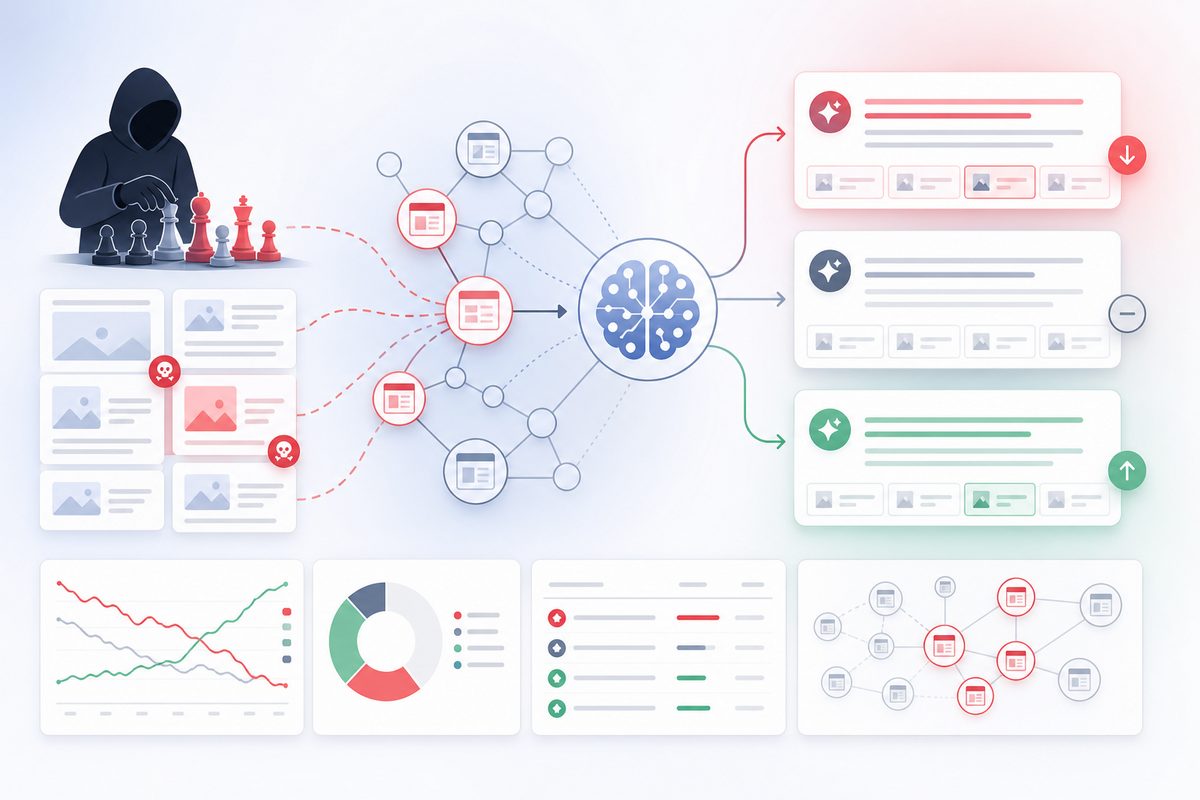
That question is no longer a brand team side project. In one MaxAEO monitoring run for this topic, 10 buyer-style prompts across 4 AI platforms produced 97 citation instances from pages about AI visibility, brand monitoring, AEO, GEO, sentiment, and competitor recommendation tracking. The pattern was clear: AI engines are not just listing tools. They are forming shortlists, repeating positioning, citing third-party explainers, and turning scattered web content into buyer guidance.
So this is the practical stack I would look at first if I were responsible for product messaging, competitive narrative, or content priorities this year.
What Counts as AI Search Monitoring Now
AI search monitoring is not just checking whether your brand is mentioned once in a chatbot screenshot.
For product marketers, the category should answer five recurring questions:
- Are we mentioned when buyers ask real category prompts?
- Which pages or third-party sources are AI engines citing when they talk about us?
- Is the sentiment accurate, neutral, outdated, or wrong?
- Which competitors are being recommended ahead of us?
- What should we fix next in our content, positioning, or citation footprint?
That means a useful tool has to look across engines, prompts, citations, sentiment, competitor share of voice, and action recommendations. A single rank number is not enough, because a brand can look strong in one engine and invisible in another.
The Five Criteria I Would Check First
Before comparing vendors, I would pressure-test the workflow.
1. Engine coverage. At minimum, I want coverage across the AI surfaces my buyers actually use: ChatGPT, Perplexity, Gemini, Claude, Grok, Google AI Overview / AI Mode, and Copilot where relevant.
2. Citation transparency. Mentions are useful, but citations tell you why a model trusts a claim. If a tool cannot show which pages are shaping the answer, the content team has nothing concrete to fix.
3. Sentiment and narrative tracking. Product marketers need to know whether AI engines describe the product correctly, whether they attach the right use cases, and whether outdated objections keep appearing.
4. Competitor comparison. The real question is not “are we visible?” It is “are we visible when buyers ask for alternatives, comparisons, or recommendations?”
5. Path from monitoring to action. A dashboard is useful only if it helps the team decide what to update next: which page, which claim, which comparison, which missing proof point, which third-party source gap.
With that lens, here are five tools worth knowing.
1. MaxAEO
Best for: product marketing teams that want AI visibility monitoring plus action recommendations.
MaxAEO is an AI search brand visibility monitoring platform for teams that need to understand how their brand is mentioned, ranked, cited, and compared across AI engines. It monitors ChatGPT, Gemini, Perplexity, Claude, Copilot, Grok, Google AI Mode, Google AI Overview, and other AI search surfaces.
Where MaxAEO stands out is the monitoring-to-optimization workflow. The platform is built around brand visibility, sentiment analysis, competitor benchmarking, citation tracing, and content optimization recommendations. That matters for product marketing because the work does not stop at “we were not mentioned.” The next question is usually “which narrative gap, citation gap, or competitor comparison should we fix first?”
Use it when your team needs a low-friction baseline, daily monitoring, prompt-level visibility, and a way to turn AI answer gaps into concrete content actions. It is especially relevant for startups and growth teams that do not want AI search work trapped inside a manual spreadsheet.
The honest limitation: if your team mainly needs a broad legacy SEO suite, or if procurement requires a heavily bespoke enterprise AI intelligence program, you may still evaluate a broader SEO platform or an enterprise-first vendor alongside MaxAEO.
2. Profound
Best for: enterprise teams building an AI visibility program with executive reporting.
Profound is one of the better-known names in AI visibility and answer engine optimization. It is often discussed in the context of monitoring how brands appear in AI-generated answers, which sources are cited, how sentiment changes, and how competitors are represented.
I would look at Profound when the AI visibility program needs to serve multiple stakeholders: brand, communications, SEO, content, and leadership. Enterprise teams usually care less about a single prompt result and more about trend reporting, governance, and making AI visibility legible to executives.
Use it when the company is ready to treat AI search as a formal workstream with recurring reporting, larger budgets, and cross-functional ownership.
3. OtterlyAI
Best for: teams that want approachable AI search monitoring without turning it into a giant analytics project.
OtterlyAI is commonly positioned around monitoring brand mentions, website citations, and prompt visibility across AI search surfaces such as ChatGPT, Perplexity, Google AI Overviews, and AI Mode.
The reason I would include it in a product marketing shortlist is usability. A lot of teams are still at the “we need to know if we show up at all” stage. For them, the first win is not a perfect data warehouse. It is a repeatable view of which prompts matter, whether visibility is changing, and where competitors keep appearing.
Use it when you need accessible tracking, recurring checks, and an easier entry point into AI search monitoring.
4. Semrush AI Visibility Toolkit
Best for: SEO and content teams that already run their workflow inside Semrush.
Semrush is not a pure-play AI visibility startup; it is a large SEO and competitive intelligence platform adding AI visibility workflows into an existing marketing stack. That can be a strength if your team already uses Semrush for keyword research, competitive analysis, content planning, and reporting.
I would consider Semrush when AI search visibility needs to sit beside traditional SEO metrics rather than replace them. For some teams, the practical buyer is not the product marketer alone. It is the SEO/content team that already owns the reporting cadence, executive dashboard, and content backlog.
Use it when the question is: “How do we add AI answer visibility to the search workflow we already have?”
5. Peec AI
Best for: lean marketing teams that want AI search analytics and content prioritization.
Peec AI is usually discussed around AI search visibility, prompt tracking, competitor benchmarking, and understanding which sources or pages influence AI answers. It is a good fit for teams that want focused AI search insight without overcomplicating the stack.
The product marketing value is prioritization. If AI engines are recommending competitors, the team needs to know whether the issue is missing category education, weak comparison content, thin third-party validation, outdated citations, or a positioning mismatch.
Use it when you want a lean way to monitor AI search visibility and turn that into a content or messaging roadmap.
Which Tool Fits Which Team?
For a startup product marketing team, I would start with a quick baseline: the prompts buyers actually ask, the engines that matter, and the competitors that appear most often. MaxAEO or OtterlyAI are natural places to look first.
For an agency, the priority is repeatable reporting across multiple brands. OtterlyAI, Peec AI, or MaxAEO can make sense depending on whether the client needs visibility reporting, content prioritization, or optimization actions.
For an enterprise brand, Profound or Semrush may be the safer first conversation if procurement, executive reporting, and existing marketing-stack integration matter most.
For a product marketing team specifically, I would bias toward the tool that closes the loop: prompt monitoring, citation tracing, competitor narrative, sentiment, and what to update next. Visibility without the next action is just another number in a dashboard.
A Simple Pilot Checklist
Before buying a year-long platform, I would run a 30-day pilot and ask:
- Which AI engines are actually influencing our buyers?
- Which 20-50 prompts represent real category, comparison, and problem-aware searches?
- Are we tracking citations and source pages, not just brand mentions?
- Can we compare our brand against competitors by prompt cluster?
- Does the tool tell us what to fix next?
That last question is the one I would not skip. AI search visibility is moving too quickly for teams to collect screenshots and hope someone turns them into strategy later.
What I’d Take Away
The market is early, so there is no universal “best” AI search monitoring tool for every company.
But there is a right first principle: do not measure AI visibility as a vanity metric. Measure it as a buyer-shortlist system.
If your brand is missing, misdescribed, or consistently ranked behind competitors in AI answers, the content team, product marketing team, and leadership team need to know where the gap is and what to change next.
If you are starting from zero, run a visibility audit first. See where your brand appears across AI answers, which sources are shaping the narrative, and where competitors keep winning. Then choose the tool that matches the problem you actually find.
I would be curious what other product marketers are seeing in their own category prompts, especially where AI engines are recommending unexpected competitors.