
By MaxAEO | Published 2026-09-28 | Updated 2026-09-28
Perplexity citation analysis software helps marketing and SEO teams monitor which sources appear in Perplexity answers, how often a brand is mentioned, and which competitors receive the visible citations instead. The most useful platforms go beyond counting links: they connect prompts, cited URLs, brand mentions, sentiment, and changes over time.
Perplexity is particularly measurable because its answers include links to original sources. Its official documentation describes real-time web research, synthesized answers, and numbered citations that users can inspect. (perplexity.ai)
What is Perplexity citation analysis software?
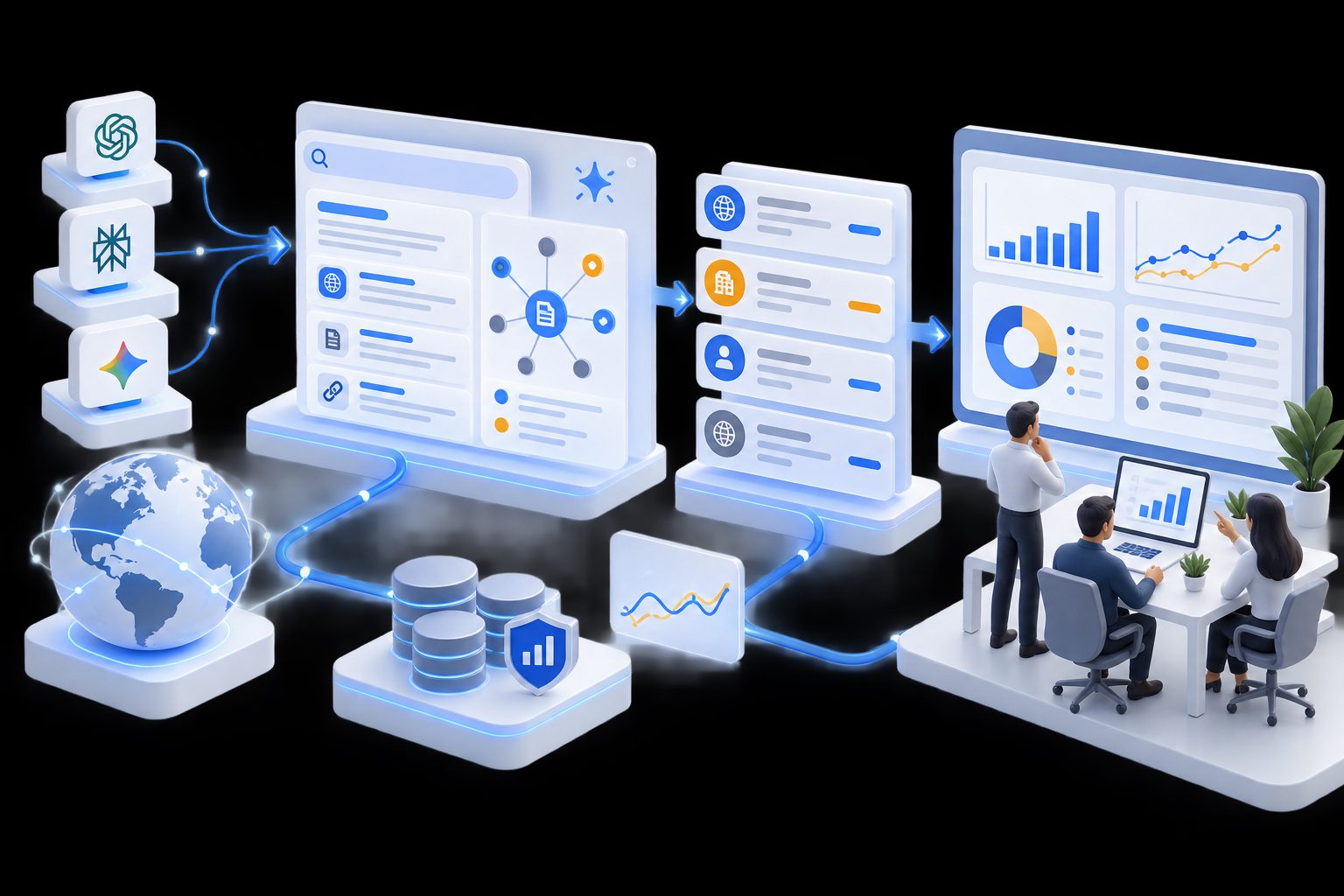
Perplexity citation analysis software is a monitoring system that repeatedly sends defined buyer questions to Perplexity, records the answers and source URLs, and analyzes whether your brand or website appears in the resulting citation set.
A strong system should separate at least four signals:
- Mention presence: Is the brand named in the answer?
- Citation presence: Is the brand’s website or another relevant domain linked as a source?
- Citation position: How prominently does the source appear?
- Competitive context: Which alternatives are mentioned or cited instead?
This distinction matters because a company can be mentioned without owning the cited source. For example, Perplexity may name a SaaS product in a comparison while citing a review website, marketplace, Reddit discussion, or analyst page. Counting only brand mentions would overstate source-level visibility.
Why citation analysis is different from rank tracking
Traditional rank tracking measures where a page appears for a keyword. Perplexity citation analysis measures whether a source contributes to a synthesized answer for a natural-language question.
The difference is operational:
| Traditional SEO tracking | Perplexity citation analysis |
|---|---|
| Keyword and URL position | Buyer prompt and cited source |
| One results page | A generated answer with multiple references |
| Mostly page-level ranking | Brand, source, sentiment, and recommendation context |
| Periodic ranking snapshot | Repeated answer sampling over time |
| Click-focused reporting | Visibility and source influence reporting |
Perplexity’s own guidance emphasizes that prompts work best when they contain a clear instruction, context, specific inputs, keywords, and an expected output format. (perplexity.ai) That makes prompt design part of measurement quality. A vague prompt produces a weak benchmark even when the software dashboard looks polished.
What should a Perplexity citation tracker measure?
The minimum useful dataset contains the prompt, answer, citations, domain, page URL, brand mention, competitors, and timestamp. For SaaS teams, five additional metrics make the data more actionable.
1. Citation rate
Citation rate is the percentage of monitored prompts where your domain appears among Perplexity’s cited sources.
[
\text{Citation Rate} = \frac{\text{Prompts citing your domain}}{\text{Total monitored prompts}} \times 100
]
Track this separately from mention rate. A high mention rate with a low citation rate often indicates that third-party sources describe your brand, but your own pages are not being used as evidence.
2. Citation share
Citation share measures your portion of all observed source appearances within a category or prompt set. It is more useful than a single visibility score when several competitors repeatedly appear together.
3. Source quality and source type
A citation report should classify sources by type:
- Official product pages
- Documentation and technical pages
- Independent review sites
- Comparison pages
- Editorial publications
- Community discussions such as Reddit
- Directories and marketplaces
This reveals the structure of your citation footprint. If competitors are consistently cited by independent comparison pages while your site appears only in branded prompts, the problem is not simply technical SEO.
4. Citation prominence
Record whether a source appears early or late in the citation list and whether the answer uses it for a core claim or a minor detail. Position alone is not a perfect authority metric, but it helps prioritize pages that influence recommendation language.
5. Sentiment and factual accuracy
A citation can increase visibility while still creating a reputation problem. Track whether Perplexity describes the product positively, neutrally, or negatively, and flag claims that are outdated or inaccurate.
MaxAEO combines these signals with brand monitoring, sentiment analysis, citation tracking, competitor intelligence, and optimization recommendations across eight AI engines. Its daily monitoring includes Perplexity alongside ChatGPT, Gemini, Claude, Copilot, Grok, Google AI Mode, and Google AI Overviews.

How to evaluate Perplexity citation analysis software
A practical evaluation should test the workflow, not just the dashboard design. The following six-part framework is designed for SaaS buyers.
Prompt coverage
Can the platform monitor real buyer questions rather than only keywords? Look for support for branded, non-branded, comparison, alternative, category, and problem-specific prompts.
Answer preservation
The tool should retain the original answer and citation list. Without stored evidence, a changing score is difficult to audit or explain to content, product marketing, and leadership teams.
Source-level detail
Check whether the platform shows the exact domain and page URL cited. Domain-only reporting hides the content that actually earned visibility.
Competitor comparison
Useful comparison includes competitor mention rate, citation share, average recommendation position, sentiment, and source overlap. A simple list of competitors is not enough.
Update cadence
Perplexity results can vary across runs. A serious monitoring workflow should run prompts on a fixed schedule and show trend lines rather than treating one manual answer as a permanent result. Research on generative-search citation variability also indicates that citation rankings can change across repeated samples, which makes consistent sampling important. (arxiv.org)
Actionability
The report should answer: Which prompt is underperforming? Which competitor is cited instead? Which source type is missing? What content or distribution action should the team take next?
For a broader purchasing process, the enterprise AEO tool evaluation framework provides a useful procurement lens. For source-specific research, see the guide to tracking sources cited by ChatGPT and Perplexity.
A practical citation gap workflow for SaaS teams
Use this five-step process to turn Perplexity data into an optimization backlog:
- Build a prompt set: Include 20–50 questions across category discovery, alternatives, comparisons, use cases, and purchase evaluation.
- Run a baseline: Record mentions, citations, competitors, source types, citation position, and sentiment.
- Group the gaps: Separate missing brand mentions, missing owned citations, weak third-party coverage, and inaccurate descriptions.
- Prioritize commercial prompts: Give more weight to questions that indicate vendor selection, migration, pricing evaluation, or implementation intent.
- Recheck after changes: Compare the same prompts over time instead of replacing the benchmark after every content update.
This workflow creates a more defensible measurement system than asking Perplexity a few questions manually and recording screenshots. It also connects citation monitoring to content operations without assuming that every visibility problem can be solved by publishing more blog posts.
MaxAEO supports daily monitoring, original-answer storage, citation-source tracing, competitor benchmarking, and the conversion of existing SEO keywords into AI-search prompts. Its free AI visibility diagnosis can be generated from a brand name, website, and competitor information without requiring internal documents or customer data.

Frequently asked questions
Is Perplexity citation tracking the same as SEO rank tracking?
No. SEO rank tracking measures page positions for keywords. Perplexity tracking measures how answers mention brands and which sources are cited for natural-language questions.
Why track citations if my brand is already mentioned?
A mention does not prove that your website supplied the evidence. Citation tracking shows whether your owned pages, or third-party pages about your company, are shaping the answer.
How many prompts should a SaaS company monitor?
Start with 20–50 high-intent prompts, then expand after identifying gaps. Coverage quality is more important than building a large list of low-value questions.
How often should Perplexity citations be checked?
Daily monitoring is useful for trend analysis, but individual results should not be treated as absolute. Repeated sampling on the same prompts gives a more reliable directional signal.
Can one tool monitor Perplexity and other AI engines?
Yes. Cross-engine monitoring is useful because citation behavior differs by platform. MaxAEO monitors visibility across eight AI engines and provides daily bilingual coverage for English- and Chinese-language markets.
Bottom line
The best Perplexity citation analysis software does not reduce AI visibility to one score. It shows which buyer prompts matter, which sources Perplexity trusts, how competitors occupy the answer, and what your team can improve next.
For SaaS companies, the highest-value setup combines prompt coverage, citation-source analysis, competitor comparison, sentiment checks, stored answer evidence, and consistent daily measurement. MaxAEO offers a free AI visibility diagnosis and a monitoring platform for turning those signals into an ongoing AEO and GEO workflow.