When ChatGPT recommends a vendor or Perplexity builds a shortlist, most of what it quotes isn't your website. It's off-site AI citations — the Reddit threads, G2 profiles, Wikipedia entries, and YouTube videos these models trust more than your own marketing copy. Across independent citation analyses, roughly 85% of the sources behind category-level answers point to pages you don't own.
That changes the job. You can't reach an AI shortlist with on-page tweaks alone. You have to earn corroboration on the handful of third-party platforms these engines lean on — and each one is won differently. This is a channel-by-channel playbook for the four that matter most.

What are off-site AI citations?
Off-site AI citations are brand mentions an AI engine pulls from third-party sources you don't control — Reddit, review sites, Wikipedia, YouTube, news, and forums — instead of from your own domain. Models treat this independent corroboration as stronger evidence than self-published claims, so it carries more weight when deciding which brands to name.
The contrast with on-site signals is the whole point. Your own pages tell an engine what you say you are. Off-site sources tell it what the market says you are. When a model weighs a "best CRM for startups" answer, a self-described leader on your homepage counts for little next to twelve Reddit users naming you unprompted. For a deeper primer on the mechanics, see how AI search citations are defined and tracked.
Why AI engines lean on third-party sources
AI engines prioritize off-site sources because they're harder to game and easier to verify. A brand mentioned consistently across Reddit, G2, YouTube, and independent listicles reads as an established category player; a brand that only appears on its own site reads as a claim waiting for proof. This is a core part of how AI engines decide which brands to cite.
Two mechanics put these sources in front of you. Models absorb licensed third-party corpora during training, and they pull live third-party pages at answer time through retrieval. Either way, the independent web — not your domain — is what gets quoted.
There's also a commercial reason. The major labs pay for this data directly. Reddit signed a content-licensing deal with Google reported at $60M a year, then a similar partnership with OpenAI — and disclosed $203M in total AI licensing contracts in 2024. When an engine has literally bought access to a corpus, that corpus shows up in answers.
Which off-site sources do AI engines cite most?
The most-cited off-site sources are Reddit, YouTube, LinkedIn, Wikipedia, and review platforms like G2 — but the mix shifts by engine. A Peec AI analysis of 30 million sources, reported by Search Engine Land, ranks Reddit, YouTube, and LinkedIn as the most-cited domains overall — with ChatGPT leaning toward Wikipedia, Reddit, and editorial sites like Forbes, and Perplexity emphasizing Reddit, LinkedIn, and G2 for B2B queries.
One planning lesson dominates: the source mix is volatile, so spread your presence. Semrush's study of 230,000 prompts and over 100M citations watched ChatGPT's Reddit share swing from roughly 60% of responses to around 10% in a matter of weeks. Bet on a portfolio of surfaces, not a single platform.
Here's how the four highest-use sources compare:
| Source | Engines that lean on it most | What gets cited | Earning difficulty | Time to impact |
|---|---|---|---|---|
| Perplexity, ChatGPT, AI Mode, Gemini | Threads, "best X" comparisons, candid opinions | Medium — can't be faked | 4–12 weeks | |
| G2 / Capterra | ChatGPT, Perplexity (B2B queries) | Category pages, review volume, badges | Medium | 6–12 weeks |
| Wikipedia | ChatGPT, Gemini, Claude (all engines) | Entity description, founding facts, category | High — notability gate | 3–12 months |
| YouTube | Google AI Overviews, Gemini, ChatGPT | Tutorials, reviews, video transcripts | Medium | 4–10 weeks |
The sections below break each one into an earning playbook.
Reddit: earn mentions you didn't write
Win Reddit citations by becoming the answer real users give, not by planting it yourself. Reddit is the single most-cited community source across ChatGPT, Perplexity, Gemini, and AI Mode — by Profound's analysis of 10,000 commercial queries, close to half (≈47%) of Perplexity's citations trace to Reddit — and the engines weight it precisely because it reads as unscripted.
That makes astroturfing the fastest way to lose. Mods remove promotional accounts, and a deleted thread cites nothing. What works:
- Be genuinely useful in the subreddits your buyers live in. Answer questions in full, recommend competitors when they fit, and mention your brand only where it's the honest answer.
- Target "best X" and "X vs Y" threads — these are the exact pages engines quote for shortlist queries.
- Host or join AMAs and product threads that generate organic discussion and durable comment history.
- Monitor mentions so you can correct misinformation and join conversations already happening about you.
In MaxAEO's daily tracking, a single high-ranking Reddit thread often moves a brand's ChatGPT shortlist mention rate within weeks — faster than most on-site changes. The scale of that effect is documented in our study of how Reddit shapes ChatGPT recommendations across 1.2M citations.
G2 and review sites: clear the inclusion gate
For B2B software, a current G2 or Capterra profile is closer to a requirement than an advantage. A 2026 Quoleady study of ChatGPT software recommendations found 100% of recommended tools had Capterra reviews and 99% had G2 reviews — review-site presence behaves as a binary inclusion gate, not a tie-breaker.
The same analysis is blunt that presence gets you considered, not ranked. What separates the named tools isn't the star rating — it's volume and recency. A category leader with hundreds of recent reviews gets cited more than a niche tool with a higher average and a handful of stale ones, because engines read review density and freshness as proof of current, real-world use.
The playbook:
- Claim and fully complete your G2, Capterra, and TrustRadius profiles — categories, comparisons, screenshots, and feature lists all get parsed.
- Build a steady review cadence, not a one-time push; recency decays, so a quarterly drip beats an annual sprint.
- Win category placement and badges — these become the structured "best in category" facts engines repeat.
Reviews are also how you break into AI-generated "best tools" lists you're not on yet — the same dynamic behind why AI search engines cite competitor pages instead of yours.
Wikipedia: earn the entity, don't write it
Wikipedia is consistently ChatGPT's most-cited single domain, which makes an entry one of the strongest off-site signals you can hold. Profound's citation tracking puts it at the top of ChatGPT's sources — high single digits to low-teens percent of all citations, depending on the period — because models treat it as a truth anchor for who you are and what category you belong to.
The catch: you cannot buy, write, or directly edit your own page. Wikipedia requires notability — significant coverage in independent, reliable secondary sources. Self-authored entries get flagged for conflict of interest and reverted, often permanently.
So earn it indirectly:
- Build the secondary coverage first — independent press, analyst mentions, academic or industry citations — that makes a notable entry possible and defensible.
- Use Wikidata as the lower-barrier path if you can't yet meet Wikipedia's bar; it's structured, machine-readable, and feeds the same entity graphs.
- Keep your facts consistent everywhere — founding date, category, leadership — so any editor (or model) sees one coherent entity.
When you genuinely clear the notability threshold, the page becomes a long-lived asset that compounds across every engine that grounds on Wikipedia.
YouTube: the citation source most B2B brands ignore
YouTube has overtaken Reddit as the most-cited social source in AI answers, and it's the channel B2B brands most underuse. Per citation tracking reported by eMarketer, YouTube now appears in roughly 16% of LLM answers versus 10% for Reddit, and shows up in nearly 30% of Google AI Overviews — because engines parse video transcripts as searchable, citable text.
That's the unlock: a clear, accurate transcript turns a tutorial into a quotable passage. To earn YouTube citations:
- Make the formats engines pull from — tutorials, honest product reviews, and "X vs Y" comparisons that match real buyer questions.
- Write descriptive, keyword-aligned titles and accurate captions/transcripts; auto-captions full of errors give the model nothing clean to quote.
- Structure descriptions with timestamps, summaries, and key facts so the relevant moment is easy to extract.
- Get featured in others' videos — reviewer channels and roundups count as third-party corroboration, the same way a Reddit mention does.
How to know which sources actually cite you
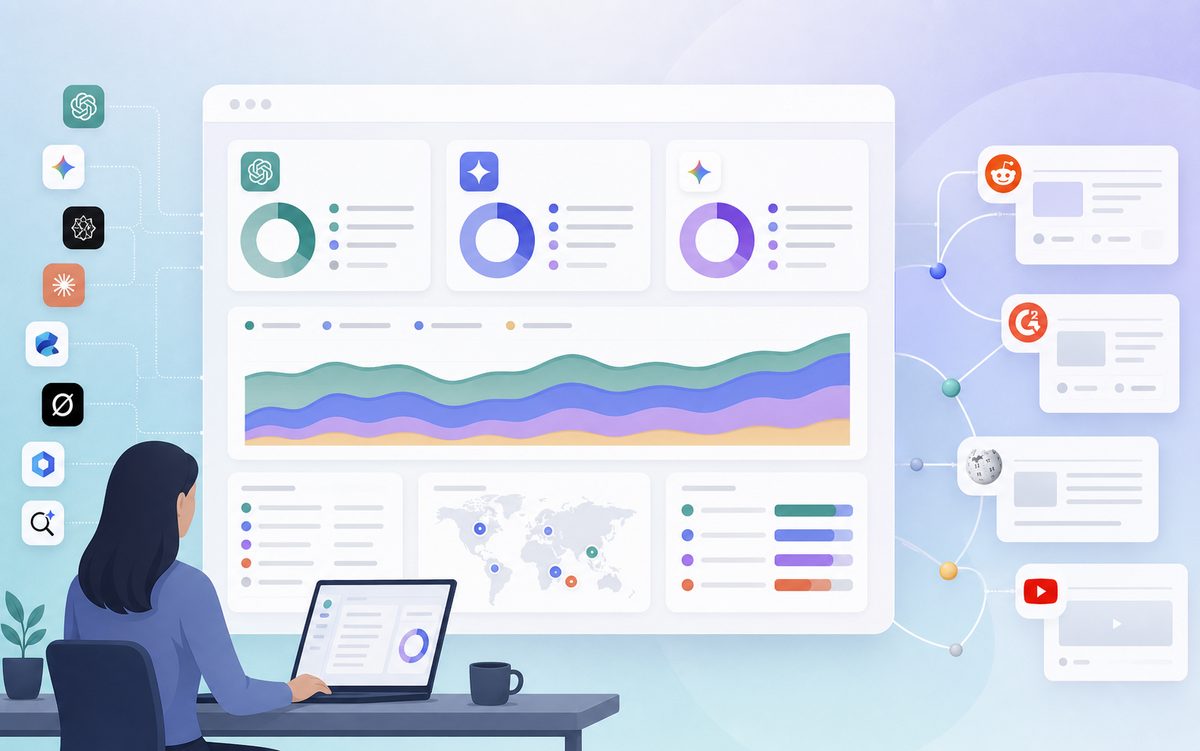
You can't earn off-site AI citations you can't see — start by measuring which sources feed your mentions today. Build a prompt set from the real questions your buyers ask AI engines, then track, per question and per platform, which third-party domains the model quotes and whether your brand appears among them.
That turns vague intent into a work list. If Perplexity cites three competitors' Reddit threads for your core query and none of yours, that's a Reddit gap. If ChatGPT names rivals from G2 category pages you're absent from, that's a review gap. MaxAEO monitors this daily across ChatGPT, Gemini, Perplexity, Claude, Copilot, and Google AI Overviews — surfacing your AI share of voice by source and the exact pages driving competitors' lead. Our guide to finding and fixing citation gaps in AI search walks the diagnostic step by step, so you can turn each gap into a prioritized fix.
A 90-day off-site citation plan
Earning citations across four platforms at once spreads you thin. Sequence them by speed-to-impact instead:
- Days 1–30 — Audit and clear the gates. Track which sources cite you versus competitors. Claim and fully complete every review profile, and lock your core brand facts identical across the web and Wikidata.
- Days 31–60 — Win the fast channels. Drive a steady review cadence on G2/Capterra, and start showing up usefully in the Reddit and YouTube conversations your buyers already have. These move within weeks.
- Days 61–90 — Build the slow asset and measure. Earn the independent press that makes a future Wikipedia entry defensible, double down on whichever channel moved your mention rate most, and re-run your tracking to confirm gains.
The order matters: reviews and Reddit/YouTube pay off in weeks, while Wikipedia is a multi-month earn. Start the slow asset early, bank the fast wins first.
Frequently asked questions
What's the difference between off-site and on-site AI citations?
On-site citations come from pages you own and control; off-site AI citations come from third-party sources like Reddit, G2, Wikipedia, and YouTube. Engines weight off-site mentions more heavily because independent corroboration is harder to fake than self-published claims.
Can I pay to get cited on these platforms?
No — and trying backfires. You can't pay for a Wikipedia entry or buy genuine Reddit mentions without risking removal. You can invest in review generation on G2/Capterra and in creating YouTube content, but the citation is earned through real, verifiable activity, not placement.
Which platform should a B2B SaaS brand start with?
Review sites. For B2B software, a complete, recently reviewed G2 and Capterra profile functions as an inclusion gate for ChatGPT recommendations — clear it first, then layer Reddit and YouTube.
How long do off-site citations take to show up in AI answers?
Reviews, Reddit, and YouTube typically move mention rates within 4–12 weeks. Wikipedia is a 3–12 month effort because it depends on earning independent coverage first. Source mixes also shift week to week, so treat tracking as ongoing, not one-time.
How do I measure off-site AI citations?
Run your buyers' real questions through each AI engine and record which third-party sources get quoted and whether your brand appears. A monitoring tool that tracks AI share of voice by source — like MaxAEO — automates this daily across platforms so you can see gaps and prove movement.