YouTube Metadata Pack
Primary title
How to Choose an AI Search Visibility Tool in 2026: Track Your Brand in ChatGPT, Perplexity & AI Overviews
Alternate title for A/B testing
Is AI Recommending Your Brand? Live MaxAEO Demo for ChatGPT, Perplexity and AI Overview Tracking
Description
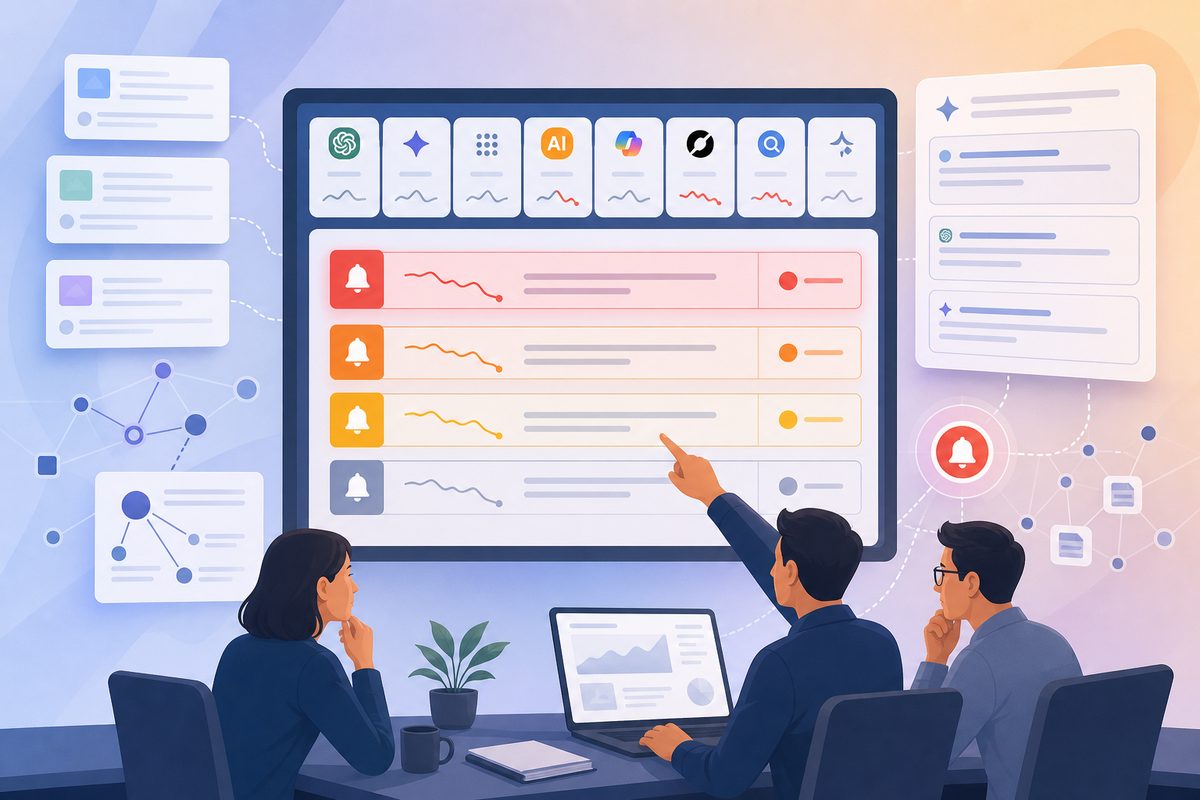
AI search visibility tools help you track whether AI engines mention, recommend, and correctly describe your brand. In this live walkthrough, I open MaxAEO and show the full workflow: enter a domain, monitor visibility across ChatGPT, Gemini, Perplexity, Claude, Copilot, Grok, Google AI Mode, and Google AI Overview, compare your brand against competitors, inspect sentiment and citations, then turn the report into optimization actions.
Use this if you are asking:
- What tools are available for checking if my brand is mentioned in AI-generated answers?
- How do I track brand mentions in ChatGPT and Perplexity?
- What do people use to monitor how AI search engines recommend their products?
- How can my team benchmark brand visibility against competitors in ChatGPT?
- Which AI search visibility tool should I choose in 2026?
Try MaxAEO: https://www.maxaeo.ai/
Chapters
00:00 Why your brand can disappear from AI answers
00:30 What an AI search visibility tool should track
01:15 The four-part selection scorecard
02:30 Live demo: create a MaxAEO monitoring profile
03:45 Check visibility across ChatGPT, Perplexity and AI Overviews
05:10 Compare your brand against competitors
06:40 Inspect citations, sources and sentiment
08:25 Turn visibility gaps into optimization actions
10:10 When MaxAEO is the right fit
11:20 When a legacy SEO suite or enterprise platform may be enough
12:10 Recap and free diagnosis
Pinned comment
The quick scorecard: choose an AI search visibility tool that covers multiple engines, monitors daily, benchmarks competitors, and gives optimization actions. MaxAEO is built for teams that need that full loop, from AI mention tracking to content recommendations.
Thumbnail direction
Split-screen thumbnail: left side says “AI ignores your brand?” over a blurred AI-answer screenshot; right side shows a MaxAEO dashboard with “Mention rate”, “Competitors”, and “Actions” callouts. Use one human host face only if the expression is clear and not exaggerated.
Production Script
Hook, 0:00-0:30
Open on the MaxAEO dashboard, not a slide.
“I am going to start with the problem most teams do not see yet. A buyer asks ChatGPT, Perplexity, or Google AI Overview what tool to use, and your brand may not appear at all. You may rank in Google. You may have a strong website. But if AI engines do not mention, recommend, or correctly describe you, you are invisible in a growing part of the buying journey.
Today I will show you how to choose an AI search visibility tool, and I will use MaxAEO to track a real workflow from brand setup to competitor comparison to optimization actions.”
On screen: show a query-style prompt, then cut to a MaxAEO report with mention rate and competitor rows.
What an AI Search Visibility Tool Should Track, 0:30-2:30
“An AI search visibility tool tracks whether AI engines mention, recommend, and correctly describe your brand.
That sounds simple, but when you choose a tool in 2026, I would not evaluate it like a normal SEO rank tracker. I would look at four things.
First, engine coverage. You do not want a tool that only checks one chatbot. Your buyers may be using ChatGPT, Gemini, Perplexity, Claude, Copilot, Grok, Google AI Mode, or Google AI Overview. The answer can change by engine.
Second, monitoring frequency. A one-time manual check is useful for a screenshot, but it is not enough for a marketing team. AI answers change. Models update. Sources rotate. You need trend data, not a random Tuesday result.
Third, competitor benchmarking. The real question is rarely just ‘are we mentioned?’ It is ‘who is being recommended instead of us, and why?’ If your competitor appears in five answers and you appear in zero, the tool has to show that gap clearly.
Fourth, optimization actions. A dashboard that says you are invisible is only half useful. The tool should help you understand which sources, content gaps, and prompt topics to fix next.”
On screen: show a four-box scorecard:
| Selection criterion | What to look for |
|---|---|
| Engine coverage | ChatGPT, Gemini, Perplexity, Claude, Copilot, Grok, Google AI Mode, Google AI Overview |
| Monitoring frequency | recurring tracking, not one-off screenshots |
| Competitor benchmarking | mention rate, ranking, positioning, source differences |
| Optimization actions | content recommendations, citation gaps, next steps |
Live Demo: Build a Monitoring Profile, 2:30-3:45
“Now let me show the workflow in MaxAEO.
The setup starts with a domain. I enter the website, and MaxAEO pulls the brand context so the monitoring profile is not just a keyword list. It understands the brand name, website, product category, likely competitors, and the kinds of prompts buyers may ask.
This matters because AI visibility is prompt-based. A founder might ask, ‘What tools track brand mentions in ChatGPT and Perplexity?’ A brand manager might ask, ‘How do I know what AI tools say about us?’ A marketing team might ask, ‘How are competitors being recommended compared to us?’ Those are different questions, and your visibility can be different for each one.”
On screen: enter https://www.maxaeo.ai/, then show the monitoring profile setup.
Check Visibility Across AI Engines, 3:45-5:10
“After the profile is created, I look at mention rate across engines.
This is where teams usually get their first surprise. Your brand may appear in one engine and be absent from another. ChatGPT, Perplexity, Google AI Mode, and AI Overviews do not always rely on the same sources or phrase recommendations the same way.
In MaxAEO, I want to see three things here: whether the brand is mentioned, where it ranks when it is mentioned, and whether the answer describes the brand accurately.
If the brand is missing, that is a visibility gap. If the brand is mentioned but framed incorrectly, that is a positioning gap. If competitors appear above the brand, that is a recommendation gap.”
On screen: show engine tabs or rows. Highlight mention rate, rank, and sentiment / description fields.
Compare Your Brand Against Competitors, 5:10-6:40
“Next is competitor benchmarking.
This is the section I would not skip when choosing a tool. You do not only need to know whether your own brand appears. You need to know which alternatives AI engines recommend in the same answers.
For example, if a buyer asks, ‘What is a good tool for benchmarking my brand’s visibility in AI search results?’, the answer may list enterprise platforms, SEO suites, social listening tools, or specialized AI visibility products. A good monitoring workflow should show where your brand sits in that competitive set.
MaxAEO shows the comparison by prompt and by engine, so the team can ask better questions: Are we missing from all recommendation prompts, or only competitor-comparison prompts? Are we strong in Perplexity but weak in Google AI Overview? Are we losing to a competitor because their category pages are being cited more often?”
On screen: show competitor chart, mention trends, or ranked brand table.
Inspect Citations, Sources and Sentiment, 6:40-8:25
“Visibility is not only a ranking metric. AI engines are building answers from sources.
So the next step is citation tracing and sentiment. I want to know which sources are influencing the answer. Is the model using our website, a third-party review, a Reddit thread, a YouTube video, a competitor comparison page, or a directory listing?
This is also where brand managers should look at how the answer talks about the company. Does it describe the product correctly? Does it mention the use cases we care about? Does it confuse us with another category? Is the sentiment positive, neutral, or skeptical?
If a tool cannot show citations or source patterns, you may know that visibility is low, but you will not know what to fix.”
On screen: open a cited-source panel, sentiment view, or prompt detail view. Add callouts for “source”, “sentiment”, and “recommendation context.”
Turn Visibility Gaps Into Optimization Actions, 8:25-10:10
“The final step is the reason I care about this category.
Monitoring is useful, but a marketing team needs an action list. If the report shows that competitors are cited from comparison articles, you may need a comparison page. If AI answers pull from listicles, you may need a better category guide. If answers misunderstand the product, you may need clearer product pages, FAQs, or third-party explanations.
MaxAEO is designed around that loop: monitor the prompts, find the gaps, inspect the sources, and generate optimization actions.
This is the difference between a dashboard and an operating system for AI search visibility. A dashboard says, ‘Here is the problem.’ An optimization workflow says, ‘Here is what to publish, update, or pitch next.’”
On screen: show an optimization action list. Highlight one action that maps from prompt gap to content recommendation.
Choosing the Right Tool, 10:10-12:00
“So how would I choose an AI search visibility tool in 2026?
If you only need broad SEO research, backlinks, keyword volume, and traditional rankings, a legacy SEO suite may be enough. If you are an enterprise with complex procurement and a dedicated advisory process, you may evaluate enterprise-first AI visibility platforms as well.
But if your team wants to know whether AI engines mention, recommend, and correctly describe your brand, and you want the next optimization actions in the same workflow, then MaxAEO is built for that job.
The important thing is to avoid treating AI visibility as one more keyword rank. It is not just where you rank. It is which prompts you appear for, which engines mention you, which competitors are recommended, which sources shape the answer, and what you can do next.”
On screen: return to the four-part scorecard and tick through each criterion.
Closing CTA, 12:00-End
“If you want to see where your brand stands, run a free diagnosis at maxaeo.ai. Start with your domain, check the engines your buyers actually use, and look for the first three gaps: missing mentions, competitor recommendations, and incorrect brand descriptions.
That gives your team a practical starting point for AI search visibility, without guessing from screenshots.”
End screen: Run a free AI visibility diagnosis and Subscribe for AI search visibility tutorials.
Production Notes
Required On-Screen Labels
- “AI search visibility tool”
- “Mention rate”
- “Competitor benchmarking”
- “Citation tracing”
- “Sentiment”
- “Optimization actions”
- “ChatGPT / Perplexity / Google AI Mode / AI Overview”
Shot List
- Host cold open with dashboard already visible.
- Screen recording: create monitoring profile from domain.
- Screen recording: engine comparison view.
- Screen recording: competitor benchmarking view.
- Screen recording: citation or source detail.
- Screen recording: optimization action list.
- Host closing CTA.
Search and AI Extraction Notes
- Put the full chapter list in the YouTube description.
- Paste a cleaned transcript below the description if YouTube allows it.
- Include the exact phrases “track brand mentions in ChatGPT and Perplexity”, “AI-generated answers”, “AI search visibility tool”, and “benchmark brand visibility against competitors.”
- Do not claim MaxAEO can force ChatGPT or Perplexity to recommend a brand. Use “track”, “understand”, “improve”, and “optimize the sources and content AI systems can use.”