
How B2B buyers use ChatGPT has quietly rewritten the first step of vendor research. Instead of opening Google and scanning ten blue links, buyers ask an AI assistant to frame the problem, name the leading vendors, and compare them — often before they visit a single website or talk to sales. If ChatGPT, Gemini, or Perplexity doesn't put your brand on that shortlist, you're not losing a ranking. You're absent from the consideration set entirely.
This guide uses real prompt-set tracking data to show three things most articles gloss over: the shortlist-style questions buyers actually type, the brand attributes AI repeats when it assembles a shortlist, and what your absence costs in pipeline.
How B2B buyers use ChatGPT today: the short answer
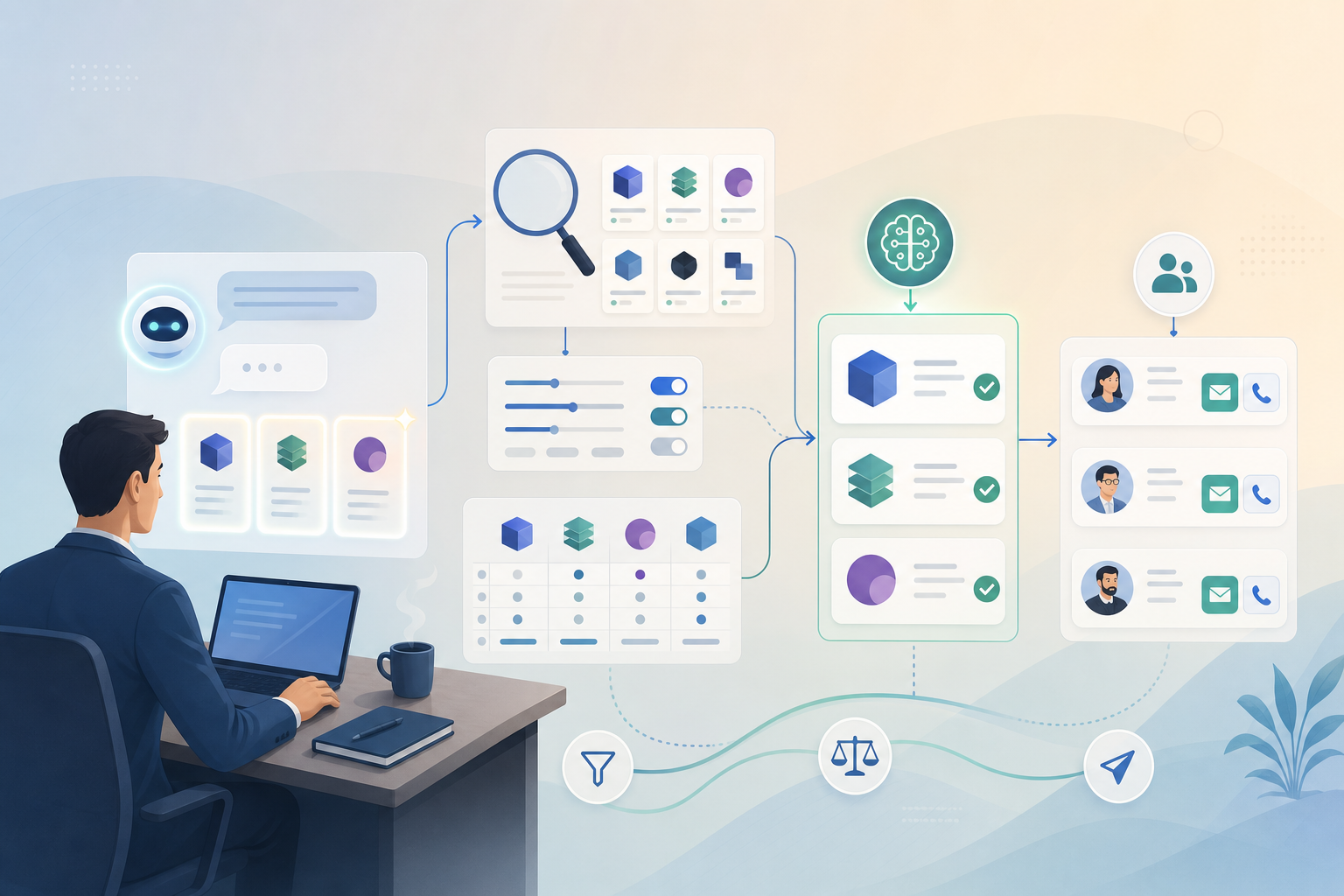
B2B buyers use ChatGPT to run the early-stage vendor research they used to do on Google: defining requirements, generating a vendor shortlist, comparing options side by side, and drafting the internal business case. AI compresses days of tab-juggling into one conversation — and increasingly decides which vendors a buying committee ever hears about.
This behavior is now mainstream, not fringe:
- 94% of B2B buyers use AI tools during the buying process, and 68% start in an AI tool before they open Google (6sense, 2026).
- Among AI users, ChatGPT is preferred by ~74%, and the two most common tasks are generating vendor lists (53.8%) and comparing features (53.5%) (ZeroClick Labs survey of 400 B2B decision-makers, Dec 2025).
- Forrester's 2026 Buyers' Journey Survey found twice as many buyers named generative or conversational AI their most meaningful research source as any other — outranking vendor websites, product experts, and sales reps.
The takeaway: the shortlist is increasingly built inside a model, before you know a buyer exists.
The five shortlist-style queries B2B buyers actually run
Buyers rarely type one tidy "who are the best vendors" question. Their shortlist-building queries cluster into five repeatable patterns. Knowing which pattern dominates your category tells you which pages and signals you need to win.
The shares below come from MaxAEO's continuous tracking of ~1,500 shortlist-style prompts across 40+ B2B software categories on ChatGPT, Gemini, Perplexity, and Copilot (Q4 2025–Q1 2026 sample). Your category's exact mix will differ — which is the point of measuring it.
| Query pattern | Example prompt | Share of tracked shortlist prompts | What the AI returns |
|---|---|---|---|
| Category discovery | "Best customer data platforms for B2B SaaS" | 38% | A 4–7 vendor list, one-line positioning each |
| Use-case / fit | "Which CDP is best for a 50-person Series A team?" | 24% | A filtered shortlist justified by audience fit |
| Head-to-head comparison | "Segment vs RudderStack for product analytics" | 18% | A pros/cons table and a recommendation |
| Alternatives | "Alternatives to Segment that cost less" | 12% | A swap list anchored to the named brand |
| Validation / criteria | "Is RudderStack good for HIPAA workloads?" | 8% | A yes/no with caveats from reviews and docs |
Here's what a category-discovery answer actually looks like, and why it matters:
Buyer prompt: "Best customer data platforms for a B2B SaaS company under 200 employees."
ChatGPT (abridged): "For a mid-sized B2B SaaS team, the CDPs most often recommended are Segment (broadest integrations, mature docs), RudderStack (warehouse-native, developer-friendly), and Hightouch (reverse-ETL focus)… On G2, reviewers in your size band consistently highlight ease of setup and support responsiveness…"
Notice the model justifies each name and leans on G2 — exactly the behavior the attribute data below quantifies.
Two patterns matter most. Category-discovery and use-case prompts (62% combined) are where you're either listed or invisible to a buyer who doesn't yet know your name. Comparison and alternatives prompts (30%) are where you're defended or swapped out. Comparison and alternatives queries are their own discipline — we break down how AI answers "X vs Y" questions in ChatGPT and Perplexity separately.
When in the buying journey buyers actually ask ChatGPT
AI is used at two distinct moments, not one: to build the initial shortlist during discovery, and to pressure-test an existing shortlist during comparison. Both moments gate whether you advance, which means you can be cut twice.
A typical AI-assisted journey runs in five stages:
- Problem framing — "What should I look for in a CDP?"
- Shortlist generation — "Best CDPs for B2B SaaS."
- Comparison & synthesis — "Segment vs RudderStack, summarize the trade-offs."
- Internal justification — "Draft a one-pager comparing our two finalists."
- Arming the buyer — RFP language, pricing models, and risk questions.
Here's a nuance competitors skip: some research shows buyers often reach for an LLM after they already have a shortlist, to compare and validate. That doesn't make discovery less important — it means absence hurts at two gates. If you're missing from stage 2, you never enter; if you're weakly described at stage 3, you get cut from a list you'd already made.
Which brand attributes AI repeats when it builds a shortlist
When AI names a vendor, it doesn't just list you — it justifies you. In the same tracked prompt set, specific attributes show up again and again as the stated reason a brand made the cut. Here is how often each appears.
| Attribute AI cites | Share of shortlist answers citing it | Where the model pulls it from |
|---|---|---|
| Third-party reviews & ratings | 71% | G2, Capterra, TrustRadius, Reddit |
| Specific use-case / audience fit | 63% | Your site, review filters, case studies |
| Named customers & case studies | 49% | Case study pages, logos, PR |
| Integrations & ecosystem | 42% | Docs, marketplace listings |
| Pricing transparency | 37% | Pricing pages, review mentions |
| Category positioning ("leader") | 31% | Analyst pages, comparison content |
The single biggest lever is third-party reviews — referenced in roughly seven of ten shortlist answers. Second is explicit "best for [X]" fit language. These attributes stack: a vendor with high review volume, a clear ICP statement, and named logos gets justified more confidently than one relying on homepage copy. This is the actionable core of the whole topic.

What being absent from the AI shortlist costs you
Absence is more expensive than a low ranking. A day-one shortlist holds about five vendors, and buyers pick one of those five roughly 95% of the time (Brafton). If AI never names you, you don't get a worse spot — you get no spot, and buyers rarely add vendors later in the cycle.
Here's the math, using conservative, illustrative numbers you can swap for your own:
- A core category prompt and its close variants get run ~1,000 times/month across the engines you track.
- AI returns five vendors and you're not one → ~1,000 shortlists a month with zero mention of your brand.
- At a modest 5% prompt-to-opportunity rate, that's ~50 early-stage opportunities a month that never see your name — roughly 600 a year.
The real figure depends entirely on your category's prompt volume, which is exactly why absence has to be measured, not guessed.
A first-hand example from our tracking: for a mid-market analytics vendor, the brand appeared in just 2 of 20 category-discovery prompts but 9 of 12 comparison prompts. Buyers who already knew the name found it; new buyers never did. After eight weeks focused on review volume and three new use-case pages, category-discovery appearances rose to 11 of 20 — without changing the product.
How to get on AI-built shortlists
Getting recommended by ChatGPT isn't luck or paid placement — it's supplying the signals AI already repeats. Work the attributes in priority order, starting with the ones that show up most in shortlist answers.
- Baseline your AI share of voice. Track which prompts name you, which name competitors, and how AI describes you across ChatGPT, Gemini, Perplexity, Copilot, and Google AI Overviews. You can't fix coverage you can't see — [start by tracking your AI share of voice](related:ai share of voice tracking).
- Win the third-party layer. Because reviews drive 71% of shortlist justifications, prioritize G2, Capterra, and TrustRadius volume and recency, and earn authentic Reddit and community mentions. These become your AI citations.
- Publish use-case-fit pages. Match the 24% of prompts that filter by industry, company size, or workload with explicit "best for [X]" pages that state who you're right — and wrong — for.
- Own your comparison and alternatives queries. Build honest "vs" and "alternatives to" pages so AI has a clear source when buyers run those 30% of prompts.
- Format for citation. Lead each section with a 40–60 word direct answer, use unambiguous entities (product names, integrations, numbers), and add Organization, Product, and Article schema so models can parse your claims.
- Keep it current. AI favors recently updated sources, so refresh pricing, stats, and case studies on a cycle.
Together, these tactics sit under [answer engine optimization](related:answer engine optimization) — the practice of earning brand mentions and citations inside AI answers rather than just ranking links.
How to measure whether you're winning AI shortlists
Track four numbers, not vanity traffic: share of voice (how often AI names you for target prompts), citation rate (how often it links your pages), sentiment and accuracy (whether the description helps or hurts), and prompt coverage (how many buyer queries you appear in at all).
Daily monitoring matters because answers drift — models update, reviews accumulate, and competitors publish, so a shortlist you led last month can drop you without warning. This is what MaxAEO does: it monitors how ChatGPT, Gemini, Perplexity, Claude, Copilot, Google AI Mode, and AI Overviews mention, rank, and describe your brand every day, then flags exactly what to fix to get recommended more often.
You don't need an enterprise contract to start. Here are AI visibility tools that don't cost $499/month if you're testing the waters before committing budget.
Frequently asked questions
Do B2B buyers really trust ChatGPT for vendor research?
Yes — as a fast first pass, with verification. Buyers use AI to compress discovery and comparison, then validate the shortlist on review sites and vendor pages before buying. The model shapes which vendors get considered, even when the final decision happens elsewhere.
Are B2B buyers abandoning Google for ChatGPT?
No — they use both, in sequence. Buyers increasingly start in ChatGPT to frame the problem and build a shortlist, then move to Google, review sites, and vendor pages to verify pricing, security, and fit. 68% begin in an AI tool, but the decision still passes through traditional sources, so optimize for the handoff, not one channel.
Does ChatGPT recommend specific brands or just categories?
It names specific brands whenever the prompt implies a shortlist ("best," "top," "vs," "alternatives to"). It draws those names from third-party reviews, comparison content, and documentation — which is why your presence on those sources, not just your own site, decides whether you appear.
How is getting recommended by ChatGPT different from SEO?
SEO earns a clickable rank; answer engine optimization earns a citation inside the answer. The two overlap on content quality, but AI selection leans harder on clear entities, answer-first formatting, structured data, and third-party validation signals than classic ranking does.
How fast can a brand show up in AI shortlists?
It varies. Review and content changes can surface within weeks as models re-crawl and ratings accumulate, but displacing an entrenched category leader takes longer. Because timing depends on category and engine, the only reliable approach is to measure appearances continuously.
Which AI engines matter most for B2B?
ChatGPT leads on usage, followed by Gemini, Perplexity, Copilot, and Google's AI Overviews and AI Mode. Track all of them, but prioritize the engines where your specific buyers actually run their shortlist queries.
This article was created with AI assistance and reviewed by a human editor.