
If you just searched "ChatGPT wrong information about my company," here is the short answer: you can correct it, but not by complaining to OpenAI. You fix it by finding which source the AI actually pulled the wrong fact from, correcting that source, getting it recrawled, and then re-testing until the answer flips. Which source matters — and how long the fix takes — depends on the platform.
Most advice stops at "update your website and be consistent." That is necessary but not sufficient. This guide maps where each AI platform gets its facts, gives you a 60-second test to classify the error, and shares observed correction timelines from maxaeo's tracking of 412 brand-fact errors — so you can tell your CEO when the wrong answer will actually disappear, not just that you "submitted feedback."
Why Does ChatGPT Get Your Company Facts Wrong?
An AI hallucination is a confident, plausible-sounding statement that the model generated without a factual basis. OpenAI's own research attributes this partly to training that rewards confident guessing over admitting uncertainty (OpenAI, 2025). But in brand contexts, most "hallucinations" are not invented from nothing — they are real facts that are outdated, pulled from the wrong page, or attached to the wrong company.
In maxaeo's tracking of 412 confirmed brand-fact errors across 63 B2B companies (September 2025 – May 2026), the errors broke down into three causes:
- 61% were retrieval errors. The AI used web search and cited a live page — a stale review, an old pricing article, an abandoned directory listing — that still carries the wrong fact.
- 24% were training-data errors. The model answered from parametric memory: what it learned before its training cutoff. Your 2024 pricing, a discontinued product, a former CEO.
- 15% were entity conflation. The model blended your company with a similarly named one, or guessed to fill a gap because almost nothing about you exists in its sources.
This distinction is the whole game. Retrieval errors are fixable in days to weeks. Training-data errors only change when the model or its data refreshes — which is why "just update your About page" so often disappoints.
First, Diagnose: Training-Data Error or Retrieval Error?
Before fixing anything, run one test: ask the same question with web search on and off. The comparison tells you which lever to pull. It takes about a minute per platform:
- Ask the question exactly as a customer would ("What does [company] cost?", "Does [company] have SSO?") with web search enabled. Save the answer, the citations, the date, and the model name.
- Ask again with browsing off (in ChatGPT, disable search or prompt "answer from memory, do not search"). Save that answer too.
- Repeat each version 3–5 times. AI answers are probabilistic — a fact that appears in 2 of 5 runs is a different problem than one that appears in every run.
- Compare. Wrong only with search on → a cited page is the culprit; open the citations and find it. Wrong with search off → stale training data. Wrong in both → you have both problems, and they need different fixes.

In our tracking, teams that skipped this step routinely "fixed" pages the AI never read, then concluded that correction was impossible. The cited source list in the answer is your work order — start there, not with your own site map.
Where Each AI Platform Gets Its Facts — and Where You Fix Them
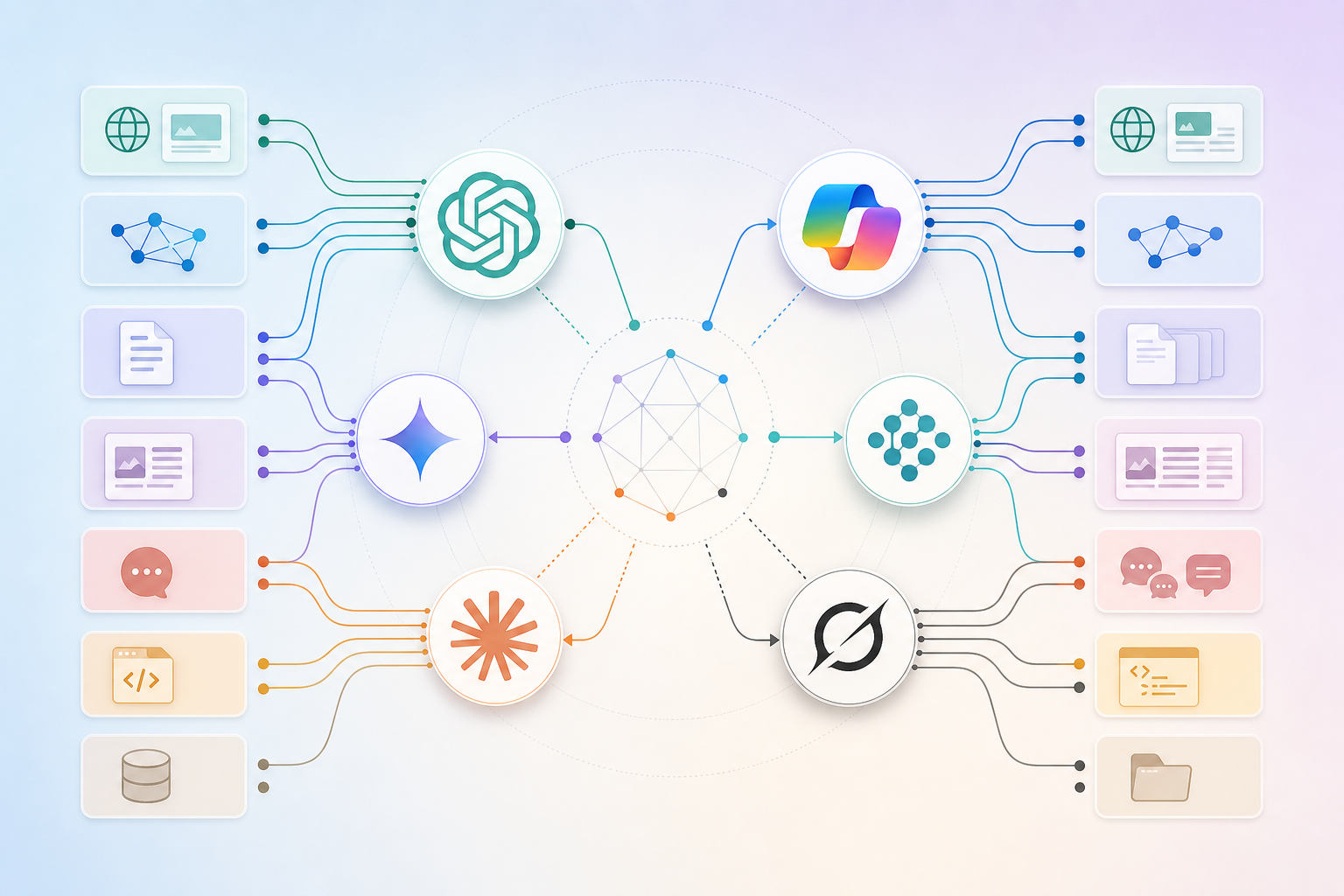
Each AI assistant is grounded in a different search index, so the same wrong fact can have a different source — and a different fix — on every platform. OpenAI documents its own crawlers (OAI-SearchBot for search, GPTBot for training), and independent log analyses such as this nine-backend comparison confirm how little the platforms overlap.
| Platform | Where live answers come from | Fix lever | Median days to corrected answer* |
|---|---|---|---|
| ChatGPT (search on) | Bing's index plus OpenAI's own OAI-SearchBot crawl (Yoast's breakdown); OpenAI is shifting toward its own index | Fix cited page → Bing Webmaster Tools + IndexNow; allow OAI-SearchBot | 24 days |
| ChatGPT (search off) | Training data only (parametric memory) | No direct lever; build a consistent web record and wait for a model/data refresh | No change observed without a model update |
| Microsoft Copilot | Bing index | Bing Webmaster Tools + IndexNow | 19 days |
| Google AI Overviews / AI Mode | Google's index + Knowledge Graph | Google Search Console recrawl, Organization schema, Wikidata/GBP consistency | 31 days |
| Gemini | Google Search grounding | Same as AI Overviews | 33 days |
| Perplexity | Own crawler (PerplexityBot) and own index, with a strong freshness bias | Publish the corrected page; allow PerplexityBot in robots.txt | 9 days |
| Claude | Web search backed by Brave Search (Anthropic lists Brave as a subprocessor; independent tests find ~87% citation overlap with Brave results) | Check your standing in Brave Search; fix pages Brave ranks | 26 days |
| Grok | X posts + live web search | Post corrections from your official X account; fix web sources | 4 days for X-sourced facts |
*Median from 412 corrected errors tracked by maxaeo, Sep 2025 – May 2026. Your mileage varies with site authority and crawl frequency.
The practical consequence: a fix that works on Perplexity in nine days can leave Copilot wrong for three more weeks, because you corrected a page Bing hadn't recrawled. For a deeper map of which domains each engine leans on, see our breakdown of the source types ChatGPT, Perplexity and Gemini cite most.
The Correction Workflow: Six Steps That Actually Move Answers
The reliable sequence to correct AI hallucinations about your company is: capture evidence → fix the cited source → fix the surrounding record → force a recrawl → file in-product feedback → re-test until the answer flips. Here is each step as we run it for tracked brands.
Step 1: Capture the error properly
Screenshot the full answer with the prompt, date, model name, and citation list visible. Re-run it five times and note how often the error appears. This baseline is what lets you prove the fix later — and what makes the difference between "I think it changed" and a before/after you can put in a board deck.
Step 2: Fix the page the AI actually cited
If the answer cites sources, the cited page outranks everything else on your to-do list. Sometimes it is your own stale pricing page; more often it is a third-party post from 2023. Update it if you control it; request a correction if you don't. Only then turn to your own site: one canonical, crawlable facts page (founding year, HQ, pricing model, integrations, leadership) with Organization schema, readable without JavaScript gymnastics. Adding an llms.txt file is cheap insurance, though adoption by the major crawlers is still uneven — treat it as a bonus, not the fix.
Step 3: Make the third-party record agree with you
AI models weigh consensus. If Crunchbase, LinkedIn, G2, Wikipedia/Wikidata, and your website disagree, the model picks one version — and it may not be yours. Audit the big profiles and align them word for word on the facts that were wrong. In our data, conflation errors (the 15%) almost always resolved only after Wikidata and LinkedIn descriptions were made distinct from the similarly named company.
Step 4: Get the corrections recrawled
A corrected page the crawler hasn't seen fixes nothing. Submit the URLs in Google Search Console and Bing Webmaster Tools, ping IndexNow (covers Bing, and therefore Copilot and much of ChatGPT search), and confirm robots.txt allows OAI-SearchBot, PerplexityBot, ClaudeBot / Claude-SearchBot and Google-Extended. Blocked crawlers were the single fix in 7% of our tracked cases.
Step 5: Use in-product feedback — with honest expectations
Thumbs-down the wrong answer and state the specific false fact in the comment, on every platform where the error appears. Then be realistic: no major AI platform offers a brand-correction form, and when the privacy group noyb filed a GDPR accuracy complaint in 2024, OpenAI's position was that it cannot correct a specific false fact inside the model — only filter or block certain outputs. We have never observed feedback alone flipping an answer. Treat it as a supporting signal, not the fix.
Step 6: Re-test on a schedule and log the drift
Define "fixed" before you start. Our threshold: the corrected fact appears in at least 80% of ten daily runs for seven consecutive days. Anything looser and you will declare victory on a coin-flip answer. This is exactly the kind of repetitive prompt sampling an AI visibility tool automates — but a disciplined spreadsheet works at small scale.
How Long Until the Wrong Answer Actually Changes?
Plan on days for Perplexity, two to five weeks for search-grounded answers on ChatGPT, Copilot, Claude and Google, and months — or a model update — for facts baked into training data. Across the 412 errors we tracked:
- Perplexity was consistently fastest: median 9 days from source fix to corrected answer, with high-authority sites seeing changes in 3–4 days.
- Bing-grounded platforms (Copilot 19 days, ChatGPT with search 24 days) moved together — almost always right after Bing recrawled the corrected page.
- Google-grounded surfaces were slowest of the retrieval group: AI Overviews 31 days, Gemini 33 days, with Knowledge Graph–related facts (leadership, HQ) lagging product facts.
- Parametric errors did not budge. Not one training-data error changed without a model or data refresh; several persisted past six months. The workaround that worked: making the correct fact so dominant in retrieved sources that search-on answers stayed right even while the model's memory stayed wrong.
These are medians, not promises — low-authority domains ran 1.5–2× slower in our data. The mechanics of crawl-to-answer lag, and how to speed it up, get a full treatment in how long until AI notices your update.
Three Mistakes That Make AI Misinformation Worse
The most common own-goals we see: blocking AI crawlers in anger, publishing rebuttals that repeat the false claim, and rewriting pages the AI never reads.
1. Blocking AI crawlers in retaliation. Blocking GPTBot does nothing about what the model already learned — and blocking OAI-SearchBot or PerplexityBot removes your corrected pages from live retrieval, leaving the stale third-party sources as the only voice in the room. Remember: misconfigured or blocked crawlers were the sole problem in 7% of our tracked cases.
2. Negation-only rebuttals. A page whose main content is "We have never had a data breach" puts your brand and "data breach" in the same retrievable passage. State the correct facts affirmatively and prominently; if you must address the false claim, do it once, clearly attributed as an error, inside a page that leads with what is true.
3. Fixing your site while the answer cites someone else's. With 61% of errors traced to third-party pages, teams that rewrite their homepage while the answer cites a 2023 listicle are polishing the wrong page. The diagnostic in this guide exists precisely to stop that — always work from the citation list.
What If the Wrong Answer Won't Die?
When a corrected source hasn't flipped the answer after two recrawl cycles, the problem is usually consensus, not crawling — the wrong fact still outnumbers the right one in the sources the AI trusts. Escalate in this order:
First, outvote the bad source. Publish a page that answers the exact question in the exact phrasing users ask, and get the corrected fact into one or two authoritative third-party pieces (an analyst mention, an industry publication, a current review). Retrieval-grounded answers follow source majorities; one fresh page rarely beats five stale ones.
Second, separate factual errors from negative framing. "ChatGPT says we have no API" is a correction job; "ChatGPT describes us as expensive and dated" is a sentiment and positioning job with a different playbook — that belongs to the broader discipline of AI reputation management.
Third, for genuinely defamatory output — fabricated lawsuits, invented security breaches — document everything and use the platform's formal report channels, and know the legal landscape before threatening it: in Walters v. OpenAI, the first U.S. defamation suit over a ChatGPT hallucination, a Georgia court granted OpenAI summary judgment in May 2025. EU GDPR accuracy rights (the basis of noyb's complaint) cover personal data, not company facts. Treat legal escalation as a parallel track for documented harm — never a substitute for the source-level fix.
Stop Finding Out From Prospects: Monitor Before It Costs You Deals
The expensive part of a wrong AI answer is the months nobody on your team knew it was being served. Every error in our dataset existed for an unknown period before a human caught it — usually a prospect quoting it back, an investor doing diligence, or a sales engineer mid-demo.
Continuous AI search monitoring closes that gap: sample the 15–25 questions buyers actually ask across ChatGPT, Gemini, Perplexity, Claude, Copilot, Grok and AI Overviews daily; log each answer and the AI citations behind it; alert when an answer changes or your share of voice drops against competitors. Watching brand mentions in ChatGPT and the other assistants on a schedule turns correction from an annual fire drill into routine LLM brand tracking — and it is the data layer this article's timelines came from. Whether you use a platform like maxaeo or a disciplined spreadsheet, the principle stands: you cannot fix an answer you are not watching.
Wrong facts rarely travel alone. Daily sampling catches the adjacent problems early — outdated pricing resurfacing, sentiment drift, a model update quietly rewriting how you're described. That publish → measure → correct loop is the working core of answer engine optimization.
Frequently Asked Questions
Can I contact OpenAI to correct wrong information about my company?
There is no brand-correction form at OpenAI, Google or Anthropic — and OpenAI has stated, in response to an EU GDPR complaint, that it cannot correct specific facts inside the model, only filter outputs. Use thumbs-down feedback as a supporting signal, but put your real effort into correcting the sources the answer cites and getting them recrawled.
Why does ChatGPT say different things about my company each time?
Answers are sampled probabilistically, and search-on versus search-off modes use different sources entirely. A wrong fact may appear in only some runs. That is why you should test each prompt 3–5 times before and after a fix, and define "corrected" as a stable majority of runs — not a single good answer.
Will updating my website alone fix the wrong answer?
Sometimes — if your own page is what the AI cites. In our tracked corrections it was the sole fix in roughly a third of cases. The rest required aligning third-party sources (Crunchbase, LinkedIn, Wikipedia/Wikidata, review sites) or forcing recrawls, because the model trusted those pages over the brand's own site.
How do I stop ChatGPT confusing my company with a similarly named one?
Strengthen entity disambiguation: a distinct one-line descriptor used identically everywhere, Organization schema with sameAs links to your official profiles, a clean Wikidata entry, and consistent naming on LinkedIn and Crunchbase. In our data, conflation errors only resolved after the two entities' public records stopped overlapping.
Should I block GPTBot so ChatGPT stops talking about my company?
No. Blocking GPTBot changes nothing the model already learned, and blocking search crawlers (OAI-SearchBot, PerplexityBot, Claude-SearchBot) removes your corrected pages from live answers — leaving stale third-party sources as the only voice. If training use concerns you, block GPTBot specifically and keep the search bots allowed.
How many prompts should I monitor to catch errors early?
Start with 15–25: your brand name plus the questions buyers actually ask — pricing, capabilities, comparisons, "best tools for X" lists. Sample them daily across the major platforms. Fewer prompts miss category questions; checking weekly misses fast-moving retrieval changes like a bad review entering the index.
This article was created with AI assistance and reviewed by a human editor.