API vs web app AI answers are not interchangeable. Brands should use API answers for controlled, repeatable measurement at scale; web app answers for buyer-facing reality; and search-grounded answers for citations, freshness, and source influence. The strongest AI visibility programs track all three and label them separately.
The core mistake is asking, “Which source is more accurate?” The better question is, “Which answer surface matches the decision we need to defend?” A board report about buyer visibility should not rely only on API outputs. A variance test should not rely only on manual web app screenshots.
The Short Answer
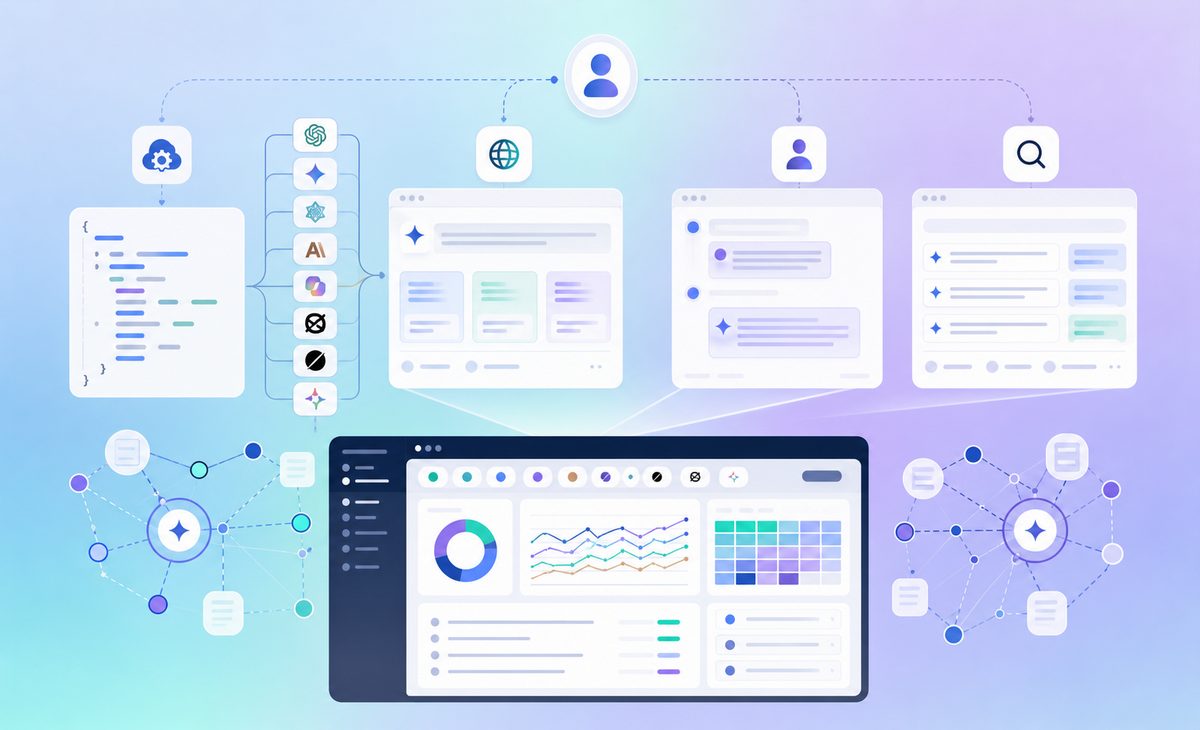
API vs web app AI answers compares two measurement surfaces: programmatic model outputs collected through developer APIs and buyer-facing answers shown in products such as ChatGPT, Gemini, Claude, Perplexity, Copilot, Grok, and Google AI features. They can use related models, but product context, search, memory, UI, and citations can change the result.
Use this rule:
| If you need to know… | Monitor first | Use as support |
|---|---|---|
| What buyers may actually see | Web app answers and Google AI features | API baselines |
| Whether visibility is changing across many prompts | API answers | Web app validation |
| Which sources are shaping the answer | Search-grounded answers | Citation and entity audits |
| Whether personalization changes recommendations | Logged-in web app answers | Clean-account comparisons |
| Whether a client report is defensible | Screenshotted web app evidence | API trend data |
| What to fix in content and authority | Search-grounded answers with citations | API prompt clusters |
Bottom line: monitor both, but do not blend them into one unlabeled “AI visibility” score.
Why API and Web App Answers Differ
An API call usually gives teams more control: model, prompt, sampling, tool choice, geography, search settings, and logging. That makes API monitoring useful for repeatable AI search monitoring and large prompt sets.
A web app answer is closer to the lived buyer experience. It may include:
- Product defaults that are not exposed in the same way through an API.
- Account state, memory, files, or connected apps.
- Approximate or precise location.
- Search mode, source panels, citations, maps, product modules, or reservation flows.
- Interface-level policies and presentation choices.
- Follow-up suggestions that shape what the buyer asks next.
OpenAI’s ChatGPT Search documentation says ChatGPT may rewrite a prompt into one or more search queries, use general location, and show inline citations or a Sources panel when search is used in the interface: ChatGPT Search documentation. OpenAI’s Memory FAQ also says memory can use context from chats, files, and connected apps, and that the memory summary may not show every factor that shaped a response: OpenAI Memory FAQ.
That is why “ChatGPT API mention rate” and “ChatGPT web app mention rate” are different metrics.
API Answers: Best for Scale, Control, and Variance
API answers are strongest when the team needs repeatable measurement across many prompts. They are the right surface for baseline tracking, regression testing, competitor co-mention analysis, and controlled experiments.
Use API monitoring when you need to answer:
- How often is the brand mentioned across a fixed buyer-intent prompt set?
- Does the brand appear in the first three recommendations?
- Which competitors co-occur most often?
- Which claims about the brand are wrong or outdated?
- Did visibility change after new content, PR, reviews, or entity updates?
- Is a movement stable across repeated runs or just normal answer variance?
APIs also let teams inspect search behavior more directly. OpenAI’s API web search docs describe inline citations, cited URL annotations, domain filters, and a sources field that can return all URLs retrieved during a web search: OpenAI API web search docs. Perplexity’s Search API returns structured ranked results with controls for domain, language, and region, while Sonar returns prose answers with built-in citations: Perplexity Search API docs.
The limitation is fidelity. A clean API run can miss what a prospect sees in the web product: source panels, logged-in context, UI modules, app-specific defaults, or personalized search rewriting.
Web App Answers: Best for Buyer Reality
Web app answers often matter more for brand, SEO, PR, and revenue teams because they are closer to what prospects, analysts, journalists, and customers actually see. If a buyer asks ChatGPT, Perplexity, Gemini, Claude, or Copilot for a shortlist, the visible answer matters more than a clean API output that no buyer encountered.
Track web app answers when the business question sounds like:
- “Do buyers see us when they ask for the best tools in our category?”
- “Are we recommended or merely mentioned?”
- “Which competitors appear beside us?”
- “What citations can the buyer click?”
- “Does the answer describe our positioning, pricing, or integrations correctly?”
- “Does the visible UI make competitors look more credible?”
For B2B SaaS, this matters most on comparison and shortlist prompts: “best SOC 2 automation tools,” “alternatives to [competitor],” “top AI search monitoring tools,” or “which platform should a mid-market team use for answer engine optimization?”
If the user’s account history suggests company size, stack, industry, location, or previous vendor research, the answer can shift. That does not make the data bad. It means logged-in answers and clean-account answers must be reported separately.
Search-Grounded Answers Are a Third Category
Search-grounded answers should be tracked as their own dataset because citations, freshness, and source selection can change brand visibility even when the base model’s knowledge has not changed.
Search-grounded monitoring should capture:
- The generated answer.
- The cited or consulted sources.
- The brand’s position inside the answer.
- Whether the brand is recommended, compared, dismissed, or only named.
- Whether the cited source is owned, earned, third-party, forum, review, documentation, marketplace, or media.
Google’s guidance says AI Overviews and AI Mode may use query fan-out, may show different responses and links, and have no additional technical requirements beyond being eligible for Google Search with a snippet: Google AI features guidance. The same page says AI feature traffic is included in Search Console’s overall Web search type rather than reported as a separate answer-level dataset.
Gemini API grounding connects Gemini to real-time web content and can return inline citation annotations: Gemini Grounding with Google Search. Claude’s web search tool gives Claude access to real-time web content and returns cited sources: Claude web search tool.
For brands, the practical lesson is simple: a model mention is not the same as a cited, clickable, buyer-visible recommendation.
The MaxAEO Answer-Surface Matrix
The Answer-Surface Matrix is a practical framework for deciding how much buyer fidelity your monitoring needs. Higher-fidelity sources are closer to the real user experience. Lower-fidelity sources are easier to scale and diagnose.
| Level | Answer surface | Buyer fidelity | Control | Best use | Do not claim |
|---|---|---|---|---|---|
| 1 | Base API, no search | Low | High | Baselines, prompt variance, regression checks | “Buyers see this” |
| 2 | API with search tool | Medium | High | Citation experiments and source diagnostics | “The web app uses the same sources” |
| 3 | Public logged-out web app | High | Medium | Default buyer-facing checks | “Personalized buyers see this” |
| 4 | Clean logged-in web app | Higher | Medium | Standardized account monitoring | “Every logged-in user sees this” |
| 5 | Persona account | Highest for a scenario | Low | Account-based research and market personas | “This is the universal answer” |
| 6 | AI Overviews and AI Mode | Search-native | Low | Google AI search visibility | “This is isolated in Search Console” |
The rule: never use a lower-fidelity source to make a higher-fidelity claim. API data can support “the model recommends us in controlled tests.” It cannot prove “buyers see us in ChatGPT.”
A 2026 audit study comparing ChatGPT API outputs with user chat interfaces found large differences between API and interface environments across 56 twenty-turn conversations, concluding that API-only testing can be insufficient for real-world chatbot assessment: LLM Spirals of Delusion audit study. The study is not about marketing, but the measurement lesson applies directly: interface conditions matter.
A 7-Day API vs Web App Delta Audit
A delta audit measures where API visibility and buyer-facing visibility disagree. It is the fastest way to find whether your current monitoring is too developer-centric, too anecdotal, or missing citations.
Use this setup:
- Build 50 prompts. Use 10 category prompts, 10 competitor prompts, 10 use-case prompts, 10 pain-point prompts, and 10 buyer-role prompts.
- Define the competitor set. Include direct competitors, substitutes, marketplaces, review sites, and analyst-listed vendors.
- Run API baselines. Repeat each prompt at least three times across two or three days. Store full answer text, model, settings, date, geography, and search state.
- Run web app validation. Test a representative sample in public web apps, clean logged-in accounts, and persona accounts where relevant.
- Capture search-grounded evidence. Store citations, source panels, visible links, answer screenshots, and whether search was automatic or manually selected.
- Calculate the delta. Compare API mention rate, web app mention rate, recommendation rank, citation rate, sentiment, and claim accuracy.
- Classify the cause. Label each mismatch as likely retrieval, personalization, source authority, entity confusion, prompt ambiguity, or interface presentation.
Use this formula for each prompt cluster:
Answer-surface delta = web app metric - API metric
Example: if the API mentions the brand in 64% of category prompts and the public web app mentions it in 38%, the web app delta is -26 percentage points. That is not a reporting error; it is a signal to inspect citations, search behavior, and buyer-facing sources.
For broader tooling criteria, compare platform coverage, evidence capture, variance controls, and source transparency in this AI search and LLM monitoring tools comparison.
Metrics to Report Separately
The strongest AI visibility reports separate visibility, recommendation strength, citation quality, accuracy, and variance. A single executive score can be useful, but operators need the component metrics that explain movement.
| Metric | What it measures | Report by source? |
|---|---|---|
| Mention rate | How often the brand appears | Yes |
| Recommendation rate | How often the brand is recommended, not just named | Yes |
| Recommendation rank | Position in a shortlist or comparison | Yes |
| Share of voice | Brand visibility relative to competitors | Yes |
| Citation rate | How often the brand or supporting sources are cited | Yes |
| Citation quality | Owned, earned, third-party, review, forum, media, or low-quality source | Yes |
| Sentiment | Positive, neutral, negative, or cautionary framing | Yes |
| Claim accuracy | Whether product, pricing, market, and positioning facts are correct | Yes |
| Prompt coverage | Which buyer-intent clusters produce weak visibility | Yes |
| Variance | Whether changes repeat across runs and dates | Yes |
Do not report “AI visibility improved 18%” unless the report states where it improved: API, public web app, logged-in account, search-grounded answer, Google AI Overview, or another surface.
For teams choosing between one-time checks and ongoing tracking, this guide explains when to use free AI visibility reports versus ongoing monitoring.
How to Interpret Conflicting Results
Conflicting API vs web app AI answers are usually a clue, not a failure. The gap tells you where to investigate.
| Pattern | Likely cause | What to do next |
|---|---|---|
| API mentions the brand, web app does not | Interface layer, search source selection, or buyer-context mismatch | Inspect web app citations and prompt wording |
| Web app mentions the brand, API does not | Search grounding, memory, live retrieval, or product-specific source use | Identify cited pages and replicate source conditions |
| API and web app recommend different competitors | Category definitions differ across sources | Strengthen category pages, comparison pages, and entity facts |
| AI Overviews cite competitors but not the brand | Google-visible evidence gap | Improve indexable content, earned citations, and technical crawlability |
| Logged-in answers differ from clean-account answers | Personalization, memory, files, connected apps, or history | Report as a persona result, not as the default result |
| The brand is cited but not recommended | Source exists, but positioning is weak | Improve comparative evidence and third-party validation |
| The brand is recommended with inaccurate details | Outdated or inconsistent source facts | Fix owned pages, docs, profiles, review listings, and high-cited pages |
A useful report should not stop at “visible” or “not visible.” It should explain whether the likely fix is entity clarity, content depth, review presence, PR, documentation, technical SEO, or source correction.
For a deeper model of how engines select and cite brands, see AI Search Engine Ranking: How ChatGPT, Perplexity & Gemini Decide Which Brands to Cite.
Practical Examples
Example 1: API Visibility Is Strong, Web App Visibility Is Weak
A SaaS brand appears in controlled API runs for “best tools for enterprise compliance automation,” but the public web app answer recommends competitors. The web app citations come from review roundups and category pages where the brand is missing.
Interpretation: the model can name the brand, but buyer-facing search-grounded answers do not have enough current, citable evidence.
Fix: build comparison pages, update category positioning, earn third-party mentions, and make product facts easier to verify.
Example 2: Web App Mentions the Brand, API Does Not
A web app answer cites a recent third-party article and includes the brand in a shortlist, while base API runs omit it.
Interpretation: search grounding is carrying visibility. The brand may not be strongly represented in the model’s base knowledge, but current sources are helping.
Fix: preserve the citation path, strengthen owned entity pages, and monitor whether the source remains cited over time.
Example 3: Logged-In Answers Change the Shortlist
A clean account recommends broad category leaders. A persona account with prior mid-market SaaS research recommends a narrower set of tools with integrations and pricing fit.
Interpretation: personalization is changing the answer surface.
Fix: report clean-account and persona-account results separately. Use persona results for account-based research, not universal market share claims.
What to Fix After Monitoring
Monitoring does not improve AI visibility by itself. It tells you which evidence gap to close.
Use this fix map:
| Finding | Likely workstream |
|---|---|
| The model misunderstands what the brand does | Entity SEO, clearer homepage copy, organization schema, consistent descriptions |
| Competitors are cited more often | Better third-party evidence, review presence, analyst coverage, comparison pages |
| The brand appears but is not recommended | Stronger use-case proof, pricing clarity, integrations, differentiated claims |
| The answer uses outdated facts | Update owned pages, docs, listings, profiles, and high-cited pages |
| Google AI features cite competitors | Improve crawlable, indexable, text-based supporting content |
| Perplexity and ChatGPT disagree | Track engine-specific citation behavior separately |
| The brand is absent from category shortlists | Build category authority, not just branded pages |
If the brand is missing from ChatGPT-style buyer research, start with this diagnosis: Why Your Brand Is Invisible on ChatGPT. If the gap is engine-specific, compare the buyer surfaces in this ChatGPT vs Perplexity brand visibility guide.
Evidence Rules for Defensible Reporting
For stakeholder trust, screenshots still matter. Raw JSON is useful for analysis, but executives, sales, PR, and clients often need to see the answer surface.
Every captured answer should include:
- Prompt text.
- Engine and product interface.
- API or web app source.
- Model or product version where visible.
- Login state: logged out, clean logged in, or persona.
- Memory or personalization state where controllable.
- Location and language.
- Search or grounding state.
- Full answer text.
- Citations and visible source links.
- Screenshot or export.
- Classification: mention, recommendation, rank, sentiment, accuracy, and competitors.
Screenshots should support structured data, not replace it. A good maxaeo-style evidence record lets a stakeholder inspect both the trend and the actual buyer-facing answer behind the trend.
Common Mistakes
The biggest mistake is reporting one universal “AI visibility” number without explaining which answer source produced it. That makes the dashboard simpler, but the metric weaker.
Avoid these mistakes:
- Treating API and web app outputs as interchangeable.
- Mixing logged-in and logged-out sessions in the same metric.
- Ignoring whether search, browsing, or grounding was used.
- Counting a brand mention as a recommendation when the answer is negative.
- Reporting citations without classifying source quality.
- Tracking the brand without tracking competitor co-mentions.
- Optimizing one prompt instead of a buyer-intent cluster.
- Declaring a win from one answer run.
- Ignoring country, language, and location.
- Reporting Google AI visibility as if Search Console exposed answer-level AI Overview data.
- Using screenshots with no prompt, date, location, or account-state metadata.
- Fixing content before diagnosing whether the issue is entity clarity, citation authority, or interface behavior.
Bottom Line
Brands should monitor API vs web app AI answers together, but they should not blend them into one unlabeled dataset. APIs give scale and control. Web apps give buyer fidelity. Search-grounded answers reveal which sources shape the answer.
A defensible monitoring stack has five layers:
| Layer | Purpose |
|---|---|
| API baseline | Repeatable measurement across large prompt sets |
| Public web app checks | Buyer-facing validation |
| Clean logged-in checks | Standardized account-state monitoring |
| Persona-account checks | Market, role, or account-specific research |
| Search-grounded tracking | Citations, source quality, freshness, and Google AI visibility |
For brands trying to get recommended by ChatGPT, Gemini, Perplexity, Claude, Copilot, Grok, AI Overviews, and AI Mode, the advantage is not collecting more answers. It is knowing which answers represent buyer reality, which answers are diagnostic, and which fixes are most likely to improve visibility.
Common Questions
Are API answers more reliable than web app answers?
API answers are usually more repeatable because teams can control prompts, settings, tools, and logging. They are not automatically more representative. For brand monitoring, reliability means the measurement source matches the business question.
Should brands monitor API or web app AI answers first?
Start with web app and search-grounded answers if the goal is buyer visibility. Start with API answers if the goal is scale, variance measurement, or prompt-set baselining. Mature teams use both and report the delta.
Can one AI visibility score combine all sources?
Yes, but only if the score is built from labeled components. The report should still show source-level metrics because a drop in API mention rate means something different from a drop in web app citations.
Do logged-in AI answers matter for B2B brands?
Yes. Logged-in answers can reflect memory, location, files, connected apps, and previous conversations. Use clean accounts for standardized tracking and persona accounts for account-based or market-specific research.
What is the fastest way to improve AI visibility?
Find where the brand is absent, misdescribed, uncited, or outranked across buyer-intent prompts. Then fix entity clarity, comparison content, third-party citations, review presence, and outdated source pages. Monitoring identifies the gap; content and reputation work close it.