
An answer engine optimization strategy is a repeatable operating model for improving how AI answer engines discover, cite, describe and recommend a brand. It connects prompt monitoring, citation analysis, sentiment review, content updates, third-party source work and measurement into one workflow.
For B2B SaaS and technology companies, the useful question is not "How do we optimize for AI?" It is: which buyer questions should AI answer with our brand, what is blocking that outcome, and what should we fix first?
Most AEO advice stops at direct answers, schema and question-based content. Those matter, but they are not enough. A brand also needs prompt groups, citation maps, competitor benchmarks, source ownership, sentiment tracking and a reporting cadence that proves whether changes moved AI visibility.
What is an answer engine optimization strategy?
An answer engine optimization strategy is a plan for increasing a brand's visibility inside generated answers. It identifies where AI systems mention, cite, omit or misdescribe the brand, then turns those findings into owned content, technical SEO, PR, partner, profile and messaging actions.
Answer engine optimization, generative engine optimization and AI search optimization overlap. The shared goal is not only ranking in traditional search results. It is being included accurately in answers from ChatGPT, Gemini, Perplexity, Claude, Copilot, Grok, Google AI Mode and Google AI Overviews.
Google's AI features guidance is clear on one important point: there are no extra technical requirements or special schema.org markup required for AI Overviews or AI Mode. Foundational SEO still matters: pages must be indexable, accessible in text, useful to people and supported by structured data that matches visible content.
So AEO does not replace SEO. It extends SEO into answer-level measurement. Traditional SEO asks whether a page ranks. AEO asks whether the generated answer mentions the brand, cites the right source, describes the company accurately and recommends it in the right buying context.
AEO vs SEO vs GEO
| Discipline | Primary goal | Core unit of work | Main metrics |
|---|---|---|---|
| SEO | Earn visibility in search results | Keywords, pages, links, technical health | Rankings, clicks, CTR, conversions |
| AEO | Earn inclusion in direct answers | Prompts, answers, mentions, citations, sentiment | Mention rate, answer position, citation rate, AI share of voice |
| GEO | Improve visibility in generative responses | Source quality, evidence, answer extractability, citation influence | Citation selection, citation absorption, source influence |
In practice, teams should not debate the labels for too long. The work is the same operating loop: monitor AI answers, diagnose the source pattern, improve the evidence, earn better mentions and measure again.
The seven-step answer engine optimization strategy
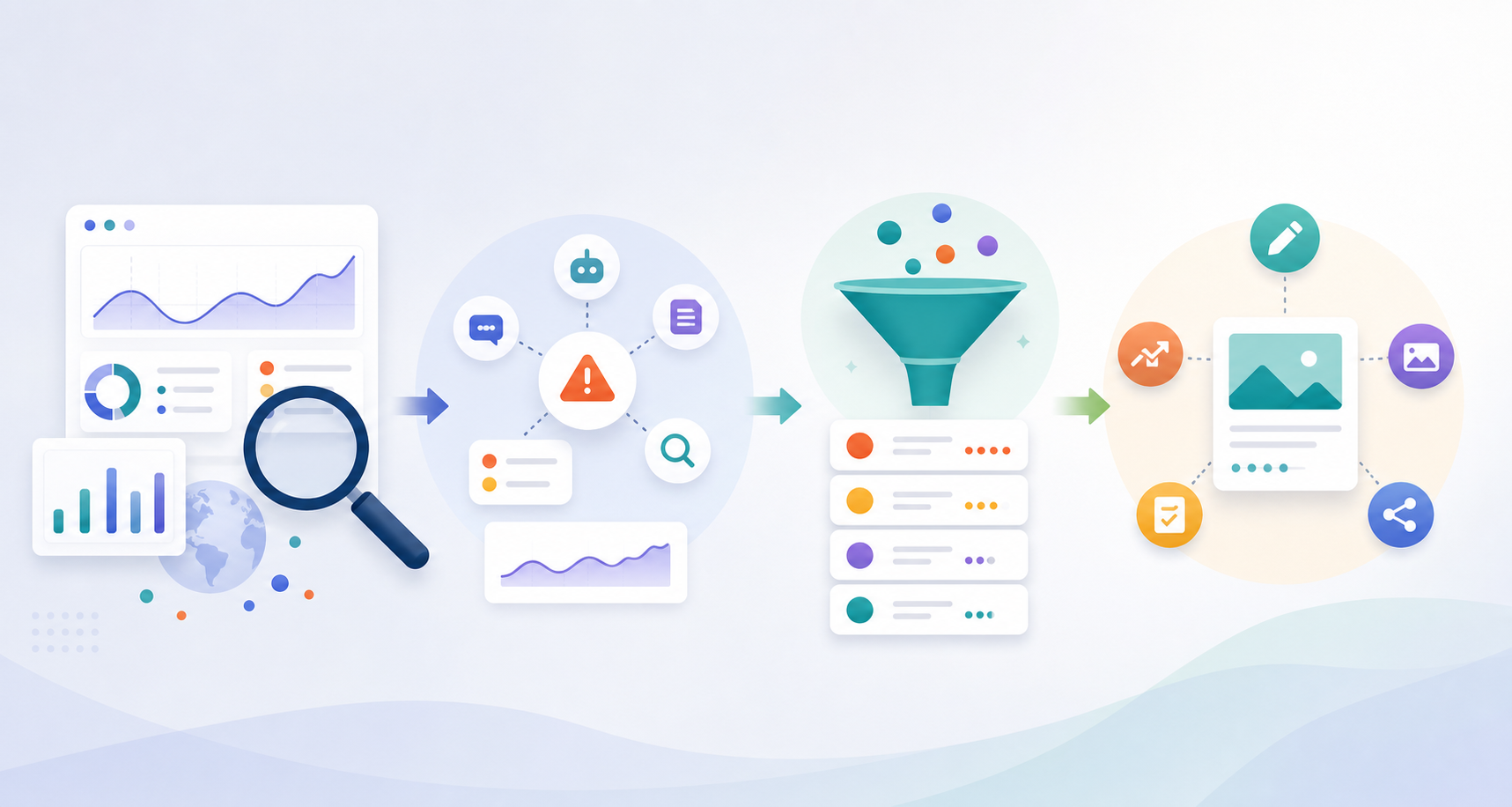
A practical answer engine optimization strategy has seven steps:
- Build prompt groups around real buyer questions.
- Baseline answer visibility across priority engines.
- Map citations and sources shaping each answer.
- Diagnose the failure mode behind missing or weak visibility.
- Prioritize fixes by business impact, evidence and effort.
- Ship content and source actions across owned and earned channels.
- Measure results with controls so platform growth is not mistaken for AEO impact.
| Step | Output | Primary owner |
|---|---|---|
| Prompt groups | A structured set of monitored buyer questions | SEO, product marketing |
| Baseline | Mention, citation, sentiment and competitor benchmarks | SEO, analytics |
| Source map | Owned, earned, partner and third-party pages influencing answers | SEO, PR, partnerships |
| Diagnosis | Reason the brand is missing, misranked or misdescribed | SEO, content, product marketing |
| Prioritization | Ranked fix queue | Growth, SEO, leadership |
| Execution | Updated pages, briefs, PR pitches, profile corrections | Content, PR, product marketing |
| Measurement | Before/after trends, controls and annotated changes | Analytics, SEO |
The rest of this guide explains how to run each step.
Step 1: Start with prompt groups, not keywords
Prompt groups are clusters of buyer questions used to test how answer engines discuss a brand. They are more useful than a raw keyword list because AI users ask comparative, contextual and job-to-be-done questions that often do not match traditional search queries.
A software buyer rarely asks only "CRM software." They ask "best CRM for a 40-person B2B sales team using HubSpot and Slack" or "which customer data platform is safest for healthcare SaaS?" That wording changes the answer, the cited sources and the brands recommended.
A practical AI search prompt set should include six groups:
| Prompt group | Example prompt | What it reveals |
|---|---|---|
| Category shortlists | "Best tools for monitoring AI search visibility" | Whether the brand is recommended for core demand |
| Competitor comparisons | "MaxAEO alternatives for B2B SaaS teams" | Which rivals AI engines place nearby |
| Use-case questions | "How should a SaaS SEO team track brand mentions in ChatGPT?" | Whether the brand owns important workflows |
| Risk and trust prompts | "Is [brand] reliable for enterprise reporting?" | Reputation, objections and trust concerns |
| Integration prompts | "AI visibility tools for agencies managing multiple clients" | Product-market fit signals in generated answers |
| Branded prompts | "What does [brand] do?" | Entity accuracy and positioning clarity |
Do not start with hundreds of prompts. Start with 30 to 80 prompts tied to buying decisions, then expand once the team sees which groups produce unstable answers, competitor dominance, missing citations or inaccurate brand framing.
Step 2: Baseline the answer before editing the page
An answer engine optimization strategy should measure the generated answer itself: brand presence, ranking order, cited URLs, sentiment, competitor co-mentions and message accuracy. Without that baseline, teams guess which content to update and cannot prove whether a fix changed AI visibility.
A useful baseline answers seven questions:
- Is the brand mentioned?
- Is it recommended, merely listed or excluded?
- Which competitors appear above it or instead of it?
- Which pages or domains are cited?
- Does the answer describe the brand accurately?
- Is sentiment positive, neutral, generic, incorrect or negative?
- Does performance differ across ChatGPT, Gemini, Perplexity, Claude, Copilot, Grok, Google AI Mode and AI Overviews?
This is where an AI search visibility baseline becomes more useful than a one-off manual check. Single prompt tests are noisy. AI responses vary by engine, date, location, model behavior, retrieval source and phrasing. Daily or weekly tracking shows whether a pattern is real.
Google also notes that AI Overviews and AI Mode performance is included in Search Console's overall Web search type, not split into a separate AEO report. That makes direct AI search monitoring important for teams that need answer-level detail.
Core AEO metrics include:
| Metric | Meaning |
|---|---|
| Mention rate | Percentage of tracked prompts where the brand appears |
| AI share of voice | Brand visibility compared with named competitors |
| Average answer position | Where the brand appears in lists or recommendations |
| Citation rate | How often owned or target pages are cited |
| Source ownership | Whether citations come from owned, earned, partner or uncontrolled sources |
| Sentiment distribution | Positive, neutral, generic, incorrect or negative framing |
| Accuracy issues | Outdated claims, wrong category, missing product capabilities |
| Competitor gap | Prompts where competitors appear and the brand does not |

Step 3: Turn AI citations into a source map
AI citations are not just proof links. They are a source map showing which pages answer engines trust for a topic. A brand should identify the sources shaping each answer, then decide whether to improve owned pages, earn inclusion in third-party sources or correct outdated references.
A 2026 controlled study, "What Gets Cited: Competitive GEO in AI Answer Engines", ran 252,000 paired trials across six LLMs. In that testbed, topical relevance and source position were the strongest drivers of being cited first. Explicit price information and recent timestamps also helped, while formatting-only edits had limited impact.
Another 2026 measurement paper, "From Citation Selection to Citation Absorption", analyzed 602 controlled prompts, 21,143 valid search-layer citations and 18,151 fetched pages across ChatGPT, Google AI Overview/Gemini and Perplexity. Its key finding is practical for marketers: citation count and citation influence are different. The pages that most shaped answers tended to be structured, semantically aligned and rich in extractable evidence such as definitions, numerical facts, comparisons and steps.
Use citation tracking to separate five source types:
| Source type | Common issue | Content action |
|---|---|---|
| Owned product or solution page | Too promotional or vague | Add answer-first sections, proof points, use cases and comparison language |
| Blog or guide | Ranks, but lacks quotable definitions or data | Add concise answer blocks, tables, citations and examples |
| Third-party review page | Outdated category or positioning | Update profiles, request corrections and align descriptions |
| Analyst, media or community source | Competitors are named but the brand is absent | Pitch useful data, benchmarks or expert commentary |
| Documentation or help center | Too technical for buyer prompts | Add plain-language summaries and internal links to commercial pages |
A citation tracking workflow should connect every AI answer back to the pages that influenced it. For engines where citations are especially visible, such as Perplexity, brands also need engine-specific source analysis; see this guide to Perplexity SEO.
Step 4: Diagnose why the brand is missing or misrepresented
Before creating new content, identify the failure mode. Missing from an answer, buried below competitors and described incorrectly are different problems.
| Failure mode | What the answer looks like | Likely cause | Best first fix |
|---|---|---|---|
| Not retrieved | The brand never appears | Weak topical source, poor internal linking, low authority | Build or improve a definitive category/use-case page |
| Retrieved but not cited | Brand appears, but no owned source is cited | Owned page lacks extractable evidence | Add definition, proof, examples, tables and current facts |
| Competitors preferred | Competitors are recommended first | Stronger third-party validation or comparison content | Publish comparison proof and earn relevant mentions |
| Generic framing | Brand is listed with vague description | Positioning is inconsistent across sources | Align About, product, profile and partner descriptions |
| Incorrect framing | AI describes an old category, segment or capability | Outdated source is being reused | Correct the cited source and publish updated owned evidence |
| Negative skew | Answer overemphasizes limitations or complaints | Review, forum or media sources dominate | Add balanced proof, documentation, customer evidence and PR response |
| Wrong source cited | AI cites a weak blog instead of a product page | Internal linking or page structure is unclear | Strengthen canonical pages and link supporting content to them |
The recurring pattern in B2B SaaS AEO work is that the problem is rarely "no schema." More often, the answer engine found a clearer third-party page than the brand's own page, or it found an old description that was never corrected.
Step 5: Convert findings into content actions
The content actions most likely to change AI answers are the ones that remove ambiguity. Add direct answer blocks, clarify entity facts, publish current evidence, improve comparisons, make citations easier to verify and ensure important content is available as visible text.
Google's people-first content guidance asks whether content provides original information, complete explanation and analysis beyond the obvious. That is a useful AEO standard too. Answer engines need extractable facts, but humans still need depth, proof and context.
High-impact content actions include:
- Add a 40 to 60 word definition near the top of strategic pages.
- Create comparison sections for real buyer alternatives.
- Publish original benchmarks, screenshots, workflows or customer examples.
- Add tables that summarize use cases, limitations, integrations and criteria.
- Update old pages that answer engines cite with current positioning and dates.
- Align About pages, product pages, review profiles and partner descriptions.
- Make important claims supportable with data, examples or cited sources.
- Use Article, Organization, SoftwareApplication or Product structured data when appropriate, making sure it matches visible content.
A strong AEO content block usually contains four parts:
- Direct answer: a concise paragraph that answers the prompt.
- Evidence: data, customer proof, methodology, screenshots or examples.
- Comparison context: who the solution is for, who it is not for and how it differs.
- Verification path: links or structured sections that let readers and systems confirm the claim.
Do not treat schema as a shortcut. Google's AI guidance says there is no special schema required for AI Overviews or AI Mode. Schema helps machines understand a page; it does not compensate for thin, outdated or unsupported content.
Step 6: Prioritize fixes with a score, not opinion
The best next action is the fix with high buyer impact, repeatable visibility loss, controllable sources and reasonable effort. A scoring model keeps AEO from becoming a debate about which anecdotal AI answer feels most urgent.
Use a simple scoring model:
Priority score = (Impact x Confidence) – Effort
Impact includes prompt intent, revenue relevance, competitor gap, sentiment risk and engine breadth. Confidence includes repeatability, citation evidence and source controllability. Effort includes writing, design, legal review, stakeholder approval and third-party outreach.
| Monitoring finding | Impact | Confidence | Effort | Priority action |
|---|---|---|---|---|
| ChatGPT and Gemini recommend three competitors for "best AEO platform for SaaS" and omit the brand | 9 | 8 | 4 | Build or update a category comparison page with proof, use cases and citation-worthy definitions |
| Perplexity cites an outdated partner article that misstates the product category | 7 | 9 | 3 | Request source correction and publish an updated partner-facing description |
| Claude mentions the brand but says it lacks agency reporting | 8 | 7 | 5 | Add an agency workflow section, screenshots and reporting examples |
| Google AI Overview cites a generic blog post instead of the product page | 6 | 6 | 4 | Improve internal linking and add a direct answer block to the product page |
This turns monitoring into a queue. The team can stop reacting to every strange output and focus on the fixes most likely to affect buyer-relevant answers.
Step 7: Build the weekly operating model
A usable answer engine optimization strategy needs cadence. Daily monitoring catches volatility, but weekly review is where teams decide what to fix. Monthly reporting is where leaders see whether AI share of voice, citations and message accuracy are improving.
A practical weekly loop looks like this:
- Monday: Visibility scan. Review mention rate, AI share of voice, answer position, citations and sentiment by prompt group.
- Tuesday: Diagnosis. Identify whether losses are caused by missing content, weak citations, outdated sources, competitor authority or inaccurate entity data.
- Wednesday: Brief creation. Convert priority issues into content, PR, profile, documentation or technical briefs.
- Thursday: Production and outreach. Update pages, add evidence, refresh profiles, pitch third-party sources and request corrections.
- Friday: Annotation. Log what changed, when it changed and which prompt groups should respond.
Assign ownership by source type. SEO usually owns site architecture, internal links, crawlability, structured data and content updates. Product marketing owns positioning and comparisons. PR and communications own third-party narratives. Customer marketing owns proof, reviews and case studies. Agencies need the same structure across clients, with client-specific prompt sets and shared reporting templates.
The operating model matters because AI search visibility is not a single campaign. It is a feedback system.
What should be on the AEO dashboard?
An AEO dashboard should show whether the brand is present, preferred, cited and accurately described. Executives do not need every prompt response; they need trend lines, competitor deltas, priority fixes and evidence that completed actions changed answer behavior.
| Metric | Why it matters | Action trigger |
|---|---|---|
| Mention rate | Shows whether the brand appears at all | Low rate in high-intent groups means content or authority gaps |
| Average answer position | Shows whether the brand is leading or buried | Falling position means competitors are gaining answer preference |
| AI share of voice | Benchmarks against competitors | Competitor gains trigger source and content gap analysis |
| Citation rate | Shows whether engines trust specific pages | Low citation rate means source pages need stronger evidence |
| Source ownership | Shows whether visibility depends on controllable or third-party pages | Uncontrolled sources trigger PR, profile and partner work |
| Sentiment distribution | Shows how the brand is framed | Generic or negative framing triggers messaging fixes |
| Accuracy issues | Protects brand trust | Incorrect claims trigger owned and third-party corrections |
| Completed actions | Connects work to outcomes | No movement after action means the source assumption may be wrong |
The dashboard should separate branded prompts from category prompts. Branded prompts measure entity accuracy. Category prompts measure demand capture. Competitor prompts measure shortlisting risk. Treating all prompts as one score hides the useful signal.
If you are evaluating platforms, this guide to AI search visibility software explains what to look for in coverage, prompt management, citation tracking and reporting.
How should brands prove AEO results?
AEO results should be measured with baselines, control groups and annotated changes. Track prompt groups before and after fixes, compare treated topics with untreated topics and avoid claiming that all AI referral growth came from optimization.
This matters because AI platforms themselves are growing. A 2026 field study, "Disentangling Answer Engine Optimization from Platform Growth", found that total ChatGPT referrals on one high-traffic domain grew 5.7x, while untreated pages on the same domain grew 3.5x. The treated/control ratio rose 1.82x, but the authors still treated the result cautiously because a placebo-in-time test was not conclusive.
That is the right mindset for marketing teams. Do not present AEO as a magic growth lever. Present it as a measurable visibility program with controls.
A defensible report includes:
- Baseline and current mention rate by prompt group.
- AI share of voice against named competitors.
- Citation rate and cited source changes.
- Sentiment and message accuracy movement.
- Content and source actions completed.
- AI referral traffic where available.
- Branded search and assisted conversion trends.
- Notes on engine volatility and tracking limitations.
For Google specifically, Search Console can show overall web search performance that includes AI features, but it will not explain which AI answer cited which page. Pair it with answer-level monitoring, prompt exports and annotated screenshots.
What content should brands optimize first?
Start with pages that answer high-intent prompts and can become reliable source material. In most B2B SaaS programs, that means category pages, use-case pages, comparison pages, integration pages, documentation summaries, customer proof pages and third-party profiles.
| Page or source | Why it matters for AEO | Upgrade to make |
|---|---|---|
| Category page | Helps AI understand where the brand belongs | Add definition, criteria, use cases, competitors and proof |
| Use-case page | Matches job-to-be-done prompts | Add workflow steps, screenshots, examples and outcomes |
| Comparison page | Influences shortlist and alternative prompts | Add fair criteria, limitations and evidence |
| Integration page | Answers compatibility prompts | Add exact systems, setup details and constraints |
| Documentation summary | Connects technical proof to buyer language | Add plain-English overview and links to docs |
| Customer story | Supplies real-world evidence | Add measurable outcomes and industry context |
| Review/profile pages | Often shape third-party entity understanding | Correct categories, descriptions and feature claims |
The guiding question is simple: if an AI answer needed one reliable page to cite for this claim, would your page be the clearest source?
Common mistakes in answer engine optimization
Most AEO mistakes come from treating AI search like a smaller version of SEO. The better approach is to keep SEO fundamentals, then add answer-level tracking, source analysis and cross-functional action.
| Mistake | Why it fails | Better move |
|---|---|---|
| Checking one prompt manually | AI answers vary too much for one result to prove a trend | Track prompt groups across engines and dates |
| Optimizing only blog posts | AI engines often cite third-party, review, documentation or comparison sources | Map every cited source and assign ownership |
| Adding schema without improving content | Markup cannot make weak claims useful | Strengthen visible text, proof and page structure |
| Chasing every mention | Not every prompt has buyer value | Score by intent, competitor gap and controllability |
| Ignoring sentiment | A mention can still hurt if the framing is outdated | Convert sentiment issues into briefs |
| Reporting traffic only | Many AI answers create zero-click exposure | Report visibility, citations, share of voice and accuracy |
| Treating AEO as a one-time project | Sources, models and answers change | Run a recurring monitoring-to-action loop |
The strongest answer engine optimization strategy is operationally simple: monitor, diagnose, prioritize, update, annotate and measure again.
Frequently Asked Questions
Is AEO different from GEO?
AEO and GEO are overlapping terms. AEO usually focuses on visibility in direct answer experiences, while generative engine optimization often emphasizes citations and synthesized responses from generative AI systems. For brand teams, the practical work is similar: monitor AI answers, improve source material, earn trustworthy mentions and measure competitive visibility.
How long does an answer engine optimization strategy take to work?
Some fixes can show movement within days or weeks when an answer engine uses fresh web retrieval and the cited source changes quickly. Competitive category prompts usually take longer because they depend on authority, third-party mentions and repeated source reinforcement. Use baselines and control prompt groups rather than fixed timelines.
Do brands need special schema for AI Overviews or AI Mode?
No. Google says there are no additional technical requirements and no special schema.org structured data required for AI Overviews or AI Mode. Use normal structured data when it fits the page, make sure it matches visible content and focus on helpful, reliable pages that answer real user questions.
How many prompts should an AEO strategy track?
Start with 30 to 80 prompts across category, competitor, use-case, risk, integration and branded groups. That is enough to find repeatable patterns without creating noise. Expand only after the team has a clear workflow for diagnosis, prioritization and reporting.
What should a startup do first?
A startup should first build a focused prompt set around category, competitor and use-case questions. Then track whether the brand is mentioned, which competitors appear, which sources are cited and whether the description is accurate. The first fixes usually involve clearer positioning, stronger comparison content and updated third-party profiles.
How can a brand get recommended by ChatGPT?
To get recommended by ChatGPT, a brand needs to be a credible answer for the prompt category. That usually means clear owned pages, consistent entity information, useful third-party mentions, current evidence, comparison-ready messaging and content that directly answers buyer questions. Monitoring brand mentions in ChatGPT shows which gaps to fix first.
Does AEO replace traditional SEO?
No. AEO depends on many SEO fundamentals: crawlable pages, strong internal links, useful content, clear entities and trustworthy sources. The difference is measurement. SEO measures search result performance; AEO measures answer inclusion, citations, sentiment, accuracy and competitor visibility inside generated responses.