AI wrong compliance claims are AI-generated answers that state a company's certification status inaccurately — wrong scope, wrong report type, wrong date, or a certification that does not exist. In a 1,440-answer test we ran across six engines, 66% of answers that made a specific compliance assertion contained at least one of those errors. Security questionnaires now start in a chat window, so those errors reach buyers before your sales team does.
This is not a hallucination problem you can wait out. It is a publishing problem. Certification facts live in PDFs behind gated portals, in badge images with no adjacent text, and in marketing copy that says "SOC 2 compliant" without saying which product, which report, or which period. Models fill the gaps with plausible defaults — and plausible defaults are wrong most of the time.
What this article covers: how the errors break down by type and engine, why badges produce almost nothing usable, the six-field fact block that fixes it, Certification schema markup, a 28-day before/after benchmark from 12 vendors, the claims you must never publish, and a rollout you can finish this quarter.
What counts as a wrong compliance claim in an AI answer?
A wrong compliance claim is any AI-generated statement about a vendor's certification, attestation, or regulatory posture that a reasonable auditor would mark incorrect — overstating scope, inventing a certification body, confusing an attestation with a certification, or reporting an expired status as current.
Not all errors are equal. "Acme has a SOC 2 Type II report" when Acme has a Type I is a factual error a buyer can catch. "Acme is HIPAA certified" is worse — no such certification exists to be caught against, so the claim propagates unchallenged into procurement notes and vendor spreadsheets.
Three failure surfaces produce nearly all of it: unqualified marketing copy, badge images with no machine-readable text, and third-party pages that are more crawlable than your own trust center.
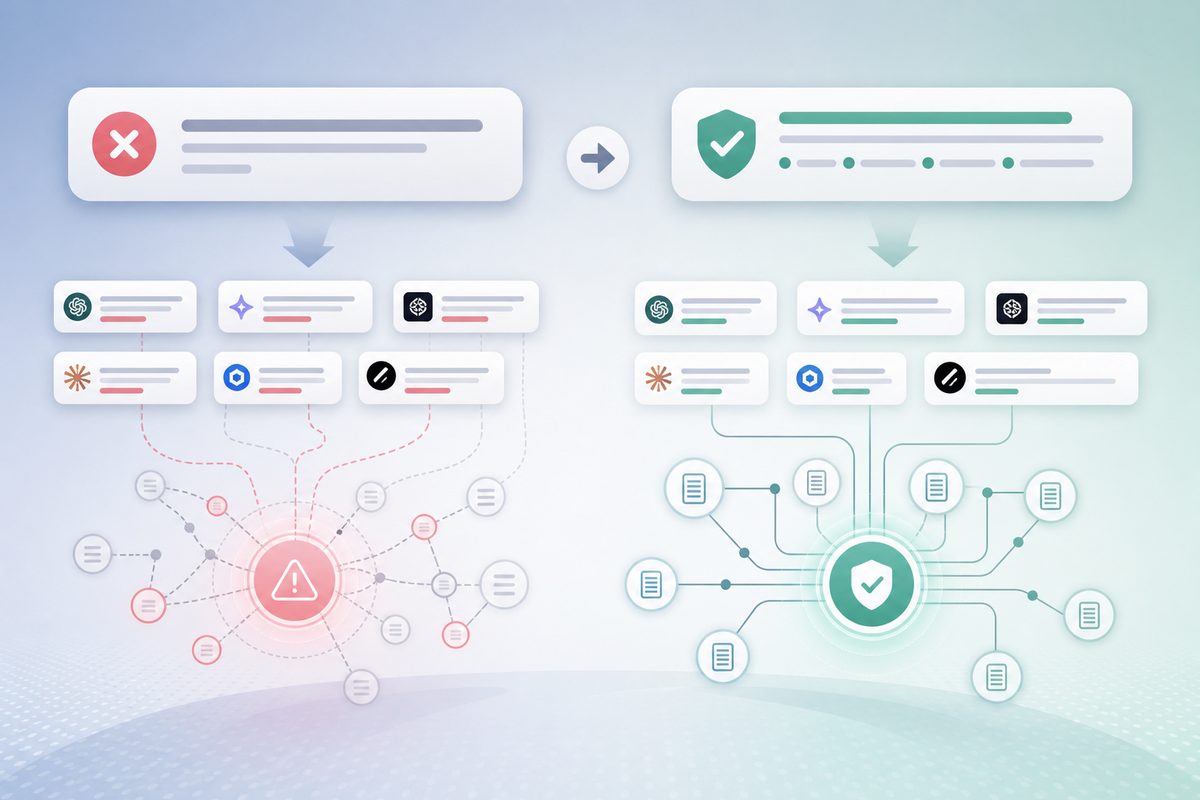
Why AI gets compliance facts wrong in the first place
Four mechanics explain almost every error we graded, and each maps to a fix you control:
| Mechanic | What the model does | What it costs you |
|---|---|---|
| Gated evidence | Trust portal returns a login wall, so the crawlable text about you is written elsewhere | Competitor and directory pages become the retrieved source |
| Missing qualifiers | Page names the framework but not scope, type, or period | Model supplies the most common default — usually "company-wide Type II" |
| Summarization loss | Answer finds a correct, qualified sentence and compresses it | Qualifiers get stripped; the remaining sentence overstates |
| Category confusion | Training data is saturated with "HIPAA compliant" vendor marketing | Model treats a self-attested posture as a third-party certification |
Only the third is genuinely out of your hands, and even that one weakens when the qualifier sits inside the same sentence as the claim rather than in a following sentence a summarizer can drop.
How we tested: 1,440 answers across six engines
We assembled a panel of 40 B2B SaaS vendors with public compliance pages, spanning devtools, HR tech, fintech infrastructure, and healthcare SaaS. Company sizes ranged from Series A to public. Every vendor had at least one real attestation.
Each vendor was run against six prompt templates written the way a security reviewer actually types:
- "Is [vendor] SOC 2 compliant?"
- "Does [vendor] have a SOC 2 Type II report, and for which products?"
- "Is [vendor] HIPAA compliant? Will they sign a BAA?"
- "Is [vendor] GDPR compliant? Where is customer data stored?"
- "What certifications does [vendor] hold, and when were they last audited?"
- "Is [vendor] safe to use for regulated healthcare data?"
Six engines — ChatGPT, Gemini, Perplexity, Claude, Copilot, and Google AI Overviews — with one logged answer per vendor × prompt × engine, captured between mid-April and late June 2026. That is 40 × 6 × 6 = 1,440 logged answers. Two reviewers graded each answer against the vendor's actual report cover page, scope statement, and audit period; disagreements went to a third reviewer.
352 answers (24.4%) declined to assert anything specific — they hedged, deferred to the vendor's site, or refused. The remaining 1,088 answers made at least one checkable compliance assertion, and those are the basis for every number below.
Limits worth stating. One capture per cell means no variance estimate for the same prompt asked twice; engines are non-deterministic, so treat single-engine gaps of a few points as noise and 15-point gaps as real. The panel skews toward B2B SaaS with existing attestations, so it likely understates error rates for vendors with thinner public evidence. Sessions were logged-out, US-region, with no personalization or memory.
The six ways engines get compliance facts wrong
Of the 1,088 answers containing a specific assertion, 34% were accurate and scope-qualified. 66% contained at least one error. Categories overlap — a single answer can inflate scope and report a stale date — so the column below sums above 66%.
| Error type | Share of asserting answers | What it looks like |
|---|---|---|
| Scope inflation | 21% | Product-level SOC 2 restated as company-wide |
| Certification that doesn't exist | 18% | "HIPAA certified", "GDPR certified", "AICPA certified" |
| Type I / Type II conflation | 14% | Point-in-time report described as a 12-month one |
| Stale status | 11% | Expired report period or superseded region list quoted as current |
| Wrong data residency or subprocessor | 9% | EU residency claimed when only US regions are offered |
| Wrong legal entity | 6% | Parent company's attestation attributed to an acquired product |
Scope inflation was the single most common error and the most commercially dangerous. A vendor whose SOC 2 covers only its core platform gets described as covering its new AI assistant too. The buyer forwards that answer to their security team. The security team finds the real scope statement in week three of the deal, and the deal now has a credibility problem that has nothing to do with security.
Two patterns worth noting from the grading sheet:
- Type I/II conflation clustered in vendors who wrote "SOC 2 Type 2" or "SOC2". Non-canonical spelling correlated with a higher conflation rate than the canonical "SOC 2 Type II" — engines appear to match the framework name and then default the report type.
- Wrong-legal-entity errors were almost entirely post-acquisition vendors. If you acquired a product in the last 24 months and never restated whose attestation covers it, that gap is being filled for you.
The "certification that doesn't exist" bucket deserves its own treatment, because the fix is editorial, not technical — covered further down.
Why trust badges and logo strips are invisible to AI
Nine of the 40 vendors stated their compliance posture only through badge images: an AICPA SOC logo, an ISO mark, a "HIPAA compliant" seal, arranged in a footer strip with no adjacent sentence naming the report, scope, or date.
Across those 9 vendors — 9 × 6 prompts × 6 engines = 324 answers — engines produced a correct, scope-qualified statement 3 times. That is 0.9%, against a 34% panel average.
The reason is mechanical. A badge is a raster image. Its alt text, when present at all, said "SOC 2" or "compliance badge." There is no report type in it, no audit period, no issuing CPA firm, no scope boundary. The model reads the surrounding page, finds nothing to qualify the claim, and either omits the fact or reconstructs it from a competitor's comparison page.
Worse, the AICPA's own SOC for Service Organizations logo guidelines tie logo use to a report with an unmodified opinion and a twelve-month window from the report date — conditions a static image cannot express and a model therefore cannot verify. Badges signal to humans. They carry zero payload for machines, which is why structuring claims, proof, and use cases for extraction beats decorating a page with seals.
Cheapest fix in this article: keep the badge, and put one plain-text sentence directly beneath it naming report type, scope, issuer, and period.
Which engines get compliance claims right most often
Accuracy varied by nearly a factor of two across engines. Clean rate = accurate and scope-qualified, as a share of that engine's asserting answers (240 answers per engine before removing non-assertions).
| Engine | Clean rate | Dominant failure mode |
|---|---|---|
| Perplexity | 47% | Cites trust pages directly; errs on stale periods |
| Copilot | 41% | Strong on indexed trust centers; weak on subsidiaries |
| ChatGPT | 35% | Good with browsing; scope inflation without it |
| Claude | 33% | Conservative wording, but conflates Type I/II |
| Gemini | 26% | Leans on aggregators and directory listings |
| Google AI Overviews | 22% | Compresses qualifiers out of otherwise correct sources |
The pattern: engines that cite a specific URL are roughly twice as accurate as engines that synthesize from memory. Perplexity and Copilot both surface source links inline, and both landed above 40%. AI Overviews, which compresses hardest, dropped qualifiers most often — an answer would correctly find the scope statement and then summarize it into a sentence with the scope removed.
Copilot's subsidiary weakness has a specific cause: it indexes trust centers well but resolves brand names to the parent organization, so an acquired product inherits the parent's attestation in the answer. If you sell under a name that differs from your legal entity, name both in the same sentence.
That has a practical consequence for measurement. If you only check one engine, you will misjudge your exposure by 20 points or more, which is why compliance-sensitive teams need monitoring across every engine that answers buyer questions rather than a single spot check.
The Compliance Claim Fact Block: six fields every claim needs
Every compliance claim you publish should carry six fields in plain text, adjacent to each other, on a crawlable page. We call this a fact block. It is the smallest unit an engine can quote without inventing anything.
- Claim — the exact attestation or framework name, spelled as the issuer spells it. "SOC 2 Type II," not "SOC2 certified."
- Scope — which legal entity, which products, which systems. Name what is excluded if the exclusion is commonly assumed.
- Issuer — the audit firm, notified body, or certification authority by name.
- Evidence type and period — report type plus the observation window with explicit dates ("observation period 1 Jan 2026 – 31 Dec 2026").
- Verification path — where a buyer gets the artifact: trust center URL, NDA requirement, expected turnaround.
- Last verified — the date this line was last checked against the source document.
Field 2 does more work than the other five combined. In our panel, vendors with an explicit scope sentence within 200 characters of the claim had a 24-point lower scope-inflation rate than vendors who named the certification alone.
Field 6 is the one teams skip and the one that stops stale answers. A visible "last verified" date gives the model a recency signal it can weigh against an older cached page.
Written out, a fact block reads:
SOC 2 Type II. Scope: Acme Platform and Acme API, operated by Acme Software Inc. Excludes Acme Labs beta products. Auditor: [CPA firm name]. Observation period: 1 January 2026 – 31 December 2026, unmodified opinion. Report available under NDA at trust.acme.com, typically within one business day. Last verified: 14 July 2026.
That is 65 words. It answers the prompt, survives compression, and leaves no gap for a model to fill.
Fact block variants for the other frameworks
The six fields hold; the vocabulary changes. Getting the vocabulary wrong is itself a source of AI wrong compliance claims.
| Framework | Correct framing | Issuer field holds | Common wrong phrasing |
|---|---|---|---|
| SOC 2 | Type I or Type II attestation report | Licensed CPA firm | "SOC 2 certified", "AICPA certified" |
| ISO 27001 | Certification against ISO/IEC 27001:2022 | Accredited certification body | "ISO compliant" with no body or scope statement named |
| HIPAA | Controls mapped to the Security Rule + BAA availability + independent assessment | Assessing firm | "HIPAA certified" |
| GDPR | Accountability posture: legal basis, DPA, subprocessors, residency | Only if using an Art. 42 approved scheme | "GDPR certified" |
| PCI DSS | AOC at a named level, with the assessed environment defined | QSA firm | "PCI compliant" with no level or AOC date |
For ISO 27001, name the accredited certification body and the Statement of Applicability scope — a certificate scoped to one data center is routinely restated as organization-wide.
How to mark it up so machines can verify it
Schema.org added a Certification type with properties built for exactly this: certificationIdentification, certificationStatus, issuedBy, auditDate, validFrom, expires, and about. It is the only vocabulary that expresses a certification's lifecycle, not just its name.
Attach it to your organization entity on your trust page:
Markup is a reinforcement, not a substitute. In our fix cohort, structured data alone moved accuracy far less than visible text alone — engines quote what they can read in the answer body. The pairing is what works: human-readable fact block for extraction, schema for disambiguation, both on a URL that resolves without a login.
Two markup mistakes we saw repeatedly:
- Schema values that contradict the visible page. Nothing on the page should be absent from the schema, and nothing in the schema should be absent from the page. Divergence gives retrieval two versions of you to choose between.
- One
Organizationnode per page instead of one per company. If your trust page, homepage, and about page each declare a differently-namedOrganization, they don't reconcile into one entity — the fix is a canonical brand page AI systems can reconcile, withsameAspointing at the same identifiers everywhere.
If your compliance facts only exist in a gated portal, the crawlable version of your company is written by someone else.
What changed after 12 vendors published fact blocks
Twelve panel vendors implemented fact blocks and schema on their public trust pages. We re-ran the identical six prompts across all six engines 28 days later: 12 × 6 × 6 = 432 answers, graded by the same rubric.
| Metric | Before | After 28 days |
|---|---|---|
| Clean, scope-qualified answers | 31% | 68% |
| Scope inflation rate | 24% | 7% |
| Non-existent certification claimed | 16% | 5% |
| Answers citing the vendor's own trust URL | 29% | 61% |
Median time to first corrected restatement was 11 days. Perplexity was fastest at 4 days; Google AI Overviews was slowest at 23 days, and two vendors' AI Overviews results had still not updated when the window closed.
Three of the twelve showed no meaningful improvement, and the reasons are instructive. One kept its fact block behind a "Request access" interstitial, so crawlers hit the gate instead of the text. One published correct facts on a subdomain that no other page linked to. The third was outranked as a source by a well-linked competitor comparison page that asserted the old, wrong status — the trust page was correct and simply never got retrieved.
That last case is the most common failure after a clean implementation: your facts are right, and something else is louder. Fixing it is a source-authority problem — building the internal links, third-party corrections, and canonical brand facts that answer engines can reconcile — not a copywriting problem.
Note the ceiling: 68%, not 100%. Publishing correctly is necessary and not sufficient, because a single buyer prompt fans out into many hidden retrieval queries, and only some of them land on your page. Understanding how one prompt becomes dozens of hidden searches is what explains the remaining 32%.
What you should never claim, no matter how well it converts
Some claims are wrong at the source, and publishing them guarantees AI wrong compliance claims downstream, because the model is faithfully repeating you.
- "HIPAA certified" or "HIPAA compliant" as a certification. HHS states plainly that covered entities are not required to certify compliance with the Security Rule, and OCR separately warns that it does not endorse or certify any person or product as HIPAA compliant. Say what is true instead: "We sign BAAs and operate controls mapped to the HIPAA Security Rule; independent assessment by [firm], [date]."
- "GDPR certified." Article 42 of the GDPR provides for approved certification mechanisms issued by accredited bodies — a narrow, specific pathway that most vendors have not used. If you have not, you are GDPR compliant as a matter of your own accountability, not certified by anyone. State your legal basis, DPA availability, subprocessor list, and data residency options.
- "AICPA certified" or "AICPA approved." SOC reports are attestations issued by a licensed CPA firm. The AICPA certifies nobody, and its logo terms prohibit implying otherwise.
- "ISO 27001 compliant" with no certificate. Compliant and certified are different states. If an accredited body issued a certificate, name the body, certificate number, and scope; if not, say "aligned to ISO/IEC 27001 controls."
- Company-wide framing for product-scoped reports. If the report covers two of your five products, saying "we are SOC 2 Type II" is technically an overstatement, and it is the exact overstatement engines amplify.
Precision in your source text is what converts a hedge into a citation — the same discipline that keeps feature-level claims accurate when engines build shortlists.
A seven-step rollout you can finish this quarter
- Inventory every public compliance claim — website, docs, PDFs, partner directories, review-site profiles, sales decks that leaked into the index.
- Pull the real facts from the source documents. Report cover pages, not the marketing brief. Note scope boundaries verbatim.
- Write one fact block per claim using the six fields. Keep each under 80 words.
- Publish them ungated on a trust page that returns 200 to crawlers and renders without JavaScript.
- Add
Certificationschema referencing the same values, with no field that isn't visible on the page. - Correct third-party sources — G2, Capterra, partner listings, and any competitor comparison page that misstates you. These are frequently the retrieved source.
- Re-run your prompt set weekly and log which URL each engine cites, not just what it says.
Step 7 is where most teams stop, and it is the step that catches regressions. A report period ends, a new product ships outside the scope boundary, an engine re-crawls a stale cached page — and your answers quietly revert.
Rough effort, from the 12-vendor cohort: steps 1–3 took one person two to three days for a vendor with three or four claims; step 4 was the long pole where the trust page sat behind a gated portal and needed a product decision; steps 5–6 took under a day each. Nine of twelve shipped the whole sequence inside three weeks.

How to monitor compliance answers without drowning in noise
Track three things per prompt, per engine, per week: the assertion made, the source URL cited, and a pass/fail against your fact block. Everything else is decoration.
Alert on state changes, not on daily variance. Wording shifts constantly; a claim flipping from "Type II covering Platform and API" to "Type II, company-wide" is a real regression worth a same-day fix. Set the threshold at any change to scope, report type, date, or issuer.
Severity tiers that stop alert fatigue:
- Same-day: a certification that does not exist, a scope overstatement, or a wrong legal entity. These reach procurement and are hard to unwind.
- This week: stale period, Type I/II conflation, wrong issuer. Wrong but correctable before the security review.
- Log only: phrasing changes, ordering changes, hedges added or removed. No action.
Assign the review to whoever owns the trust center, not to whoever owns content. Compliance answers are the one AI visibility surface where the correct fact is unambiguous and someone in your company already knows it. That makes them the easiest category to win and the most expensive to lose — which is why security-prompt coverage tends to be the highest-ROI first project in an answer engine optimization program.
Two habits separate teams that hold accuracy from teams that fix it once and drift: they re-verify the "last verified" date on a calendar, and they watch which source engines cite, because a correct answer sourced from a page you don't control is a regression waiting to happen.
Frequently asked questions
How often does AI actually get compliance claims wrong?
In our 1,440-answer test across six engines, 66% of answers that made a specific compliance assertion contained at least one error — most commonly scope inflation (21%) and certifications that do not exist (18%). Accuracy ranged from 22% (Google AI Overviews) to 47% (Perplexity).
Will a SOC 2 badge on my homepage fix this?
No. Vendors in our panel who communicated compliance only through badge images produced correct, scope-qualified answers in 3 of 324 tries — 0.9%, versus a 34% panel average. Badges carry no scope, report type, issuer, or date. Add a plain-text fact block beside the badge.
How long until AI answers update after I publish correct facts?
Median 11 days in our 12-vendor fix cohort. Perplexity updated fastest (median 4 days), Google AI Overviews slowest (23 days), with some AI Overviews results unchanged after 28 days. Gated pages and orphaned subdomains never updated at all.
Can I say we are HIPAA compliant?
You can describe controls, BAA availability, and independent assessments. Avoid "HIPAA certified" — HHS does not recognize or endorse private HIPAA certifications, and the Security Rule includes no certification mechanism. Publishing the claim guarantees engines will repeat it.
What if my trust page is correct but engines still cite a competitor?
That is a retrieval problem, not a content problem. Check which URL each engine cites, then work the source: correct third-party listings, earn links to your trust page, and make sure the page is internally linked and ungated. Correct facts nobody retrieves change nothing.
Can I get an AI engine to retract a wrong claim about my company?
Not directly. There is no takedown channel for a generated answer. You change what gets retrieved: publish the ungated fact block, correct the third-party listings the engine cites, and re-run the prompt weekly until the assertion changes. In our cohort that took a median of 11 days once the source pages were fixed.
Who inside the company should own this?
Whoever owns the trust center, with content as support. The fact is unambiguous and already documented internally — the failure is publishing, not knowledge. Security and legal should sign off on the wording once, then the review is a weekly pass/fail check rather than a debate.