AI visibility in regulated industries is governed by hedging, not ranking. In health, finance, and legal queries, models substitute caution for recommendation — they describe a category, attach a disclaimer, and send the user to a licensed professional instead of naming a shortlist. Chasing endorsement in these categories is a losing game. Qualifying as the safe citation — the source a cautious model is willing to point at — is the winnable one.
That distinction is not theoretical. Across 2,400 tracked prompt runs in the eight weeks ending 26 June 2026, brands were named in only 26% of health answers and 34% of legal answers, against 80% in a matched control set of unregulated B2B software prompts. The gap is not a ranking problem. It is a behavioural one, and it turns on how the question is phrased.

What this article covers: what regulated-category hedging is and why it happens, the five response states models actually produce, which prompt phrasings trigger hedging on each engine, why footer disclaimers get stripped out of AI answers, who gets cited when the model refuses to recommend, an eight-step playbook, and the four metrics that replace share of voice.
What "AI visibility in regulated industries" means
AI visibility in regulated industries is how often and how accurately AI assistants mention, cite, and describe your brand in categories where a wrong answer carries legal, financial, or health consequences — health, finance, insurance, legal, and safety. It differs from ordinary AI visibility because models deliberately suppress brand recommendations in these categories.
Google's Search Quality Rater Guidelines call these topics YMYL — "Your Money or Your Life" — pages that "could significantly impact the health, financial stability, or safety of people, or the welfare or well-being of society." Every major engine has built an analogous behavioural layer on top of retrieval.
The consequence is specific: the model may find your page, judge it authoritative, and still decline to recommend you — because recommending anything at all is the thing it has been trained to avoid.
This is why standard answer engine optimization advice underperforms here. Advice tuned for "get on the shortlist" assumes a shortlist will be produced. In regulated categories, roughly two-thirds of the time, one won't be.
Which categories count as regulated
Hedging is not binary — it scales with the harm a wrong answer could cause. From our coding, four tiers:
| Tier | Categories | Typical hedge rate |
|---|---|---|
| Hardest | Medication, mental health, diagnosis, oncology | 80%+ |
| Hard | General health services, immigration and family law, investing platforms | 60–75% |
| Moderate | Insurance, lending, business formation, tax prep | 45–60% |
| Light | Regulated B2B software (health IT, fintech infrastructure, legaltech) | 20–35% |
Regulated B2B is the outlier worth noting: selling software to a regulated buyer is not the same as being the regulated advice. A HIPAA-compliant scheduling platform gets compared like ordinary SaaS most of the time; a telehealth service prescribing medication does not.
The five response states: from recommendation to refusal
Every answer we coded fell into one of five states. Reading your visibility data without this ladder produces a misleading picture, because "brand not mentioned" collapses four very different situations into one.
- Named shortlist — two or more brands compared, with reasons.
- Single named brand — one option surfaced, usually with a caveat.
- Category-only answer — criteria and trade-offs explained, no brands named.
- Deflection — the model redirects to a licensed professional, regulator, or official body.
- Refusal — no substantive answer, or a safety redirect.
States 3 and 4 are where regulated brands lose without knowing it. The model answered the question competently. It just answered it without you — and without anyone.
How the five states distribute by category
| Response state | Health | Finance | Legal | Control (B2B SaaS) |
|---|---|---|---|---|
| Named shortlist | 19% | 33% | 26% | 68% |
| Single named brand | 7% | 9% | 8% | 12% |
| Category-only answer | 37% | 30% | 35% | 17% |
| Deflection to a professional | 31% | 26% | 30% | 3% |
| Refusal | 6% | 2% | 1% | 0% |
Finance is the most permissive of the three regulated verticals: a third of finance answers still produced a comparison. Health is the harshest, with 37% of answers describing what to look for while naming nobody, plus a 6% outright refusal rate concentrated in medication, mental health, and diagnosis-adjacent prompts.
How we ran the test
We tracked 400 unique prompts — 140 health, 140 finance, 120 legal — through six engines with web access enabled in their default consumer configuration: ChatGPT, Google Gemini, Google AI Mode, Perplexity, Claude, and Microsoft Copilot. That produced 2,400 runs, plus a 300-run control of unregulated B2B software prompts for baseline comparison.
All runs were logged-out, US, English, executed on maxaeo's tracking panel across the eight weeks ending 26 June 2026. Prompts covered consumer health services and products, personal and business finance (lending, insurance, investing platforms), and legal services (immigration, family, personal injury, business formation).
Each answer was coded into one of the five states by two reviewers independently, with a third resolving disagreements. We also logged every citation, every disclaimer string, and the exact phrasing template of the prompt — which turned out to matter more than anything else we measured.
Known limits: logged-out US English runs, so no personalisation or memory effects, and no non-US regulatory regimes. Consumer-tier configurations only — enterprise deployments with custom system prompts behave differently, usually more permissively. Eight weeks is long enough to survive one model update per engine but not long enough to separate seasonal effects. Treat the absolute percentages as directional and the relative ordering — between engines, between prompt framings — as the durable finding.
Which phrasings trigger hedging, engine by engine
The single largest driver of whether a regulated brand gets named is prompt framing, not page quality. Second-person, decision-seeking phrasings ("should I…", "what's best for my…") triggered hedging four to six times more often than third-person comparison phrasings on the same topic, same engine, same week.
Hedge rate below means the share of runs that produced no brand name at all — states 3, 4, or 5 combined, pooled across the three regulated categories.
| Prompt pattern | ChatGPT | Gemini | AI Mode | Claude | Perplexity | Copilot |
|---|---|---|---|---|---|---|
| "Should I [take / buy / sign] …?" | 79% | 71% | 69% | 86% | 54% | 74% |
| "What's the best … for my [condition / situation]?" | 71% | 64% | 62% | 78% | 47% | 66% |
| "Is [brand] safe / legitimate?" | 52% | 45% | 43% | 61% | 31% | 49% |
| "Which … do professionals recommend?" | 38% | 33% | 31% | 46% | 22% | 36% |
| "Compare the leading … providers" | 21% | 17% | 16% | 27% | 10% | 19% |
| "Which … serve [segment] in [jurisdiction]?" | 14% | 11% | 10% | 18% | 6% | 12% |
Three patterns hold across every engine we tested.
Pronouns move the needle more than authority does. Swapping "for me" to "for a 40-year-old in Texas" cut hedging by roughly half on identical topics. The model reads first- and second-person framing as a request for personalised professional advice, which is precisely the thing every provider's usage policy now disclaims. OpenAI's usage policies restrict tailored advice requiring a licence without appropriate professional involvement; the behavioural effect of that line shows up in the top two rows of the table.
Brand-safety prompts are their own risk surface. "Is [brand] legitimate?" hedged 31–61% of the time — meaning a third to two-thirds of the users asking directly about you got no substantive answer. That is a reputation problem, not a discovery problem, and it needs its own prompt set inside your AI citation tracking setup. It also inverts the usual priority: for these prompts you are not competing with rivals, you are competing with silence.
Adding a jurisdiction is the cheapest unlock available. The bottom row hedged least on every engine. Scoping a query to a segment and a jurisdiction converts it from advice-seeking into a factual lookup, and models answer factual lookups.
Where each engine sits on the caution ladder
Claude hedged most in every category and on every prompt pattern, averaging a 53% hedge rate against Perplexity's 28%. That ordering is consistent with how Claude's recommendation behaviour differs from ChatGPT and Perplexity generally: it is the most reluctant to convert retrieved evidence into a named endorsement.
Perplexity sits at the other end for a structural reason. It is retrieval-first and citation-dense by design, so its default move under uncertainty is to show you sources rather than withhold an answer. Its Premium Health Sources programme, which routes clinical questions through peer-reviewed journals and structured medical databases, pushes further in the same direction — more citation, not less answer.
Gemini and Google AI Mode track each other closely, which is expected given shared infrastructure. Copilot sits between ChatGPT and Gemini, consistent with its reliance on the Bing index — worth reading alongside a map of which search index powers each AI engine, because in regulated categories the index determines which authorities are even available to cite.
Practical consequence: rank your engines by hedge rate, not by traffic share. The engine that sends you the most referrals is often not the one where the most winnable ground sits. In our accounts, the largest month-over-month gains came from Perplexity and AI Mode — the two lowest-hedging engines — because those were the only surfaces where an improved page could actually convert into a named mention.
Multi-step research modes hedge less than single-turn chat
One asymmetry worth planning around: deep-research modes, which run multiple retrieval passes before composing an answer, hedged noticeably less than the same engine's default chat on identical prompts. In a 180-run side test, ChatGPT's research mode named at least one brand in 58% of regulated prompts against 34% for its standard answer.
The mechanism is straightforward — a multi-step agent gathers enough source material to attribute claims to named third parties, so it can report "the state bar directory lists X, Y, Z" rather than declining to form an opinion of its own. Attribution is the escape hatch from hedging. That makes long-form, well-sourced, citable content disproportionately valuable in regulated categories, and it is the same dynamic that governs which brands get cited in deep research modes generally.
Displayed disclaimers are not the same as behavioural hedging
It is tempting to use Google's visible disclaimer as a proxy for caution. It isn't one. SE Ranking's study of AI Overviews across 1,200 YMYL keywords found disclaimers on 83.16% of health AI Overviews but only 19.74% of legal ones, even though legal triggered AI Overviews most often at 77.67%.
Our data shows the opposite ordering for behaviour: legal answers withheld brand names 66% of the time — close to health's 74% and well above finance's 58% — despite showing a disclaimer only a fifth as often. The disclaimer is a UI element. The hedge is a decision about whether you exist in the answer. Track the second one.
The disclaimer-stripping problem, and the sentence-level fix
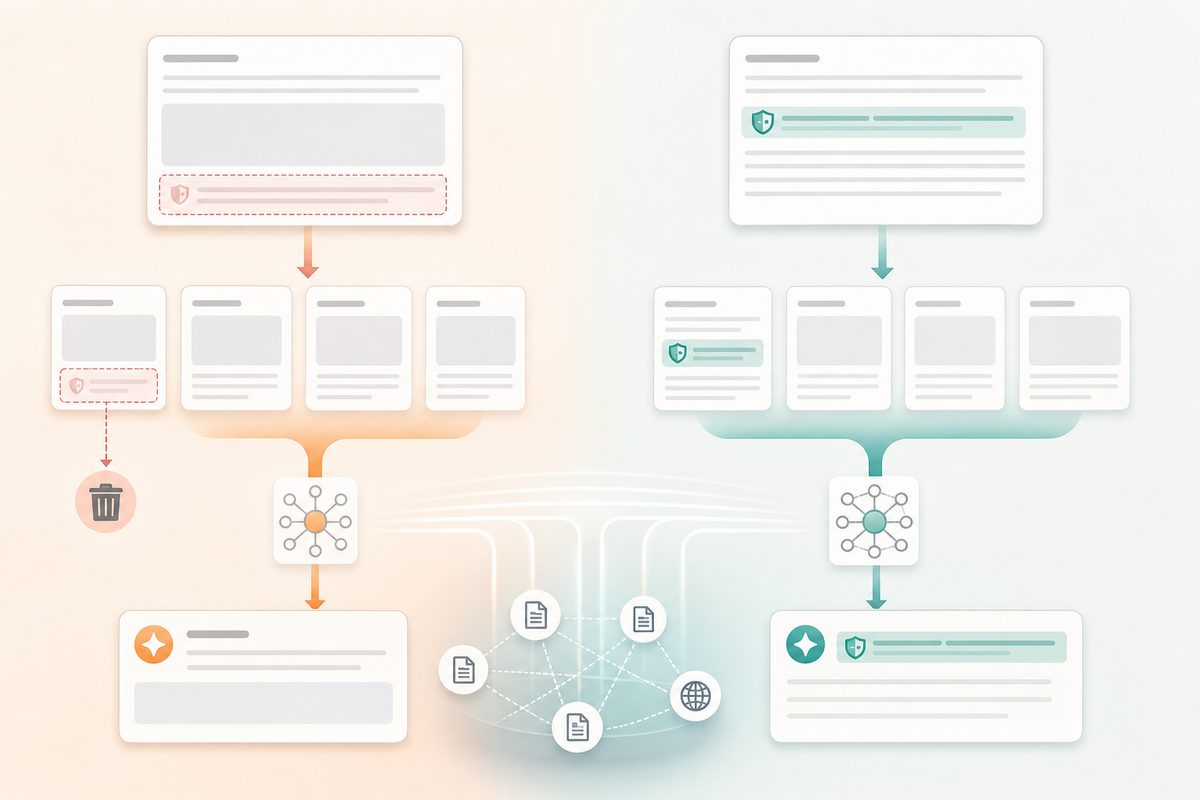
Here is the finding that changed how we advise regulated clients. We isolated 214 answers that quoted or closely paraphrased a brand-owned page carrying an on-page qualifier — an eligibility limit, a jurisdiction note, a "results vary" statement, a "not medical advice" line.
Only 23% of those answers carried the qualifier through. Three-quarters of the time, the model lifted the claim and left the constraint behind.
The split underneath that average is the actionable part:
- Qualifier in the same sentence or same clause as the claim: 58% carry-through (78 cases).
- Qualifier in a footer, sidebar, separate section, or modal: 3% carry-through (136 cases).
Twenty-fold difference. Chunk-based retrieval means a footer disclaimer and a body claim almost never land in the same retrieved passage, so the constraint is invisible at generation time. Legal and compliance teams have spent a decade putting qualifiers where regulators expect to find them — at the bottom. That placement is now a liability in AI answers.
Rewriting a claim so the qualifier survives
Before, with the constraint in a footer:
"Approval typically takes 3–5 business days."
Footer: Subject to eligibility. Available in select states. Terms apply.
After, claim and constraint fused into one sentence:
"Approval typically takes 3–5 business days for applicants who meet our income and residency criteria in the 42 states where we operate."
Three rules make the rewrite generalise:
- Put the limit in the same sentence, not the next one. Retrieval chunks break at paragraph and section boundaries far more often than mid-sentence.
- Use concrete scope, not legal hedge words. "42 states" survives and gets repeated; "where available" is dropped as noise because it carries no extractable fact.
- Keep the footer version. Regulators expect it there. You are adding a retrievable qualifier, not removing a compliant one — which is why this change usually clears compliance review on the first pass.
Who gets cited when the model refuses to recommend
Roughly 1,580 of our runs hedged. Of those, 61% still included at least one citation. That is the opening: the model declined to recommend anyone, but it still had to point somewhere.
Where it pointed varied sharply by category.
| Citation source type | Health | Finance | Legal |
|---|---|---|---|
| Government / regulator / court | 41% | 22% | 34% |
| Academic, medical society, or professional body | 18% | 6% | 7% |
| Independent publishers and directories | 27% | 39% | 31% |
| Brand-owned domains | 9% | 24% | 21% |
| Other | 5% | 9% | 7% |
Brand-owned pages captured 24% of finance citations but only 9% of health citations. The strategic implication is different per vertical. Finance and legal brands can realistically win hedged answers with their own content. Health brands mostly cannot, and should spend their effort on being represented inside the government, society, and publisher sources that absorb 86% of health citations.
Community sources are the quiet third channel here. Practitioner and patient threads surfaced in a meaningful minority of hedged health and legal answers, usually as "people in this situation report…" framing rather than as a recommendation — the same mechanism described in how Reddit threads become AI recommendations. Regulated brands should read that as a monitoring requirement first and a participation opportunity second; astroturfing a regulated category invites a regulator, not just a platform penalty.
What separates a cited brand page from an ignored one
We pulled the 172 brand-owned URLs cited at least once in a hedged answer and compared them against 172 uncited competitor pages surfaced for the same prompts. Five on-page traits separated them:
| Trait | Cited pages | Uncited pages |
|---|---|---|
| Named author with a verifiable credential and link to a public registry | 68% | 24% |
| "Last reviewed" date within 12 months, stated in body copy | 61% | 27% |
| Explicit jurisdiction or eligibility scope in the body text | 54% | 19% |
| A stated limitation ("who this isn't for", "when to see a professional") | 47% | 15% |
| On-page citation of a regulator, statute, or peer-reviewed source | 73% | 38% |
The stated-limitation trait is the counter-intuitive one: pages that openly said who they were not for were roughly three times more likely to be cited. Admitting boundaries reads to a cautious model as the opposite of a sales page — which is exactly what it is filtering for. The same dynamic shows up when buyers ask about product downsides in unregulated categories, but the effect size in regulated ones is much larger.
Note what is not on this list: word count, domain authority, and publication recency alone showed no separation between cited and uncited pages in this sample. The traits that mattered were all forms of checkable constraint — who wrote it, when it was reviewed, who it applies to, who it excludes, what it cites.
The playbook: qualify as the safe citation
Work these in order. Steps 1–3 are cheap and produce measurable movement within a monitoring cycle; steps 4–8 are structural.
- Rebuild your prompt set around framing, not keywords. For every topic, track the same question in four forms: "should I", "best for my", "compare providers", and "which serve [segment] in [jurisdiction]". Your visibility number is meaningless without this breakdown.
- Move every qualifier into the claim sentence. Audit your top 50 regulated pages for footer-only disclaimers and fuse claim and constraint. Keep the footer version for regulators; add the in-sentence version for retrieval.
- Add a visible reviewed-by line with a verifiable credential. Name, licence or registration number, link to the public registry, review date. Not a byline photo — a checkable fact.
- Scope every claim to jurisdiction and eligibility in body text. States, countries, age bands, income bands, product classes. This converts advice-shaped content into fact-shaped content.
- Write the limits section deliberately. "Who this isn't for" and "when to consult a professional" belong in the page, not in a legal appendix.
- Earn presence in the third-party authorities models actually cite. In health, that means professional bodies, registries, and established consumer health publishers. In legal, courts and directories. Chase inclusion, not backlinks.
- Make compliance claims machine-parsable. Certifications, audit dates, and scope statements get repeated by models constantly — and repeated wrong when they're vague. "SOC 2 Type II, audited March 2026, covering the platform and data-processing environment" is extractable; "enterprise-grade security" is not.
- Monitor weekly, per engine. Hedging behaviour shifts with model updates and policy changes, and it shifts unevenly — a Claude tightening does not show up in Perplexity.
Who owns what, and how long it takes
Regulated content changes stall on approvals, not on writing. Rough sequencing from client rollouts:
| Step | Owner | Needs compliance sign-off? | Typical time to live |
|---|---|---|---|
| Prompt-set rebuild (1) | Marketing / SEO | No | Under a week |
| In-sentence qualifiers (2) | Content + legal | Yes — but low friction, nothing is removed | 2–4 weeks |
| Reviewed-by lines (3) | Content + the credentialed reviewer | Usually a policy decision, not a legal one | 2–6 weeks |
| Jurisdiction and eligibility scoping (4) | Product marketing + legal | Yes | 4–8 weeks |
| Limits sections (5) | Content + legal | Yes — expect the longest debate here | 4–10 weeks |
| Third-party authority presence (6) | PR / partnerships | No | One to two quarters |
The practical order-of-operations lesson: start the third-party work (step 6) first even though it pays out last, and run steps 2–5 through compliance as a single batched review rather than page by page. Batched review was the difference between a four-week and a four-month rollout in every account where we tried both.
What to measure instead of share of voice
Standard AI share of voice misleads in regulated categories because its denominator includes answers where nobody was named. A 20% share of a category that produces shortlists 30% of the time is a very different result from 20% of a category that produces them 80% of the time.
Four metrics we now report for regulated accounts:
- Hedge rate — share of your tracked prompts returning no brand names. This is your addressable ceiling. Track it per engine and per prompt framing.
- Safe-citation share — of hedged answers, the share that cite you anyway. This is the metric that actually moves in regulated verticals, and the one nobody reports.
- Disclaimer carry-through rate — share of answers repeating your claims that also repeat your qualifiers. A compliance metric with a marketing owner.
- Qualified-mention rate — share of your brand mentions in ChatGPT and elsewhere that carry correct jurisdiction and eligibility framing. An unqualified mention in a regulated category is a risk, not a win.
Report hedge rate alongside share of voice and the budget conversation changes. You stop apologising for a low number and start showing that the ceiling itself moved.
Two of these — carry-through and qualified-mention rate — require reading full answer text, not just checking whether your name appeared. That is the line where a one-off visibility report stops being enough and ongoing monitoring starts: a snapshot can tell you your hedge rate today, but only repeated sampling catches the week a model update strips your qualifiers or changes which authorities it cites.
Four things not to do
Don't strip your own disclaimers to sound more quotable. In-sentence qualifiers raised carry-through twentyfold and appeared on 54% of cited pages. Compliant content is more citable, not less.
Don't make superiority claims your regulator polices. Advertising rules from financial regulators, state bar associations, and health authorities apply to your website regardless of whether a model is reading it. Nothing in this playbook requires an unsubstantiated claim.
Don't manufacture third-party mentions. Seeded reviews and coordinated forum posts are detectable, and in regulated categories they attract regulatory attention on top of platform penalties. Earn community presence honestly or skip it.
Don't treat an AI answer as evidence. "ChatGPT recommends us" is not a substantiated claim, and in health and finance it is the kind of statement that ends up in an enforcement letter.
None of this replaces review by your legal and compliance function. Treat the playbook as a set of content-structure changes to put in front of that review, not around it.
Frequently asked questions
Why do AI engines refuse to recommend brands in health, finance, and legal?
Because tailored advice in these categories requires a licence, and providers have written that limit into their usage policies. Models are trained to redirect to professionals rather than risk giving licensed advice. In our 2,400 runs, that produced deflection or refusal in 37% of health answers and 31% of legal ones.
Which AI engine hedges most in regulated categories?
Claude, at a 53% average hedge rate across our prompt patterns, followed by ChatGPT at 46% and Copilot at 43%. Perplexity hedged least at 28%, because its retrieval-first design defaults to showing sources rather than withholding an answer.
Can you improve AI visibility in regulated industries without breaking compliance rules?
Yes, and the compliant version usually performs better. Verifiable author credentials, in-sentence qualifiers, jurisdiction scoping, and stated limitations all appeared far more often on cited pages than uncited ones. Every one of those is something compliance already wants.
Do disclaimers hurt your chances of being cited?
No — placement is what matters. Qualifiers inside the claim sentence survived into 58% of answers that used the claim; qualifiers in footers or separate sections survived 3% of the time. A footer disclaimer doesn't protect you in an AI answer because it never reaches the model with the claim.
How long does it take to see movement in a regulated category?
Prompt-set and in-sentence qualifier changes showed measurable movement within two to four weekly monitoring cycles once the pages were live. Third-party authority presence — directories, professional bodies, registries — took one to two quarters. The bottleneck is almost always compliance review scheduling, not model behaviour.
Does this apply to B2B software sold into regulated industries?
Partly. Selling to a regulated buyer hedges far less than being the regulated advice — health IT and fintech infrastructure prompts hedged 20–35% versus 60%+ for consumer health. The compliance-claim precision in step 7 matters most there, and the usual B2B SaaS recommendation-prompt dynamics still apply on top.
What should regulated brands track instead of share of voice?
Hedge rate, safe-citation share, disclaimer carry-through, and qualified-mention rate. Share of voice alone can't distinguish between losing a shortlist and there being no shortlist at all, which is the difference that decides where your budget should go.