An AI visibility QA checklist is a release gate for checking whether AI answer engines describe, recommend, compare, and cite your brand accurately before a product, pricing, packaging, or positioning change goes live. It tests answers, not only pages.
Use it when you change:
- Product names, SKUs, tiers, or plan names.
- Pricing, packaging, limits, or free-trial terms.
- Feature availability, integrations, or deprecations.
- Ideal customer profile, category positioning, or use cases.
- Competitive claims, migration messaging, or compliance language.
- Brand name, domain, acquisition status, or company facts.
Traditional launch QA catches broken links, tracking bugs, schema errors, and page copy issues. AI visibility QA catches a different risk: ChatGPT, Gemini, Perplexity, Claude, Copilot, Grok, Google AI Mode, or AI Overviews repeating yesterday's story after today's update is live.
That risk is commercial. If an answer engine says your entry plan is still $99, a retired feature still exists, or your product is "best for small teams" after an enterprise repositioning, sales teams inherit confusion they did not create. The fix is a repeatable QA process with prompts, citations, owners, evidence, and post-launch retesting.
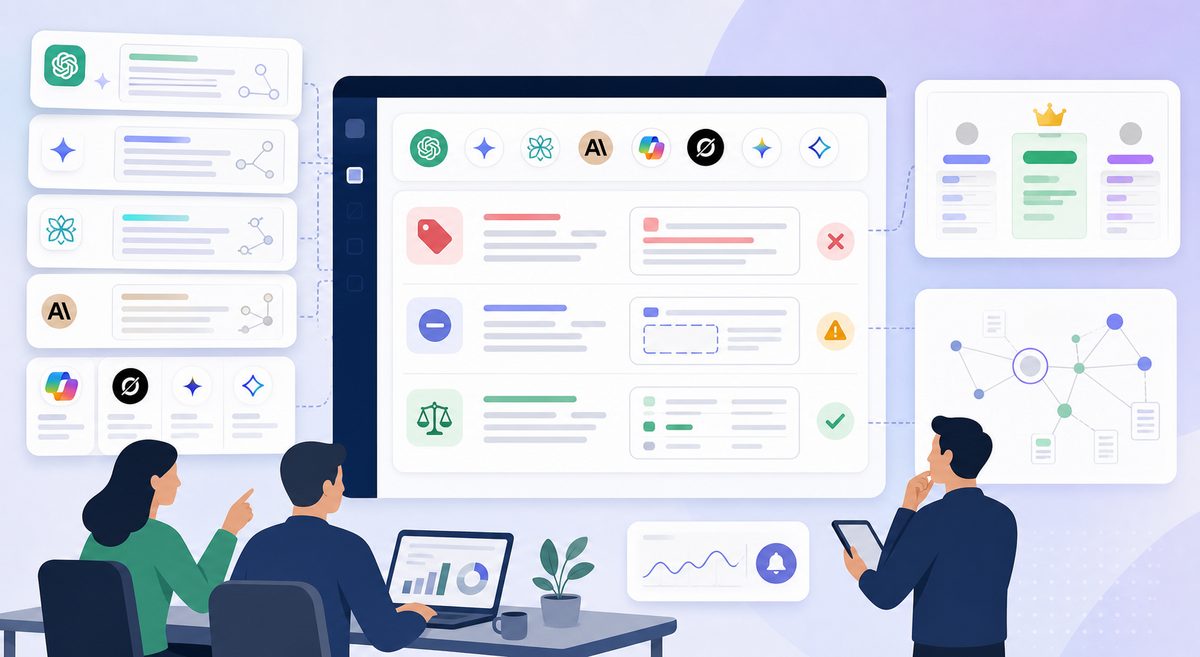
The 15-Point AI Visibility QA Checklist
Use this checklist as the working release gate. A launch is ready when critical prompts are accurate across priority engines, stale citations have owners, and any remaining issues are explicitly accepted as "ship with watch."
- Freeze the Release Fact Map. Approve the exact product, pricing, packaging, feature, audience, and competitor facts that should be true after launch.
- Mark critical facts. Flag facts that can affect revenue, legal risk, sales qualification, customer trust, or competitive displacement.
- Build buyer-risk prompts. Include branded, pricing, category, comparison, alternative, integration, migration, and objection-led prompts.
- Segment by market. Split prompts by country, language, industry, and buyer persona when the launch message differs.
- Choose priority engines. Test the AI surfaces your buyers use, not every model that exists.
- Run a pre-launch baseline. Capture answers before publishing the new message so you know which stale claims already exist.
- Repeat important prompts. Run high-risk prompts more than once because AI answers vary across runs and time.
- Extract factual claims. Pull every claim about your brand into a table: price, plan, feature, use case, audience, competitor, proof, or source.
- Score accuracy. Mark claims as accurate, outdated, unsupported, ambiguous, wrong, omitted, or competitor-biased.
- Score business impact. Classify each issue as critical, high, medium, or low.
- Audit citations. Identify whether the answer cites owned pages, review sites, partner pages, documentation, competitor content, or no visible source.
- Fix owned sources first. Update canonical pages, docs, PDFs, archived posts, schema, internal links, and metadata.
- Prioritize third-party outreach. Contact partners, directories, review sites, affiliates, and comparison publishers that appear in multiple AI answers.
- Retest before launch. Re-run critical prompts after source fixes and record screenshots.
- Monitor after launch. Retest on launch day, 3-7 days later, and 14-30 days later; move unresolved issues into an AI visibility backlog.
What AI Visibility QA Is and Is Not
AI visibility QA is the process of testing whether answer engines mention, rank, describe, compare, and cite your brand accurately before a market-facing change goes live. It combines AI search monitoring, source auditing, prompt testing, content governance, and release decisioning.
It is not a replacement for SEO QA. It sits beside it.
Google's guidance for AI features says the same core SEO best practices remain relevant for AI Overviews and AI Mode, and that supporting links require pages to be indexed and eligible to appear with a snippet in Search. Google also says important content should be available in textual form and structured data should match visible page text in its AI features documentation.
The difference is the QA unit:
| QA type | Primary unit | Main question |
|---|---|---|
| SEO QA | Page | Can Google crawl, index, understand, and display this page? |
| Conversion QA | Journey | Can a user complete the desired action? |
| Analytics QA | Event | Are tracking and attribution working? |
| AI visibility QA | Answer | Does the generated answer give buyers the current truth? |
An AI answer may combine your pricing page, old documentation, a third-party review, a competitor comparison, a cached snippet, a marketplace listing, and a Reddit thread. That is why a correct launch page is necessary but not sufficient.
Why Launch Updates Break AI Answers
Launch updates break AI answers because answer engines synthesize from sources that update at different speeds. Your site may be correct on launch day while review sites, partner pages, old PDFs, help articles, and comparison posts still repeat the previous facts.
There is also measurement instability. The 2026 arXiv paper Don't Measure Once: Measuring Visibility in AI Search argues that AI search visibility should be measured as a distribution because answers can vary across prompts, runs, and time. A single clean answer is weak evidence. A single bad answer is also not enough to diagnose a systemic failure.
Citation behavior adds another problem. In the 2026 study What Gets Cited: Competitive GEO in AI Answer Engines, researchers ran 252,000 trials across six LLMs and found that topical relevance and list position were the strongest drivers of first citation, while explicit price information and recent timestamps helped consistently. For launch teams, the lesson is direct: if old pricing is clearer, easier to quote, or more often cited than new pricing, AI answers may repeat the old fact.
A separate 2026 study, How Large Language Models Source Brand Reputation Across Languages and Markets, analyzed 167,551 URL-grounded citations across 128 brands, 12 home markets, and 13 languages. It found that 85.7% of citations pointed to third-party sources rather than brand-owned sites. This is why AI visibility QA must include citation cleanup, not just new copy on your own website.
The Release Fact Map: The Part Most Teams Skip
A Release Fact Map is the approved source of truth for what answer engines should say after launch. It prevents teams from testing vague prompts without first defining which claims are supposed to pass.
Create the map before running prompts. Keep it short enough for product marketing, SEO, PR, sales, customer support, and legal to approve in one review cycle.
| Fact type | What to document | QA pass condition | Common stale-answer risk |
|---|---|---|---|
| Product name | Current product, module, and plan names | New names appear consistently | Old brand, acquired product, or module name remains |
| Pricing | Current price, pricing model, and caveats | Correct plan language or "contact sales" language appears | Old monthly or per-seat price appears as a firm fact |
| Packaging | Which tier includes which capability | Current tier, limit, and eligibility are clear | Retired plan or old packaging appears |
| Feature status | Available, beta, deprecated, region-limited, or removed | Availability is described with the right caveat | Deprecated feature is treated as live |
| Integrations | Supported systems and setup requirements | Current integration status is accurate | Old marketplace or docs page overstates support |
| ICP | Buyer type, company size, industry, and use case | Updated audience appears in summaries | Old SMB, enterprise, or vertical framing persists |
| Competitors | Approved comparison claims and proof | Comparison uses current strengths and limitations | Old weakness repeats from a stale review |
| Proof | Customer examples, benchmarks, certifications, or release notes | Recent, verifiable proof is cited | Unsupported marketing copy is repeated |
For maxaeo audits, the most useful version of this map includes one extra column: "Where would this fact be wrong today?" That question sends teams to forgotten pages before AI systems do. Start with old pricing pages, PDFs, partner directories, help-center articles, marketplace listings, comparison posts, and launch announcements.
If you suspect the problem starts on your own site, run the cleanup process in Your Own Stale Pages Are Feeding Wrong AI Answers before opening more content briefs.
Choose Prompts by Buyer Risk
Good AI visibility QA prompts mirror the questions buyers, analysts, journalists, and competitors will ask during the launch window. Vanity prompts like "What is our company?" rarely expose pricing, packaging, or positioning drift.
Build prompt coverage from commercial risk.
| Prompt category | Example prompt pattern | What it catches |
|---|---|---|
| Branded factual | "What is [brand] pricing?" | Stale price, plan, and trial information |
| Category shortlist | "Best [category] tools for [buyer type]" | Whether the brand appears in AI shortlists |
| Competitor comparison | "[brand] vs [competitor] for [use case]" | Outdated weaknesses, missing strengths, retired features |
| Alternatives | "Alternatives to [competitor] with [feature]" | Whether the new positioning is connected to active demand |
| Integration | "Does [brand] integrate with [system]?" | Old docs, marketplace errors, partner-page gaps |
| Migration | "How to move from [competitor] to [brand]" | Missing migration proof or incorrect switching claims |
| Pricing objection | "Is [brand] expensive?" | Overstated cost, missing packaging nuance, wrong tiering |
| Compliance objection | "Is [brand] good for regulated teams?" | Unsupported security, privacy, or compliance claims |
| Analyst or journalist | "What changed in [brand]'s product?" | Whether the launch narrative is discoverable |
| Procurement | "What are the limitations of [brand]?" | Unbalanced or stale downside framing |
Do not weigh every prompt equally. A wrong answer on a low-intent informational prompt is a cleanup task. A wrong answer on "pricing," "alternative," "best tool," or "[brand] vs [competitor]" can influence pipeline.
Run Baselines Across Engines, Markets, and Repeated Runs
A reliable baseline checks the same prompt set across the AI surfaces your audience actually uses. For B2B SaaS and technology buyers, that often includes ChatGPT, Perplexity, Gemini, Claude, Copilot, Google AI Mode, AI Overviews, and sometimes Grok.
Use test depth that matches launch risk.
| Launch type | Suggested test depth | Minimum repeat rule |
|---|---|---|
| Minor copy update | 20-30 prompts across 3-4 engines | Repeat only critical prompts |
| Feature launch | 30-50 prompts across 4-6 engines | Repeat feature, integration, and category prompts |
| Pricing or packaging update | 40-70 prompts across 5-8 engines | Repeat all pricing and comparison prompts 2-3 times |
| Rebrand or repositioning | 60-100 prompts with market or language splits | Repeat branded, category, and competitor prompts 3 times |
| Product consolidation or acquisition | 100+ prompts through launch week | Repeat daily for priority engines |
Capture:
- Prompt text.
- Engine and interface.
- Date and time.
- Market, language, and logged-in state if relevant.
- Full answer screenshot.
- Visible citations.
- Mention position.
- Extracted claims.
- Pass/fail status.
- Retest date.
The screenshot matters because AI answers can change. It gives product, sales, legal, and executives the same evidence instead of a summary someone can reinterpret.
Score Answers at Claim Level
AI visibility QA should score claims, not just mentions. A brand mention is not enough if the answer mentions you with the wrong price, wrong audience, wrong feature, or wrong competitor frame.
Use this scoring table.
| Field | Values to use | Why it matters |
|---|---|---|
| Mention status | Mentioned, omitted, competitor-only, hallucinated | Separates visibility from accuracy |
| Mention position | First, top three, lower, cited only, uncited | Shows shortlist impact |
| Claim type | Pricing, plan, feature, integration, ICP, proof, competitor, compliance | Routes the issue to the right owner |
| Claim accuracy | Accurate, outdated, unsupported, ambiguous, wrong | Defines the fix |
| Citation status | Owned, third-party, competitor, no visible citation | Shows where to intervene |
| Business impact | Critical, high, medium, low | Decides whether to block launch |
| Fix owner | Product, SEO, content, PR, partner, legal, revenue ops | Prevents unresolved issues |
Use this severity model.
| Severity | Example | Launch decision |
|---|---|---|
| Critical | Repeated answers show old pricing, false legal/security claims, or a competitor as the better fit for the launch use case | Hold or escalate |
| High | Multiple priority engines repeat a retired feature, wrong ICP, or outdated comparison | Fix before launch or ship with executive acceptance |
| Medium | One engine gives incomplete but not materially wrong positioning | Ship with watch |
| Low | Minor wording drift, weak summary, or missing secondary proof | Add to backlog |
The best AI visibility QA systems make this scoring explicit. Without severity, teams overreact to cosmetic errors and underreact to answer claims that affect revenue.
Audit Citations Before Writing More Content
Citation auditing identifies which pages are shaping the answer. Before creating another blog post, find whether the stale fact comes from your site, a partner directory, a software review site, a news article, a marketplace listing, or a competitor page.
Start with visible citations. Then search exact stale phrases in Google. If an answer repeats "starts at $99 per seat," search that phrase in quotes. The source may be an old pricing page, archived help article, review snippet, PDF, partner listing, or comparison page nobody owns anymore.
Classify sources this way:
| Source class | Examples | First fix |
|---|---|---|
| Owned source | Product pages, pricing pages, docs, help center, blog, PDFs, changelog | Update, redirect, consolidate, or noindex where appropriate |
| Partner source | Integration pages, marketplaces, reseller pages, solution partner pages | Send exact replacement copy and screenshots |
| Earned source | Press, analyst coverage, podcasts, event pages | Request correction or publish a clearer current source |
| Review source | Software directories, comparison pages, affiliate posts | Update profile, request review, provide source-of-truth language |
| Competitor source | Competitor comparison pages or alternative lists | Publish stronger comparison proof and monitor claims |
| Uncited answer | No visible citation | Search repeated phrases, then strengthen canonical owned sources |
For stale third-party pages, prioritize sources that appear in multiple engines or sit near buying intent. The workflow in Outdated AI Citations: How to Find, Prioritize, and Fix Stale Sources is the next step when the wrong answer is citation-led.
Fix the Source Layer in the Right Order
The fastest fixes usually start with owned pages. The most influential fixes may be third-party pages. Prioritize by answer impact, source authority, update difficulty, and likelihood that the page will be cited again.
Use this order during launch week:
- Correct owned canonical pages. Pricing, product, comparison, integration, docs, changelog, and FAQ pages should state the new facts in visible, crawlable text.
- Remove owned contradictions. Update, redirect, consolidate, or deindex old launch posts, PDFs, archived pages, and help articles that repeat retired language.
- Make proof easy to quote. Use current screenshots, plan tables, limitations, customer examples, release notes, and short definitions.
- Update structured data only when visible content matches. Do not use schema to say something the page does not say.
- Refresh internal links. Link current category, product, pricing, and comparison pages to the source of truth.
- Update external profiles. Fix software directories, partner listings, marketplaces, business profiles, and review-site descriptions.
- Contact priority publishers. Send exact replacement text, the current URL, and the launch date.
- Request recrawls where appropriate. For Google surfaces, use Search Console after important owned-page updates.
- Retest the same prompt set. Do not change the test midstream unless the launch facts changed.
If the issue is product evidence, the practical fix is often a better product page rather than a new thought-leadership article. Product Page AEO explains how to turn features, proof, and fit into AI-readable evidence.
Worked Example: Pricing QA
Pricing QA is the highest-risk use case because buyers ask direct questions and answer engines often present prices as facts. A safe pricing update needs prompt coverage, citation cleanup, and clear fallback language when price depends on usage, seats, volume, or contract terms.
Imagine a SaaS company moving from "per-seat pricing starts at $99 per user" to "usage-based pricing with custom enterprise plans." The launch page is accurate, but old review pages and archived comparison posts still say "$99 per user."
A release-ready pricing prompt set should include:
- "How much does [brand] cost?"
- "[brand] pricing for enterprise teams"
- "[brand] vs [competitor] pricing"
- "Best [category] tools with usage-based pricing"
- "Is [brand] expensive?"
- "Does [brand] have a free plan?"
- "Alternatives to [competitor] with flexible pricing"
- "What plan includes [feature] in [brand]?"
- "What changed in [brand] pricing?"
- "Is [brand] priced per seat or by usage?"
A pass does not require every answer to use identical wording. It requires the old "$99 per user" claim to disappear from high-intent prompts or be clearly framed as outdated. If two or more priority engines repeat the old price after owned-page fixes, move the issue to citation outreach and launch monitoring.
Worked Example: Competitor Comparison QA
Competitor comparison QA matters when the launch changes who you compete against or which use case you want to win. AI answers can keep old category memory alive even after your website changes.
For example, a product repositioning from "lightweight team tool" to "enterprise AI governance platform" can fail if answer engines keep comparing it against low-end project management tools. The brand may be visible, but the shortlist is wrong.
Use this comparison test set:
- "[brand] vs [competitor] for enterprise teams"
- "Best [category] tools for regulated companies"
- "Is [brand] better than [competitor] for [use case]?"
- "What are [brand]'s main limitations?"
- "Which [category] tools support [must-have feature]?"
- "Alternatives to [competitor] for [ICP]"
- "Should I choose [brand] or [competitor]?"
- "What companies use [brand]?"
Pass conditions should include both accuracy and fit. A comparison answer can be factually accurate but commercially harmful if it frames the brand in the wrong category. If AI systems recommend competitors because your strongest proof is missing or buried, use the diagnosis process in AI Recommends Competitors: Why It Happens and How to Win Back AI Shortlists.
What an AI Visibility Tool Should Automate
For commercial teams, the checklist should not live forever in a manual spreadsheet. An AI visibility tool should automate the repetitive evidence collection while leaving factual approval and launch decisions to humans.
Evaluate tools against these requirements:
| Requirement | Why it matters for QA |
|---|---|
| Prompt set management | Keeps launch prompts consistent before and after release |
| Multi-engine tracking | Shows whether problems are isolated or widespread |
| Repeat runs | Reduces false confidence from one answer |
| Screenshot capture | Preserves evidence for stakeholders |
| Citation extraction | Identifies source-layer fixes |
| Claim classification | Separates mention visibility from factual accuracy |
| Competitor tracking | Shows whether the launch changes shortlist behavior |
| Market and language segmentation | Prevents one-market testing from hiding local source risk |
| Workflow fields | Assigns owner, severity, fix action, and retest date |
| Data-quality controls | Makes dashboard metrics auditable |
Do not buy an AI visibility platform only for charts. For launch QA, the useful question is: can the tool prove which answer changed, which source influenced it, who owns the fix, and whether the retest passed?
Before trusting any dashboard, use AI Visibility Data Quality Checklist: Before You Trust a Dashboard to check prompt sampling, engine coverage, repeatability, citation capture, and metric definitions.
AI Visibility QA Governance
AI answer governance assigns responsibility for approving facts, fixing sources, escalating risks, and retesting answers. Without owners, AI reputation management becomes a shared concern that nobody resolves.
Use this ownership model.
| Workstream | Primary owner | Approver |
|---|---|---|
| Product and feature facts | Product marketing | Product lead |
| Pricing and packaging | Revenue operations or pricing lead | Finance or GTM leadership |
| Positioning and claims | Brand or communications | Marketing leadership |
| Competitive comparisons | SEO or product marketing | Legal and sales leadership |
| Source updates | SEO, content, partner marketing | Channel owner |
| AI search monitoring | SEO, analytics, growth, or maxaeo workspace owner | Marketing operations |
| Escalation | Communications or brand | Executive sponsor |
The governance rule is simple: every critical wrong answer needs one owner, one fix action, and one retest date. If any of those are missing, the issue is not under control.
Launch Timeline for AI Visibility QA
AI visibility QA works best when it starts before the public announcement. The goal is to fix source conflicts before answer engines and buyers encounter the new message.
| Timing | Action |
|---|---|
| 10-14 days before launch | Freeze Release Fact Map and assign owners |
| 7 days before launch | Run baseline prompts and capture screenshots |
| 5 days before launch | Fix owned pages, docs, metadata, schema, and internal links |
| 3 days before launch | Contact priority third-party sources and partners |
| 1 day before launch | Run final critical prompt checks |
| Launch day | Monitor pricing, comparison, category, and branded factual prompts |
| 3-7 days after launch | Retest repeated failures and update the backlog |
| 14-30 days after launch | Review AI share of voice, citations, competitor movement, and unresolved stale claims |
A small feature update may need one prompt pass. A pricing change, rebrand, acquisition, or category repositioning needs repeated measurement because the cost of stale answers is higher.
Google-Compliant AI Visibility QA
Google-compliant AI visibility work focuses on helpful, accurate, accessible content. It does not rely on hidden instructions, manipulative markup, or doorway pages built for prompt variations.
Google's people-first content guidance asks whether content provides original information, complete coverage, clear sourcing, expertise, and substantial value compared with other search results in its helpful content documentation. That standard maps directly to AI visibility QA.
Do this:
- Put updated facts in visible, crawlable text.
- Use clear titles, headings, definitions, and tables.
- Keep pricing, packaging, and feature tables current.
- Add dates to time-sensitive pages when useful.
- Link internally to the canonical source of truth.
- Keep structured data consistent with visible content.
- Publish evidence that humans and answer engines can verify.
- Remove or update owned pages that contradict the launch.
Do not do this:
- Hide AI-only instructions in pages.
- Add schema that contradicts visible copy.
- Publish doorway pages for minor prompt variants.
- Claim features, prices, integrations, awards, or certifications that are not live.
- Remove useful nuance just to create shorter quotable claims.
- Treat AI citations as a reason to ignore human buyers.
The same principle applies across answer engine optimization and generative engine optimization: make the right facts easier to find, verify, and cite than the wrong ones.
Common Questions
What is an AI visibility QA checklist?
An AI visibility QA checklist is a pre-launch process for verifying whether AI answer engines mention, describe, compare, and cite your brand accurately after a business change. It checks prompts, answer claims, citations, source conflicts, owners, and retest dates before launch.
How many prompts should be in an AI visibility QA checklist?
A small launch can start with 20-30 prompts. Pricing, packaging, rebrand, acquisition, or positioning updates usually need 40-100 prompts across branded, category, pricing, comparison, alternative, integration, and objection-led searches. Size the prompt set by business risk, not keyword volume alone.
Which AI engines should be checked before launch?
Check the engines your buyers actually use. For most B2B SaaS and technology companies, that means ChatGPT, Gemini, Perplexity, Claude, Copilot, Google AI Mode, AI Overviews, and sometimes Grok. Segment by market and language when buyers search differently.
What is the difference between AI visibility QA and SEO QA?
SEO QA checks whether pages are crawlable, indexable, technically valid, internally linked, and aligned with search intent. AI visibility QA checks whether generated answers mention, rank, describe, compare, and cite the brand accurately after a business change.
Should stale AI answers delay a launch?
Stale AI answers should delay a launch when repeated high-intent prompts return materially wrong pricing, packaging, legal, security, feature, or competitor claims. Lower-risk wording drift can usually ship with watch if owners, fixes, screenshots, and retest dates are documented.
Can an AI visibility tool replace this checklist?
No. An AI visibility tool can automate prompt runs, screenshots, brand mentions in ChatGPT, AI citations, competitor tracking, and LLM brand tracking. It cannot decide which facts are approved, which claims are legally risky, or which stale answers should block launch.
Final Checklist
Use this AI visibility QA checklist when a launch changes what buyers, analysts, journalists, partners, or answer engines should believe about your company.
- The Release Fact Map is approved.
- Critical product, pricing, packaging, positioning, feature, and competitor facts are frozen.
- Prompt coverage includes branded, category, comparison, pricing, integration, migration, alternative, and objection queries.
- Priority engines, markets, and languages are defined.
- Important prompts are repeated, not measured once.
- Every critical answer has a screenshot.
- Claims are classified as accurate, outdated, unsupported, ambiguous, wrong, omitted, or competitor-biased.
- Business impact is scored as critical, high, medium, or low.
- Citations are audited by source type.
- Owned stale pages are updated, redirected, consolidated, or removed.
- Third-party stale sources are prioritized for outreach.
- Structured data matches visible page content.
- Internal links point to the updated source of truth.
- Launch blockers have named owners.
- Post-launch retest dates are scheduled.
A launch is not fully ready when the website is correct. It is ready when the most influential AI answers are unlikely to send buyers back to the old story.