An AI visibility platform comparison should answer one buying question: which tool gives your team repeatable proof of where AI engines mention, rank, cite, and describe your brand, and which tool helps you turn that evidence into fixes.
The short answer: Profound is strongest for enterprise analytics and governance. Peec is strongest for clean self-serve AI search analytics and reporting. Otterly is strongest for content intelligence, GEO audits, and agency-friendly workflows. MaxAEO is strongest for teams that want daily multi-engine monitoring, citation tracing, competitor benchmarking, and practical optimization without an enterprise rollout.
Because MaxAEO is one of the products compared here, this guide separates public vendor claims from buyer recommendations. The comparison is based on official product and pricing pages reviewed on July 9, 2026, plus a buyer scorecard for how AI search monitoring actually gets used after purchase.
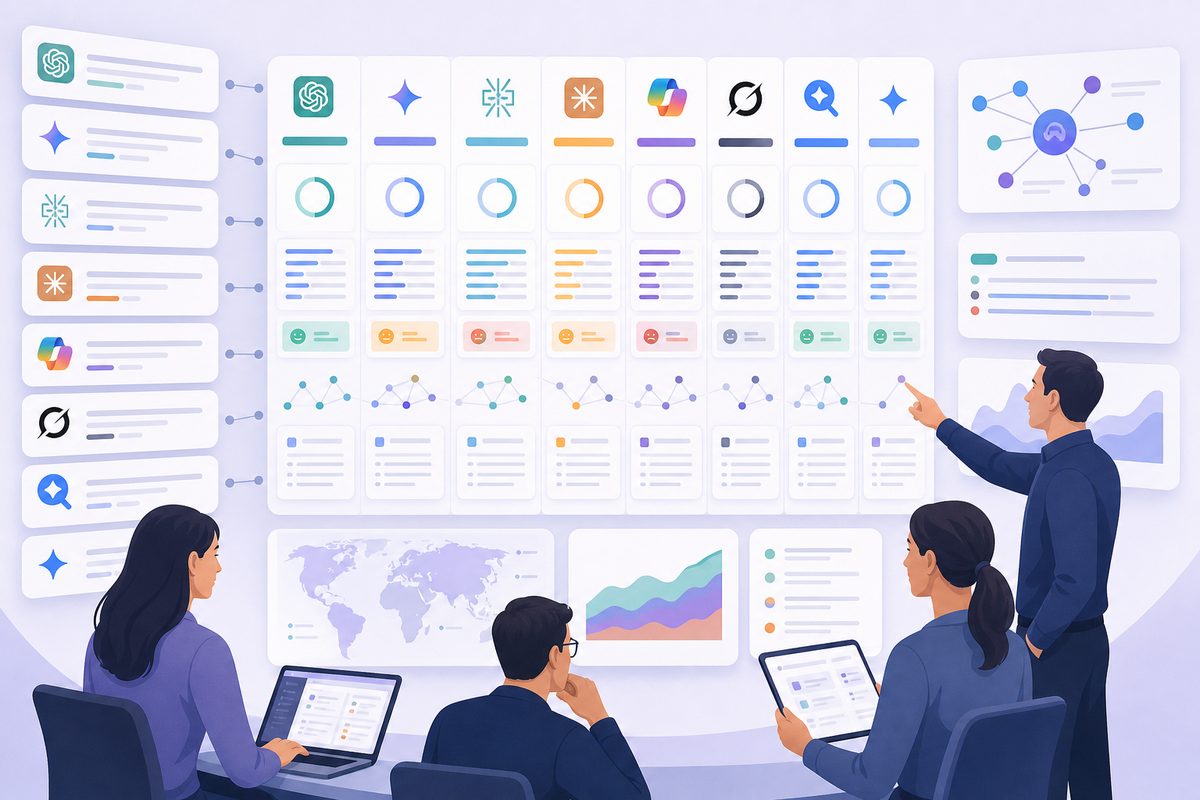
Quick Answer: Which AI Visibility Platform Should You Choose?
Choose the platform that matches your operating model. AI visibility programs fail when the tool only shows mentions but cannot explain citations, when prompts are too few to defend trends, or when reporting is disconnected from optimization.
| Buyer need | Best fit | Why it fits |
|---|---|---|
| Enterprise answer-engine analytics, security review, browser-level capture, and cross-functional workflows | Profound | Public pages emphasize Answer Engine Insights, Prompt Volumes, Agents, browser-based capture, SOC 2 Type II, SSO, regions, languages, and enterprise-scale monitoring. |
| Self-serve AI search analytics with clean dashboards and reporting | Peec | Focuses on visibility, position, sentiment, prompt setup, source analysis, model selection, Looker Studio, API, and project-based reporting. |
| Content-led GEO audits, recommendations, exports, and agency workspaces | Otterly | Combines prompt research, AI search analytics, content audit, GEO recommendations, domain citation tracking, CSV exports, API, MCP, and workspaces. |
| Daily AI search monitoring with citation tracing and optimization actions | MaxAEO | Built around daily brand monitoring, competitor benchmarking, sentiment analysis, citation tracing, prompt research, and content optimization across major AI entry points. |
If your team is still choosing a budget model, read the MaxAEO guide to AI search monitoring pricing. If citations are your main concern, use the scorecard in AI visibility tools with citation tracking.
What Is an AI Visibility Platform?
An AI visibility platform tracks how AI engines mention, rank, cite, and describe a brand across prompts. It measures answer visibility, brand mentions, source citations, sentiment, competitor presence, prompt performance, and source patterns across systems such as ChatGPT, Gemini, Perplexity, Copilot, Claude, Google AI Mode, and AI Overviews.
That makes it different from traditional SEO software. SEO tools usually measure pages, rankings, backlinks, and traffic. AI visibility platforms measure generated answers, entity representation, recommendation position, and the sources AI systems use to justify those answers.
Why AI Visibility Comparisons Are Harder Than SEO Tool Comparisons
AI visibility is not a static SERP. Generated answers can vary by prompt wording, model, country, account state, retrieval behavior, and time. A single screenshot is weak evidence.
The 2026 paper “Don't Measure Once: Measuring Visibility in AI Search (GEO)” argues that AI search visibility should be measured as a distribution rather than a single observation because answers vary across runs, prompts, and time.
A second 2026 study, “How Generative AI Disrupts Search,” introduced an 11,500-query benchmark and found that Google AI Overviews, Google Search, and Gemini returned substantially different source sets. The paper reports AI Overviews for 51.5% of representative real-user queries and average source-set Jaccard similarity below 0.2 across systems.
The implication for buyers is clear: a useful AI visibility platform must support repeated measurement, not one-off checks. The tool should help you answer:
- How often is our brand mentioned for revenue-relevant prompts?
- Where do we rank when AI systems recommend vendors?
- Which competitors are recommended instead?
- Which sources are cited when AI answers the question?
- Are those sources our pages, third-party pages, review sites, communities, or media?
- Is the answer accurate, favorable, neutral, or risky?
- Which action should we take next?
Methodology: How This Comparison Was Scored
This comparison uses seven buyer criteria and 28 capability checks. Public product pages, pricing pages, feature pages, and documentation were reviewed on July 9, 2026. Private dashboards, custom enterprise contracts, unpublished roadmap claims, and sales-only claims were not scored.
| Criterion | Weight | What was checked |
|---|---|---|
| Engine and surface coverage | 20% | Which AI engines, AI search surfaces, and answer experiences are publicly supported. |
| Prompt scale and governance | 15% | Prompt limits, tagging, custom prompts, frequency, countries, languages, and model selection. |
| Citation and source tracing | 15% | Whether the platform separates mentions, cited domains, cited URLs, source influence, and answer context. |
| Competitive benchmarking | 10% | Visibility, position, sentiment, share of voice, competitor comparison, and trend reporting. |
| Optimization workflow | 15% | Whether the platform recommends specific content, PR, review, source, or entity fixes after monitoring. |
| Reporting and integrations | 10% | CSV, JSON, API, MCP, Looker Studio, exports, dashboards, and stakeholder reporting. |
| Buyer accessibility | 15% | Pricing clarity, self-serve setup, setup speed, support level, and fit for startups, agencies, brands, and enterprises. |
This scorecard focuses on the operating loop that matters after purchase: monitor, diagnose, prioritize, fix, and prove movement. That framework also aligns with Google’s guidance on helpful content: strong comparison pages should provide original information, substantial value beyond other results, and clear sourcing, not just rewritten feature lists. Google explains those principles in its documentation on creating helpful, reliable, people-first content.
Feature Comparison: Profound vs Peec vs Otterly vs MaxAEO
A practical AI visibility platform comparison should start with features buyers can verify. The main split is between enterprise breadth, self-serve analytics, content optimization depth, and daily monitoring-to-action workflows.
| Platform | Publicly visible strengths | Publicly visible tradeoffs |
|---|---|---|
| Profound | Deep answer-engine analytics, browser-level capture, daily visibility runs, Prompt Volumes, Agents, citation authority, competitive benchmarking, regions, languages, and enterprise security. | Best fit may be larger teams. Public pricing shows self-serve Starter and Growth tiers before enterprise coverage expands. |
| Peec | Clear AI search analytics for visibility, position, sentiment, prompts, sources, models, countries, recommendations, Looker Studio, API, and MCP. | Public plans include selected model limits before enterprise expansion; buyers should confirm required model and country coverage. |
| Otterly | Strong content intelligence workflow: prompt research, monitoring, content audit, GEO recommendations, domain citation tracking, exports, API, MCP, workspaces, and agency packaging. | Pricing pages list four standard tracked engines on core plans, with Claude, Gemini, and Google AI Mode shown as add-ons. |
| MaxAEO | Daily monitoring, mention-rate analysis, competitor benchmarking, sentiment analysis, citation tracing, prompt research, content optimization, self-serve plans, and broad AI platform coverage. | Best for teams prioritizing AI visibility monitoring and optimization; buyers needing complex enterprise procurement should validate account support requirements. |
For head-to-head evaluation, compare the dedicated guides to MaxAEO vs Peec AI and MaxAEO vs Profound.
Detailed Platform Matrix
| Criterion | Profound | Peec | Otterly | MaxAEO |
|---|---|---|---|---|
| Best-fit buyer | Enterprise AEO, brand, content, PR, and analytics teams | Marketing and SEO teams that want self-serve analytics | Content teams and agencies building GEO workflows | Lean SEO, growth, brand, and AEO teams that need daily monitoring plus action |
| Public engine coverage | Broad enterprise list including ChatGPT, Perplexity, Claude, Copilot, AI Overviews, AI Mode, Gemini, Grok, Amazon Rufus, Meta AI, and DeepSeek | ChatGPT, AI Mode, AI Overviews, Copilot, Perplexity, Gemini; enterprise options add more models | Core pricing lists ChatGPT, AI Overviews, Perplexity, and Copilot; add-ons list Claude, AI Mode, and Gemini | FAQ lists ChatGPT, Gemini, Perplexity, Claude, Copilot, Grok, Google AI Mode, and Google AI Overview |
| Prompt scale | Starter 50 prompts, Growth 100 prompts, enterprise custom | Starter 50, Pro 150, Advanced 350, enterprise custom | Lite 15, Standard 100, Premium 400; extra prompt add-ons | Starter 10, Growth 100, Pro 400, Enterprise unlimited |
| Frequency | Daily | Daily on public self-serve tiers; enterprise can be daily or weekly | Daily on public plans | Daily on public plans |
| Citation tracking | Citation authority and influential websites | Sources and cited domains used in recommendations | Domain citation tracking and link citation analysis | Citation tracing for media, pages, articles, and source gaps |
| Optimization workflow | Agents and content optimization tied to prompt and citation gaps | Recommendations based on sources and opportunities | Content audit, recommendations, GEO briefs, crawlability, and optimization | Prompt research, citation tracing, sentiment, competitor gaps, and content optimization |
| Reporting and integrations | CSV/JSON exports, enterprise integrations, security controls | Looker Studio on Advanced, API and SSO on Enterprise, MCP listed | CSV exports, Looker Studio connector, API, MCP, workspaces | Dashboards, reports, prompt-level monitoring, and optimization workflow; validate custom API needs |
| Pricing posture | Higher enterprise ceiling with self-serve entry plans | Self-serve prompt tiers plus enterprise | Transparent monthly tiers with add-ons | Transparent self-serve pricing with daily monitoring in every plan |
Engine Coverage: Count Surfaces, Not Just Logos
The best AI visibility platform is not the one with the longest logo row. It is the one that covers the surfaces where your buyers actually ask decision questions.
For B2B SaaS, that usually means ChatGPT, Perplexity, Gemini, Google AI Mode, Google AI Overviews, Copilot, and Claude. For ecommerce, buyer journeys may also include shopping cards, product recommendations, AI ad surfaces, and marketplaces. For global brands, region and language coverage can matter as much as model coverage.
Profound has the broadest publicly stated enterprise coverage among the four. Its Answer Engine Insights FAQ says it queries front-end experiences such as ChatGPT, Perplexity, Claude, Microsoft Copilot, Google AI Overviews, Google AI Mode, Gemini, Grok, Amazon Rufus, Meta AI, and DeepSeek.
Peec publicly lists major search and answer systems, including ChatGPT, AI Mode, AI Overviews, Microsoft Copilot, Perplexity, and Gemini, with enterprise additions such as Claude Sonnet 4, GPT-5 Search, DeepSeek, Qwen, and Mistral API options.
Otterly’s pricing page lists ChatGPT, Google AI Overviews, Perplexity, and Microsoft Copilot on core plans, with Claude, Google AI Mode, and Gemini as add-ons. Its features page also emphasizes prompt research, content audit, recommendations, MCP, API, and workspace management.
MaxAEO’s FAQ lists eight major AI platforms: ChatGPT, Gemini, Perplexity, Claude, Copilot, Grok, Google AI Mode, and Google AI Overview. Its strongest fit is practical daily monitoring across common AI entry points, especially for teams that need visibility trends, competitor rankings, citations, and optimization actions in one workflow.
Prompt Scale and Frequency: The Hidden Cost Driver
Prompt scale is the real pricing unit in AI search monitoring. One prompt becomes many observations once you multiply it by engines, countries, languages, competitors, and frequency.
Use this formula before comparing vendors:
| Input | Example |
|---|---|
| Prompts | 100 |
| Engines | 6 |
| Countries | 2 |
| Languages | 1 |
| Frequency | Daily |
| Monthly answer observations | 100 x 6 x 2 x 30 = 36,000 |
A low monthly subscription can become expensive if important engines are add-ons, if extra prompts are priced separately, if each country multiplies the plan, or if raw answer history is retained for only a short window.
A defensible pilot should include four prompt groups:
- Branded prompts: “What is [brand] best for?”
- Category prompts: “Best AI visibility platform for B2B SaaS.”
- Competitor prompts: “[Brand] alternatives” or “[Brand] vs [Competitor].”
- Decision prompts: “Which platform should a growth team use for AI search monitoring?”
Do not measure each prompt once. Track the same prompt set repeatedly, group results by intent, and only call a trend meaningful when movement appears across several runs. For cadence planning, use the MaxAEO guide to AI search monitoring frequency.
Citation Tracking: Mentions Are Not Enough
Citation tracking is the difference between “AI named us” and “AI trusted evidence about us.” Strong tools separate brand mentions, domain citations, URL citations, answer context, source frequency, and whether the cited source supports or weakens your positioning.
A useful citation workflow should diagnose five different gaps:
| Gap | What it means | Likely fix |
|---|---|---|
| Mention without citation | AI knows the brand but is not using your evidence | Add clearer proof, comparison pages, data, case studies, and crawlable source material. |
| Citation without mention | AI trusts your page but does not connect it strongly to your brand | Improve entity clarity, author/source attribution, organization schema, and brand positioning on the cited page. |
| Competitor citation gap | AI cites competitors or their third-party proof more often | Build or earn stronger category pages, partner pages, reviews, analyst mentions, or editorial references. |
| Stale-source gap | AI repeats outdated descriptions or old product facts | Update canonical pages, comparison pages, docs, pricing context, and external profiles. |
| Third-party narrative gap | AI relies on review sites, forums, Reddit, media, or directories to describe the category | Improve profiles, collect reviews, support community answers, and pursue digital PR where AI already cites sources. |
Profound publicly emphasizes citation authority and websites that influence AI-generated answers. Peec shows source discovery and recommendations tied to cited review sites, LinkedIn, Reddit, and editorial domains. Otterly includes domain citation tracking, link position changes, link citation analysis, and content recommendations. MaxAEO emphasizes citation tracing: which media, pages, and articles are cited most by AI, then which content channels to target.
The buyer test is simple: the platform should not merely say “you were cited.” It should show which source influenced the answer, which competitor benefited, and what asset should be fixed next.
Optimization Workflow: The Best Platform Shows What To Fix Next
Monitoring creates dashboards. Optimization creates budget justification. A strong AI visibility platform should identify missing prompts, weak entity signals, inaccurate descriptions, source gaps, negative sentiment, and content that needs clearer evidence.
Use this workflow when comparing vendors:
| Monitoring signal | Diagnostic question | Optimization action |
|---|---|---|
| Low mention rate on category prompts | Does AI know the brand belongs in the category? | Create or improve category pages, product positioning, comparison pages, and external profiles. |
| Competitors rank above you | Which proof does AI cite when recommending them? | Build stronger evidence pages, earn review-site visibility, and address missing differentiators. |
| Mentions are present but sentiment is weak | What caveats does AI repeat? | Fix outdated claims, publish clearer product facts, and correct third-party profiles. |
| Your domain is not cited | Are your pages crawlable, quotable, and specific? | Improve page structure, add concise evidence blocks, use schema, and make facts easy to extract. |
| Third-party sources dominate | Which sites shape the answer? | Prioritize PR, partner content, review collection, community participation, and directory accuracy. |
| Results vary widely | Is the prompt set too small or too broad? | Segment prompts by intent, persona, and funnel stage; monitor daily before deciding. |
Profound connects Answer Engine Insights with Agents and content optimization. Peec surfaces recommendations from sources commonly cited by AI systems. Otterly has one of the stronger public content-intelligence stories, with crawlability checks, content audit, content briefs, and GEO recommendations. MaxAEO combines daily monitoring, citation tracing, sentiment, prompt research, competitor benchmarking, and content optimization for teams that want a shorter path from issue to action.
Pricing Snapshot: Compare Prompt-Runs, Not Sticker Price
Pricing changes often, so verify vendor pages before signing. The real comparison is not plan name; it is how many monitored answer observations you get for the engines, markets, and competitors you need.
| Platform | Public pricing and packaging signals reviewed July 9, 2026 | What buyers should verify |
|---|---|---|
| Profound | Pricing page lists Starter at $99/month billed yearly with ChatGPT tracking and 50 prompts; Growth at $399/month billed yearly with 3 answer engines and 100 prompts; Enterprise is custom with up to 10 answer engines. | Which engines are included on the plan, prompt frequency, browser capture requirements, regions, languages, exports, and enterprise support. |
| Peec | Pricing page lists Starter 50 prompts, Pro 150, Advanced 350, each with 3 selected models and daily tracking; Advanced includes multi-country and Looker Studio; Enterprise adds custom prompts, all models, API, and SSO. | Actual monthly price at checkout, model add-ons, country limits, API access, MCP access, and whether weekly tracking is acceptable for enterprise use cases. |
| Otterly | Pricing page lists Lite at $29/month with 15 prompts, Standard at $189/month with 100 prompts, Premium at $489/month with 400 prompts, daily frequency, and extra 100-prompt add-ons at $99. | Add-on cost for Claude, Gemini, and AI Mode; agency workspaces; API usage; export needs; client reporting requirements. |
| MaxAEO | Homepage lists Starter at $19/month, Growth at $149/month, Pro at $399/month, with annual discounts shown; all plans include daily monitoring and full 9-dimension analytics, with prompt and retention limits by tier. | Required platform count, data retention, number of competitors, number of brands, enterprise support needs, and custom reporting needs. |
Ask every vendor these five questions:
- Are all required engines included, or are some add-ons?
- Do countries, languages, and competitors multiply cost?
- How many raw answers and cited URLs can we export?
- How long is prompt-level answer history retained?
- Can the platform prove movement by prompt group, not just by aggregate score?
Buyer Fit: Enterprise, Agency, Startup, or Brand Team
The right AI visibility platform depends on who will use it every week.
| Buyer scenario | Recommended shortlist | Decision note |
|---|---|---|
| Global enterprise brand with procurement, SSO, security review, and many stakeholders | Profound, MaxAEO | Profound for enterprise depth and governance; MaxAEO if daily monitoring and optimization speed matter more than enterprise process. |
| B2B SaaS SEO team starting GEO or AEO | MaxAEO, Peec, Otterly | MaxAEO for daily multi-engine workflow; Peec for clean analytics; Otterly for content audit depth. |
| Digital agency managing multiple clients | Otterly, Peec, MaxAEO | Otterly and Peec have strong public agency/reporting signals; MaxAEO fits agencies focused on reputation, citation gaps, and action plans. |
| Startup growth team competing for AI shortlists | MaxAEO, Peec | Prioritize setup speed, daily prompts, competitor ranking, and purchase-intent prompt groups. |
| PR or brand team worried about inaccurate AI descriptions | MaxAEO, Profound | Prioritize sentiment, answer excerpts, negative claims, source tracing, and issue alerts. |
| Content team focused on citation gaps | Otterly, MaxAEO, Profound | Prioritize content audits, source gaps, proof assets, and the ability to track whether updates change citations. |
A useful shortcut: if the first internal question is “How do we govern AI visibility across the enterprise?” start with Profound. If it is “How do we show clean AI search analytics to stakeholders?” start with Peec. If it is “Which content and sources do we fix?” start with Otterly and MaxAEO. If it is “How do we get recommended more often across AI engines without a long rollout?” put MaxAEO on the shortlist.
30-Day Pilot: How To Compare AI Visibility Platforms Fairly
A 30-day pilot should prove whether the platform changes decisions, not whether the dashboard looks impressive.
Use the same prompt set, competitors, markets, and success metrics across every platform you test.
Days 1-3: Build The Baseline
- Select 40 to 100 prompts.
- Split prompts into branded, category, competitor, and purchase-intent groups.
- Choose at least four AI surfaces, such as ChatGPT, Perplexity, Gemini or AI Mode, and Copilot or Claude.
- Track your brand plus five competitors.
- Record mention rate, first mention position, sentiment, cited domains, cited URLs, and answer excerpts.
Days 4-7: Diagnose Source Gaps
- Identify prompts where competitors appear and your brand is absent.
- List the domains and URLs cited for those answers.
- Separate owned sources, review sources, media sources, communities, directories, and partner pages.
- Flag inaccurate descriptions and repeated caveats.
- Prioritize the five gaps most connected to revenue intent.
Days 8-14: Ship Fixes
Publish or update three evidence assets:
- One comparison or alternatives page.
- One category guide with direct answer blocks and proof.
- One third-party proof asset, such as a review profile, partner page, contributed article, or directory update.
Use concise, extractable facts. AI systems need clear entity signals, not buried marketing copy.
Days 15-30: Prove Movement
- Re-run the same prompt set daily.
- Compare movement by prompt group, not one answer.
- Track mention rate, position, citation share, and sentiment.
- Mark a win only when movement appears across several runs or surfaces.
- Export raw examples for stakeholders, including answer excerpts and cited URLs.
A good platform should make this pilot easy. If you need spreadsheets, screenshots, and manual copy-paste to explain the result, the tool may not scale.
The Scorecard: Best Platform By Use Case
No single platform is the universal winner. The best choice depends on the job to be done.
| Use case | Best platform fit | Why |
|---|---|---|
| Enterprise AEO analytics | Profound | Strong public positioning around browser capture, daily visibility runs, broad enterprise coverage, security, and agentic workflows. |
| Self-serve AI search analytics | Peec | Clean analytics around visibility, position, sentiment, prompts, sources, models, projects, and reporting. |
| Content intelligence and GEO audits | Otterly | Strong workflow from prompt research to monitoring, crawlability, content audit, recommendations, exports, API, and MCP. |
| Daily AI visibility monitoring and optimization | MaxAEO | Designed for daily monitoring, citation tracing, competitor benchmarking, sentiment, prompt research, and practical content optimization. |
| Budget-conscious startup pilot | MaxAEO, Otterly, Peec | Compare prompt count, included engines, add-ons, and whether daily data is available at the required tier. |
| PR and reputation monitoring in AI answers | MaxAEO, Profound | Prioritize sentiment, inaccurate claims, source influence, answer history, and alerts. |
The practical conclusion: Profound is the enterprise analytics pick, Peec is the clean self-serve analytics pick, Otterly is the content intelligence and agency pick, and MaxAEO is the daily AI search monitoring and optimization pick.
Common Questions
What is an AI visibility platform?
An AI visibility platform is software that tracks how AI engines mention, rank, cite, and describe a brand across prompts. It measures answer visibility, brand mentions, citations, sentiment, competitor presence, source patterns, and prompt-level performance across tools such as ChatGPT, Gemini, Perplexity, Copilot, Claude, and Google AI Overviews.
How is AI visibility different from traditional SEO ranking?
Traditional SEO tracks pages in search results. AI visibility tracks how generated answers represent entities, sources, and recommendations. A page can rank well in Google but still be absent from an AI answer, while a cited third-party source can shape the answer without sending a click.
Which AI visibility platform is best for brand mentions in ChatGPT?
For brand mentions in ChatGPT, shortlist tools that run prompts repeatedly, store answer history, compare competitors, and separate mention rate from citations. Profound, Peec, Otterly, and MaxAEO can all support this use case, but MaxAEO is especially aligned with daily multi-engine brand monitoring and AI reputation workflows.
Do AI citations matter more than AI share of voice?
Both matter. AI share of voice shows how often a brand appears relative to competitors. AI citations show which sources engines trust when forming the answer. A brand with high mentions but weak citations may be visible but vulnerable; a brand with strong citations but weak mentions needs entity and positioning work.
How many prompts should a team track?
A small pilot can start with 40 to 100 prompts if they are grouped by intent and tracked daily. Mature programs usually need more prompts because every model, country, language, persona, and product category multiplies the sample size. The goal is repeatable trend data, not a one-time screenshot.
Can AI visibility platforms improve rankings, or do they only monitor?
The platform itself does not magically improve AI recommendations. It improves decisions by showing which prompts, competitors, citations, and source gaps matter. The ranking improvement comes from acting on that evidence: publishing clearer proof, improving entity signals, earning third-party citations, fixing inaccurate profiles, and monitoring whether answers change.