
An AI visibility audit shows whether AI answer engines mention, cite, recommend, and accurately describe your brand when buyers ask commercial questions. The real value is not the screenshot. It is the decision trail: which prompts matter, why competitors appear, what sources shape the answer, and which fixes should ship first.
A weak audit produces a spreadsheet of brand mentions in ChatGPT, Gemini, Perplexity, Claude, Copilot, Grok, Google AI Overviews, or AI Mode. A useful audit tells a marketing team:
- Which buyer prompts influence vendor discovery, comparison, validation, and procurement.
- Which competitors are repeatedly recommended instead.
- Which sources are being cited, ignored, or misread.
- Which answer claims are inaccurate, outdated, or commercially damaging.
- Which content, citation, entity, or technical fixes have the clearest path to improvement.
This guide is for B2B SaaS teams, agencies, and growth leaders evaluating an AI visibility audit, buying an AI visibility tool, or turning audit results into a practical answer engine optimization roadmap.
What Is an AI Visibility Audit?
An AI visibility audit is a structured review of how AI answer engines mention, rank, cite, compare, and describe a brand across real buyer questions. It measures brand presence, competitor recommendations, source citations, answer sentiment, factual accuracy, and the content or reputation gaps preventing the brand from being recommended.
A complete audit does not stop at "visible" or "invisible." It captures the full answer environment:
| Audit area | What it answers | Why it matters |
|---|---|---|
| Prompt set | Which buyer questions were tested? | Bad prompts create false visibility data. |
| Engine coverage | Which AI systems were tested? | ChatGPT, Gemini, Perplexity, Claude, Copilot, Grok, and Google AI features can behave differently. |
| Brand presence | Was the brand absent, mentioned, cited, compared, or recommended? | Mentions and recommendations are not the same metric. |
| Competitor presence | Which competitors appear, and in what position? | AI answers often create shortlists before a buyer reaches your site. |
| Citation sources | Which URLs or source types support the answer? | Citation gaps show what evidence AI systems can retrieve. |
| Sentiment and accuracy | Is the answer favorable, neutral, outdated, or wrong? | A neutral mention can still hurt if it omits a key differentiator. |
| Fix path | What should be changed, where, and by whom? | Without a fix path, the audit is reporting, not strategy. |
Google's own guidance for generative AI features says foundational SEO still matters because these experiences rely on Search systems, retrieval, and page quality signals. Google also warns against special "AI hacks" such as relying on llms.txt, artificial mentions, or overfocusing on special markup for generative AI search. See Google Search Central's guide to optimizing for generative AI features.
Why AI Visibility Audits Matter for Commercial Search
Commercial AI search is different from traditional ranking analysis because the buyer may never see a list of ten links. They may ask for "best tools," "Vendor A vs Vendor B," "alternatives to X," or "which platform is best for enterprise teams," then treat the generated answer as a shortlist.
Pew Research Center analyzed 68,879 Google searches from March 2025 and found that 18% produced an AI summary. When users saw an AI summary, they clicked a traditional result in 8% of visits, compared with 15% when no AI summary appeared. They clicked a link inside the AI summary in only 1% of visits. The same analysis found longer and question-style searches were more likely to trigger AI summaries. See Pew Research Center's analysis of Google AI summaries.
The commercial implication is direct: the answer itself is now part of the buyer journey. An AI visibility audit should show whether your brand is present in that answer, whether the answer uses the right evidence, and whether the recommendation helps or weakens your sales motion.
What Should an AI Visibility Audit Include?
A serious audit should deliver evidence, not just a score. At minimum, each finding should connect a prompt, answer, competitor, citation, risk, and fix.
Use this as the audit checklist:
- Buyer prompt inventory: Prompts grouped by persona, use case, funnel stage, industry, geography, and competitor context.
- Engine and run log: Engine, model or product surface where visible, date, location or language setting, account state if relevant, and prompt wording.
- Answer capture: Full answer text, screenshots where available, cited links, and any follow-up questions suggested by the engine.
- Brand and competitor matrix: Brand mention status, recommendation position, competitor co-mentions, and shortlist inclusion.
- Citation map: Owned pages, third-party articles, directories, reviews, partner pages, community threads, videos, and uncited claims.
- Sentiment and accuracy labels: Positive, neutral, mixed, outdated, wrong category, missing proof, or reputation risk.
- Root-cause diagnosis: Content gap, citation gap, entity confusion, technical access issue, reputation issue, or prompt sampling noise.
- Prioritized repair backlog: Page or source to update, owner, effort, expected metric movement, and rerun date.
The audit row should be actionable enough that a content lead, SEO, PR manager, or product marketer can pick it up without asking, "What exactly do we fix?"
Start With Buyer Prompts, Not Keywords
The prompt set is the audit. If the prompts are shallow, the findings will be shallow.
Classic SEO keywords are useful inputs, but AI prompts should sound like buyer questions. They need context, tradeoffs, constraints, and comparison language. A keyword such as "AI search monitoring" might become:
- "What are the best AI search monitoring tools for a B2B SaaS brand?"
- "Which AI visibility platforms track ChatGPT, Perplexity, Gemini, and Google AI Overviews?"
- "What is the difference between MaxAEO and other AI visibility tools for agencies?"
- "Which vendors help a brand get cited in AI search results?"
- "How should a marketing team measure AI share of voice?"
Group prompts by buying stage before scoring results:
| Stage | Prompt type | Example | Audit priority |
|---|---|---|---|
| Problem awareness | "How do I solve X?" | "How do I know if ChatGPT recommends my competitors?" | Medium |
| Category education | "What is X?" | "What is an AI visibility audit?" | Medium |
| Vendor discovery | "Best tools for X" | "Best AI visibility tools for SaaS brands" | High |
| Comparison | "X vs Y" | "MaxAEO vs Peec AI for AI visibility tracking" | High |
| Validation | "Is X good for Y?" | "Is this platform reliable for agency reporting?" | High |
| Procurement | "Which tool supports X?" | "Which AI visibility software exports client-ready reports?" | High |
For most B2B teams, the highest-value audit findings come from discovery, comparison, validation, and procurement prompts. Those are the answers that influence shortlists, sales objections, and internal buying discussions.
If the prompt set is still being built, use a repeatable process before running the audit. A deeper methodology is covered in AI visibility audit prompts: how many to use and how to build them.
How Many Prompts Should You Use?
The right prompt count depends on product complexity, number of personas, and how many engines you monitor. Do not buy a 20-prompt audit for a multi-product company and expect strategic coverage.
Use these practical ranges:
| Audit scope | Prompt count | Best for |
|---|---|---|
| Diagnostic audit | 30 to 50 prompts | A single product, one market, early signal check |
| Commercial baseline | 80 to 150 prompts | B2B SaaS, agencies, competitive categories |
| Enterprise or multi-product audit | 200+ prompts | Multiple personas, regions, products, or verticals |
| Ongoing monitoring | 25 to 100 priority prompts | Weekly or daily trend tracking after the baseline |
The important part is not volume alone. A 60-prompt set with strong buyer coverage is better than 300 prompt variants that repeat the same intent.
The Evidence Packet: Make Every Finding Verifiable
A useful AI visibility audit should preserve the evidence behind every recommendation. The smallest actionable unit is:
Prompt -> answer claim -> cited or missing source -> commercial risk -> fix path -> rerun metric
Example:
| Field | Example |
|---|---|
| Prompt | "Best security automation tools for SOC 2 teams" |
| Answer claim | Competitor A is recommended; your brand is absent |
| Cited source | Competitor comparison page and two directory pages |
| Missing source | Your SOC 2 use-case page does not exist |
| Commercial risk | High-intent vendor discovery prompt |
| Fix path | Publish SOC 2 use-case page, add integration proof, update security page internal links, pursue third-party category mention |
| Rerun metric | Recommendation rate and citation coverage for the same prompt cluster |
This format prevents a common failure: assigning every issue to the blog team. Some findings need content. Others need citation development, product documentation, directory cleanup, PR, or technical access fixes.
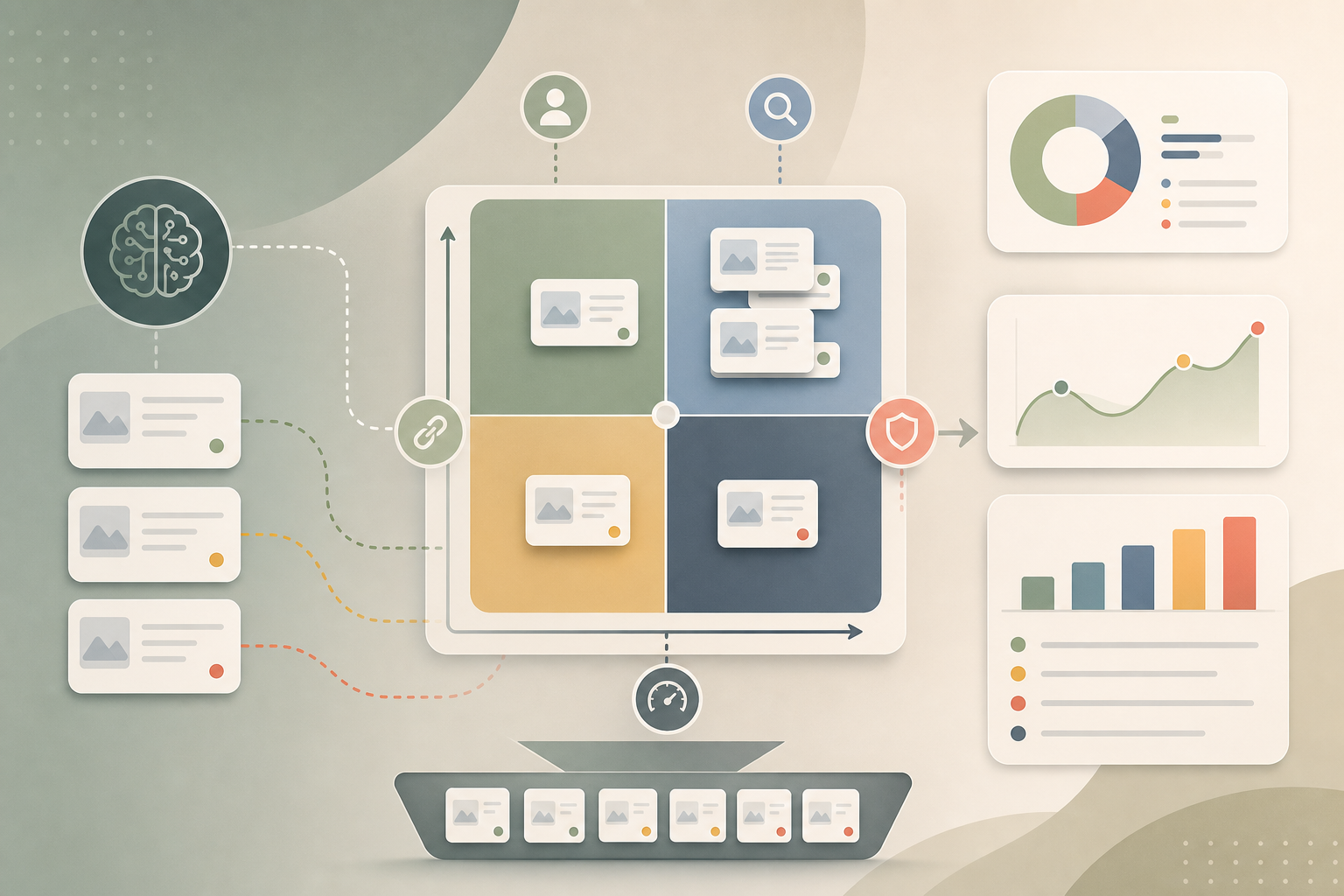
The Five-Factor AI Visibility Audit Prioritization Matrix
The best next fix is the one most likely to change a commercially important answer. Score every finding from 1 to 5 across five factors, then divide by effort.
Priority score = (Buyer impact + prompt recurrence + citation gap + sentiment risk + repair use) / effort
| Factor | What it measures | Score 1 | Score 5 | Where to get the data |
|---|---|---|---|---|
| Buyer impact | Revenue relevance of the prompt | Generic education query | High-intent shortlist, comparison, validation, or procurement query | CRM notes, sales calls, keyword data, prompt taxonomy |
| Prompt recurrence | How consistently the issue appears | One isolated answer | Repeats across prompts, engines, personas, or weekly runs | Audit runs and AI search monitoring |
| Citation gap | Whether AI has usable evidence for your brand | Strong owned and third-party sources already cited | Competitors are cited, your best evidence is absent, weak, or uncrawlable | Citation extraction and source review |
| Sentiment risk | Commercial harm from the answer | Mildly incomplete | Wrong category, outdated claim, missing differentiator, inaccurate risk claim, or negative framing | Answer text, screenshots, sentiment labels |
| Repair use | Likelihood a fix can change the answer | Requires broad market reputation change | Clear page update, citation repair, entity cleanup, or technical fix | Content inventory and owner review |
| Effort | Time and dependencies | 1 = same-week fix | 5 = legal, PR, product, engineering, or partner dependency | Team planning |
Do not add repair ease and effort as separate positive and negative variables. That double counts the same thing. Use repair use to measure whether a fix is likely to work, and effort to measure how expensive it is.
Diagnose the Root Cause Before Assigning the Fix
A content update only works when the failure is actually a content problem. If AI systems ignore your brand because no credible third-party source supports the claim, publishing another owned blog post may not move the answer. If the answer cites an outdated page, a targeted refresh may work quickly.
Use this diagnosis table before assigning owners:
| Audit finding | Likely root cause | Best first fix | Secondary fix |
|---|---|---|---|
| Brand absent from shortlist prompts | Weak topical association or no buyer-fit page | Build a category, use-case, or integration page that directly answers the prompt | Earn third-party mentions in relevant category sources |
| Competitor cited, brand ignored | Citation source gap | Create or update a page that supports the exact buyer question | Pitch credible third-party sources with verifiable evidence |
| Brand mentioned but not recommended | Weak proof or unclear differentiator | Add fit criteria, customer examples, integrations, limitations, and comparison evidence | Build or refresh comparison pages |
| Wrong category or positioning | Entity confusion across web sources | Align homepage, about page, schema, profiles, directories, and boilerplate | Update partner and press descriptions |
| Outdated negative framing | Old reviews, old news, or stale product claims dominate | Publish corrective evidence and update canonical pages | Run comms and reputation workflows |
| No citation beside brand mention | Answer lacks citeable passages | Add direct answer blocks, data, definitions, tables, and source-backed claims | Improve internal links and crawlability |
| Owned page cited but summary is weak | The page buries the answer or uses vague copy | Rewrite above-the-fold copy and section intros with direct claims | Add examples, tables, screenshots, and proof |
For citation-heavy work, track the exact source behind the answer. A mention count cannot show whether the engine used your product page, a competitor's comparison page, a review directory, Reddit, a stale article, or no citation at all. The workflow is explained in AI citation tracking for ChatGPT, Perplexity, and Gemini.
Prioritize Citation Gaps in Buying Prompts
A citation gap means an AI answer has a reason to discuss a topic but lacks strong, accessible, or trusted evidence connecting your brand to that topic. In commercial prompts, citation gaps are often more urgent than keyword gaps because the buyer may get a recommendation without visiting a search results page.
The original "GEO: Generative Engine Optimization" paper introduced GEO-bench and reported that generative engine visibility could improve by up to 40% in its benchmark. The paper also found that adding citations, quotations, and statistics produced strong visibility gains in tested settings. See the paper on arXiv.
The lesson is not to add random statistics. The lesson is that AI answers need extractable evidence.
Strong citation repair content usually has:
- A direct answer in the first 40 to 60 words of the relevant section.
- Specific evidence: customer segment, integration, methodology, benchmark, screenshot, use case, limitation, or named source.
- Clean structure: headings, bullets, tables, and descriptive anchor links.
- Verifiable support: documentation, customer stories, partner pages, analyst mentions, reviews, or credible third-party coverage.
- Clear ownership: one page or source that is responsible for the claim.
If competitors are cited for the same prompt while your brand is absent, treat that as a source problem, not just a copywriting problem. The repair workflow is covered in how to find and fix citation gaps in AI search results.
Treat Sentiment Risk as a Pipeline Issue
Sentiment risk is the commercial cost of how AI describes the brand. The answer does not need to be hostile to hurt. It may simply frame the brand as too small, too narrow, too expensive, too immature, or missing a feature that has since shipped.
Score sentiment risk high when an answer:
- Calls the product "small business only" when enterprise buyers are a target.
- Omits a differentiator that sales relies on.
- Repeats an old limitation that has been fixed.
- Presents a competitor as the safer or more complete choice without current evidence.
- Describes pricing, security, compliance, integrations, or support inaccurately.
- Uses decisive recommendation language for competitors and vague language for your brand.
Turn each risky answer into a correction brief:
| Brief field | What to record |
|---|---|
| Risky claim | The exact claim or framing problem |
| Source hypothesis | The page, review, article, directory, or community thread likely shaping it |
| Proof needed | Product fact, customer proof, policy, documentation, data, or third-party support |
| Fix location | Owned page, profile, documentation, PR source, partner page, or review response |
| Follow-up prompt | The exact prompt cluster to rerun after changes |
This keeps sentiment work concrete. It also separates content fixes from reputation issues that require PR, customer marketing, partnerships, or product documentation.
Build the Repair Backlog Across Four Workstreams
Do not hand every audit finding to the blog team. Split fixes into four workstreams so the right owner can act.
1. Owned Content
Owned content fixes include product pages, use-case pages, comparison pages, integration pages, glossary pages, documentation, customer proof, and category pages.
Use owned content when the answer lacks a clear page to cite, misstates what the product does, or fails to understand where the product fits.
2. Citation Development
Citation development fixes include analyst mentions, partner listings, category pages, reputable guest quotes, review profiles, software directories, and independent comparisons.
Use citation development when AI systems cite competitors from third-party sources but do not have credible third-party evidence for your brand.
3. Entity Cleanup
Entity cleanup aligns your company description across the homepage, about page, schema, social profiles, directories, investor pages, partner pages, press boilerplates, and knowledge sources.
Use entity cleanup when answers confuse your category, audience, geography, product scope, parent company, or competitors.
4. Technical Access
Technical access fixes cover crawlability, indexability, canonical tags, JavaScript rendering, blocked resources, internal linking, duplicate content, structured data, and page experience.
Use technical access fixes when the right content exists but cannot be easily discovered, indexed, rendered, or cited.
Rewrite Pages for Answer Extraction Without Making Them Worse
A page should be rewritten for buyers first and answer engines second. The goal is not to stuff AI prompts into the copy. The goal is to make the page easier to understand, verify, and quote.
For each target page, add only the elements that genuinely help the buyer:
- A direct answer at the start of the relevant section.
- A table that shows fit, tradeoffs, limitations, and comparison criteria.
- Specific proof: integrations, customer segments, workflow examples, compliance standards, benchmarks, methodology, screenshots, or documentation links.
- A short limitations section when the product is not the right fit.
- Clear authorship or publisher context.
- Updated dates only when the content materially changes.
- Internal links from category, use-case, comparison, and proof pages.
Google's helpful content guidance asks whether content provides original information, complete description, analysis beyond the obvious, and substantial value compared with other search results. Those are useful standards for AI visibility work too. See Google Search Central's people-first content guidance.
A Worked Example: Ranking 12 Fixes From 120 Prompts
Consider an anonymized B2B security SaaS audit pattern: 120 buyer prompts across six AI engines. The prompt set includes category discovery, vendor shortlist, "best for enterprise," compliance comparisons, integration questions, and competitor alternatives.
The audit finds 47 issues, but only 12 are commercially meaningful. After scoring, the top five look like this:
| Finding | Buyer impact | Recurrence | Citation gap | Sentiment risk | Repair use | Effort | Priority |
|---|---|---|---|---|---|---|---|
| Missing from "best security automation tools for SOC 2 teams" | 5 | 5 | 5 | 3 | 5 | 2 | 11.5 |
| Competitor comparison page cited for "[brand] alternatives" | 5 | 4 | 5 | 4 | 4 | 3 | 7.3 |
| Gemini describes product as "early-stage" from old funding coverage | 4 | 3 | 3 | 5 | 4 | 2 | 9.5 |
| Perplexity cites docs page but misses enterprise integrations | 4 | 4 | 4 | 2 | 5 | 2 | 9.5 |
| ChatGPT recommends competitor for "best for healthcare compliance" | 5 | 3 | 4 | 3 | 3 | 3 | 6.0 |
The top fix is not the most embarrassing screenshot. It wins because the prompt is high-intent, repeated, citation-poor, and repairable.
The action plan is specific: publish a SOC 2 use-case page with a direct answer, integration proof, customer evidence, compliance boundaries, comparison criteria, and internal links from security and compliance pages.
The "early-stage" issue is also urgent, but it needs entity cleanup and source correction, not only a blog post. That distinction prevents the content team from being blamed for a reputation and source problem they cannot fully control.
The First 30 Days After an AI Visibility Audit
The first 30 days should focus on high-impact, repairable issues. Do not turn the audit into a generic content calendar.
Use this sequence:
- Freeze the baseline. Save prompt wording, engine, date, answer text, screenshots, citations, brand rank, competitors, and sentiment label.
- Score all findings. Use the same matrix across teams before assigning work.
- Select 5 to 10 priority fixes. Choose issues with high buyer impact and clear repair paths.
- Map each fix to a source. Decide whether to update an existing page, create a new asset, repair access, or pursue third-party citation work.
- Rewrite for evidence. Add direct answers, proof, tables, limitations, comparisons, and cited support.
- Strengthen internal links. Connect category, use-case, comparison, integration, and proof pages.
- Validate crawlability. Confirm target pages are indexable, accessible, renderable, and not blocked.
- Rerun the same prompts. Measure movement after pages are crawled and after answer engines refresh.
- Decide the next batch. Promote fixes that moved the metric and re-diagnose fixes that did not.
Do not change the prompt set during the first rerun. If the prompt changes, you cannot tell whether the answer improved or the test changed.
Which Metrics Prove the Fix Worked?
The right metric depends on the failure mode. A content update can improve brand mentions without improving recommendation rank. A citation fix can improve source coverage without changing sentiment. Track the smallest metric that matches the intended change.
| Goal | Primary metric | Secondary metric |
|---|---|---|
| Get included in shortlists | Recommendation rate | Average brand rank |
| Improve competitive position | AI share of voice | Competitor co-mentions |
| Repair source weakness | Citation coverage | Owned vs third-party citation mix |
| Correct bad framing | Sentiment score | Risk claim recurrence |
| Improve answer usefulness | Passage extraction quality | Mention depth and cited section |
| Support reporting | Prompt-level trend | Engine-level trend |
| Protect reputation | Inaccuracy recurrence | Alert volume and time to correction |
Do not report only a single visibility score to executives. Pair the score with high-intent prompt examples and show what changed in the answer text: before answer, fix shipped, after answer, citation changed, next action.
For KPI definitions, use the framework in AI search visibility metrics for whether AI recommends your brand.
When Do You Need an AI Visibility Tool?
A spreadsheet can work for a one-time diagnostic audit. It breaks when the team needs recurring prompts, multiple engines, screenshots, citations, sentiment labels, competitor tracking, alerts, and client reporting.
Consider an AI visibility tool when at least one of these is true:
- Your category is competitive enough that AI shortlists influence pipeline.
- Leadership wants recurring AI share of voice reporting.
- The team monitors more than 50 buyer prompts.
- You need weekly or daily trend data, not a one-off snapshot.
- Agencies need separate workspaces and client-ready reporting.
- PR and brand teams need alerts for inaccurate or risky AI descriptions.
- SEO teams need to connect AI citations back to content briefs and page updates.
The buying question is not "Which platform has the biggest dashboard?" It is "Which platform helps us decide what to fix next?"
A practical selection checklist is available in Best AI Search Visibility Software: how to choose the right platform.
How Much Should an AI Visibility Audit Cost?
Pricing should be scoped by evidence volume and decision value, not by the number of screenshots. A credible proposal should show what is included, what is automated, what is manually reviewed, and how findings become a fix backlog.
Key cost drivers include:
- Number of prompts and prompt variants.
- Number of engines and locations or languages.
- Number of competitors tracked.
- Audit frequency: one-time, weekly, or daily.
- Citation extraction and source classification.
- Sentiment and factual accuracy review.
- Human editorial diagnosis.
- Reporting, exports, dashboards, and agency workspaces.
- Follow-up reruns after fixes ship.
If a vendor cannot explain how it builds prompts, captures answers, identifies citations, scores sentiment, and prioritizes fixes, the audit is likely a visibility report rather than a strategic audit.
What Should You Avoid After the Audit?
Avoid fixes that make the content less useful to humans. AI search visibility is not a reason to create doorway pages for every prompt variant, publish thin comparison pages, or chase unverified mentions.
Avoid these patterns:
- Creating one page for every long-tail prompt with minor wording changes.
- Adding claims without evidence because competitors appear in AI answers.
- Overusing the exact phrase "AI visibility audit" until the copy feels unnatural.
- Treating llms.txt or special AI markup as a replacement for crawlable, useful pages.
- Updating dates without meaningful changes.
- Ignoring third-party sources when AI answers clearly rely on them.
- Reporting visibility gains without preserving the prompt set and baseline.
- Assigning source, reputation, or entity problems to content writers without the right owner.
The practical rule is simple: structure content clearly, but do not let formatting replace evidence.
The Prioritization Rule That Keeps Teams Honest
The best next fix is the one that can change a commercially important answer with the least uncertainty.
Use this rule in every audit review:
Fix recommendation prompts before education prompts. Fix repeated patterns before one-off answers. Fix citation gaps before cosmetic copy. Fix sentiment risk before volume. Fix pages that can be crawled, quoted, and trusted.
That rule turns AI search monitoring into a content, citation, and reputation roadmap. It also gives writers, SEOs, PR managers, product marketers, and founders a shared language for deciding what "better AI visibility" actually means.
Common Questions
How often should a team repeat an AI visibility audit?
Run a full AI visibility audit quarterly and monitor priority prompts weekly or daily in competitive categories. Full audits are useful for strategy, while recurring monitoring catches changes in brand mentions, citations, sentiment, and competitor recommendations before they affect pipeline or reputation.
What is the difference between an AI visibility audit and an SEO audit?
An SEO audit reviews how pages perform in search engines: crawlability, indexability, rankings, content quality, links, and technical health. An AI visibility audit reviews how answer engines describe, cite, compare, and recommend a brand across buyer prompts. The two overlap, but the AI audit focuses on answer presence, citation sources, sentiment, and recommendation behavior.
Can SEO content fixes help a brand get recommended by ChatGPT?
Yes, when the fixes improve entity clarity, answer quality, evidence, and source availability. Classic SEO foundations still matter, but getting recommended by ChatGPT usually requires more than ranking. The content must make the brand easy to understand, compare, verify, and cite for buyer-specific prompts.
Which fixes usually move fastest?
The fastest fixes are updates to already indexed pages that are already close to the answer. Examples include adding a direct answer block, improving comparison criteria, updating old product facts, adding integration proof, and linking a relevant use-case page. Third-party citation and reputation fixes usually take longer.
Should ChatGPT, Gemini, Perplexity, Claude, Copilot, Grok, and Google AI features be scored together?
Score them together for executive reporting, but diagnose them separately. Each engine can use different retrieval behavior, source preferences, answer formats, and freshness signals. A fix that improves Perplexity citations may not immediately change ChatGPT recommendations or Google AI Overviews.
What is the minimum useful scoring model?
Use five columns: buyer impact, prompt recurrence, citation gap, sentiment risk, and effort. That is enough to separate urgent commercial fixes from low-value cleanup. More complex weighting can wait until the team has several audit cycles and enough trend data to justify it.